Glass Letter Boxes at Lunch by a Parking Lot in Los Angeles

 
I hated Steve Jobs. Now that he’s dead I like him better. Looked snotty to me, but he came up with some nice things. I’m using an iPad right now, trying to master the stiff-finger jabbing action in my lap with the thing leaning in front of a Greek salad on a greasy streaked patio tabletop out of the sun in a breeze that keeps flipping my napkins over and threatening to send them back toward the door from which my food came – delivered to a number on a stick. The number’s gone now. She must have taken it when she placed my trays in front of me. So far, the finger-jabbing is workable if not entirely productive. My problems with Steve Jobs notwithstanding, I dig this pad and carry it everywhere, even when I should know that it makes me look like – what do you call them – a goddamn geek. But I have too much face-breaker in me to ever be mistaken for a geek with an iPad. I annoy geeks because they sense the lout underneath the programmer.
 
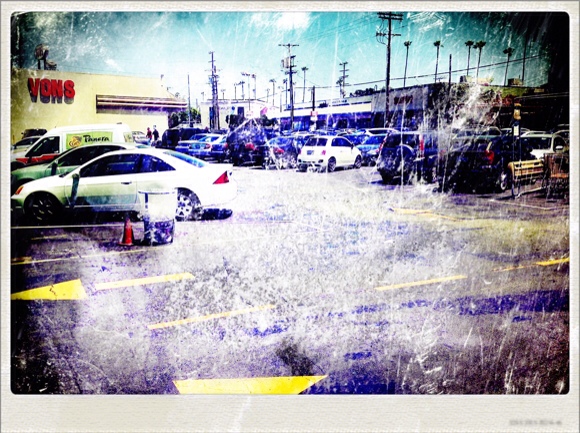
So anyway or anywho as all the wannabe smarties like to say – if someone says anywho to you, just casually punch their front teeth out, understand? Even if it’s me. The use of the word indicates a fractured personality who wants to present itself as innocuous. Anyhow, there’s a thing about iPads and rear-facing cameras, filters, touch screens, Wifi connections, and trying to capture the moment or the under-moment of a place as surface-oriented and deeply mysterious as Los Angeles. You can’t let snobbery and distaste for a personality prevent you from diving into what you identify as bullshit for a nice swim in the same dirty water everyone else is so interested in. Sometimes, for the artist, immersion is essential. You can’t stand on the shoreline watching the swimmers, critiquing their bathing suits and lovely fat rolls. You’ve got to go in and swim around between their legs like a lingering shark looking for easy meat. You can still be a little separated as far as viewpoint, but you must try the water. That’s my theory behind the photo of the parking lot. It was taken on the move from parking spot to Panera Bread, then filtered up, framed and filtered again while trying to control the napkin traffic across my lunch. It’s a little like painting really. Despite the stupidity of the millions of photos uploaded to the hellish quagmire known as Instagram, the digital photo/filter combo just might be vastly superior to the instamatic toy point and shoots that it so cleverly imitates. You know, art’s a funny thing. It crops up in odd places. There’s that photographer – can’t remember his name now – maybe it was William Eggleston… don’t know… but any… who? Anyway, back in the seventies when galleries and museums – if there’s a difference – were all showing black and white photos as art… well this guy throws a bunch of color snapshots into a suitcase, travels to New York, walks into the Museum of Modern Art and demands a showing. He becomes one of the great photo artists of the 20th century and sets off the realization that color photographs can be shown as art. Everyone at the time of course really knew that, but they didn’t act as if they knew it. There’s a huge step in between.

A Brief History of John Baldessari: Narrated by Tom Waits

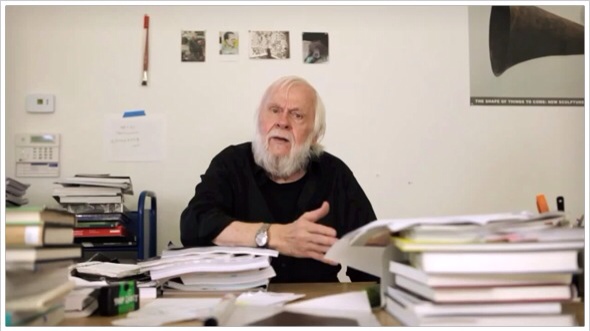
Here is a short humorous biopic about legendary Los Angeles artist John Baldessari. It was directed by Henry Joost and Ariel Schulman as a commission from the Los Angeles County Museum of Art. It’s wonderfully narrated by Mr. Tom Waits who was apparently picked by Baldessari for the job. If I have criticism of Baldessari, it would probably be that he has too much fun making art. Actually I’m not kidding. It’s a harsh criticism from where I stand. But I still like his work. I know his printer in downtown Los Angeles. He lets me stop by now and then to see what’s cooking on his great big old-fashioned printing press. In fact, I am the proud owner of an original signed Baldessari artist’s proof. It makes me smile with confusion whenever I walk past it. Despite Baldessari’s obvious enthusiasm for making conceptual art, there’s a lurking seriousness underneath all those colored dots and old time movie stills. He makes art in the margin between painting and filmmaking.


Documentary: Los Angeles Meets the Megalith

Artist Michael Heizer’s enormous new work on the grounds of the Los Angeles County Museum of Art required a 340-ton boulder as its centerpiece. The boulder had to be transported over 100 miles from its quarry. At first, I was very interested in this rock. It’s huge! But soon I became more interested in the city’s reaction to the rock. So this film documents the final few miles of the rock’s journey, but it also documents the people who came out to be a part of the great Los Angeles rock transport. The film is part documentary and part personal impression. The simple fact of the matter is that the rock’s arrival is an unusual milestone in the life of this city. You can tell that simply by looking at the faces in my film.

Trauma: A Video Poem Triptych by Swoon

Swoon is a Belgian poet filmmaker who makes films that try to blur the boundary between written poem and moving image. He mixes his own footage with found footage and sometimes mixes his own words with others. I like the quiet easy tone of his work. I like his manipulation of imagery. His work is a very difficult kind of work because it tries to make something new from two different things. Poetry is a perfect form all by itself. But film is never satisfied. It’s always looking for something to include within it. So it’s natural for film to go looking for poetry and try to bring it in. But poetry resists all alliances. Poetry seems content and willing to wait for centuries. It requires nothing. It doesn’t care what film wants. It will sit on a dry page in some crowded shelf somewhere waiting six hundred years for just a single pair of eyes to come along in boredom, open to the page, glance in, read half-way down and then slap the book shut for another six hundred years until someone decides to finish reading the goddamn thing. That’s patience. Film doesn’t have that. Film must be seen now or it withers. It begins to rot. Even if it’s digital. Digital films become confused and get lost in the forest of other digits. They may never find their way out again. So working with the two things and trying to get them together is very difficult but may actually make perfect sense.

This is a film poem triptych that is Swoon’s first work to include his own words. There’s a site for the film with more information.

Jean Cocteau – Lies and Truths: 1996 French Documentary


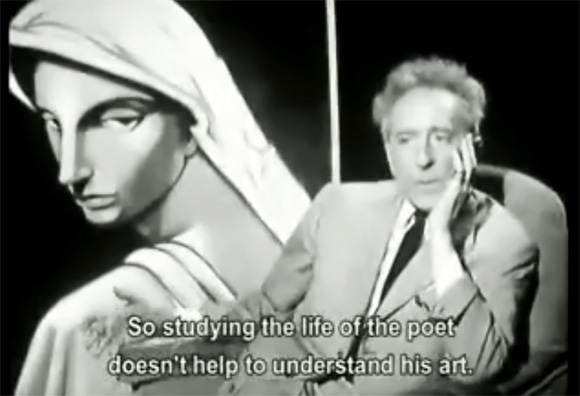
This is a 1996 documentary by Noël Simsolo, featuring many interviews with Jean Cocteau himself, Jean-Luc Godard and actor Jean Marais. The great French director of films like ‘Blood of a Poet,’ ‘Orpheus,’ and ‘Beauty and the Beast,’ was also an essayist, poet, artist, and playwright. When I was a kid I read the book he wrote about filming ‘Beauty and the Beast.’ I understood little of it except that there was the general impression of someone working against constant hardship to attain a mysterious something. The book detailed his struggles with the subtleties of light, weather and performance in the pursuit of a mysterious quality that must be present in the fairytale. I knew that his efforts had worked because I had seen the film on television and understood that it was simply the most convincing fairytale I had ever seen. Another film with this totally mysterious quality is ‘Orpheus,’ which is Cocteau’s modern version of the Greek myth in which the great musician/poet descends into the underworld to bring his wife back to the world of the living. Cocteau’s telling of the tale is at once ancient and modern, always mysterious and always trying to get close to poetry. Whenever I see that film I feel that I am seeing an important picture of French artistic life in the late 1940s told through the prism of ancient Greek myth. The film sits in that fascinating period of artistic ferment and dawning of a new cinematic movement that was a reaction to the end of World War II. Possibilities in films of that period seem limitless. There is a calmness of the image, an almost casual approach to creating scenes. Things are becoming more fluid and less studio-bound. Films are beginning to lean toward poetry and art.

Even though I never really understood what was being said in the ‘Orpheus’ film, it is probably one of the most important influences on the little bits of work that I do in film and video. Various images and scenes from ‘Orpheus’ regularly pop into my head as I work.

One of the best things I think an artist can learn from looking at Jean Cocteau is to follow one’s own interests without worrying about being unqualified – pretending can eventually get you where you want to go if you do it absolutely.

Continue reading

A Colour Box: 1935 Abstract Direct Paint on Film Animation by Len Lye

Len Lye’s 1935 film, ‘A Colour Box,’ was made by painting and applying dye directly to the film surface. It is apparently the first direct paint film to gain a general public release and has been widely seen ever since. The film is an odd way to advertise for cheap parcel post and this message starts popping up near the end. The cheerfully infectious music is ‘La Belle Créole’ by Don Baretto and his Cuban Orchestra. Lye’s work must have been hugely influential for the later work of direct paint filmmaker Stan Brakhage.

The Birth of the Robot: 1936 Experimental Advertising Film by Len Lye for Shell Oil Company


In 1936, experimental filmmaker Len Lye made this short surreal animation to advertise the benefits of Shell oil for lubricating things. The film is a hyper-saturated stop-motion extravaganza that involves a mechanical world turning on some sort of hand crank. There’s an adventurer driving around the sands of Egypt. His car winds down and konks out leaving the man dead in the desert. The angel of oil rains drops of lubricating crude down on the Egyptian landscape bringing the parched skeleton to life as the Shell Oil robot. Fascinating. It’s got that awkward, shiny, naive beauty that could only be achieved in the 30s. Parts of this thing look like they might be influenced by Salvador Dali’s work. Something about that dead skeleton and the desert looks like it could fit right into the Surrealist master’s paintings.

Lye was from New Zealand and worked not only as an experimental filmmaker but also in newsreels and advertising. He was a kinetic sculptor, poet, painter and a writer of essays on artistic theory and philosphy. He made a 1935 short film called ‘A Colour Box’ which was the first generally exhibited film made by painting directly on the film emulsion. It’s a brilliant experimental animation posing as an advertisement for cheaper parcel post.  I’m sure the great direct paint filmmaker Stan Brakhage must have been familiar with Lye’s work.

Here’s a gallery site with information and examples of his artwork.

1964 Documentary on Spanish Surrealist Film Director Luis Buñuel


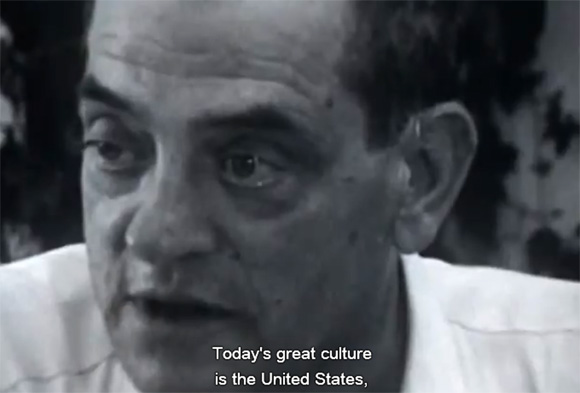
Luis Buñuel was the great Spanish film director who made ‘Un Chien Andalou’ and ‘L’Age d’Or,’ two of the original surrealist films. This documentary, directed by Robert Valey, was made in 1964. The director talks freely and with a certain charming guile about his influences, friends, paranoias, enjoyments and his impressions of various countries. He once smacked Salvadore Dali down on 5th Avenue in New York city!

I enjoy listening to people like him talk about their work because they talk about how they see things – how they interpret the world. Compare the way he talks in this film to what you normally see coming from people like Steven Spielberg or Martin Scorsese. Those people don’t seem real. They don’t seem to have any point of view. Notice how people in the film consistently associate Buñuel’s filmmaking with the work of painters. It is the continual grinding down of art into business that destroys real culture. One should immerse one’s self in better ideas and more subtle things if one wants to avoid the dullness that permeates most film work currently going on in the United States. I have found it to be a general rule that people with real talent who are artists answer questions in a slightly confusing manner. Clarity is another word for fake. Buñuel appears to me to fit this general principal.

Buñuel wrote a short and very beautiful autobiography called ‘My Last Sigh.’ I recommend it very highly if you want to know more about the mind behind Surrealist film.

And of course, here is the great Surrealist short film, ‘Un Chien Andalou,’ made by Buñuel in 1929.

Alejandro Jodorowsky Discusses Psychomagic But He Smiles Too Much


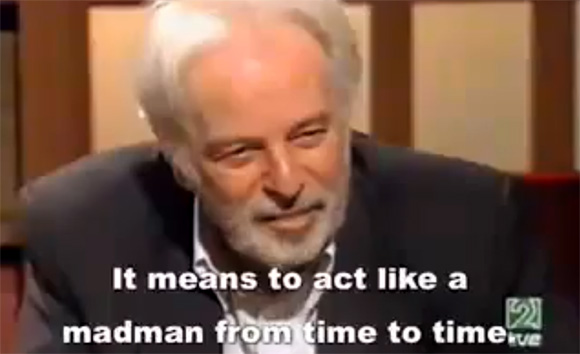
Alejandro Jodorowsky on the Spanish program ‘Negro Sobre Blanco’ discussing his ‘phsychomagic’ ideas about how people must understand the influence of the family tree and how breaking with habits or curses from the past is essential for health and happiness. Jodorowsky has long held to the idea that art must heal human beings and society. His use for systems of magic like the Tarot are never for divination but rather for understanding one’s self and one’s place in the world. He approaches his own thoughts and theories with humor and exuberance. I find him to be very magnetic as a speaker. I also find that his good nature seems to prevent people from aggressively arguing some of his general assertions. In other words, most people who interact with Jodorowsky do so with the attitude that they are dealing with a grand old man of wisdom. In many ways I think he is just that. However, one should not have that in mind when actually talking to him. I also think he’s a nice man who genuinely works to help people feel better.

Continue reading

Aleph: California Beat Artist Wallace Berman’s Only Film

While I was running through the Getty Center’s flagship portion of the massive citywide ‘Pacific Standard Time‘ art exhibit, I was struck by just how great this Wallace Berman fellow really was. Known primarily as the ‘father’ of assemblage art, he was also a member of the Beat Movement. He made a single film which occupied much of his time through the 1960s and 70s. It’s less than eight minutes long and it’s a drop dead gorgeous thing to see. He’s one of those film artists interested in what I like to call the messy image. The film seems to have been dragged through ink and dirt. It’s been scratched, wrinkled, folded, cut, slashed and stained. Letters flash by like subliminal messages. Pop culture crashes into modern art. He films magazines, papers, radios, faces, hands, rock stars, body parts, buildings, streets and apparently just about everything he had lying around in his studio. This film is a quiet little reminder that crystal clear HD and super sharp focus are not anywhere near the concerns of some artists.

And here is California assemblage artist George Herms talking about Berman recently as part of the Pacific Standard Time series of exhibits:

Crosscurrents: Film About Pacific Standard Time Art Exhibits Focused on Los Angeles Art From 1945 – 1980

Pacific Standard Time is a massive overview of Los Angeles art from 1945 to 1980. At least sixty galleries and museums are taking part over the next few months. I have already been to the largest exhibits at the Museum of Contemporary Art, Los Angeles County Museum of Art, and the Getty Center. The whole thing is a lot of fun and I have discovered artists I never knew about before. There are magnificent things on display and the curators have also published big books to go along with each exhibit. I seriously recommend that you always get the books because they have far more information in them than the exhibits themselves. I view it as my own effort to compile a record of this unique regional art show.

You can find almost everything you need at the Pacific Standard Time web site.

This film was put together for the Getty Center’s flagship exhibit, Crosscurrents, which covers 1950 to 1970. It’s a very nice little documentary about some of the major art developments in Los Angeles.