Light On a Snowy Day: Children’s Holiday Story by Artie Knapp

Story by Artie Knapp
Illustration by Maya Ramaswamy

Light On a Snowy Day

IT WAS TWO DAYS before Christmas and young Maggie Dotson was already being told that her Christmas wish would not be coming true. Paxton she was told, would not be coming back.

A year before that December day an injured baby deer had been abandoned in the woods behind the Dotson’s home. So weak was the little deer, that he hadn’t the strength to run from Maggie’s father when he approached him.

As he carried the little deer towards their home, Maggie rushed outside and greeted her father with great excitement.

“Wow, a deer! What happened to him, Daddy?” asked Maggie.

“Well, I’m not sure how he managed to do it, but he mangled one of his hoofs pretty severely,” Mr. Dotson said.

Maggie leaned in to take a better look. “Poor little reindeer. Can we keep him, Daddy?”

“First of all, he’s a white­-tailed deer,” laughed Mr. Dotson. “And no, we can’t keep him. He’s a wild animal, Maggie. I’ll do everything I can and then he’ll have to be set free.”

While gently rubbing the little deer’s nose it licked Maggie’s hand, which made her laugh. Mr. Dotson smiled and just shook his head. He proceeded to carry the little deer to the garage.

After Mr. Dotson carefully placed the little deer on the floor, he asked Maggie to go to the house and get his medical bag. The little deer was in luck. He was being attended to by James Dotson, local Veterinarian.

In what seemed like two seconds to Mr. Dotson, Maggie rushed inside the garage carrying his medical bag, and a handful of lettuce she had grabbed from the refrigerator. Maggie handed her father the bag, and then placed the lettuce by the little deer’s mouth – but he wasn’t interested.

“Why isn’t he hungry, Daddy?”

“Maybe he’s just too scared to eat right now.”

“I know what he needs,” Maggie said. “He needs carrots, because that’s what Santa’s reindeer like to eat.”

“He’ll get plenty of food, alright. Right now he just needs to have his hoof cleaned and bandaged.”

As Mr. Dotson placed a bandage around the little deer’s injured hoof, Maggie became excited as the little deer began to nibble on the lettuce. And then, she pointed out to her father that the little deer had markings above its eyes that looked like the sun. After a quick observation, Mr. Dotson was struck by how much the little deer’s markings did in fact resemble the sun with protruding rays of light.

It was dark outside and the temperature was quite cold. Despite her reluctance to leave the little deer, Maggie’s father convinced her that he would be safe in the garage. Maggie insisted that her father return with carrots and warm blankets for him. He promised he would.

After he turned off the light in the garage, Maggie turned to her father and said, “I’m going to name him Paxton, Daddy.”

“That’s a fine name for a deer, Maggie.”

“You really think so, Daddy?”

“Sure do.”

“Daddy?”

“Yes.”

“Are you sure Paxton is going to be alright?”

“He’s going to be fine, Maggie. Now let’s get inside where it’s warm.”

Later that night Maggie could barely sleep. She kept getting up to view the garage from the window in her room. Even though she couldn’t see Paxton, looking out at the garage comforted her.

After she awoke the next morning, Maggie rushed down the stairs and was heading for the front door, when her mother asked her where she thought she was going.

“I’m going to go see Paxton, Mommy.”

“Not before you eat your breakfast, young lady.”

To the dissatisfaction of her mother, Maggie wolfed down her breakfast. She had two eggs, scrambled, and a piece of toast. Her glass of orange juice never left the table.

“Where’s Daddy? Is he in the garage with Paxton?”

“Yes, he’s in the garage tending to your little….” Before Mrs. Dotson had finished her sentence, Maggie was out the door.

As Maggie darted into the garage she nearly knocked her father over.

“How’s Paxton, Daddy?”

“He’s doing fine, Maggie.”

“Is his hoof all better now?”

“Well, it’s going to take time to heal. Right now he just needs to work on getting his strength back.”

Paxton was very timid as Maggie approached him.

“Why is he afraid of me, Daddy?”

“He’s still not used to us. This is a strange place to him.”

But with time and persistence, Maggie finally gained the little deer’s trust. In fact, he was soon eating carrots right out of her hand. And when the holidays were over and Maggie was back in school, she never left without feeding Paxton first thing every morning.

Mr. Dotson could see the bond that his daughter felt for the little deer. That scared him, though, because he knew Maggie would never be able to say goodbye. So when his hoof had finally healed, Mr. Dotson came home early one afternoon to set Paxton free.

When Maggie learned that her father had released Paxton, she was devastated. Mr. Dotson had believed it would be easier on Maggie that way, but he was wrong. His daughter never forgot the little deer and she called out to him every day, hoping he would hear her.

In time, though, Maggie did come to understand that deer are not like puppies, or kittens. She understood that wild animals, even little deer, need to be in their natural habitat. But that didn’t change how much Maggie cared for and missed Paxton.

Between the Dotson’s home and acres of woods lay a pond that always froze-solid in the winter months. It was a large pond, and many children would come over to ice-skate on it. But the pond hadn’t frozen over that winter yet, because the weather had been warmer than usual.

As Maggie stood by the pond one afternoon, it started to snow. Mr. Dotson saw Maggie through the kitchen window and could tell she looked upset. Without having to ask what was wrong, he knew.

Mr. Dotson felt guilty about having not been more supportive of his daughter’s belief that she would see Paxton again. And even though he didn’t want to give her false hope, he realized that no longer mattered. Maggie was hurting and he wanted to help.

As Mr. Dotson walked outside to greet his daughter, he carried a pair of binoculars with him. He and Maggie would spend the next couple of hours in the woods, where they searched for deer tracks in the newly fallen snow. But as Mr. Dotson had expected, their search came up empty.

“I’m sorry we didn’t have better luck, Maggie.”

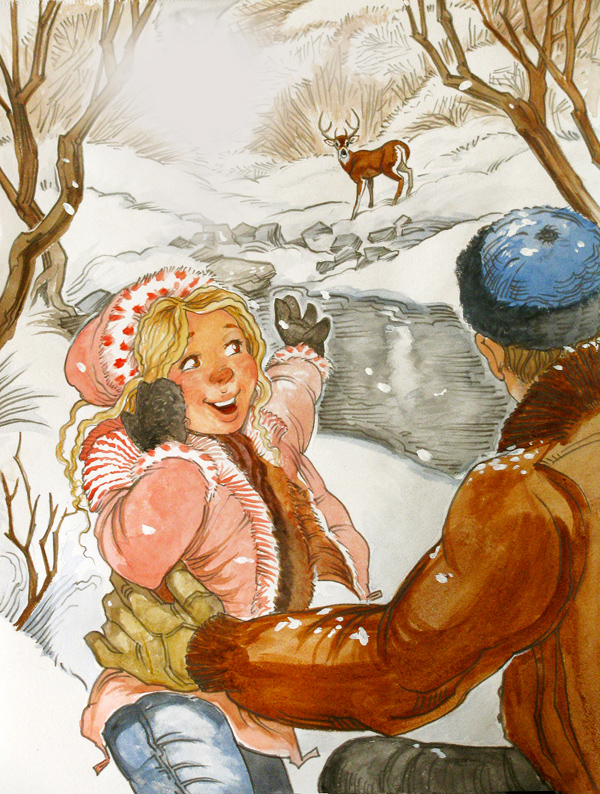
Maggie sadly nodded at her father, who was now carrying her because her toes felt like popsicles. But then something happened! As they were exiting the woods, two deer were standing next to the pond. One of the deer was female, and the other was a buck with antlers. Based on the size of the deer, Maggie never considered that either could be Paxton. But her father quickly reminded her of how much Paxton would have grown over the past year.

As Maggie and her father edged closer to the pond, the doe quickly abandoned her attempt at a drink of water. The buck turned and saw them staring in his direction. But the buck stood still, barely flinching. Maggie, who was no longer being held by her father, watched as he peered through his binoculars. As Mr. Dotson got a closer view of the buck, something stood out through the falling snow; it was the markings above the buck’s eyes. He handed the binoculars to his daughter, and whispered if she recognized anything special about the deer with antlers. Maggie immediately recognized the markings on the buck as Paxton’s. With great excitement, Maggie called out to him, and then the two deer darted away. She continued to call out to Paxton, who briefly stopped in his tracks and looked back at her. After a few moments, he darted off again to catch up with the doe and then disappeared into the woods.

At first, Maggie felt happy, but her happiness soon turned to sadness. She felt as if she had lost Paxton all over again. But her father explained to her the gift she had received in getting to see him once more.

As Maggie stood next to her father, with the snow still falling, a carp jumped making a large splash in the pond. It had been a long day. They went inside to thaw from the cold.

Many years later when Maggie told this story to her grandchildren, she reminded them that the best Christmas presents often aren’t found under a tree, but in your heart.

The End

Here’s a post with information on how you can buy Artie Knapp’s ‘Living Green: A Turtle’s Quest For a Cleaner Planet.’

Here’s a link to the author’s web site where you can purchase more books.

Inspiration From the Arabian Nights

The Arabian Nights have inspired writers, poets, composers and painters in the West.

In 1882, Robert Louis Stevenson, the author of ‘Treasure Island,’ wrote:

‘There is one book, for example, more generally loved than Shakespeare, that captivates in childhood, and still delights in age – I mean the ARABIAN NIGHTS – where you shall look in vain for moral or for intellectual interest. No human face or voice greets us among that wooden crowd of kings and genies, sorcerers and beggarmen. Adventure, on the most naked terms, furnishes forth the entertainment and is found enough.’

Continue reading

The History of the Arabian Nights

The Arabian Nights have a history that is largely mysterious. However, it is widely considered that they may include tales told by ancient travelers and merchants along the Chinese Silk Route. As they made their way from Northern China to the Middle East and Egypt, the travelers stopped in various towns and trading posts where they would tell these stories to each other for entertainment.

Continue reading

Arabian Nights: The Ruined Man Who Became Rich Again Through a Dream (the John Payne translation)

Translated by John Payne (1901)

There lived once in Baghdad a very wealthy man, who lost all his substance and became so poor, that he could only earn his living by excessive labour. One night, he lay down to sleep, dejected and sick at heart, and saw in a dream one who said to him, ‘Thy fortune is at Cairo; go thither and seek it.’ So he set out for Cairo; but, when he arrived there, night overtook him and he lay down to sleep in a mosque.

Continue reading

Arabian Nights: Ali Baba and the Forty Thieves (the Edward Lane translation)

Translation by Edward Lane (1841)
Illustration by Edmund Dulac (1907)

IN former days there lived in a town of Persia two brothers, one named Kasim, and the other ‘Ali Baba. Their father divided a small inheritance equally between them. Kasim married a rich wife, and became a wealthy merchant. ‘Ali Baba married a woman as poor as himself, and lived by cutting wood and bringing it upon three asses into the town to sell.

Continue reading

Arabian Nights: The Story of the Merchant and the Jinni (the Edward Lane translation)

Translation by Edward Lane (1841)

IT has been related to me, O happy King, said Shahrazad, that there was a certain merchant who had great wealth, and traded extensively with surrounding countries; and one day he mounted his horse, and journeyed to a neighbouring country to collect what was due to him, and, the heat oppressing him, he sat under a tree, in a garden, and put his hand into his saddle-bag, and ate a morsel of bread and a date which were among his provisions. Having eaten the date, he threw aside the stone, and immediately there appeared before him an ‘Efrit, of enormous height, who, holding a drawn sword in his hand, approached him, and said, Rise, that I may kill thee, as thou hast killed my son. the merchant asked him, How have I killed thy son? He answered, When thou atest the date, and threwest aside the stone, it struck my son upon the chest, and, as fate had decreed against him, he instantly died.

Continue reading

Arabian Nights: Introduction (the Edward Lane translation)

Translation by Edward Lane (1841)

In the name of God, the Compassionate, the Merciful.

PRAISE be to God, the Beneficent King, the Creator of the universe, who hath raised the heavens without pillars, and spread out the earth as a bed; and blessing and peace be on the lord of apostles, our lord and our master Mohammad, and his Family; blessing and peace, enduring and constant, unto the day of judgment.

Continue reading

Arabian Nights: Ali Baba and the Forty Thieves

Translated by Sir Richard Francis Burton (1885)

If you want to listen to our 1-hour audio version of Ali Baba and the Forty Thieves, click here.

IN days of yore and in times and tides long gone before, there dwelt in a certain town of Persia two brothers, one named Kasim and the other Ali Baba, who at their father’s demise had divided the little wealth he had left to them with equitable division, and had lost no time in wasting and spending it all. The elder, however, presently took to himself a wife, the daughter of an opulent merchant, so that when his father-in-law fared to the mercy of Almighty Allah, he became owner of a large shop filled with rare goods and costly wares and of a storehouse stocked with precious stuffs, likewise of much gold that was buried in the ground. Thus was he known throughout the city as a substantial man. But the woman whom Ali Baba had married was poor and needy. They lived, therefore, in a mean hovel, and Ali Baba eked out a scanty livelihood by the sale of fuel which he daily collected in the jungle and carried about the town to the bazaar upon his three asses.

Continue reading

Arabian Nights: The Tale of the Ensorceled Prince

Translated by Sir Richard Francis Burton (1885)

KNOW then, O my lord, that whilom my sire was King of this city, and his name was Mahmud, entitled Lord of the Black Islands, and owner of what are now these four mountains. He ruled threescore and ten years, after which he went to the mercy of the Lord and I reigned as Sultan in his stead. I took to wife my cousin, the daughter of my paternal uncle, and she loved me with such abounding love that whenever I was absent she ate not and she drank not until she saw me again. She cohabited with me for five years till a certain day when she went forth to the hammam bath, and I bade the cook hasten to get ready all requisites for our supper. And I entered this palace and lay down on the bed where I was wont to sleep and bade two damsels to fan my face, one sitting by my head and the other at my feet.

Continue reading

Arabian Nights: The Fisherman and the Jinni

Translated by Sir Richard Francis Burton (1885)

IT hath reached me, O auspicious King, that there was a fisherman well stricken in years who had a wife and three children, and withal was of poor condition. Now it was his custom to cast his net every day four times, and no more. On a day he went forth about noontide to the seashore, where he laid down his basket and, tucking up his shirt and plunging into the water, made a cast with his net and waited till it settled to the bottom. Then he gathered the cords together and haled away at it, but found it weighty. And however much he drew it landward, he could not pull it up, so he carried the ends ashore and drove a stake into the ground and made the net fast to it. Then he stripped and dived into the water all about the net, and left not off working hard until he had brought it up.

Continue reading

Arabian Nights: The Tale of the Bull and the Ass

Translated by Sir Richard Francis Burton (1885)

KNOW, O my daughter, that there was once a merchant who owned much money and many men, and who was rich in cattle and camels. He had also a wife and family, and he dwelt in the country, being experienced in husbandry and devoted to agriculture. Now Allah Most High had endowed him with understanding the tongues of beasts and birds of every kind, but under pain of death if he divulged the gift to any. So he kept it secret for very fear. He had in his cow house a bull and an ass, each tethered in his own stall, one hard by the other. As the merchant was sitting near-hand one day with his servans and his children were playing about him, he heard and bull say to the ass:

Continue reading

Arabian Nights: The Story of King Shahryar and his Brother

Translated by Sir Richard Francis Burton (1885)

PRAISE BE TO ALLAH – THE BENEFICENT KING – THE CREATOR OF THE UNIVERSE – LORD OF THE THREE WORLDS – WHO SET UP THE FIRMAMENT WITHOUT PILLARS IN ITS STEAD – AND WHO STRETCHED OUT THE EARTH EVEN AS A BED – AND GRACE, AND PRAYER-BLESSING BE UPON OUR LORD MOHAMMED – LORD OF APOSTOLIC MEN – AND UPON HIS FAMILY AND COMPANION TRAIN -PRAYER AND BLESSINGS ENDURING AND GRACE WHICH UNTO THE DAY OF DOOM SHALL REMAIN – AMEN! – O THOU OF THE THREE WORLDS SOVEREIGN!

AND AFTERWARD. Verily the works and words of those gone before us have become instances and examples to men of our modern day, that folk may view what admonishing chances befell other folk and may therefrom take warning; and that they may peruse the annals of antique peoples and all that hath betided them, and be thereby ruled and restrained. Praise, therefore, be to Him who hath made the histories of the past an admonition unto the present! Now of such instances are the tales called “A Thousand Nights and a Night,” together with their far-famed legends and wonders.

Continue reading

Arabian Nights: The Story of Two Sisters Who Were Jealous of Their Younger Sister

Once upon a time there reigned over Persia a Sultan named Kosrouschah, who from his boyhood had been fond of putting on a disguise and seeking adventures in all parts of the city, accompanied by one of his officers, disguised like himself. And no sooner was his father buried and the ceremonies over that marked his accession to the throne, than the young man hastened to throw off his robes of state, and calling to his vizir to make ready likewise, stole out in the simple dress of a private citizen into the less known streets of the capital.

Continue reading

Arabian Nights: The Enchanted Horse

Illustration by Edmund Dulac (1907)

It was the Feast of the New Year, the oldest and most splendid of all the feasts in the Kingdom of Persia, and the day had been spent by the king in the city of Schiraz, taking part in the magnificent spectacles prepared by his subjects to do honour to the festival. The sun was setting, and the monarch was about to give his court the signal to retire, when suddenly an Indian appeared before his throne, leading a horse richly harnessed, and looking in every respect exactly like a real one.

Continue reading

Arabian Nights: The Story of Ali Colia, Merchant of Baghdad

In the reign of Haroun-al-Raschid, there lived in Baghdad a merchant named Ali Cogia, who, having neither wife nor child, contented himself with the modest profits produced by his trade. He had spent some years quite happily in the house his father had left him, when three nights running he dreamed that an old man had appeared to him, and reproached him for having neglected the duty of a good Mussulman, in delaying so long his pilgrimage to Mecca.

Continue reading