Author Interview: Artie Knapp

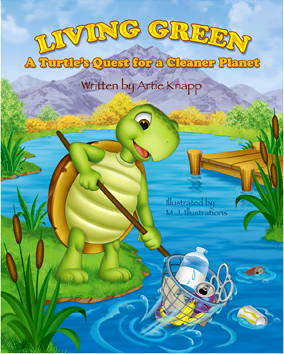
Artie Knapp’s new children’s book, Living Green: A Turtle’s Quest for a Cleaner Planet,’ is available!  Tired of seeing the land he loves cluttered with trash, Thurman the turtle decides it’s time to take action.  He’s a very environmentally conscious turtle who simply won’t take no for an answer.

Here’s a recent radio interview Artie Knapp did on a show called ‘The American Perspective:’


Get the book at Amazon

Get the book at Barnes & Noble


A delightful story that uses whimsical animal characters and engaging art to show younger readers that everyone can make a difference, no matter how small!

Sharon Martin, Newspapers in Education Manager, the Detroit Free Press

A determined turtle named Thurman shows us all that following your heart and doing what you believe in, no matter what others say, can make a difference. This story, like many of Artie Knapp’s other tales, is sure to entertain, educate and inspire our youth!

Kristin Garrison, Newspapers in Education Manager, the Cincinnati Enquirer

Kids are great ambassadors for the environment and Living Green makes the issue of human impact on the planet even more real through a brave, animal hero, Thurman, who literally risks his neck for earth.

Brandie Weikle, Editor of the Toronto Star’s parenting website, ParentCentral.ca

There’s even a special web site for Thurman the turtle.
Living Green: A Turtle’s Quest For a Cleaner Planet

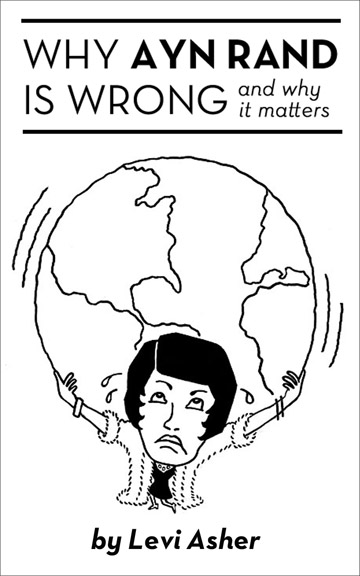
Artie Knapp’s new children’s book, Living Green: A Turtle’s Quest for a Cleaner Planet,’ is out today!  Tired of seeing the land he loves cluttered with trash, Thurman the turtle decides it’s time to take action.  He’s a very environmentally conscious turtle who simply won’t take no for an answer.

We feature many of Knapp’s children’s stories here and this one is a nice big bright addition to his list of wonderful and charming stories that teach a few simple lessons.  This book is 36 fully illustrated pages and is aimed at readers 5 to 10 years old.  The illustrations are by M.J. Illustrations and the publisher is Mightybook, Inc.


Get the book at Amazon

Get the book at Barnes & Noble


A delightful story that uses whimsical animal characters and engaging art to show younger readers that everyone can make a difference, no matter how small!

Sharon Martin, Newspapers in Education Manager, the Detroit Free Press

A determined turtle named Thurman shows us all that following your heart and doing what you believe in, no matter what others say, can make a difference. This story, like many of Artie Knapp’s other tales, is sure to entertain, educate and inspire our youth!

Kristin Garrison, Newspapers in Education Manager, the Cincinnati Enquirer

Kids are great ambassadors for the environment and Living Green makes the issue of human impact on the planet even more real through a brave, animal hero, Thurman, who literally risks his neck for earth.

Brandie Weikle, Editor of the Toronto Star’s parenting website, ParentCentral.ca

There’s even a special web site for Thurman the turtle.
Why Ayn Rand is Wrong (and Why It Matters): Kindle Book by Levi Asher

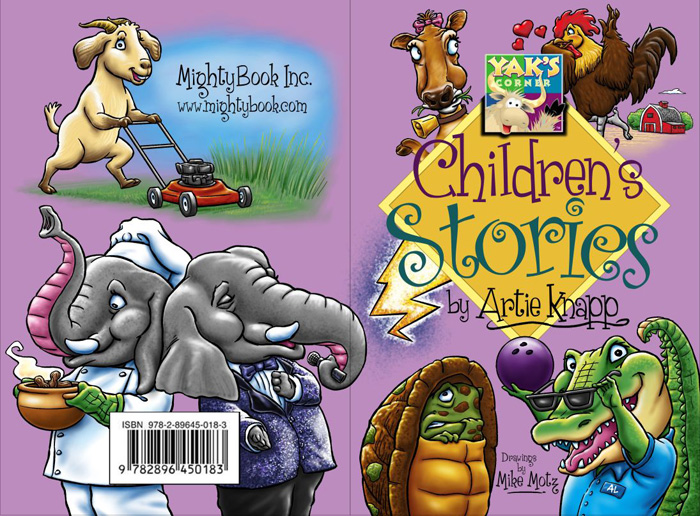
Levi Asher, the writer behind the long-running Literary Kicks site, has decided to move into the world of Kindle ebook publishing.  He’s starting the series off with a philosophical essay on the Objectivism of Ayn Rand.  Why Ayn Rand is Wrong (and Why It Matters) expands upon several posts Asher has made recently in his ongoing Philosophy Weekend discussions.  The focus on philosophy and its requirements for logical thinking and argument is especially needed right now in a political and ideological world of harsh opinion and attack masquerading as argument.  I often do this kind of attack-dog arguing myself.  It’s fun and it clears the sinuses effectively.  But it does not really serve much purpose.  Rational philosophical debate does serve a purpose and tends to foster respect between opposing parties.

Ayn Rand, for me, is simply the author of a very readable but rather simplistic novel, The Fountainhead.  I tried to read Atlas Shrugged, but gave up after two hundred pages, finding it so belabored and filled with lunkheaded ideas that I simply couldn’t put up with another speech from one of its cutout characters.   However, Rand also has a body of philosophical writing that seems to have been very influential and is having some kind of a resurgence lately among mostly conservative-minded people.

I have always thought that Rand was basically reacting violently to the mass-mindedness she saw everywhere in the first half of the twentieth century.  That mass-mind quality led millions to death via the trenches of World War I or the concentrations camps and genocide of Hitler and Stalin.  In the face of such horror, I think I too would have found solace in elevating the individual above all else.

I have purchased my copy of the Kindle book but I have not read it yet.  When I do finish the book and if I feel competent to do so I will try to write a little review.  But since I know Levi Asher’s writing very well from his fascinating blog I can certainly recommend that you head over to Amazon and buy a copy of a book that is for thinking.

Get Why Ayn Rand is Wrong (and Why It Matters) on Amazon

Artie Knapp Children’s Book Announcement and Online Tales

Artie Knapp writes marvelous, cheerful and gently humorous tales for children.  He’s been offering his stories to this site for years and I always look forward to a new one.  Knapp’s latest accomplishment is an illustrated book of stories published by Mighty Book, Inc. and illustrated by Mike Motz. The stories included were previously published by Detroit Free Press/Yak’s Corner.  It will be available soon and I’ll post an update when it hits the shelves!

In addition to the upcoming print collection, Knapp has begun offering his children’s stories through Mighty Book’s web site.  His recent story, Stuttering Stan Takes a Stand, is available as an animated read-aloud/read-along that is a perfect way to introduce your kids to the Artie Knapp story universe.  I am proud to say that I produced the audio and narration for the read-along and I think Mighty Book has done a wonderful job creating an interface for children.

It has also won some recent awards, including the Speech Woman’s Speech-Language Pathology Site of the Month Award for January 2011 and the Stop, Think, & Speak Award, which was a student nominated award from Penn State University.

You can also buy Stuttering Stan Takes a Stand from Amazon.

Mighty Book will soon publish more Knapp stories, including The Wasp and the Canary, The Hummingbird Who Chewed Bubblegum, and There’s a Crocodile in Our Pickle Jar, as fully illustrated Flash-animated books.

Inside Penguin’s Publishing Offices

Guy Kawasaki over at Holy Kaw! posts about the various team members and office spaces at his publisher, Portfolio, which is an imprint of Penguin.  He’s put up a bunch of photos he took inside the Manhattan office building where all the book work goes on.

It’s all more or less just fine… until we get to the photo of the art department (although I don’t trust smiling publishers).  The poor art people are given those brutally unprivate low-walled cubicles to work in.  All management teams use the exact same excuses for these open work areas:  fosters team spirit, allows easy direct communication over cubicle walls, lets the window light spread throughout the work area.

The real reason management installs low-rise cubicles is for observation and control.  It puts all employees, even the most dedicated and creative ones, in the position of monitoring each others’ work habits and arrival/departure times.  Low-rise cubicles are an insult to employees and do not foster team attitudes.  Professionals build teams by sharing their skills, not by watching each other.

Here’s Kawasaki’s book at Amazon.  And the cover really just truly sucks.  It’s about how to convince people to do the things you would like for them to do in business.  It probably helped convince the art designers to work in this cubicle hell.  His next book should be about how to smash furniture.

Do Books Work as Memory Theater?

Open Letters Monthly has an article called In Defense of the Memory Theater, by Nathan Schneider in which he argues that books on shelves perform the function of reflecting memories back at us.  They are a constant reminder of the various events, stages, and emotional states of our lives.  We look at our shelves and can instantly catapult ourselves back in time to events surrounding our reading of various volumes.

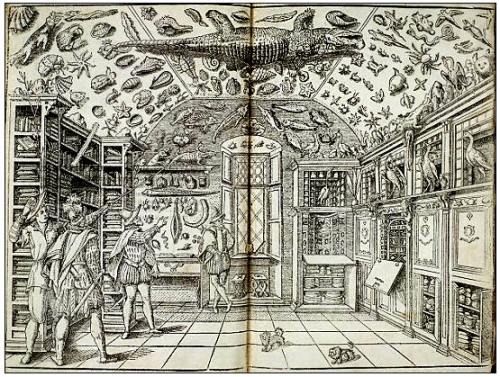
Schneider mentions a 16th-century memory theater that used images and symbols of the cosmos to inspire observers and enhance their intellectual powers.  Books, for Schneider, do something similar when they are visible on our shelves.  I agree up to a point.  I am often taken back in time by my own books upon their shelves.  But so am I transported by nearly every object in my home.  Objects all have this power.  Books are not exceptional in this regard.

Continue reading

A Book is Just a Book

Chris Roth animated this little video spot for a new children’s book coming out in August. It’s message is all about books being books and they don’t have anything more to them than the story they’re telling. I love a good e-reader perfectly well, but I still want a real book more than my e-reader. Every good book should have a cover. It’s as simple as that.

Newsreel Film From 1947: Making Books

“This man is an author. He writes stories. He has just finished writing a story. He thinks many people will like to read it.” So begins this 1947 Encyclopedia Britannica film about how books are printed and bound. Almost none of what you see in the film, with the possible exception of the book trimming blade, exists anymore. It’s fascinating and horrifying at the same time. Fascinating because we get to see the mysterious process of making a book. Horrifying because we see how machines dictate the movements of human beings in an assembly line environment.  It’s so dreadful that I may never want to read an old book again.  Perhaps e-books are some kind of salvation after all.

Alice In Wonderland For iPad

I’ve got lots of grumps against Apple’s iPad, like the lack of support for Flash, one of the greatest web technologies in existence. But this Alice in Wonderland eBook looks fantastic. I’d love to make all the pictures move around and I think kids will too. This must be right because when I was a kid I fervently wished for every illustration to wake up and start moving.

Is Stealing eBooks Ethical?

Is it ethical to steal an eBook if you’ve purchased the hardback version?  Sure.  Stealing the hardbacks themselves is much more fun though.  Is it ethical for a publisher to charge what they charge for hardbacks?  No way at all.  Sorry publishers, your pricing sucks and you know it.  So, certainly it’s ethical to steal an eBook if I’ve been robbed by the hardback price already.

Now of course all the minimum wage proof readers in New York City will pounce on me and call me terrible names because they dread being turned into temp workers.

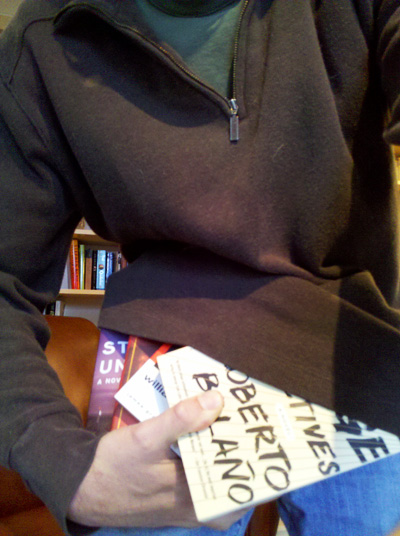
But stealing books is a real talent.  You need a big army jacket that has lots of giant pockets inside and out.  It’s best to steal them from large grocery and discount stores.  eBooks are too easy to steal and you never really know what’s waiting for you on the other end of a download link anyway.  The photo is of me demonstrating my own book-stealing technique.  I have amassed quite the respectable library this way.  But I never lend books out because they seldom make their way back home.

Here is an effort by a New York Times writer to answer the question of whether stealing ebooks is ethical or not if you’ve already bought the hardback.

But here’s a better piece at The Millions about an eBook pirate who’s pretty clear about what he likes.

Also, if you want to see how stealing books actually improves the world and culture, read The Savage Detectives by Roberto Bolaño.

The Nature of the Book

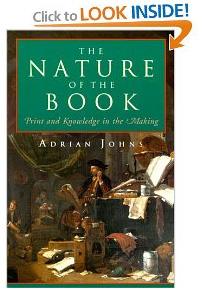
I sat down with my Kindle e-reader on Saturday morning to read the Los Angeles Times.  There was an article about an L.A. used bookstore called Iliad Books.  Sounded nice.  So I went.  What should I find but a section of books about books and publishing.  There was a copy of The Nature of the Book: Print and Knowledge in the Making by Adrian Johns. The author’s main thrust is to examine how books in early modern England influenced and largely caused the development of the modern scientific method and the general acquisition and spread of knowledge. He wonders why readers assume that books are accurate and fixed. This is an interesting inquiry in light of the recent changes in publishing which involve ever-changeable electronic publishing and web postings. The history of the effort to make books fixed and true representations of their authors’ intentions and ideas is a fascinating one. It includes an analysis of widespread piracy that dogged publishers of books from the very beginnings of printed material.

Thinking about the nature of books and their history, along with the underworld of book manipulation, piracy, copyright, and the conveying of knowledge is essential as publishing undergoes its greatest changes since the beginnings of the printed page.

Reading On a Kindle Is a Pleasure

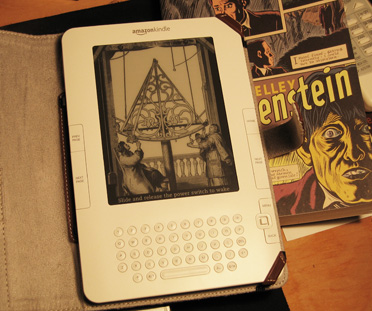
After two years of reading reviews, watching products come out and compete, listening to people gripe about DRM and ebook pricing, I jumped directly into the fray and opted for the Kindle from Amazon. I am completely and utterly smitten with the thing.  It feels like a magic book.  No – more like a printing press.  It’s got ink inside and the computer arranges the ink on the screen and it feels a little bit like you’re printing each page as you look at it.  It’s wonderful.  I don’t think I’ve ever read so much in a two-day stretch before.  I’ve subscribed to the New York Times and Asimov’s Science Fiction magazine.  I’ve purchased a single Amazon ebook for $9.99 and I’ve downloaded some free books from Project Gutenberg.  It all works beautifully and makes for the single best addition to my library since I acquired a two-hundred-year-old copy of Don Quixote.
Continue reading

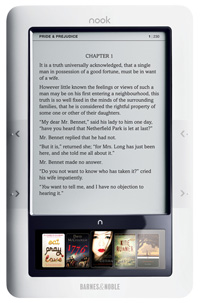
Barnes & Noble Nook is a Dreadful Failure

I’ve been so waiting with my bated breath and all for this magical Nook machine from Barnes & Noble.  I was in a right dither tonight about an hour and a half ago as I shoved my reading glasses into my pocket, put my regular glasses on my face and piled into my car for the short ride to my nearest Barnes & Noble bookseller.  But I stopped first at the Lenscrafters to run in and have them adjust my frames because my glasses are so new and have been drifting over lopsided all week.  So the woman there fixed them up nicely and shined them good.  Then I drove on toward my Nook encounter.

The store had a lone unit attached to an anti-theft device that scared the hell out of me because I tend to demonstrate new devices to myself until nearby customers think I’m a lunatic and I certainly didn’t want to raise any alarms.  The Nook said, ‘Press the Power Button to Wake Up.’  I spun the device around several times until I located said button embedded in the upper edge of the Nook.  I pressed it.

I waited.

Then I pressed it perhaps fourteen or fifteen times to try and make something wake up.  Then the screen went through a series of blinks, flashes and some rather frightening symbols appeared and then disappeared.  And then the machine said, ‘Press the Power Button to Wake Up.’

Continue reading

Amazon and Macmillan Raise eBook Prices

There’s been a huge battle of the ebooks going on between Amazon.com and publisher Macmillan.  Last week, Macmillan, in response to rotten Apple’s announcement of $14 and $15 ebooks on its new iPad, insisted that Amazon give Macmillan the right to choose its own higher ebook pricing for the Kindle ereader device.  Amazon got peevish about the deal and simply de-listed all of Macmillan’s books.  I thought that was a nice nasty smack in the kisser for a doomed publisher at the time.  I was feeling so good about Amazon and its Kindle and so snitty about Apple’s iPad that I was within 60 minutes of plunking my digital money down on a brand new shiny Kindle.  But wait!  Amazon caved!  They rolled over and gave Macmillan what it wanted.

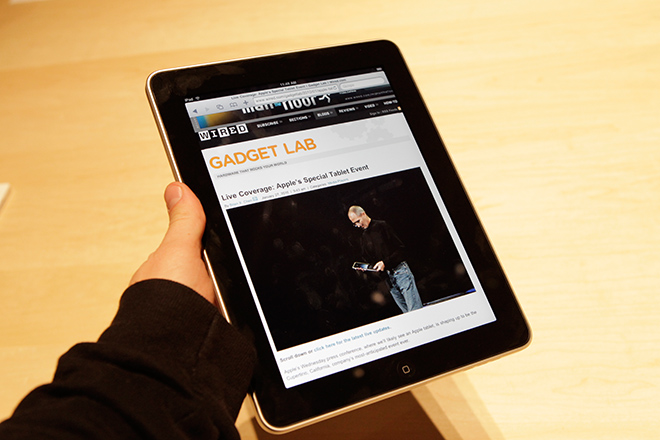
So now, dear reader, your Kindle ebooks from Macmillan will cost more.  Frankly, I was always kind of miffed by the whole $9.99 price tag on Kindle ebooks.  Too high.  Ebooks are invisible.  You can’t stack them and put boards across to make a coffee table.  Ebooks don’t have nice covers or fancy paper that you can bend and spill coffee on.  I don’t know about anyone else reading this blog out there, but when I walk into a book store I’m just a customer.  I don’t frankly give a damn about how the publisher is doing or how Amazon is getting along, or care a whit for Steve Jobs’ health, or the status of your average mid-list author and how he or she’s going to pay their mortgage.  I don’t give one syllable of a damn. Continue reading

I Take it Back: Apple Tablet is Dopey

So after all the hoopla the Apple company has decided that it’s a good idea to sell an iPod Touch that you can’t carry.

The just-announced iPad is big, with a fullscreen display instead of widescreen, has no camera, and cannot multi-task.  So only one application at a time will run.  The fullscreen thing may make sense when you consider that people will need to be typing on a virtual keyboard, but I’m not sure that it will fly.  I see it as going out to buy a fullscreen monitor somehow.

I think I’m finally ready to go get myself a Kindle from Amazon!

I’ve been yawning all morning and I’m still yawning.