Overwrought, hysterical, panicked, demented, distressed, hilarious. How have I missed these?
Overwrought, hysterical, panicked, demented, distressed, hilarious. How have I missed these?

 Every word in Thomas Pynchon’s deranged dance macabre, ‘Gravity’s Rainbow,’ seems, like HTML, to link out to some other subject. The book seems for me to exist in-between worlds, barely attached to this one while trying desperately to connect us with another fuzzily glimpsed, just-hinted, vague world, suggested by pure chance connections between ideas and events here on a fractured and demented earth. I’m barely one hundred and sixty-five pages into this book and I’m reacting for it and against it in nearly equal measure. It’s a goddamn blast. It’s also a motherfucking bitch. Every page of it so far mentions some kind of rocket trajectory, launch pad, descent, explosion or blast of light. Everyone in the book seems to be living out one debauchery or another while all the time expecting to be blown away in bits, perhaps even looking forward to it. Death, for Pynchon, seems on the surface like fun. The book almost makes a mockery of dark humor, of dying. It’s as if Pynchon wants to give the finger straight into the yawning mouth of death’s favorite century.
Things I notice so far about the book: Rockets of course. Everywhere and in every mind of the characters. It’s all about predicting bomb hits and finding the rockets. People want to understand how one of the characters can possibly manage to have sex in various locations just prior to those spots being bombed into oblivion by German V-2 rockets. The books seethes with sexual excitement that’s a death-wish. I also notice that Pynchon is associating Hansel & Gretel, the forest and the witch’s oven with Germany and the events of World War II. The Holocaust is looming over this book on every page. There are constant mentions of cause and effect, how it operates and whether it might be possible to break out of its logic. Can a rocket attack be sensed before it even hits? Psychological early warning system. Brain radar. Statistical analysis for making predictions.
Imagine a missile one hears approaching only after it explodes. The reversal! A piece of time neatly snipped out…a few feet of film run backwards…the blast of the rocket, fallen faster than sound–then growing out of it the roar of its own fall, catching up to what’s already death and burning…a ghost in the sky…
Quite a few references to film in this book so far up to page one hundred and sixty-five.
What could be more paranoid than a constant worry about bomb rockets? The book seems like a grotesque exaggeration at first. But that’s the joke I think. It’s actually an understatement and proves paranoia to be the most well-placed and logical mental operation in a century during which people were dug into trenches and told to march toward each other like polite firing squads. A century in which men marched millions of people into gas chambers and pushed them through ovens. A century in which entire cities were blown off the face of the planet while the citizens were out shopping for groceries. Pynchon seems like an author who is not afraid of any of it. He’s like a guy laughing at the scene of a traffic accident. Or photographing it like Warhol did. And the book’s laugh-in-a-sort-of-half-shocked-way funny. Here’s a bit from a funny scene where a guy visits a nurse he wants to sleep with but must endure a lengthy sit-down with an older woman patient who wants to share her candy:
Under its tamarind glaze, the Mills bomb turns out to be luscious pepsin-flavored nougat, chock-full of tangy candied cubeb berries, and a chewy camphor-gum center. It is unspeakably awful. Slothrop’s head begins to reel with camphor fumes, his eyes are running, his tongue’s a hopeless holocaust. Cubeb? He used to smoke that stuff. “Poisoned…” he is able to croak.
“Show a little backbone,” advises Mrs. Quoad.
“Yes,” Darlene through tongue-softened sheets of caramel, “don’t you know there’s a war on? Here now love, open your mouth?”
It’s funny, no? But it should also set off sparks off recognition in your head that link up with gas chambers. You just can’t trust Pynchon to be genuinely funny. He’s watching you laugh and getting ready to slit your careless throat. No wonder Pynchon uses a secret identity. He’s dangerous. He seems slightly criminal. This guy loves conspiracies. He must have some really excellent ideas about who killed Kennedy. I mean he’d probably say Oswald did it, but it’s why Oswald thought he was doing that makes it interesting.
I love it when authors hide their identities. Pynchon has been effectively doing this for about fifty years now. This reminds me, as all secret identities do, of Batman.
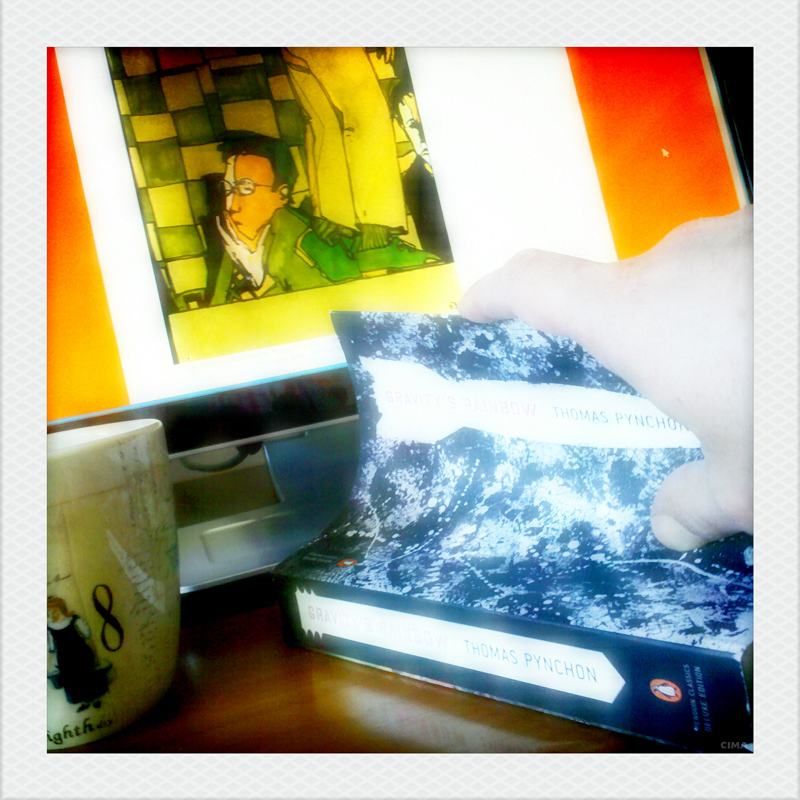
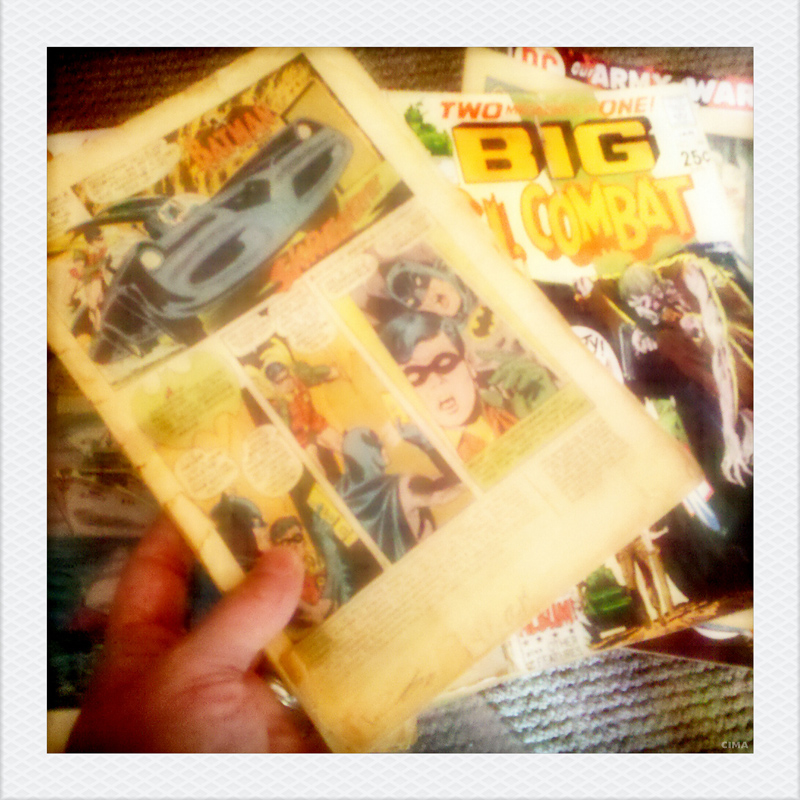 Here’s my ancient and torn copy of a Batman giant issue from 1969. Down in the lower margin there I wrote ‘fuck.’ I’m not sure why I would have done something so charming to a Batman comic. I must have been practicing my favorite words or something. What does an old comic book have to do with Pynchon? I don’t really know but it seems to fit. In fact, comic artist Frank Miller did the cover for the recent Penguin edition of Gravity’s Rainbow. That’s the copy of the book in the first photograph above. Behind the book in that photo is a computer screen showing a drawing by artist Zak Smith who did a thing he called ‘Illustrations for Each Page of Gravity’s Rainbow.’ It’s been shown at the Whitney Museum and you can buy it in book form.
It’s strange how much I’m enjoying this book because I hated ‘Ulysses’ by James Joyce. I think Pynchon snagged some stuff from Joyce. He even resorts to script format for some portions of the book the way Joyce did. But I only like the first part of Ulysses which takes place on top of a tower and has a character shaving. I also enjoy the part about Bloom in the park watching the girl’s underpants. But that book suggests to me that Joyce was mentally ill. With Pynchon I get the feeling that the world and everyone in it is mentally ill.
There’s also a definite connection between Pynchon and William S. Burroughs. In fact I wouldn’t be surprised if they were the same person. But that’s impossible. They both like secret organizations of scientists or researchers though. They share this fascination with science gone crazy and used to control minds – populations. But Pynchon is a better writer – less concerned with gimmicks. His language is a constant beauty which is the great antidote to his hilariously murderous world view. His entertaining and wildly connecting sentences indicate to me that Thomas Pynchon is an optimist. But, as with Joyce, I find myself constantly shutting the book and wondering, ‘How did he do it?’ How for fuck’s name did this guy not only maintain a secret identity but accumulate so much esoteric knowledge in the late sixties so as to be able to jam-pack every single sentence in the bloody book with some reference or other to some event or other that no sane person would ever have heard of in a lifetime? What the hell is going on in this man’s mind that allowed him to achieve Google knowledge density in 1973?
For all the good it might do anyone, I’ll keep reading the book and make a few more posts about it. I tend to relate work like Pynchon’s to my own video work. It’s something to do with the density of thought and imagery. It’s always good to read solid evidence of someone being crazier than you are so that you can get down and work at your own stuff with a little less embarrassment.
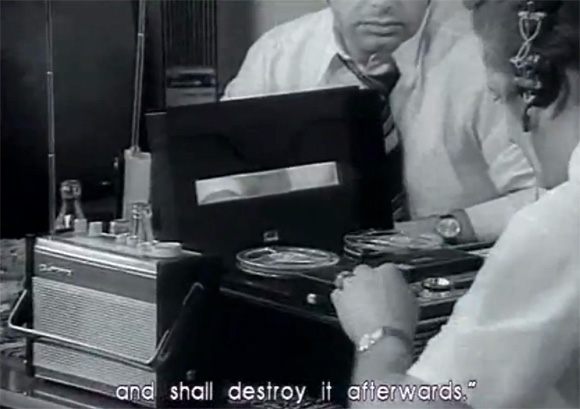
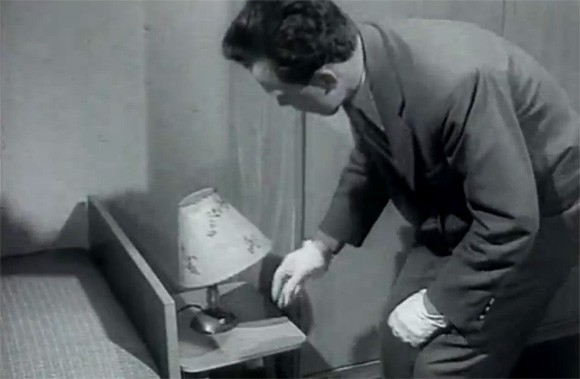
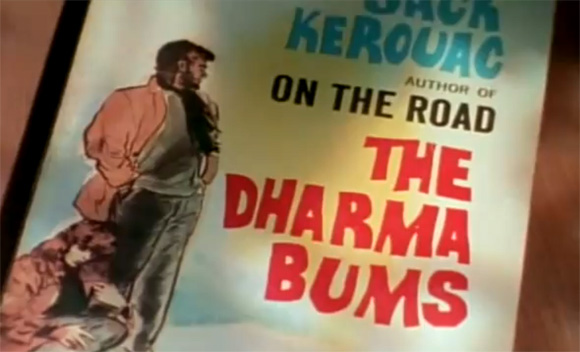
What I like about this documentary is that it does in fact touch upon this subject. What I don’t like about it is Johnny Depp prancing around with an unsmoked cigarette trying to convince us of his Beat/hipster/baggy jacket coolness.
The Beat hatred of all things female manifests itself most obviously in the fact that Burroughs stood his wife, Joan Vollmer, up against a wall in Mexico and blew her brains out with a gun. There’s great mystery surrounding his escape from the authorities in Mexico who quite naturally wanted to investigate and prosecute the man for murder. I would have prosecuted him too. He told various stories about playing a game of ‘William Tell,’ or inebriation or drug use to explain how it happened. But in order to fire a bullet through his wife’s forehead he had to lift the gun and point it at her. It sort of goes without saying. Would you be able to point a gun at your spouse? Hopefully not. I wouldn’t be able to even lift a gun in my wife’s general direction. So why was a man who blasted his wife’s head open welcomed back into his little group of Beat friends? Why would such a man become the life of the party in literary circles? Why would such a man love guns and fire them at tin cans in his backyard for the rest of his life? Good questions. Easily answered. Nobody gave a shit about the man’s dead, blown-open wife. She was just a lady in Mexico married to a bisexual genius. That’s the problem with the Beats. That’s the rock bottom attitude of the most important literary movement in America during the twentieth century.
Here’s what Burroughs had to say about killing his wife:
I am forced to the appalling conclusion that I would never have become a writer but for Joan’s death, and to a realization of the extent to which this event has motivated and formulated my writing. I live with the constant threat of possession, and a constant need to escape from possession, from control. So the death of Joan brought me in contact with the invader, the Ugly Spirit, and maneuvered me into a life long struggle, in which I have had no choice except to write my way out.
Let me translate that for you: “I killed my wife and was so inspired by the act of killing a female that I became a great writer. And I want to kill again. I have to constantly struggle with the urge. My writing helps with that.”
Get the idea? Murder inspires good writing… according to one-third of the Beat literary movement. The other two-thirds were just fine with that.
You may think I’ve gone too far or have some literary ax to grind. But I would suggest that reading the Beats without keeping these ideas in mind is self-deception. It’s all right there on the page if you actually read the stuff. These guys weren’t gentle spirits with open hearts and minds. They were brutal little elitists from Columbia University who were willing to kill and dump dead bodies into rivers in order to protect their group. Kerouac helped a friend dispose of a murder weapon, then took the murderer out to a movie. That murder, which was in fact the brutal slaughter of a gay man who was making advances, led to inspiration for Kerouac, Burroughs and Ginsberg who all attempted and partially succeeded at novels based on the incident. Again, murder inspires Beat writings. If one really wants to get down in it, one would go so far as to say that the prime mover behind the Beat movement – its basic inspiration – was a gay-bashing murder in Riverside Park. People may say whatever they like about writers trying to work out the demons, but I see something much darker than that.
Kerouac later based the main character of ‘On the Road’ on Neal Cassady, a man who appears on film to be a psychopath. I’d be looking for dead bodies buried under any house that guy ever lived in.
I think the Beat movement should be done over for the twenty-first century. This time, try not to blast anyone’s brains out across a wall.
Imagine yourself sitting in a finished basement room with wood panel walls, a nice thick shag carpet, and a long low console television. In the 70s, I remember running from house to house to see everyone’s color screens because I had a black & white at home. An episode of Star Trek in full color glory was a rare form of Nirvana for me. I wasn’t really as uncool as that sounds. Don’t let it fool you. Pretty soon our current infatuation with HD will seem just as naive.
While I was running through the Getty Center’s flagship portion of the massive citywide ‘Pacific Standard Time‘ art exhibit, I was struck by just how great this Wallace Berman fellow really was. Known primarily as the ‘father’ of assemblage art, he was also a member of the Beat Movement. He made a single film which occupied much of his time through the 1960s and 70s. It’s less than eight minutes long and it’s a drop dead gorgeous thing to see. He’s one of those film artists interested in what I like to call the messy image. The film seems to have been dragged through ink and dirt. It’s been scratched, wrinkled, folded, cut, slashed and stained. Letters flash by like subliminal messages. Pop culture crashes into modern art. He films magazines, papers, radios, faces, hands, rock stars, body parts, buildings, streets and apparently just about everything he had lying around in his studio. This film is a quiet little reminder that crystal clear HD and super sharp focus are not anywhere near the concerns of some artists.
And here is California assemblage artist George Herms talking about Berman recently as part of the Pacific Standard Time series of exhibits:
Pacific Standard Time is a massive overview of Los Angeles art from 1945 to 1980. At least sixty galleries and museums are taking part over the next few months. I have already been to the largest exhibits at the Museum of Contemporary Art, Los Angeles County Museum of Art, and the Getty Center. The whole thing is a lot of fun and I have discovered artists I never knew about before. There are magnificent things on display and the curators have also published big books to go along with each exhibit. I seriously recommend that you always get the books because they have far more information in them than the exhibits themselves. I view it as my own effort to compile a record of this unique regional art show.
You can find almost everything you need at the Pacific Standard Time web site.
This film was put together for the Getty Center’s flagship exhibit, Crosscurrents, which covers 1950 to 1970. It’s a very nice little documentary about some of the major art developments in Los Angeles.
I did not know this filmmaker, Paolo Gioli, existed until yesterday. And that really bothers me because I feel a very strong kinship with this filmmaker just on the basis of having seen two of his pieces. What can a filmmaker do with his own backyard? That is the question that comes to my mind as I watch his films. Can a filmmaker take his camera out back and make something astounding? Of course. In fact, that skill is central to being a creative filmmaker. It is the feeling I get from Gioli. He makes films that have a guiding concern but he is not afraid to slip a little off of the main track and let you see him experimenting. One can observe his enthusiasm for a new mechanical technique and he allows his film to wander into the territory of the new machine or splicing method for a while. And then he comes back to the main thing. He never lets this get out of control and it is a miracle to watch. One can learn how to experiment by watching a brilliant experimentalist. It’s that simple.
There are many filmmakers I wish I could meet and perhaps work with. Gioli is one of them. In fact, this brings to mind again my thought that things like YouTube are the greatest cinematic development of the past half century. The reason has nothing to do with screen format or size or image quality. It has to do with intimacy. The feeling of connection one can get by watching a filmmaker’s work on the computer is far more intimate than could be achieved in a theater. It is this quality that is the most important contribution of online film to world cinema. Intimate connection to the artist. It has a powerful effect on artists and communicates ideas and inspiration from generation to generation far more effectively than any prior cinematic display technology.
Here is a nice long article by Bart Testa about this wonderful Italian filmmaker.
Here is an article by David Bordwell on how Gioli’s hand-made cameras influence his ‘vertical cinema’ technique.
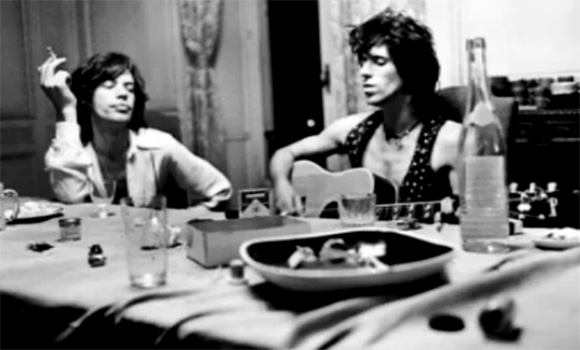
It’s all very confused and mysterious. In 1972, the Rolling Stones hired photographer and filmmaker Robert Frank to make a film about their American tour. He made something wonderful called ‘Cocksucker Blues,’ which immediately angered the Stones because it actually showed them to be the ultra coolest and baddest band in the world. They sued him to keep the film out of circulation. Go figure. Why would you sue a guy for making the one absolute piece of evidence that you are what you say you are: ‘The greatest rock & roll band in the world?’ Well I don’t know the answer. Drugs and addled minds perhaps. This short film is actual footage taken by Frank on Super 8 cameras. It’s been edited by someone called Videodrumz on YouTube and put together with ‘Rocks Off’ from the ‘Exile on Main Street’ album. It’s good. It works. The footage is absolutely recognizable as Frank’s.
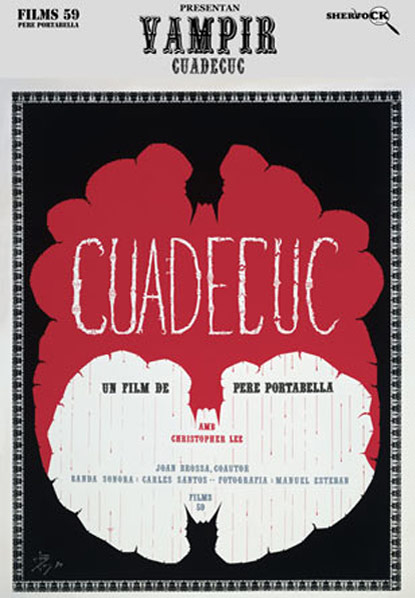 Here’s an extremely rare underground Halloween treat for anyone who loves film. Ah, but only the very fewest of you will actually watch this all the way through! Give it a try. Not only is this film underground… it’s underhanded. Pere Portabella made ‘Cuadecuc, Vampir’ in 1970 by filming on the set of a Christopher Lee film called ‘Count Dracula’ that was being directed by Jesus Franco. Portabella’s underground classic is on its surface a silent horror film. But it’s also a documentary about the making of the Dracula film. It tells its story by stealing scenes from the feature being shot around it, almost as if the film were a mashup of existing footage! The high-contrast black and white photography evokes such cinema greats as Carl Theodor Dreyer’s ‘Vampyr’ and F.W. Murnau’s ‘Nosferatu.’ We see typical horror scenes like a stagecoach racing through the wilderness, or a dusty crypt, interrupted by the arm of a prop person using a fan to blow fake spiderwebs or a cameraman shooting from behind furniture. These slippages from horror into documentary actually produce a weird terror when you realize that the film was being shot under the watchful eyes of Spain’s dictator, General Francisco Franco. What the film really is underneath all the fantastic and disturbing imagery is a vicious attack on Franco and the false media manipulation that keeps all dictators in power. The portrait it paints of Franco himself is one of a sad, disturbed and largely ineffective vampire who lives inside a mental construction based on the past. The other characters in the film seem to be wandering through this psychotic realm, trying to find a way out.
The soundtrack incorporates jet engines, muzak, electronic music, opera singing, jackhammers, stuck records and various other electronic sounds. Don’t let this throw you because the soundtrack is one of the most eerie and unsettling that you will ever hear.
And I’m thinking that Criterion needs to jump on this and make a nice blu-ray release out of it.
Pere Portabella has a web site.
Now, just for kicks, here is a scene from the actual color film of Dracula being shot while Pere Portabella stole his own film right under Christopher Lee’s nose! You decide which film seems scarier.
George Pocari made this film of Los Angeles in 1978. It’s beautiful and it shows the things one sees every day without really noticing. Films like this one turn out to be incredibly valuable glimpses of the past. It’s funny how home movies end up getting closer to art films as they age. But this one actually started off as a kind of art film. It’s very well made.
Here’s a 1973 film with Italian film director Pier Paolo Pasolini talking about the need to protect the basic form of a city because it is an expression of anonymous popular history. Pasolini believed that modern consumerism was destroying Italy in the early seventies more successfully than fascism.
This is a film by Jonas Mekas that features Andy Warhol, Yoko Ono, John Lennon, and George Maciunas who founded the New York art movement known as Fluxus. The film shows a Whitney Museum art opening in 1971 and an artists’ party in New York. Home movies become an artform in Mekas’ hands.