Visions of the Jinn: Illustrators of the Arabian Nights


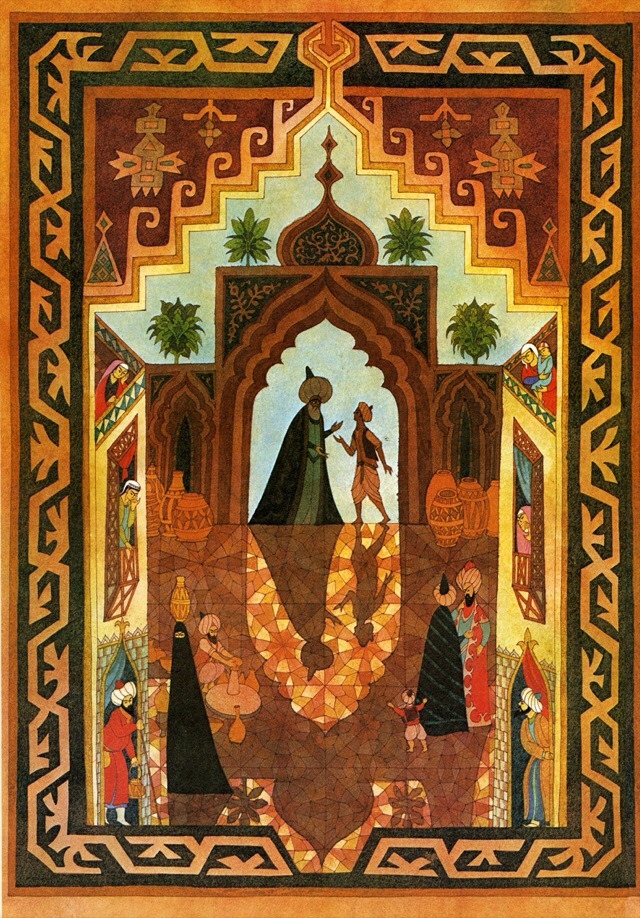
Alladin by Errol Le Cain 1981

Visions of the Jinn: Illustrators of the Arabian Nights (Studies in the Arcadian Library)is a massive volume written by Robert Irwin and published by Oxford University Press that provides an overview of illustrated versions of The Tales since the first Dutch images of 1714 by an artist named David Coster.


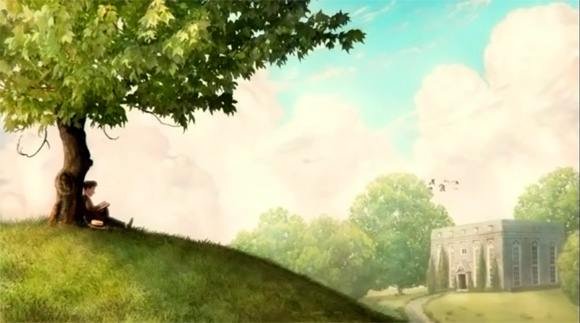
The Fantastic Flying Books of Mr. Morris Lessmore: Oscar Winning Short Animation

This is the 2011 Oscar winning short animation, ‘The Fantastic Flying Books of Mr. Morris Lessmore.’ It’s the first film from Moonbot Studios in Shreveport, Louisiana. It was co-directed by William Joyce and Brandon Oldenburg

The film is also an iPad app that combines animation with an interactive picture book narrative.

Here’s a Cartoon Brew interview with the filmmakers..

On Reading Thomas Pynchon’s Gravity’s Rainbow – Part 1

Every word in Thomas Pynchon’s deranged dance macabre, ‘Gravity’s Rainbow,’ seems, like HTML, to link out to some other subject. The book seems for me to exist in-between worlds, barely attached to this one while trying desperately to connect us with another fuzzily glimpsed, just-hinted, vague world, suggested by pure chance connections between ideas and events here on a fractured and demented earth. I’m barely one hundred and sixty-five pages into this book and I’m reacting for it and against it in nearly equal measure. It’s a goddamn blast. It’s also a motherfucking bitch. Every page of it so far mentions some kind of rocket trajectory, launch pad, descent, explosion or blast of light. Everyone in the book seems to be living out one debauchery or another while all the time expecting to be blown away in bits, perhaps even looking forward to it. Death, for Pynchon, seems on the surface like fun. The book almost makes a mockery of dark humor, of dying. It’s as if Pynchon wants to give the finger straight into the yawning mouth of death’s favorite century.

Things I notice so far about the book: Rockets of course. Everywhere and in every mind of the characters. It’s all about predicting bomb hits and finding the rockets. People want to understand how one of the characters can possibly manage to have sex in various locations just prior to those spots being bombed into oblivion by German V-2 rockets. The books seethes with sexual excitement that’s a death-wish. I also notice that Pynchon is associating Hansel & Gretel, the forest and the witch’s oven with Germany and the events of World War II. The Holocaust is looming over this book on every page. There are constant mentions of cause and effect, how it operates and whether it might be possible to break out of its logic. Can a rocket attack be sensed before it even hits? Psychological early warning system. Brain radar. Statistical analysis for making predictions.

Imagine a missile one hears approaching only after it explodes. The reversal! A piece of time neatly snipped out…a few feet of film run backwards…the blast of the rocket, fallen faster than sound–then growing out of it the roar of its own fall, catching up to what’s already death and burning…a ghost in the sky…

Quite a few references to film in this book so far up to page one hundred and sixty-five.

What could be more paranoid than a constant worry about bomb rockets? The book seems like a grotesque exaggeration at first. But that’s the joke I think. It’s actually an understatement and proves paranoia to be the most well-placed and logical mental operation in a century during which people were dug into trenches and told to march toward each other like polite firing squads. A century in which men marched millions of people into gas chambers and pushed them through ovens. A century in which entire cities were blown off the face of the planet while the citizens were out shopping for groceries. Pynchon seems like an author who is not afraid of any of it. He’s like a guy laughing at the scene of a traffic accident. Or photographing it like Warhol did. And the book’s laugh-in-a-sort-of-half-shocked-way funny. Here’s a bit from a funny scene where a guy visits a nurse he wants to sleep with but must endure a lengthy sit-down with an older woman patient who wants to share her candy:

Under its tamarind glaze, the Mills bomb turns out to be luscious pepsin-flavored nougat, chock-full of tangy candied cubeb berries, and a chewy camphor-gum center. It is unspeakably awful. Slothrop’s head begins to reel with camphor fumes, his eyes are running, his tongue’s a hopeless holocaust. Cubeb? He used to smoke that stuff. “Poisoned…” he is able to croak.

“Show a little backbone,” advises Mrs. Quoad.

“Yes,” Darlene through tongue-softened sheets of caramel, “don’t you know there’s a war on? Here now love, open your mouth?”

It’s funny, no? But it should also set off sparks off recognition in your head that link up with gas chambers. You just can’t trust Pynchon to be genuinely funny. He’s watching you laugh and getting ready to slit your careless throat. No wonder Pynchon uses a secret identity. He’s dangerous. He seems slightly criminal. This guy loves conspiracies. He must have some really excellent ideas about who killed Kennedy. I mean he’d probably say Oswald did it, but it’s why Oswald thought he was doing that makes it interesting.

I love it when authors hide their identities. Pynchon has been effectively doing this for about fifty years now. This reminds me, as all secret identities do, of Batman.
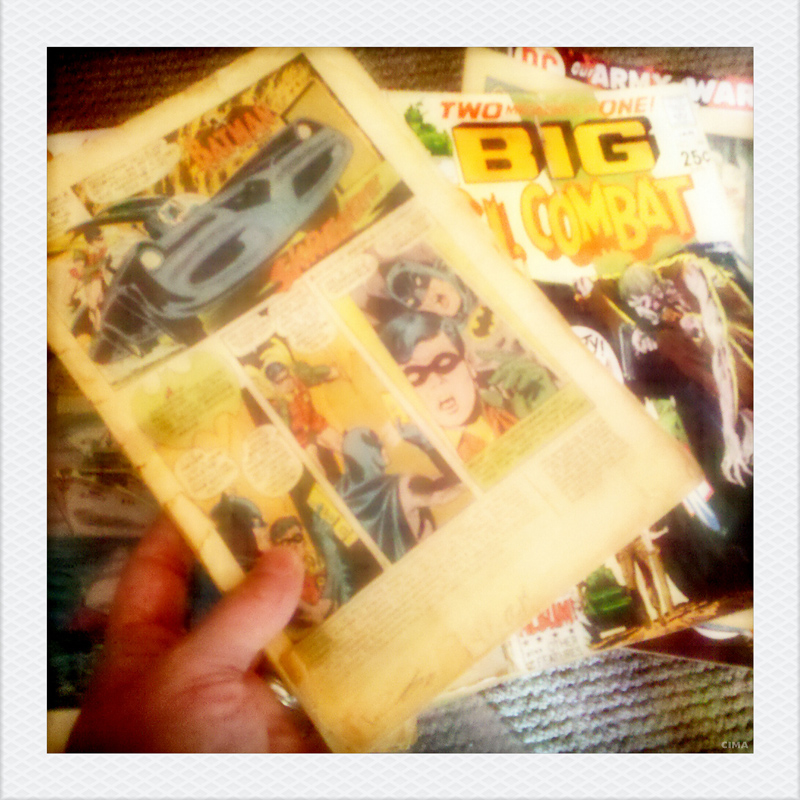
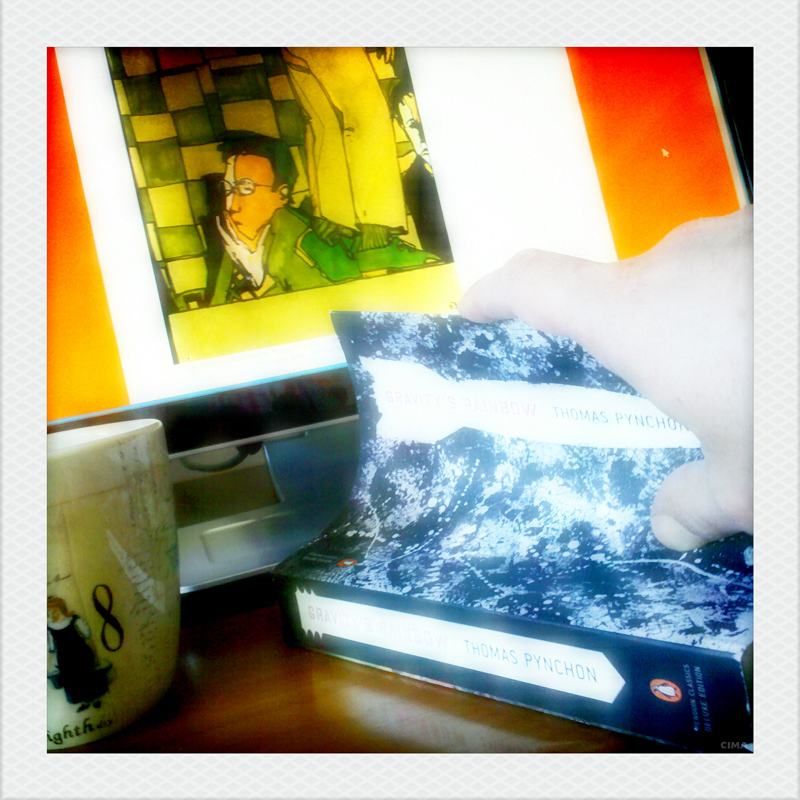
Here’s my ancient and torn copy of a Batman giant issue from 1969. Down in the lower margin there I wrote ‘fuck.’ I’m not sure why I would have done something so charming to a Batman comic. I must have been practicing my favorite words or something. What does an old comic book have to do with Pynchon? I don’t really know but it seems to fit. In fact, comic artist Frank Miller did the cover for the recent Penguin edition of Gravity’s Rainbow. That’s the copy of the book in the first photograph above. Behind the book in that photo is a computer screen showing a drawing by artist Zak Smith who did a thing he called ‘Illustrations for Each Page of Gravity’s Rainbow.’ It’s been shown at the Whitney Museum and you can buy it in book form.

It’s strange how much I’m enjoying this book because I hated ‘Ulysses’ by James Joyce. I think Pynchon snagged some stuff from Joyce. He even resorts to script format for some portions of the book the way Joyce did. But I only like the first part of Ulysses which takes place on top of a tower and has a character shaving. I also enjoy the part about Bloom in the park watching the girl’s underpants. But that book suggests to me that Joyce was mentally ill. With Pynchon I get the feeling that the world and everyone in it is mentally ill.

There’s also a definite connection between Pynchon and William S. Burroughs. In fact I wouldn’t be surprised if they were the same person. But that’s impossible. They both like secret organizations of scientists or researchers though. They share this fascination with science gone crazy and used to control minds – populations. But Pynchon is a better writer – less concerned with gimmicks. His language is a constant beauty which is the great antidote to his hilariously murderous world view. His entertaining and wildly connecting sentences indicate to me that Thomas Pynchon is an optimist. But, as with Joyce, I find myself constantly shutting the book and wondering, ‘How did he do it?’ How for fuck’s name did this guy not only maintain a secret identity but accumulate so much esoteric knowledge in the late sixties so as to be able to jam-pack every single sentence in the bloody book with some reference or other to some event or other that no sane person would ever have heard of in a lifetime? What the hell is going on in this man’s mind that allowed him to achieve Google knowledge density in 1973?

For all the good it might do anyone, I’ll keep reading the book and make a few more posts about it. I tend to relate work like Pynchon’s to my own video work. It’s something to do with the density of thought and imagery. It’s always good to read solid evidence of someone being crazier than you are so that you can get down and work at your own stuff with a little less embarrassment.
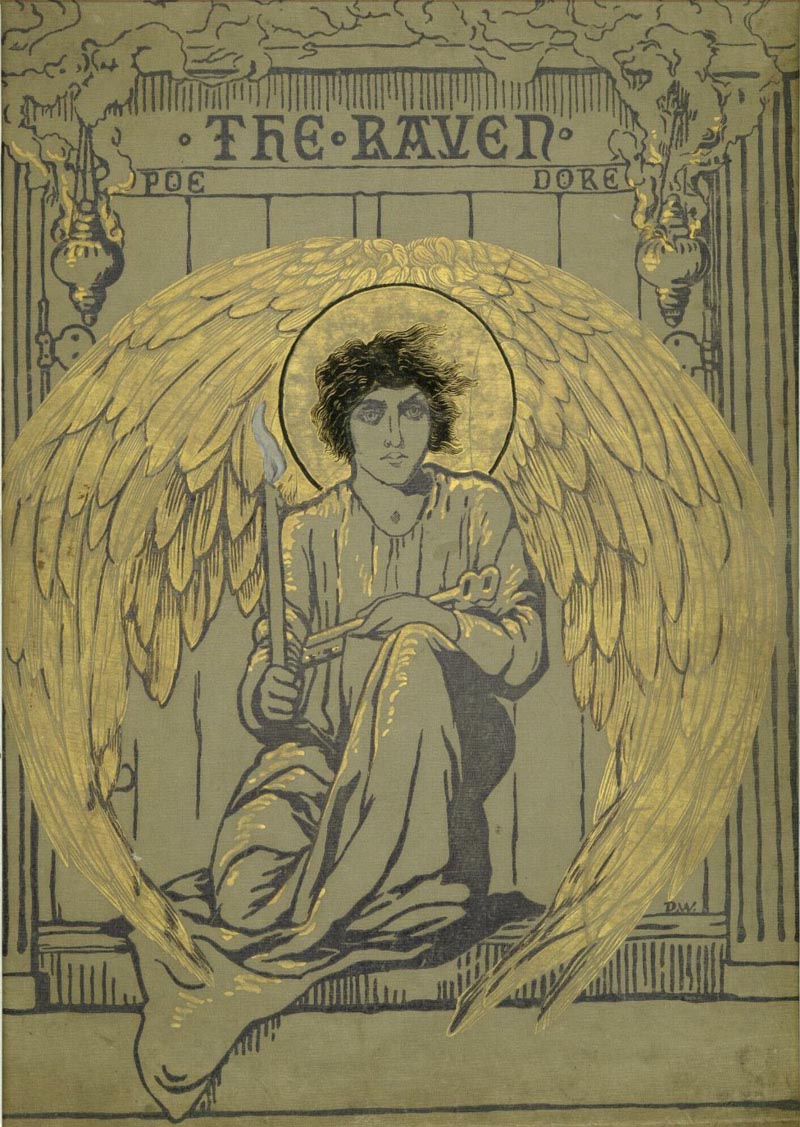
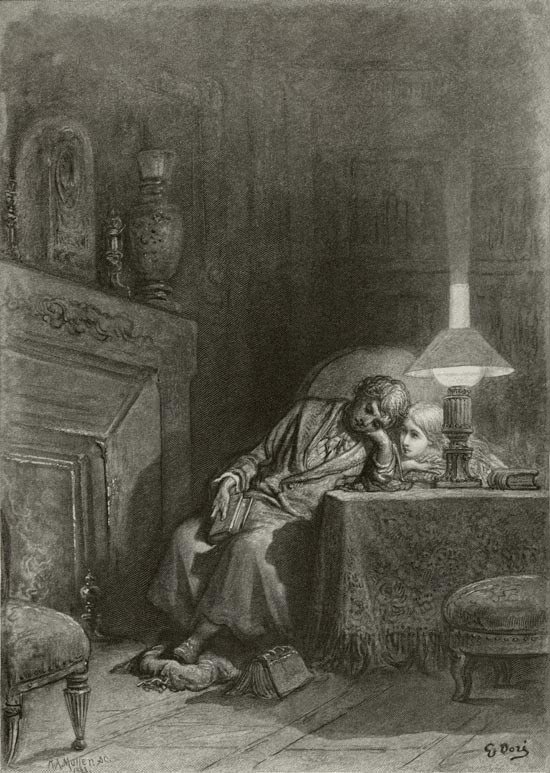
Edgar Allan Poe’s ‘The Raven’ Illustrated by Paul Gustave Doré

This incredibly beautiful edition of Edgar Allan Poe’s ‘The Raven’ was published in 1884 with illustrations by Paul Gustave Doré. Click on the images to see full sizes.

Once upon a midnight dreary, while I pondered, weak and weary,
Over many a quaint and curious volume of forgotten lore–
While I nodded, nearly napping, suddenly there came a tapping,
As of some one gently rapping, rapping at my chamber door.
“‘Tis some visiter,” I muttered, “tapping at my chamber door–
Only this and nothing more.”

Continue reading

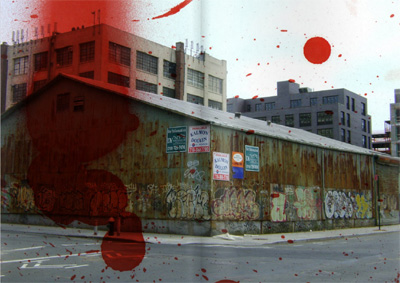
BOMB: A Manifesto of Art Terrorism

Artist and filmmaker Raymond Salvatore Harmon has written an inspiring and thought-provoking book that insists on changing the way art is perceived and approached by artists, viewers and the ever-problematic gallery world. Harmon presents several stories of his own brushes with law enforcement that are both funny and rather harrowing. He consistently recommends behaving as if you have every business being exactly where you are even if you have no permission to paint the front of a building. Confidence and apparent command of a situation will often get a clever artist out of a jam. Harmon is a very likeable guy and I can’t imagine there would be too many police all that interested in arresting this particular artist whose work always seems to have good intentions behind it.

Here’s an important quote from the book:

Ultimately, corporations play the biggest part in designing our modern world. Corporations sell goods, make cars, pump oil and make medicines. They design city planning and develop urban neighborhoods in order to make profit. They create ghettos to house those people that they pay so little they are unable to afford to live anywhere else. Making them exist at the most nominal part of financial need, particularly outside of the white picket fences of the 1st world nations.

Yet, in the darkness of the city night there are those that go out and change the urban landscape without planning permission of a performance license. These people vary in intent and talent but they collectively do what they do against society and against the law.

I like this book. I find it generally inspiring and agitating in the best possible way. However, I do have arguments with it. In general, I tend to prefer looking at street art that does not actually destroy or harm property. Artists who violate laws by gluing things on walls should I think be treated rather lightly. However, I can certainly imagine scenarios in which a business – even a corporate one – could be seriously harmed by the placement of street art on its walls. Not all corporations are British Petroleum. I don’t see any logical link between artistic statement and one’s attitude about a public or corporate wall. If art should in fact be more focused on the act of creation and viewing by the public without concern for how quickly the art is removed, as Harmon’s book suggests, then street artists should be content with painting their work on paper or cloth and hanging it from those corporate walls. Why is there a link between the making of an image and the destruction of a blank corporate wall? Why not make the art and preserve the blank wall?

Harmon has some harsh words for the art world that links itself inextricably with the art schools, identifying artists it likes, feeding them into a network of wealthy friends and collectors, creating an insular world of wealthy back slappers and promoters. You can see this world in operation all over New York and even in Los Angeles. However, I would point out that crony networks are notoriously good at finding and publicizing actual brilliance.

Elsewhere in the book, famed artist/street prankster Banksy is quoted as saying:

Remember, crime against property is not real crime.

Banksy is of course not someone I would want to be taking very seriously since it is more than likely that he is little more than an employee or creative group working at Urban Outfitters. Thankfully, one of Harmon’s stories about copyright leads right into an episode that reveals Mr. Urban… sorry… Banksy, to be just as copyright-obsessed as any corporation. Banksy is apparently working hard on a piece in model Kate Moss’s bathroom… you kind of get the picture?

You’d do much better reading this marvelous and good-natured jab-in-the-ribs art manifesto than paying attention to Banksy, that’s for sure.

Elsewhere in the book is a thoroughly amusing account of an assault on a major art world event that involves video cameras, dark suits and some very CIA-type stuff going on. Read it and enjoy.

Here is the entire book:

Author Interview: Artie Knapp

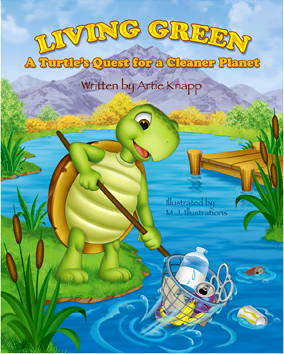
Artie Knapp’s new children’s book, Living Green: A Turtle’s Quest for a Cleaner Planet,’ is available!  Tired of seeing the land he loves cluttered with trash, Thurman the turtle decides it’s time to take action.  He’s a very environmentally conscious turtle who simply won’t take no for an answer.

Here’s a recent radio interview Artie Knapp did on a show called ‘The American Perspective:’


Get the book at Amazon

Get the book at Barnes & Noble


A delightful story that uses whimsical animal characters and engaging art to show younger readers that everyone can make a difference, no matter how small!

Sharon Martin, Newspapers in Education Manager, the Detroit Free Press

A determined turtle named Thurman shows us all that following your heart and doing what you believe in, no matter what others say, can make a difference. This story, like many of Artie Knapp’s other tales, is sure to entertain, educate and inspire our youth!

Kristin Garrison, Newspapers in Education Manager, the Cincinnati Enquirer

Kids are great ambassadors for the environment and Living Green makes the issue of human impact on the planet even more real through a brave, animal hero, Thurman, who literally risks his neck for earth.

Brandie Weikle, Editor of the Toronto Star’s parenting website, ParentCentral.ca

There’s even a special web site for Thurman the turtle.

Living Green: A Turtle’s Quest For a Cleaner Planet

Artie Knapp’s new children’s book, Living Green: A Turtle’s Quest for a Cleaner Planet,’ is out today!  Tired of seeing the land he loves cluttered with trash, Thurman the turtle decides it’s time to take action.  He’s a very environmentally conscious turtle who simply won’t take no for an answer.

We feature many of Knapp’s children’s stories here and this one is a nice big bright addition to his list of wonderful and charming stories that teach a few simple lessons.  This book is 36 fully illustrated pages and is aimed at readers 5 to 10 years old.  The illustrations are by M.J. Illustrations and the publisher is Mightybook, Inc.


Get the book at Amazon

Get the book at Barnes & Noble


A delightful story that uses whimsical animal characters and engaging art to show younger readers that everyone can make a difference, no matter how small!

Sharon Martin, Newspapers in Education Manager, the Detroit Free Press

A determined turtle named Thurman shows us all that following your heart and doing what you believe in, no matter what others say, can make a difference. This story, like many of Artie Knapp’s other tales, is sure to entertain, educate and inspire our youth!

Kristin Garrison, Newspapers in Education Manager, the Cincinnati Enquirer

Kids are great ambassadors for the environment and Living Green makes the issue of human impact on the planet even more real through a brave, animal hero, Thurman, who literally risks his neck for earth.

Brandie Weikle, Editor of the Toronto Star’s parenting website, ParentCentral.ca

There’s even a special web site for Thurman the turtle.

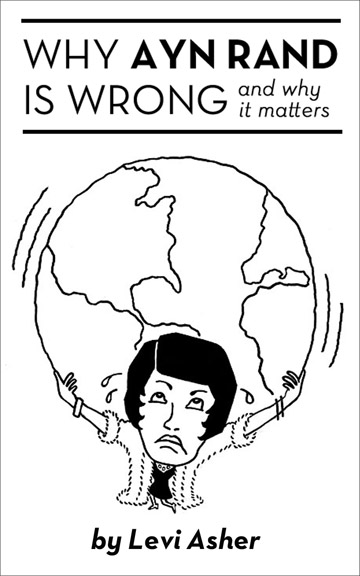
Why Ayn Rand is Wrong (and Why It Matters): Kindle Book by Levi Asher

Levi Asher, the writer behind the long-running Literary Kicks site, has decided to move into the world of Kindle ebook publishing.  He’s starting the series off with a philosophical essay on the Objectivism of Ayn Rand.  Why Ayn Rand is Wrong (and Why It Matters) expands upon several posts Asher has made recently in his ongoing Philosophy Weekend discussions.  The focus on philosophy and its requirements for logical thinking and argument is especially needed right now in a political and ideological world of harsh opinion and attack masquerading as argument.  I often do this kind of attack-dog arguing myself.  It’s fun and it clears the sinuses effectively.  But it does not really serve much purpose.  Rational philosophical debate does serve a purpose and tends to foster respect between opposing parties.

Ayn Rand, for me, is simply the author of a very readable but rather simplistic novel, The Fountainhead.  I tried to read Atlas Shrugged, but gave up after two hundred pages, finding it so belabored and filled with lunkheaded ideas that I simply couldn’t put up with another speech from one of its cutout characters.   However, Rand also has a body of philosophical writing that seems to have been very influential and is having some kind of a resurgence lately among mostly conservative-minded people.

I have always thought that Rand was basically reacting violently to the mass-mindedness she saw everywhere in the first half of the twentieth century.  That mass-mind quality led millions to death via the trenches of World War I or the concentrations camps and genocide of Hitler and Stalin.  In the face of such horror, I think I too would have found solace in elevating the individual above all else.

I have purchased my copy of the Kindle book but I have not read it yet.  When I do finish the book and if I feel competent to do so I will try to write a little review.  But since I know Levi Asher’s writing very well from his fascinating blog I can certainly recommend that you head over to Amazon and buy a copy of a book that is for thinking.

Get Why Ayn Rand is Wrong (and Why It Matters) on Amazon

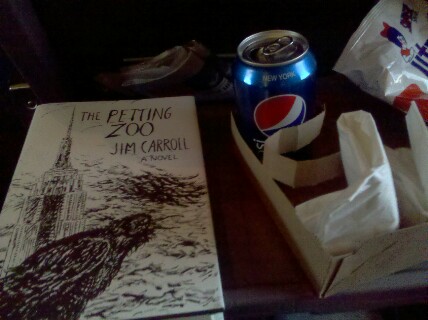
The Petting Zoo by Jim Carroll

image

Oh boy have I found a great book!  Poet Jim Carroll was finishing this thing up when he passed away in 2009.  I have only read 73 pages so far but I recognize this as one of the greatest novels I have ever read.  A New York painter reacts strongly to some paintings by Velazquez, stumbles into Central Park and winds up in the looney bin where he finds some time to think straight.  Simple and magnificent.  What a damn great writer!  I think this will actually be the first novel I write a review of.  Now back to reading.

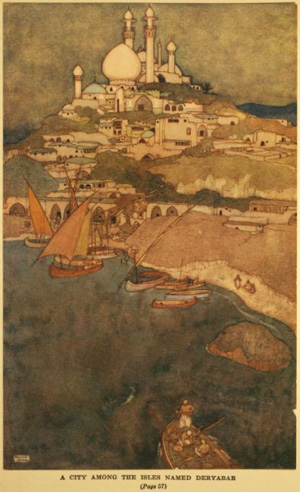
Online Book Scan of Stories From the Arabian Nights

The Internet Archive has a beautiful scan of Stories From the Arabian Nights, by Laurence Housman with illustrations by Edmund Dulac.

It contains the following stories:

Ali Baba and the Forty Thieves
The Story of the Wicked Half Brothers
The Story of the Princess of Deryabar
The Story of the Magic Horse
The Fisherman and the Genie
The Story of the King of the Ebony Isles
The History of Badoura, Princess of China, and of Camaralzaman, the Island Prince
The Seven Voyages of Sinbad the Sailor
Aladdin and the Wonderful Lamp

Read Stories From the Arabian Nights

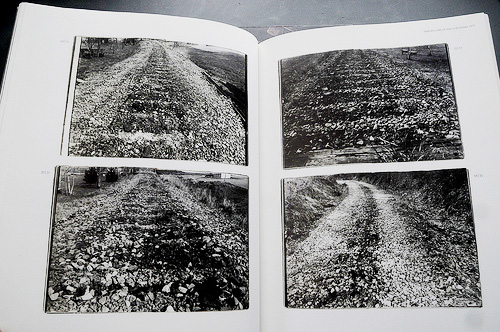
The Books of Anselm Kiefer

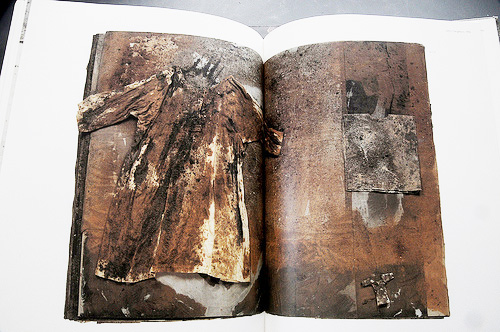
The Art of Memory, a blog that specializes in minimal film, music, literature, poetry and art, has posted a series of images from a rare book called The Books of Anselm Kiefer, 1969-1990Kiefer has worked on books since the sixties and incorporates many different materials in them, including photography, painting, sand, straw, cloth, and metal.  The books are one of a kind artworks and are seldom seen.

There is always something fascinating about a book made by the hand of an artist.  The problem with seeing books in museums is always the same though: you can only see two pages of any given book.  But since most people have no experience with turning a book’s pages, you simply would not want to trust patrons with this responsibility.

One of Kiefer’s main instincts has always been to try to look directly at the horrific history of Germany in the twentieth century.  These book pages contain some of his attempts to do so.

Picture Book by Terry Bisson and Rudy Rucker

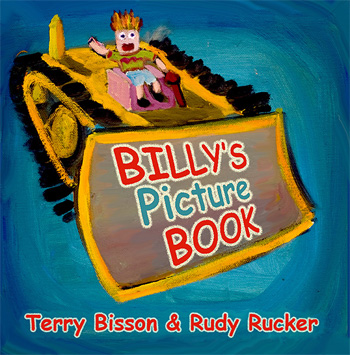
Billy’s Picture Book by Terry Bisson, a collection of jarringly twisted short stories for adult children, has a set of illustrations by Rudy Rucker.  The stories follow one precocious Billy through the harrowing and sickening ordeal of being a kid.  If your kid has a mind that is easily warped or disturbed or if your kid is just plain crazy, don’t read these stories to them!  But if your kid has a casual interest in murder and mayhem, well this might be just the book for the little monster.

The book is available as a free e-book and as a paperback for purchase.

Do Books Work as Memory Theater?

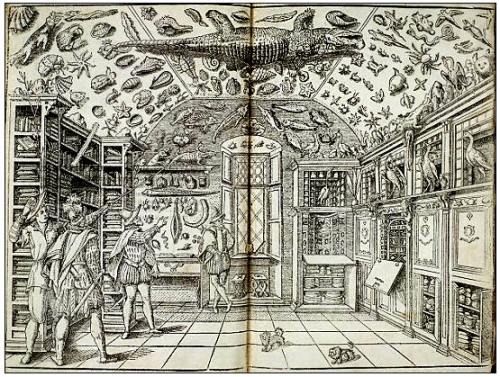
Open Letters Monthly has an article called In Defense of the Memory Theater, by Nathan Schneider in which he argues that books on shelves perform the function of reflecting memories back at us.  They are a constant reminder of the various events, stages, and emotional states of our lives.  We look at our shelves and can instantly catapult ourselves back in time to events surrounding our reading of various volumes.

Schneider mentions a 16th-century memory theater that used images and symbols of the cosmos to inspire observers and enhance their intellectual powers.  Books, for Schneider, do something similar when they are visible on our shelves.  I agree up to a point.  I am often taken back in time by my own books upon their shelves.  But so am I transported by nearly every object in my home.  Objects all have this power.  Books are not exceptional in this regard.

Continue reading