Short Experimental Western Film: The Magical Dead Sunstroke Valley

Sunstroke-Valley-Final-2

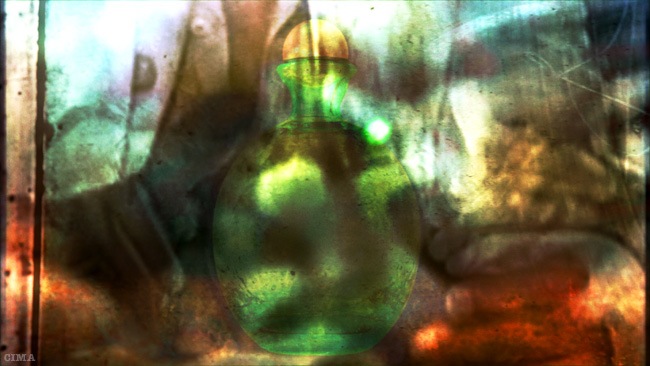
A film combining the mythology of the Hollywood/Spaghetti western, Tarot, magic, occult, Jungian psychology, and mysticism with flamboyant, multi-layered, supersaturated imagery.

Multiple narratives conflict and adhere. Meanings emerge and contradict. Music and dialog tell another layered story, sometimes agreeing with the images, sometimes trying to subvert them.

A film should be a container for the psychic unconscious energy of its creator. That is what this is.

There is also a commercial.

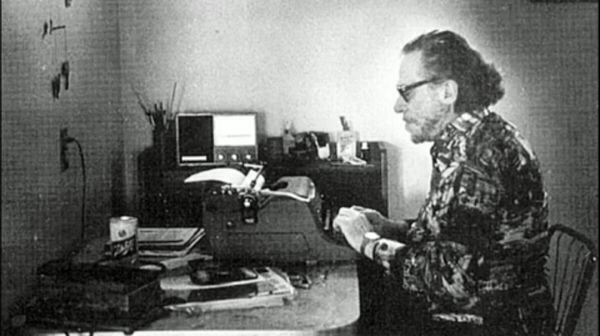
The Charles Bukowski Tapes by Barbet Schroeder

Bukowski

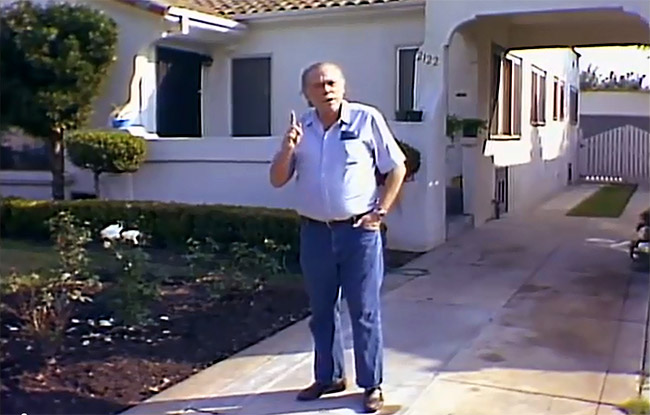
During the lengthy production of the film ‘Barfly,’ director Barbet Schroeder conducted a series of short interviews with the poet Charles Bukowski. This is the complete set of those interviews and comes in at nearly four hours. Observe Bukowski and see what you think of his style. He was an incredibly sensitive soul trying to be a boxer. He was also one of those people who when they speak you just can’t wait to hear what they might say next. A real page-turner of a person.

If you want to read a fascinating book about the time of making Barfly, read Bukowski’s novel, ‘Hollywood.’ He changes the names of all the people involved, but you can easily figure out who they are. It is the best book about making a movie I have ever read in my entire life – without exception.

The Rime of the Ancient Mariner: Orson Welles Narrates 1977 Film by Lawrence Jordan

Rime1

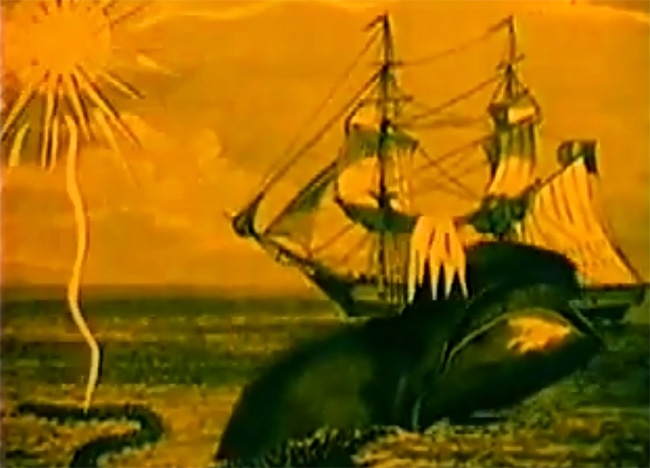
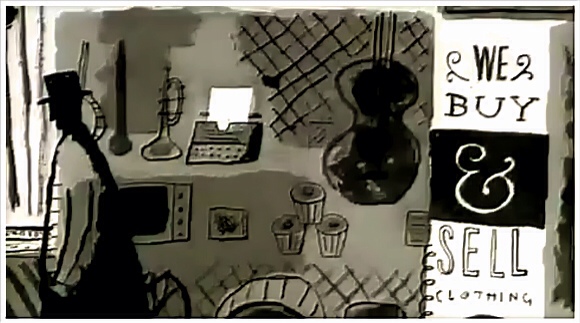
Filmmaker Lawrence Jordan calls this 'a long opium dream of the old Mariner' that marries the engravings of Gustave Dore to the poem by Samuel Taylor Coleridge. Jordan adds many of his own cutout elements to the animation, creating something totally unique. Orson Welles' performance of the poem is unforgettable, simultaneously delicate and powerful as he fully embodies the role of the old Mariner with a story to tell. There is enough mystery and otherworldliness from Jordan's hands to pair magnificently with one of the saddest and most beautiful poems ever written in English.

The film is dedicated to the great assemblage artist and filmmaker Wallace Berman who was a close friend of Jordan.


Trauma: A Video Poem Triptych by Swoon

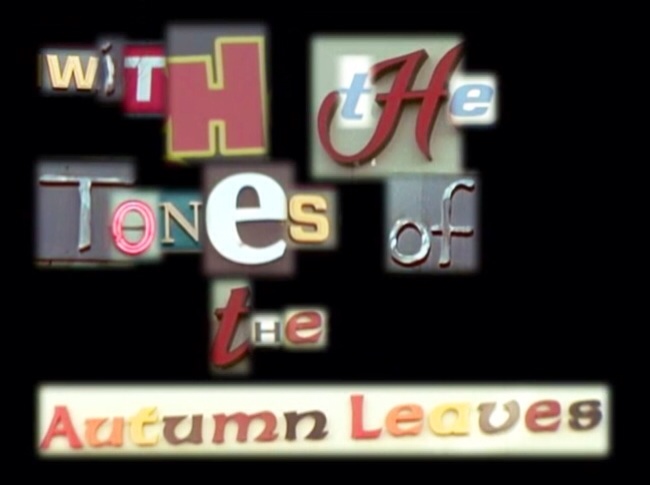
Swoon is a Belgian poet filmmaker who makes films that try to blur the boundary between written poem and moving image. He mixes his own footage with found footage and sometimes mixes his own words with others. I like the quiet easy tone of his work. I like his manipulation of imagery. His work is a very difficult kind of work because it tries to make something new from two different things. Poetry is a perfect form all by itself. But film is never satisfied. It’s always looking for something to include within it. So it’s natural for film to go looking for poetry and try to bring it in. But poetry resists all alliances. Poetry seems content and willing to wait for centuries. It requires nothing. It doesn’t care what film wants. It will sit on a dry page in some crowded shelf somewhere waiting six hundred years for just a single pair of eyes to come along in boredom, open to the page, glance in, read half-way down and then slap the book shut for another six hundred years until someone decides to finish reading the goddamn thing. That’s patience. Film doesn’t have that. Film must be seen now or it withers. It begins to rot. Even if it’s digital. Digital films become confused and get lost in the forest of other digits. They may never find their way out again. So working with the two things and trying to get them together is very difficult but may actually make perfect sense.

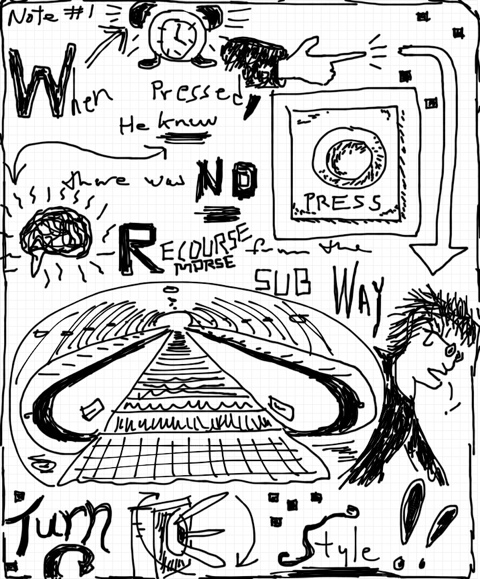
This is a film poem triptych that is Swoon’s first work to include his own words. There’s a site for the film with more information.

Jean Cocteau – Lies and Truths: 1996 French Documentary


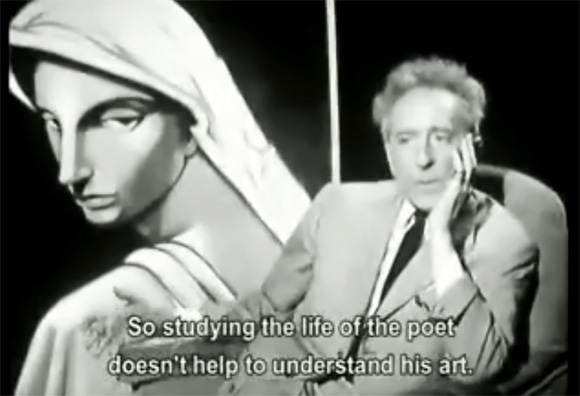
This is a 1996 documentary by Noël Simsolo, featuring many interviews with Jean Cocteau himself, Jean-Luc Godard and actor Jean Marais. The great French director of films like ‘Blood of a Poet,’ ‘Orpheus,’ and ‘Beauty and the Beast,’ was also an essayist, poet, artist, and playwright. When I was a kid I read the book he wrote about filming ‘Beauty and the Beast.’ I understood little of it except that there was the general impression of someone working against constant hardship to attain a mysterious something. The book detailed his struggles with the subtleties of light, weather and performance in the pursuit of a mysterious quality that must be present in the fairytale. I knew that his efforts had worked because I had seen the film on television and understood that it was simply the most convincing fairytale I had ever seen. Another film with this totally mysterious quality is ‘Orpheus,’ which is Cocteau’s modern version of the Greek myth in which the great musician/poet descends into the underworld to bring his wife back to the world of the living. Cocteau’s telling of the tale is at once ancient and modern, always mysterious and always trying to get close to poetry. Whenever I see that film I feel that I am seeing an important picture of French artistic life in the late 1940s told through the prism of ancient Greek myth. The film sits in that fascinating period of artistic ferment and dawning of a new cinematic movement that was a reaction to the end of World War II. Possibilities in films of that period seem limitless. There is a calmness of the image, an almost casual approach to creating scenes. Things are becoming more fluid and less studio-bound. Films are beginning to lean toward poetry and art.

Even though I never really understood what was being said in the ‘Orpheus’ film, it is probably one of the most important influences on the little bits of work that I do in film and video. Various images and scenes from ‘Orpheus’ regularly pop into my head as I work.

One of the best things I think an artist can learn from looking at Jean Cocteau is to follow one’s own interests without worrying about being unqualified – pretending can eventually get you where you want to go if you do it absolutely.

Continue reading

For the Beats Killing Women Was Not a Problem


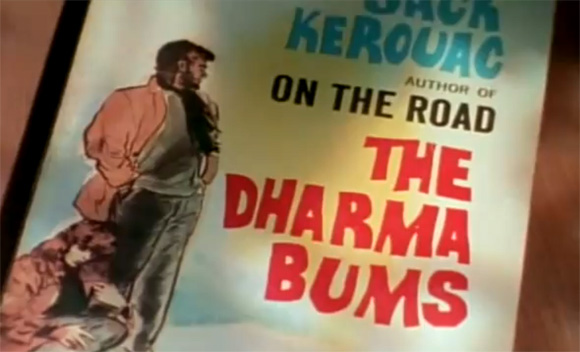
I have very mixed feelings about the core group of writers known as ‘The Beats.’ They were Jack Kerouac, William S. Burroughs, and Allen Ginsberg. Kerouac’s ‘On the Road’ is one of the milestones (or millstones, depending on point of view) of American literature. Ginsberg’s ‘Howl’ is one of the great twentieth century poems, and Burroughs wrote the distorted fever dream of homo-erotica known as ‘Naked Lunch.’ There’s lots of intensity in Beat literature and poetry. There’s a willingness to seek out the world and experience. There’s a seeming openness of mind. But every time I delve into the Beats and their work, I become listless, bored, irritable and worried. I find the general direction of their writing to be toward a distinct and virulent hatred of women. The glassy-eyed hero worship of these writers seems odd to me. Wouldn’t it be better to try rejecting their premises? Why do they still have such a hold over the popular imagination? Why hasn’t poetry been able to dispense with these people yet?

What I like about this documentary is that it does in fact touch upon this subject. What I don’t like about it is Johnny Depp prancing around with an unsmoked cigarette trying to convince us of his Beat/hipster/baggy jacket coolness.

The Beat hatred of all things female manifests itself most obviously in the fact that Burroughs stood his wife, Joan Vollmer, up against a wall in Mexico and blew her brains out with a gun. There’s great mystery surrounding his escape from the authorities in Mexico who quite naturally wanted to investigate and prosecute the man for murder. I would have prosecuted him too. He told various stories about playing a game of ‘William Tell,’ or inebriation or drug use to explain how it happened. But in order to fire a bullet through his wife’s forehead he had to lift the gun and point it at her. It sort of goes without saying. Would you be able to point a gun at your spouse? Hopefully not. I wouldn’t be able to even lift a gun in my wife’s general direction. So why was a man who blasted his wife’s head open welcomed back into his little group of Beat friends? Why would such a man become the life of the party in literary circles? Why would such a man love guns and fire them at tin cans in his backyard for the rest of his life? Good questions. Easily answered. Nobody gave a shit about the man’s dead, blown-open wife. She was just a lady in Mexico married to a bisexual genius. That’s the problem with the Beats. That’s the rock bottom attitude of the most important literary movement in America during the twentieth century.

Here’s what Burroughs had to say about killing his wife:

I am forced to the appalling conclusion that I would never have become a writer but for Joan’s death, and to a realization of the extent to which this event has motivated and formulated my writing. I live with the constant threat of possession, and a constant need to escape from possession, from control. So the death of Joan brought me in contact with the invader, the Ugly Spirit, and maneuvered me into a life long struggle, in which I have had no choice except to write my way out.

Let me translate that for you: “I killed my wife and was so inspired by the act of killing a female that I became a great writer. And I want to kill again. I have to constantly struggle with the urge. My writing helps with that.”

Get the idea? Murder inspires good writing… according to one-third of the Beat literary movement. The other two-thirds were just fine with that.

You may think I’ve gone too far or have some literary ax to grind. But I would suggest that reading the Beats without keeping these ideas in mind is self-deception. It’s all right there on the page if you actually read the stuff. These guys weren’t gentle spirits with open hearts and minds. They were brutal little elitists from Columbia University who were willing to kill and dump dead bodies into rivers in order to protect their group. Kerouac helped a friend dispose of a murder weapon, then took the murderer out to a movie. That murder, which was in fact the brutal slaughter of a gay man who was making advances, led to inspiration for Kerouac, Burroughs and Ginsberg who all attempted and partially succeeded at novels based on the incident.  Again, murder inspires Beat writings. If one really wants to get down in it, one would go so far as to say that the prime mover behind the Beat movement – its basic inspiration – was a gay-bashing murder in Riverside Park. People may say whatever they like about writers trying to work out the demons, but I see something much darker than that.

Kerouac later based the main character of ‘On the Road’ on Neal Cassady, a man who appears on film to be a psychopath. I’d be looking for dead bodies buried under any house that guy ever lived in.

I think the Beat movement should be done over for the twenty-first century. This time, try not to blast anyone’s brains out across a wall.

Continue reading

The Mad Ones: A Brief History of the Beat Generation

Krystal Cannon (PersonTV) made this short documentary about the Beat Generation in which she not only narrates as Queen Elizabeth, but also plays various roles including Allen Ginsberg, Joan Vollmer, Bob Dylan, Jack Kerouac, John Lennon, Edie Sedgwick and Abbie Hoffman. She gives a clear account of the Beat movement then moves into the general social reaction. She also makes some very interesting points about how women were sidelined even though many of them made great contributions to Beat culture. I think that what the Beats were working on is in very fine hands indeed with Ms. Cannon at work.

Thanks to Marc Campbell at Dangerous Minds.

Edgar Allan Poe’s ‘The Raven’ Illustrated by Paul Gustave Doré

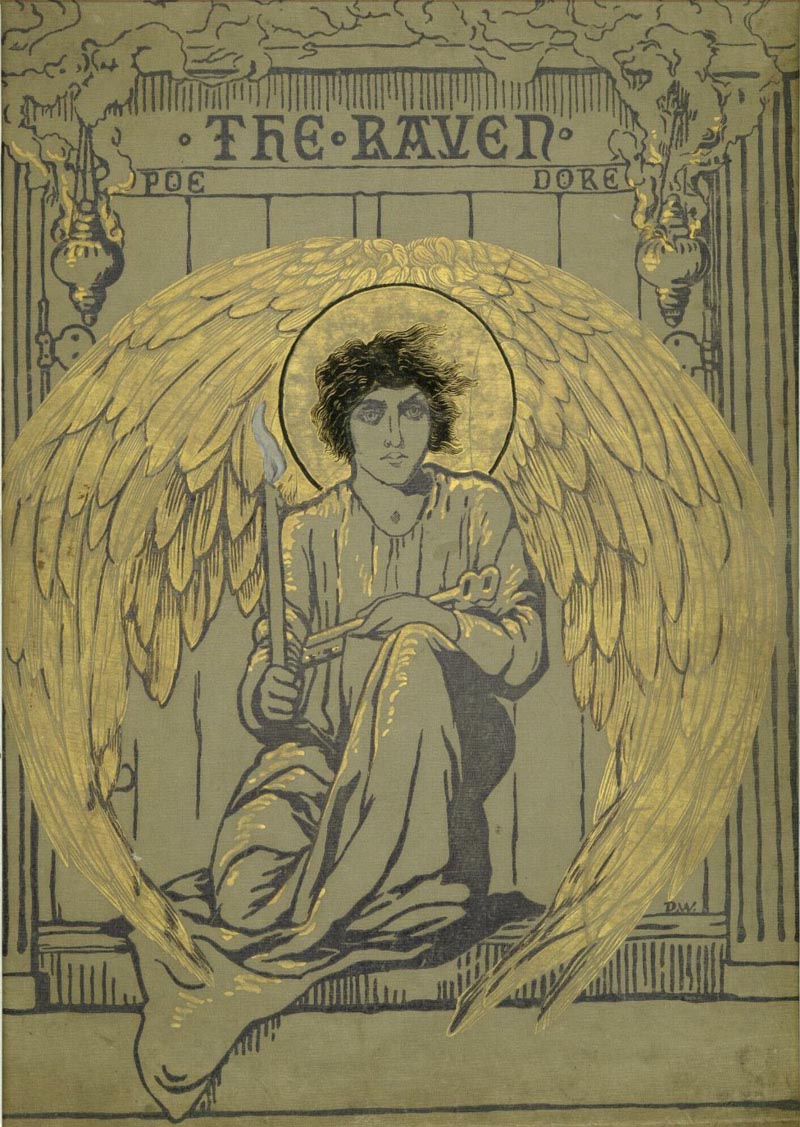
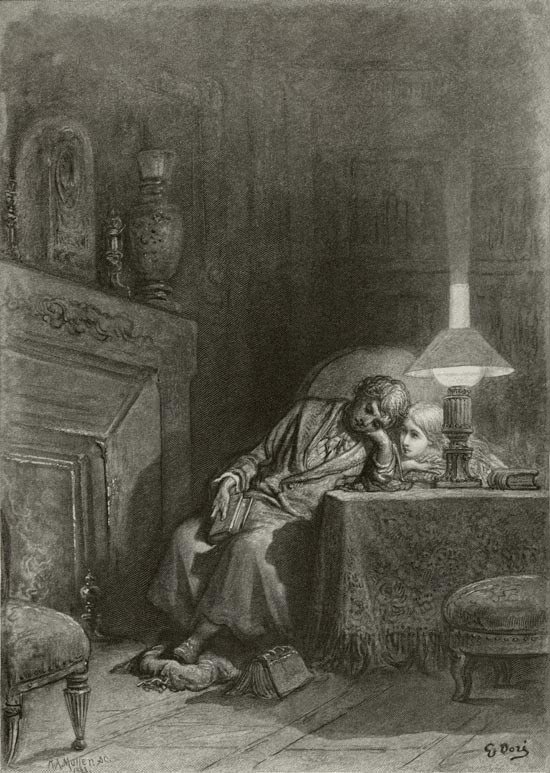
This incredibly beautiful edition of Edgar Allan Poe’s ‘The Raven’ was published in 1884 with illustrations by Paul Gustave Doré. Click on the images to see full sizes.

Once upon a midnight dreary, while I pondered, weak and weary,
Over many a quaint and curious volume of forgotten lore–
While I nodded, nearly napping, suddenly there came a tapping,
As of some one gently rapping, rapping at my chamber door.
“‘Tis some visiter,” I muttered, “tapping at my chamber door–
Only this and nothing more.”

Continue reading

Ferry Poetry: A Short Film by Anna Bing

Actually Anna Bing is two people – Anna and Bing – who form a video production company called Video Mutants in the Netherlands.  This piece is based on a poem by Ibrahim Selman.  I don’t understand the language but the sounds of the poem as read by the narrator are just beautiful.  I could listen all day.  Check out how the film is a cheerful nod to Bob Dylan’s particular poetry film technique.  I love watching the crowds move back and forth.  They look like happy people.

The Religions of the World Are the Ejaculations of a Few Imaginative Men

You may recognize the source of the quotation that serves as title to this post.  It’s Ralph Waldo Emerson writing in his 1844 essay, ‘The Poet.’ Emerson is the intellectual bedrock of America.  He is a founding father of thought.  He embodies the true spirit of America and represents her coming of age.  Certainly, there were smart people before him.  But something in his character and thinking best express the searching confidence of the American intellect that flourished between the Revolution and the Civil War.  If you are a bit lost, a bit depressed, creatively mired, at sea, confused by the cascade of information delivery, then just go pick up a book of Emerson’s essays.  You will become calm.  You will wonder why he gets such a sudden grip on you.  You will read and re-read nearly each and every single sentence.  You will then ignite.  Your depression, your stasis will be ended.  You will be leaping ahead of yourself to learn something new – to make something – to observe something.  Do not doubt me.  I know whereof I speak.  Emerson is the most modern and most quintessentially American mind in the history of this country.  He is also one of the greatest and most productive philosopher poets to have ever lived.  Henry David Thoreau and Walt Whitman, two of this country’s greatest writers, were friends of his.  In fact, the three men are essentially responsible for the entire construction of the American mind.  Their basic contribution, as I see it, was to modify the puritanical sense of religion that was rampant in this country and inject it with something based on Eastern thought.  The mode of thinking which most closely resembles Emerson’s is Buddhism.

Here’s a fascinating line of thought from Emerson’s ‘The Poet’ essay:

The poet knows that he speaks adequately then only when he speaks somewhat wildly, or “with the flower of the mind”; not with the intellect used as an organ, but with the intellect released from all service and suffered to take its direction from its celestial life; or as the ancients were wont to express themselves, not with the intellect alone but with the intellect inebriated by nectar.

Most poets and musicians actually misinterpret that part to mean that they should experiment with drugs as mind-openers.  Everyone from Jack Kerouac to Bob Dylan to Keith Richards has apparently made this rather simple-minded misreading of Emerson.  Or perhaps they didn’t read him at all.  I suspect they could have saved themselves an enormous amount of distraction and a few suspect singles if they’d simply finished reading this magnificent essay.

He goes on:

This is the reason why bards love wine, mead, narcotics, coffee, tea, opium, the fumes of sandalwood and tobacco, or whatever other procurers of animal exhilaration. All men avail themselves of such means as they can, to add this extraordinary power to their normal powers…

But it’s a false road.  He continues…

Hence a great number of such as were professionally expressers of Beauty, as painters, poets, musicians and actors, have been more than others wont to lead a life of pleasure and indulgence; all but the few who received the true nectar; and, as it was a spurious mode of attaining freedom, as it was an emancipation not into the heavens but into the freedom of baser places, they were punished for that advantage they won, by a dissipation and deterioration.

If writing today, Mr. Emerson might well add Internet information overload to his list of baser and false nectars.

Milton says that the lyric poet may drink wine and live generously, but the epic poet, he who shall sing of the gods and their descent unto men, must drink water out of a wooden bowl.

If thou fill thy brain with Boston and New York, with fashion and covetousness, and wilt stimulate thy jaded senses with wine and French coffee, thou shalt find no radiance of wisdom in the lonely waste of the pine woods.

One must keep it simple.  Emerson defines the poet as someone who can free us from thoughts that bind us.  We can, like the man who freezes in a snowstorm just a few steps from his door, be locked forever in a single thought that lies just next door to the thought that could completely free us.  A single liberating thought can be inches away but forever locked out of view.  The poet can, by breathing his or her truths into our ear, unlock our thoughts and free us in a split second.  A flash.  We don’t even need to understand what it is that the poet is saying.

The poets are thus liberating gods.

I like that.  It just sounds awesome.

And here is an excellent documentary film about Ralph Waldo Emerson. Watch it.