Today, for the first time since the retirement of the Space Shuttle program in 2011, US astronauts launch into space on a SpaceX Falcon rocket. Watch the live NASA TV feed.
Category Archives: Space Travel
Cosmic Voyage: 1936 Soviet Science Fiction Film About a Moon Landing
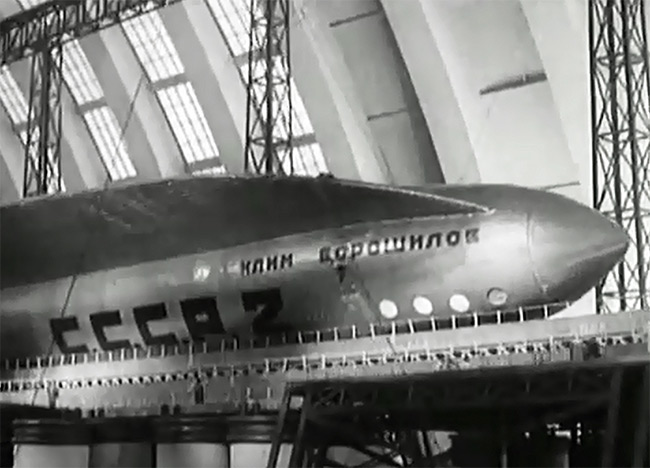
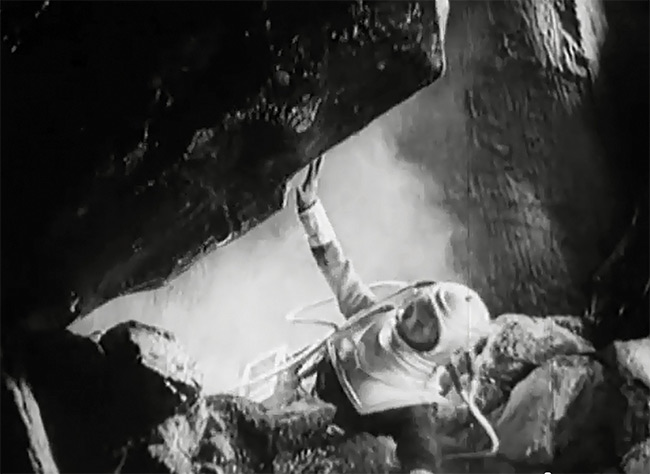
This is an absolutely fascinating and rather beautiful 1936 Soviet science fiction film that foretold how a future 1946 moon mission would work. It’s got incredible zero gravity effects, miniature models of a fantastic space ship on a launch ramp, and very cool technical details like filling the cockpit with fluid to buffer the cosmonauts from launch forces. Then there’s a marvelous sequence on the surface of the moon with excellent stop motion animation inter-cut with live actors. Apparently, the Soviet censors banned the film after a short but successful first run because they felt the cosmonauts were having too much fun on the moon. They were right. These characters go hopping and bounding about with so much joy it’s almost an embarrassment. Citizens of the Soviet Union were not supposed to be happy.
Don’t worry about understanding Russian. The film was shot as a silent and is more or less a completely visual experience.
It was directed by Vasili Zhuravlov, but what’s really most interesting about the production history is that Constantin Tsiolkovski, a Soviet scientist and professor, became enthusiastic about putting some of his theories on space travel into a film. He consulted with the filmmakers in an attempt to lend verisimilitude to the moon voyage. Many years later, Werner von Braun credited Tsiolkovski’s calculations as having been correct.
So here is a old Soviet film that went to great lengths to get many of its details right.
Here is an interesting article about the film.
Soviet Space Propaganda Posters
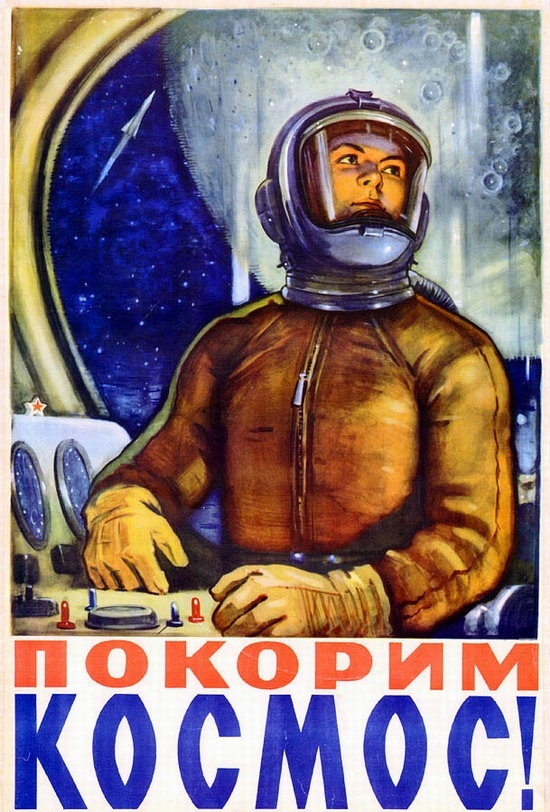
Retronaut has a stunning collection of Soviet era space propaganda posters. NASA could use a little dose of this astro-enthusiasm as it sits on its lethargic butt, totally incapable of lifting a single human being into orbit.
The Astronomer: A Film by Phil Garrett
The Moon: 1965 Soviet Film by Pavel Klushantsev
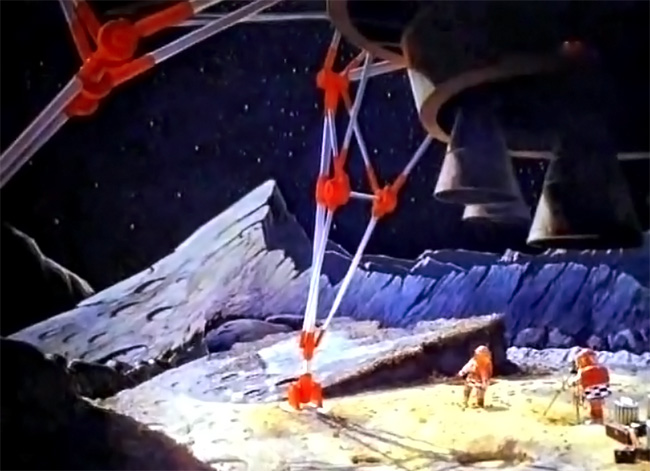
In 1965 Pavel Klushantsev made this Soviet film about how a voyage to the moon might happen. I’ve seen and posted other footage from this great science fiction director, but this is interesting because its color has been restored to saturated magnificence. Don’t worry that you can’t understand the Russian language. Just watch and enjoy the 60s communist enthusiasm! You will be treated to astronauts cavorting on the lunar surface while wearing space suits that look to me like nearly perfect adaptations from popular speculative illustrations of the time. The technical detail of this film is really quite amazing. NASA might want to refer to it while trying to re-acquire its lost Apollo knowledge.
It is apparent that Kubrick had his eye on this director’s work as he prepared to make 2001: A Space Odyssey. If you know that film, you will catch the shots I’m talking about.
Further Up Yonder: Timelapse Shot From Space Station

A Happy New Year timelapse video shot by astronauts aboard the International Space Station. It was made by Giacomo Sardelli who downloaded NASA images which he then edited into a timelapse film of extraordinary beauty.
The Live Streaming Supersonic Freefall From Space
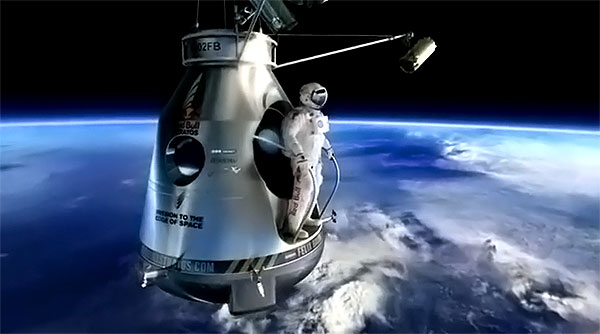
Red Bull is a drink company that I always associate with a general low-brow, trailer trash sort of existence. Chances are if you are drinking Red Bull you are an abject fool in a tank top. Maybe you’ve got a tattoo right at the top part of your ass. You’re just a lumbering primate who thinks they need some extra energy. Okay? Deal with it.
But this former Air Force parachutist is preparing to jump out of a balloon capsule from 23 miles up wearing a pressurized suit that will allow him to survive a supersonic fall from the edge of space. That’s pretty interesting because you just have to wonder if he will make it in one piece. Can a person re-enter earth’s atmosphere from space? I’m sure one can. I enjoy this little advertising film for the live stream of the jump. Hopefully, the stream will actually show us something in the next few days since inclement weather has so far delayed the jumper, Felix Baumgartner.
The live stream of the Stratos jump will be here.
http://www.youtube.com/watch?feature=player_embedded&v=zDxLl-qDy1A#!
SpaceX Dragon Capsule Docks with International Space Station
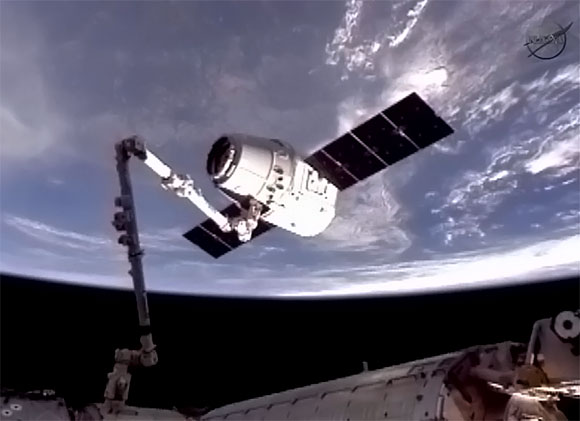
The Dragon capsule from SpaceX has become the first privately operated spaceship to dock with the International Space Station. Early this morning astronauts aboard the ISS used the station’s robotic grappling arm to snag the capsule after its successful close approach. The arm then pulled the capsule in to berth with station’s Harmony module. This is another incredible achievement in space and should begin a new era of private space travel and support for the ISS.
You can watch video of the robotic arm capture.
Ikarie XB-1: 1963 Czechoslovak Science Fiction Film of a Stanislaw Lem Novel
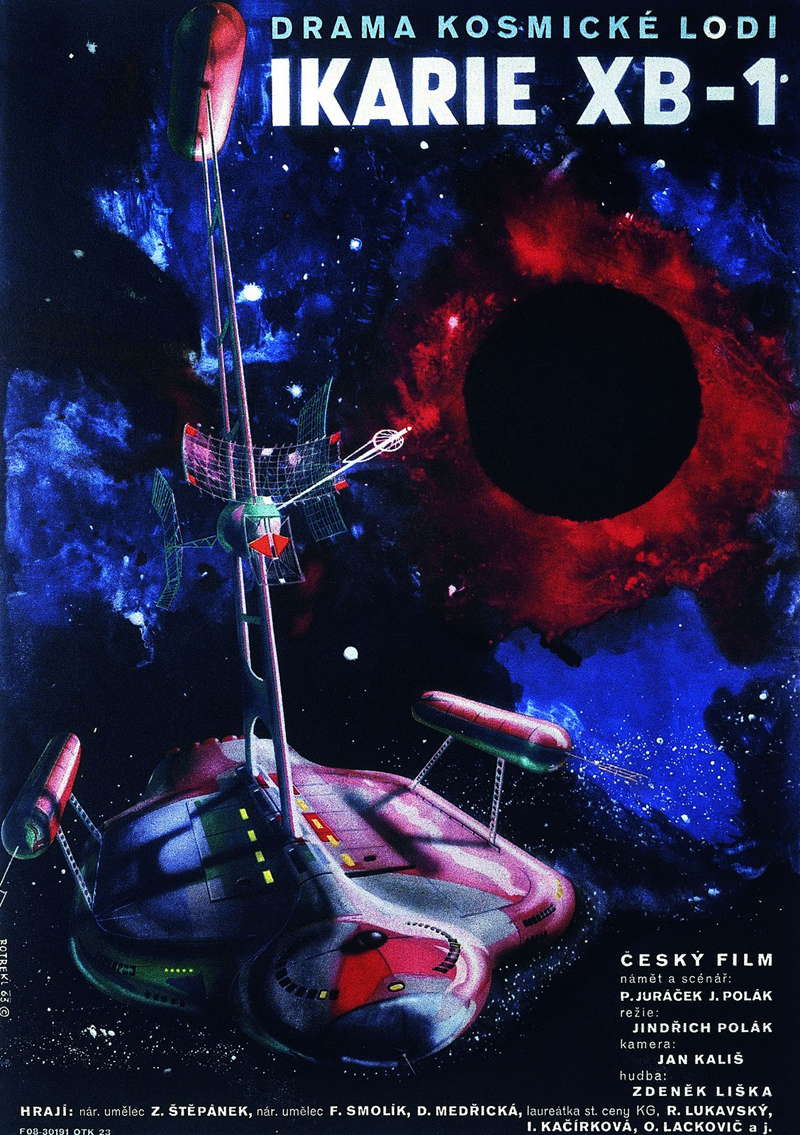 This 1963 Czechoslovak science fiction film directed by Jindrich Polák is an adaptation of a Stanislaw Lem novel called ‘The Magellanic Cloud.’ Reflexively, one tries to find similarities between this film and Kubrick’s ‘2001: A Space Odyssey.’ But I think the better place to look for influence is in Andrei Tarkovsky’s 1972 film, ‘Solaris,’ which was also a Lem adaptation. ‘Ikarie XB-1‘ follows the crew of a ship sent to investigate a planet orbiting Earth’s nearest star, Alpha Centauri. On the way, they encounter a derelict space ship from 1987 Earth which appears to originate from the United States and carries a load of deadly poison and nuclear weapons. Crew members begin to inexplicably fall asleep. The ship also finds a giant dark star that emits an unknown type of radiation from which the humans are mysteriously rescued. The end of the film is a stunning sequence of mental breakdown leading to fantastic and life-affirming discovery.
But the various events do not matter as much as the way the film dwells on the people within their technological surroundings. It’s the focus on the mental status of the crew as opposed to exciting episodes that makes for the strength of this film and its influence on ‘Solaris.’ The film has a calm and quiet approach, simply trying to let us feel the vast distances traveled by the crew. The sets and visual effects hover between beautiful and unconvincing. But they work and are often effective. It’s really a pretentious art film in space. If you like Eastern Bloc science fiction and Stanislaw Lem’s peculiar writing, this is a must see.
NASA Captures Images of Apollo Astronaut Moon Tracks
NASA’s Lunar Reconnaissance Orbiter has captured images of astronaut tracks, lunar landers, and left behind equipment from the Apollo 12, 14 and 17 moon missions. These are the sharpest images ever taken of the moon and should give fake moon landing conspiracy nuts a whole new bag of clues to play with. We can’t rebuild what we once understood and get ourselves back to the moon, but we can take pictures of our past glory.
Space Travel According to John: Hilarious Soap Powder Animation
Jamie Stone and Anders Jendenfors made this brilliant ‘washing powder’ animation about a kid named John who has lots of thoughts about Mars and man’s destiny in space. Beautiful and just hilarious.
NASA Begins its End
The final landing of a NASA space shuttle yesterday, though hailed as the final act of a great technical achievement over the past 30 years, actually represents a complete failure on the part of the United States to build upon the work of scientists and technicians from the 1960s and 70s. It should shock most of the world that the leading superpower, with the world’s most advanced space exploration systems, could not figure out a way to even build a second version of the space shuttle. I’ve never seen a product of technology that stays with version 1.0 for thirty years. There is no viable plan in existence for launching human beings off the earth by the United States. There’s a lot of vaporware and talk. There are models of crew capsules that will maybe one day launch people toward an asteroid or even to Mars. Maybe. None of it works. None of it even has a working toilet. There are no rockets being designed that could even launch the miraculous capsule into orbit. And that crew capsule? If you’ve seen it you then realize that NASA is simply building the Apollo system all over again with extra bunks for three more astronauts. But they can’t build the thing. It doesn’t exist.
There are no longer any means available to the United States for getting people to the International Space Station. There are no means available for getting any equipment up there. The U.S. must rely on rides hitched aboard Russian spacecraft for an indefinite period of time that many NASA experts are now saying could extend to 10 years.
Russia has a more advanced and reliable space exploration system than the United States.
In the mid 1990s I went to a boring Hollywood party and wandered around with a drink in my hand for about half an hour before running into an older couple sitting alone. They seemed uncomfortable and out of place. So I said hello and sat down next to them. The man turned out to be a retired engineer who worked on the design for the Lunar Landing Module during the Apollo years. I asked him why NASA had been unable to return to the moon. His answer was: ‘Because they can’t.’
He explained that NASA had been been decimated by enormous loss of technical knowledge due to retirement. He said that the agency had not properly stored its accumulation of knowledge. He said that if engineers wanted to build a rocket, command module and lander to get back to the moon, they would be completely unable to do so and would be forced to relearn almost everything that had been learned during Apollo. He then said that this would become very clear to the nation sometime within the next 15 to 20 years as existing technology wore out and could not be replaced. I told him that he seemed very depressed about it. He nodded and said the situation was much worse than he could explain. He said that technical notes from engineers hadn’t even been saved. The knowledge was just totally lost.
I think that guy was right. I don’t think NASA could build a new shuttle even if it tried.
NASA’s insistence on transferring launch responsibilities over to private space companies would perhaps make some sense if we had seen it being phased in alongside the existing shuttle technology. But to shut down our only means of space transport and hope for the best with future private launches is simply begging for disaster. How tested will this new private space launch technology be? Why would an astronaut climb into a rocket built by some company run by PayPal’s founder? It’s insane and stupid. What if the first private launch vehicle with astronauts explodes on liftoff? What happens then? Is there even a backup plan?
U.S. Effectively Abandons Human Space Flight
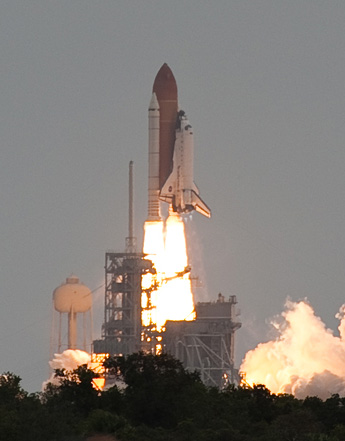 So the United States today launched its last space shuttle mission ever, leaving the task of supporting the International Space Station to Russia, a country ruled for all intents and purposes by a dictator.
NASA, along with its international partners, apparently thought it would be a good idea to build a space station and then retire its fleet of transport vehicles without any replacement in existence.
In about a week, after the final shuttle flight lands, the United States will no longer have the technical ability to put a single human being into earth orbit.
How’s that for leadership in technology and science? That’s your current president at work who was supposed to possess some magical form of science awareness.
Onward presses NASA with its plan to privatize space station supply launches… sometime… perhaps… in the next five years.
The shuttle was expensive to operate and sometimes dangerous, but it was a successful machine. No such thing exists now. Typically, when I’m ready to replace my automobile I go buy the new one first. Then I bring it home, park it in the driveway and think about how best to dispose of the old clunker. That’s how it works with me. I’m just sayin’…
Man in Space – 1955 Disney Documentary
Disney’s lavish history of rockets leading right up to a pre-Sputnik 1955!
Parts 2 – 8 after the jump