Les Mysteres Du Tarot De Marseille: French Tarot Documentary

TarotDocumentaryFrance

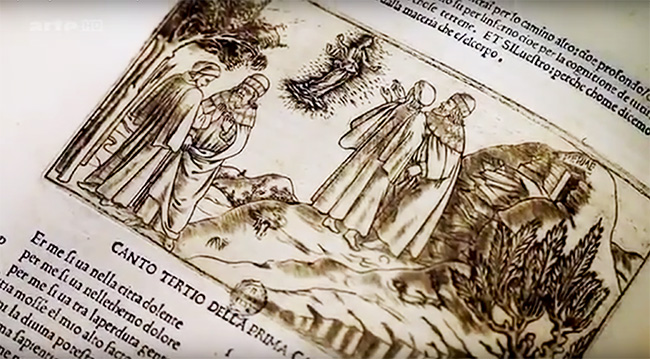
This is a fascinating French documentary exploring the artistic connection between the oldest deck of Tarot cards known as the Tarot de Marseille and 15th century art. The documentary travels to Italy where Tarot was born to follow various leads and look at examples of the oldest Tarot decks and Italian art.

The work of Sandro Botticelli features prominently, as does Plato’s philisophical cave allegory which deals with the nature of reality and whether what we see is just a rough projection of reality. The connections between this idea and the Tarot’s Devil card are fascinating.

The documentary is entirely in French without English subtitles, so you’ll probably need to speak French to enjoy this.

Celles Qui S’En Font: 1928 Short Film by Germaine Dulac

Germaine Dulac was one of the original French film ‘auteurs.’ She was also a film theorist and feminist. She had a relatively short career as an avant-garde filmmaker, making such works as ‘The Smiling Madam Beaudet (1923) and ‘The Seashell and the Clergyman’ (1928) which is often credited as being the first Surrealist film.

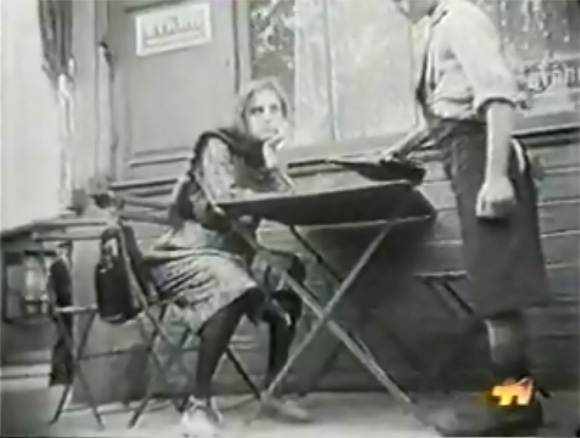
In this film, the title translated as ‘Those Who Make Themselves,’ we follow a destitute drunk woman who appears to yearn for the life of a prostitute or to engage in some sort of tryst. It is also possible that she is simply despondent over rejection by a lover. She appears to fail at everything she tries and eventually walks down a staircase into the Seine river. It’s a very simple film that manages to convey a deep sense of loneliness.

Dulac insisted on being credited as the author of her films, not accepting the standard partnership between a screenwriter and director.

Here’s a 1923 quote from Dulac:

I believe that cinematographic work must come out of a shock of sensibility, of a vision of one being who can only express himself in the cinema. The director must be a screenwriter or the screenwriter a director. Like all other arts, cinema comes from a sensible emotion … To be worth something and “bring” something, this emotion must come from one source only. The screenwriter that “feels” his idea must be able to stage it. From this, the technique follows.

Here’s a Senses of Cinema article on Germaine Dulac entitled ‘The Importance of Being a Film Author: Germaine Dulac and Female Authorship.’

Jean Cocteau – Lies and Truths: 1996 French Documentary


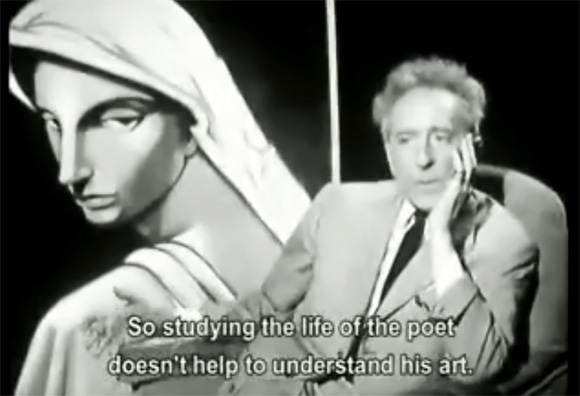
This is a 1996 documentary by Noël Simsolo, featuring many interviews with Jean Cocteau himself, Jean-Luc Godard and actor Jean Marais. The great French director of films like ‘Blood of a Poet,’ ‘Orpheus,’ and ‘Beauty and the Beast,’ was also an essayist, poet, artist, and playwright. When I was a kid I read the book he wrote about filming ‘Beauty and the Beast.’ I understood little of it except that there was the general impression of someone working against constant hardship to attain a mysterious something. The book detailed his struggles with the subtleties of light, weather and performance in the pursuit of a mysterious quality that must be present in the fairytale. I knew that his efforts had worked because I had seen the film on television and understood that it was simply the most convincing fairytale I had ever seen. Another film with this totally mysterious quality is ‘Orpheus,’ which is Cocteau’s modern version of the Greek myth in which the great musician/poet descends into the underworld to bring his wife back to the world of the living. Cocteau’s telling of the tale is at once ancient and modern, always mysterious and always trying to get close to poetry. Whenever I see that film I feel that I am seeing an important picture of French artistic life in the late 1940s told through the prism of ancient Greek myth. The film sits in that fascinating period of artistic ferment and dawning of a new cinematic movement that was a reaction to the end of World War II. Possibilities in films of that period seem limitless. There is a calmness of the image, an almost casual approach to creating scenes. Things are becoming more fluid and less studio-bound. Films are beginning to lean toward poetry and art.

Even though I never really understood what was being said in the ‘Orpheus’ film, it is probably one of the most important influences on the little bits of work that I do in film and video. Various images and scenes from ‘Orpheus’ regularly pop into my head as I work.

One of the best things I think an artist can learn from looking at Jean Cocteau is to follow one’s own interests without worrying about being unqualified – pretending can eventually get you where you want to go if you do it absolutely.

Continue reading

1964 Documentary on Spanish Surrealist Film Director Luis Buñuel


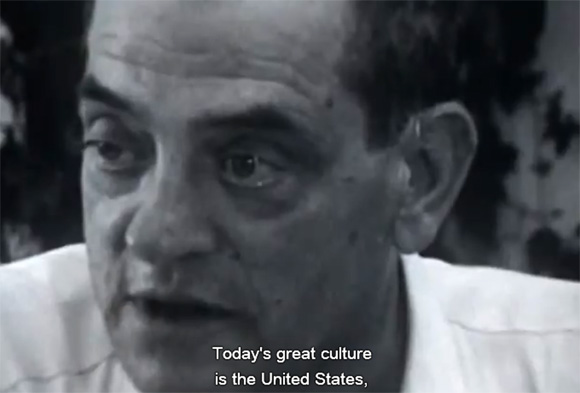
Luis Buñuel was the great Spanish film director who made ‘Un Chien Andalou’ and ‘L’Age d’Or,’ two of the original surrealist films. This documentary, directed by Robert Valey, was made in 1964. The director talks freely and with a certain charming guile about his influences, friends, paranoias, enjoyments and his impressions of various countries. He once smacked Salvadore Dali down on 5th Avenue in New York city!

I enjoy listening to people like him talk about their work because they talk about how they see things – how they interpret the world. Compare the way he talks in this film to what you normally see coming from people like Steven Spielberg or Martin Scorsese. Those people don’t seem real. They don’t seem to have any point of view. Notice how people in the film consistently associate Buñuel’s filmmaking with the work of painters. It is the continual grinding down of art into business that destroys real culture. One should immerse one’s self in better ideas and more subtle things if one wants to avoid the dullness that permeates most film work currently going on in the United States. I have found it to be a general rule that people with real talent who are artists answer questions in a slightly confusing manner. Clarity is another word for fake. Buñuel appears to me to fit this general principal.

Buñuel wrote a short and very beautiful autobiography called ‘My Last Sigh.’ I recommend it very highly if you want to know more about the mind behind Surrealist film.

And of course, here is the great Surrealist short film, ‘Un Chien Andalou,’ made by Buñuel in 1929.

La Tentation de Saint Antoine: 1898 Special Effects Film by Georges Méliès

Oh that lucky fellow, Saint Antoine! To find myself in his shoes as he is ‘tormented’ by the temptations popping in and out of his little cave! My oh my! What a lucky guy! This is Georges Méliès experimenting with making people appear and disappear magically.


Luna Park: A Film by Luciana Botelho

Paris filmmaker Luciana Botelho travels and films her love of light and color. In this one, filmed in Lausanne, Switzerland, she turns carnival rides into a celebration of exploding light and pattern that seem to exist in their own realm apart from reality. Her interests seem to lie in the unnoticed beauty of everyday environments. Her camera observes with that sly calm that I admire in any artist. She steals moments of beauty from the unaware because they do not own the moments – she does.

Elegìa: A Film by Fred. L’Epee and Dimitra Pouliopoulou

Filmmakers Fred L’Epee and Dimitra Pouliopoulou deal with the emotions of video. Their short films are visual poems in the most real sense. I like the way they flirt with the techniques of celluloid while remaining firmly anchored in video. The two things, rather than cancelling each other, work together to offer a filmmaker more tools for opening eyes and insisting that people fully observe. This kind of film dances between reality and abstraction. The ships are placed so that they traverse a line between light and dark, high and low, space and time.

In the Shadow: A Short Film Noir by Fabrice Mathieu

Written and directed by Fabrice Mathieu, ‘In the Shadow’ is a film noir about the separate lives of shadows.  It is made entirely from existing film noir shadow shots. What happens when a person’s shadow kills its ‘wearer’ and lives its own life? I love all of this film noir stuff with black and white shadows and contrast. The sense of graphic dread is missing from mainstream films today.  This short film is apparently a prequel for a feature length project.

Ménilmontant – 1926 French Film by Dimitri Kirsanoff

The film takes its name from a neighborhood in Paris. It was directed by Dimitri Kirsanoff and is considered to be his greatest work. It moves very quickly, using a montage technique that tells the story without a single intertitle.  It’s a riveting and powerful tale of disillusionment and violence.  The lead actress is wonderful and has some of the best eyes for silent film I’ve ever seen.

It is Not the Same Thing – A Film by Kathy Choi

The Echo Park Film Center in Los Angeles is posting films made in its youth film class structured around the concept of work. The students made films about how they view jobs and work. It’s a great idea for a film class and throws the students into a very mature thought process. I really like this very fine film by Kathy Choi, Ce N’est Pas La Meme Chose (It Is Not The Same Thing).  She lets a woman from France compare the working life there to the life in America.  There are fascinating and sharp observations made about how the French worker simply wants to be efficient and get the job done within the regular day contrasted with how the American worker is expected to show a willingness to stay longer and ‘look’ more busy or dedicated.

Having closely observed American corporate office life I can attest to the phenomenon that is the actual ruling principal behind the entire American economy: at all costs one must always look busy.

The sad fact of our current jobless recovery is that an enormous percentage – probably in the 50% range – of all corporate American jobs are totally and completely unnecessary and should not exist.  In other words, those jobs should not come back because they are fake.  They are occupied by people spending the vast majority of their time looking busy, talking busy, pretending, and doing next to nothing.

The French view which holds a job to be something limited and something to do efficiently and well, while not allowing it to overwhelm one’s life strikes me as a very mature and reasonable view.

This little film is exceedingly good and reminds me of Godard.