A Country Doctor: Film by Koji Yamamura

Japanese animator Koji Yamamura made this 2007 animated version of Franz Kafka's A Country Doctor. The hallucinatory tale involves a doctor who is apparently deceived into traveling through a winter night to treat a seriously ill young man. Nightmare distortion and time warping comes into play as the film seems almost to place us inside the head of this befuddled doctor who may himself be the diseased party in all of this. Beautiful hand-drawn art and a deep, mysterious soundtrack make this a brilliant Kafka film.


Via Open Culture


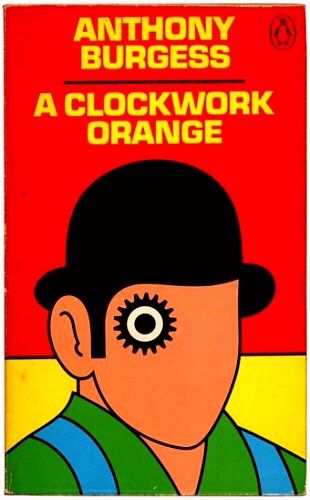
A Clockwork Orange: BBC Radio Drama of the Novel by Anthony Burgess

This is a BBC radio dramatization of A Clockwork Orange by Anthony Burgess. The book is still a shocking satire of Western culture gone to the youthful dogs of violence and mayhem. Burgess played with language by inventing a detailed and comically expressive slang for his criminal hero and the gang he leads.
 
The best info I can find about this recording dates it somewhere around 1997. It stars Jason Hughes as the murderous 'droog,' Alex.


Be One With Thoreau’s Walden in a Computer Game!

Hmmm… well gee I dunno about this. Seems just like something a crew at a university might come up with. Henry David Thoreau’s ‘Walden’ as an interactive real-time 3D game that allows you to walk in Thoreau’s ‘virtual footsteps.’ Well all I can say is that the graphics better be bloody goddamn good or I’m not even stepping out the virtual door. A rose better look like a rose and not an artichoke, know what I mean? Did nasty little Thoreau know that he was leaving virtual footsteps? Would he have wiped them out if he did? Surely we can follow some sort of footsteps through his book. Wouldn’t that be the preferred means?

And another thing, this silly game better allow me the privilege to trample Thoreau’s lovely spot in Emerson’s backyard. I’d better be able to dig up some bushes and cut some trees if I want to. Could I expand on the cabin? I bet not. I bet these USC folks are utterly humorless about this silly project and envision me casually sauntering around and looking at leaves like a lobotomized moron with an interest in the Dalai Lama. I watched the Lama himself on CNN the other night. He said he gets turned on by women. My admiration for him went up a few notches. I also like that he wears blue glasses.

Here’s some clever wording from our friends at USC:

Walden, A Game simulates both personal and environmental life, modeling the basic personal needs outlined by Thoreau, as well as some of the more experiential concepts he described. Furthermore, the game takes advantage of the detailed notes that Thoreau took about the pond, and its surrounding landscape, flora and fauna.

The Thoreau that I know would have given this author an excellent ‘experiential concept’ by putting a shovel to the side of their head.

http://www.youtube.com/watch?v=TZEQilshSA0

On Reading Thomas Pynchon’s Gravity’s Rainbow – Part 1

Every word in Thomas Pynchon’s deranged dance macabre, ‘Gravity’s Rainbow,’ seems, like HTML, to link out to some other subject. The book seems for me to exist in-between worlds, barely attached to this one while trying desperately to connect us with another fuzzily glimpsed, just-hinted, vague world, suggested by pure chance connections between ideas and events here on a fractured and demented earth. I’m barely one hundred and sixty-five pages into this book and I’m reacting for it and against it in nearly equal measure. It’s a goddamn blast. It’s also a motherfucking bitch. Every page of it so far mentions some kind of rocket trajectory, launch pad, descent, explosion or blast of light. Everyone in the book seems to be living out one debauchery or another while all the time expecting to be blown away in bits, perhaps even looking forward to it. Death, for Pynchon, seems on the surface like fun. The book almost makes a mockery of dark humor, of dying. It’s as if Pynchon wants to give the finger straight into the yawning mouth of death’s favorite century.

Things I notice so far about the book: Rockets of course. Everywhere and in every mind of the characters. It’s all about predicting bomb hits and finding the rockets. People want to understand how one of the characters can possibly manage to have sex in various locations just prior to those spots being bombed into oblivion by German V-2 rockets. The books seethes with sexual excitement that’s a death-wish. I also notice that Pynchon is associating Hansel & Gretel, the forest and the witch’s oven with Germany and the events of World War II. The Holocaust is looming over this book on every page. There are constant mentions of cause and effect, how it operates and whether it might be possible to break out of its logic. Can a rocket attack be sensed before it even hits? Psychological early warning system. Brain radar. Statistical analysis for making predictions.

Imagine a missile one hears approaching only after it explodes. The reversal! A piece of time neatly snipped out…a few feet of film run backwards…the blast of the rocket, fallen faster than sound–then growing out of it the roar of its own fall, catching up to what’s already death and burning…a ghost in the sky…

Quite a few references to film in this book so far up to page one hundred and sixty-five.

What could be more paranoid than a constant worry about bomb rockets? The book seems like a grotesque exaggeration at first. But that’s the joke I think. It’s actually an understatement and proves paranoia to be the most well-placed and logical mental operation in a century during which people were dug into trenches and told to march toward each other like polite firing squads. A century in which men marched millions of people into gas chambers and pushed them through ovens. A century in which entire cities were blown off the face of the planet while the citizens were out shopping for groceries. Pynchon seems like an author who is not afraid of any of it. He’s like a guy laughing at the scene of a traffic accident. Or photographing it like Warhol did. And the book’s laugh-in-a-sort-of-half-shocked-way funny. Here’s a bit from a funny scene where a guy visits a nurse he wants to sleep with but must endure a lengthy sit-down with an older woman patient who wants to share her candy:

Under its tamarind glaze, the Mills bomb turns out to be luscious pepsin-flavored nougat, chock-full of tangy candied cubeb berries, and a chewy camphor-gum center. It is unspeakably awful. Slothrop’s head begins to reel with camphor fumes, his eyes are running, his tongue’s a hopeless holocaust. Cubeb? He used to smoke that stuff. “Poisoned…” he is able to croak.

“Show a little backbone,” advises Mrs. Quoad.

“Yes,” Darlene through tongue-softened sheets of caramel, “don’t you know there’s a war on? Here now love, open your mouth?”

It’s funny, no? But it should also set off sparks off recognition in your head that link up with gas chambers. You just can’t trust Pynchon to be genuinely funny. He’s watching you laugh and getting ready to slit your careless throat. No wonder Pynchon uses a secret identity. He’s dangerous. He seems slightly criminal. This guy loves conspiracies. He must have some really excellent ideas about who killed Kennedy. I mean he’d probably say Oswald did it, but it’s why Oswald thought he was doing that makes it interesting.

I love it when authors hide their identities. Pynchon has been effectively doing this for about fifty years now. This reminds me, as all secret identities do, of Batman.
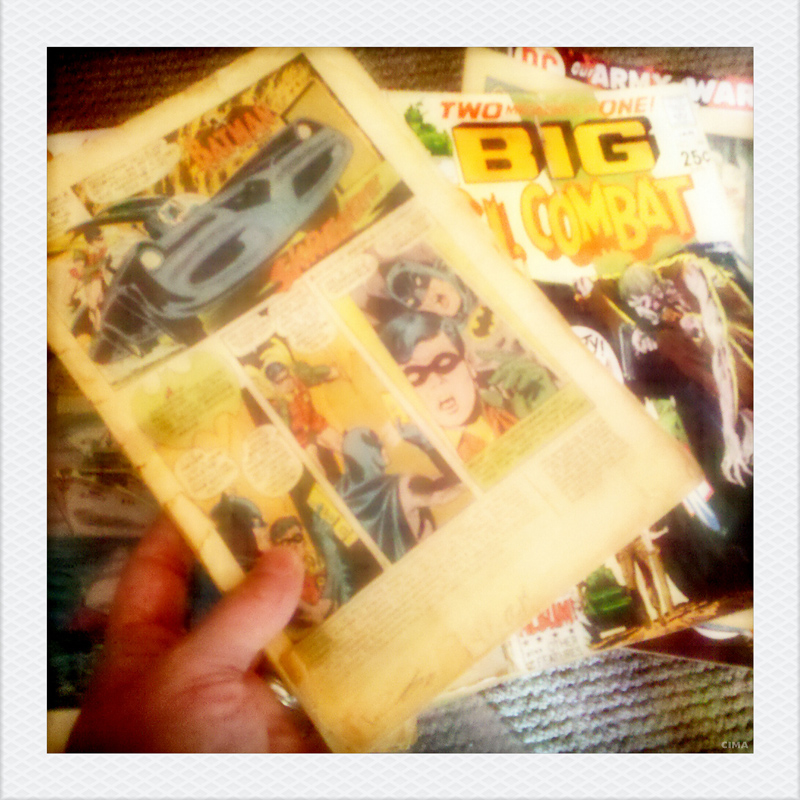
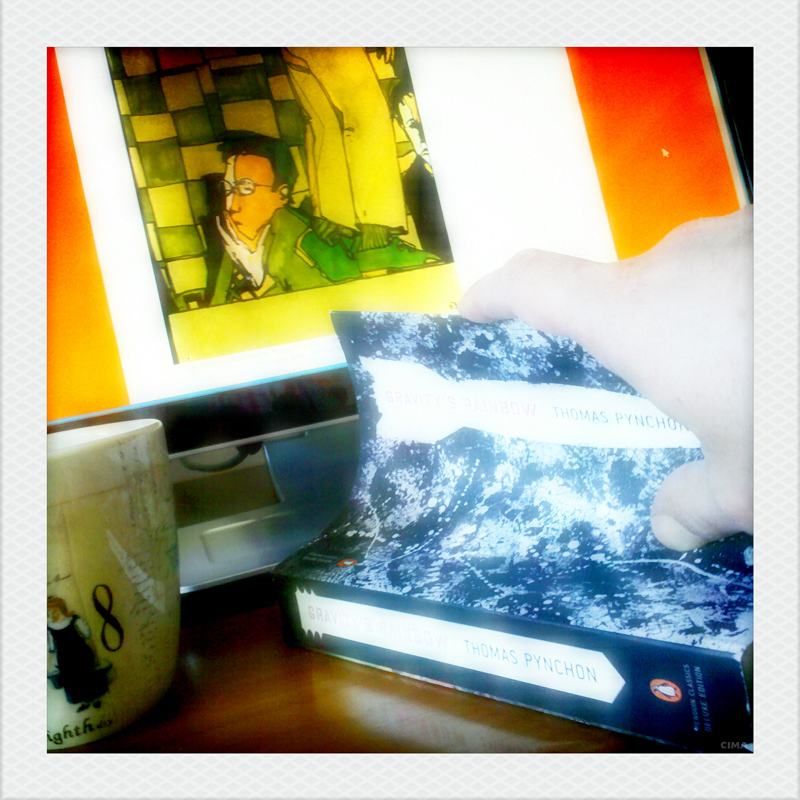
Here’s my ancient and torn copy of a Batman giant issue from 1969. Down in the lower margin there I wrote ‘fuck.’ I’m not sure why I would have done something so charming to a Batman comic. I must have been practicing my favorite words or something. What does an old comic book have to do with Pynchon? I don’t really know but it seems to fit. In fact, comic artist Frank Miller did the cover for the recent Penguin edition of Gravity’s Rainbow. That’s the copy of the book in the first photograph above. Behind the book in that photo is a computer screen showing a drawing by artist Zak Smith who did a thing he called ‘Illustrations for Each Page of Gravity’s Rainbow.’ It’s been shown at the Whitney Museum and you can buy it in book form.

It’s strange how much I’m enjoying this book because I hated ‘Ulysses’ by James Joyce. I think Pynchon snagged some stuff from Joyce. He even resorts to script format for some portions of the book the way Joyce did. But I only like the first part of Ulysses which takes place on top of a tower and has a character shaving. I also enjoy the part about Bloom in the park watching the girl’s underpants. But that book suggests to me that Joyce was mentally ill. With Pynchon I get the feeling that the world and everyone in it is mentally ill.

There’s also a definite connection between Pynchon and William S. Burroughs. In fact I wouldn’t be surprised if they were the same person. But that’s impossible. They both like secret organizations of scientists or researchers though. They share this fascination with science gone crazy and used to control minds – populations. But Pynchon is a better writer – less concerned with gimmicks. His language is a constant beauty which is the great antidote to his hilariously murderous world view. His entertaining and wildly connecting sentences indicate to me that Thomas Pynchon is an optimist. But, as with Joyce, I find myself constantly shutting the book and wondering, ‘How did he do it?’ How for fuck’s name did this guy not only maintain a secret identity but accumulate so much esoteric knowledge in the late sixties so as to be able to jam-pack every single sentence in the bloody book with some reference or other to some event or other that no sane person would ever have heard of in a lifetime? What the hell is going on in this man’s mind that allowed him to achieve Google knowledge density in 1973?

For all the good it might do anyone, I’ll keep reading the book and make a few more posts about it. I tend to relate work like Pynchon’s to my own video work. It’s something to do with the density of thought and imagery. It’s always good to read solid evidence of someone being crazier than you are so that you can get down and work at your own stuff with a little less embarrassment.
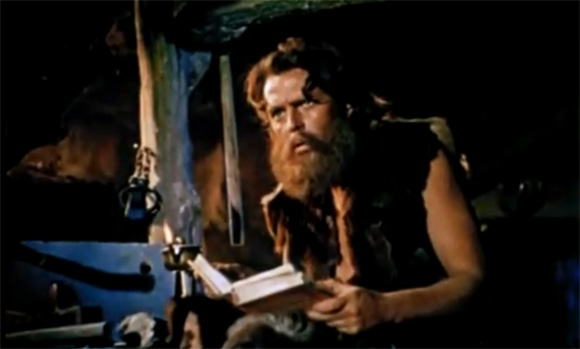
Robinson Crusoe: 1954 Feature Film Directed by Luis Buñuel

Spanish film director and original member of the Surrealist movement, Luis Buñuel, directed this version of Daniel Defoe’s ‘Robinson Crusoe‘ in 1954. It’s a very good and straightforward telling of the story with a totally convincing island locale. The Defoe novel is now more important reading than it’s ever been. That’s because it is the greatest story ever told about being alone with one’s self. All you have to do is live in Los Angeles for a while with your eyes open to understand how few people want to ever be alone with themselves. You see this problem with people very clearly when they break up with significant others and immediately slide into whatever relationship presents itself. It signifies a profound weakness of mind and character. Defoe wrote about the intricate workings of a mind alone with itself and the unexpected joys and truths one discovers in one’s self. So, read the book. It’s a tough book, full of very fine sentences and very subtle thought. Give it a try.

If you are so inclined, you can listen to the entire book right here because I sat down and read the whole thing into a microphone several years ago. But I suggest you listen now and then while making your way through the book on your own.

Here’s an article on Luis Buñuel at the Senses of Cinema site.

For the Beats Killing Women Was Not a Problem


I have very mixed feelings about the core group of writers known as ‘The Beats.’ They were Jack Kerouac, William S. Burroughs, and Allen Ginsberg. Kerouac’s ‘On the Road’ is one of the milestones (or millstones, depending on point of view) of American literature. Ginsberg’s ‘Howl’ is one of the great twentieth century poems, and Burroughs wrote the distorted fever dream of homo-erotica known as ‘Naked Lunch.’ There’s lots of intensity in Beat literature and poetry. There’s a willingness to seek out the world and experience. There’s a seeming openness of mind. But every time I delve into the Beats and their work, I become listless, bored, irritable and worried. I find the general direction of their writing to be toward a distinct and virulent hatred of women. The glassy-eyed hero worship of these writers seems odd to me. Wouldn’t it be better to try rejecting their premises? Why do they still have such a hold over the popular imagination? Why hasn’t poetry been able to dispense with these people yet?

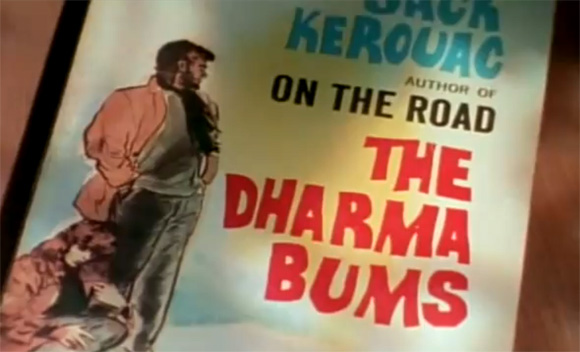
What I like about this documentary is that it does in fact touch upon this subject. What I don’t like about it is Johnny Depp prancing around with an unsmoked cigarette trying to convince us of his Beat/hipster/baggy jacket coolness.

The Beat hatred of all things female manifests itself most obviously in the fact that Burroughs stood his wife, Joan Vollmer, up against a wall in Mexico and blew her brains out with a gun. There’s great mystery surrounding his escape from the authorities in Mexico who quite naturally wanted to investigate and prosecute the man for murder. I would have prosecuted him too. He told various stories about playing a game of ‘William Tell,’ or inebriation or drug use to explain how it happened. But in order to fire a bullet through his wife’s forehead he had to lift the gun and point it at her. It sort of goes without saying. Would you be able to point a gun at your spouse? Hopefully not. I wouldn’t be able to even lift a gun in my wife’s general direction. So why was a man who blasted his wife’s head open welcomed back into his little group of Beat friends? Why would such a man become the life of the party in literary circles? Why would such a man love guns and fire them at tin cans in his backyard for the rest of his life? Good questions. Easily answered. Nobody gave a shit about the man’s dead, blown-open wife. She was just a lady in Mexico married to a bisexual genius. That’s the problem with the Beats. That’s the rock bottom attitude of the most important literary movement in America during the twentieth century.

Here’s what Burroughs had to say about killing his wife:

I am forced to the appalling conclusion that I would never have become a writer but for Joan’s death, and to a realization of the extent to which this event has motivated and formulated my writing. I live with the constant threat of possession, and a constant need to escape from possession, from control. So the death of Joan brought me in contact with the invader, the Ugly Spirit, and maneuvered me into a life long struggle, in which I have had no choice except to write my way out.

Let me translate that for you: “I killed my wife and was so inspired by the act of killing a female that I became a great writer. And I want to kill again. I have to constantly struggle with the urge. My writing helps with that.”

Get the idea? Murder inspires good writing… according to one-third of the Beat literary movement. The other two-thirds were just fine with that.

You may think I’ve gone too far or have some literary ax to grind. But I would suggest that reading the Beats without keeping these ideas in mind is self-deception. It’s all right there on the page if you actually read the stuff. These guys weren’t gentle spirits with open hearts and minds. They were brutal little elitists from Columbia University who were willing to kill and dump dead bodies into rivers in order to protect their group. Kerouac helped a friend dispose of a murder weapon, then took the murderer out to a movie. That murder, which was in fact the brutal slaughter of a gay man who was making advances, led to inspiration for Kerouac, Burroughs and Ginsberg who all attempted and partially succeeded at novels based on the incident.  Again, murder inspires Beat writings. If one really wants to get down in it, one would go so far as to say that the prime mover behind the Beat movement – its basic inspiration – was a gay-bashing murder in Riverside Park. People may say whatever they like about writers trying to work out the demons, but I see something much darker than that.

Kerouac later based the main character of ‘On the Road’ on Neal Cassady, a man who appears on film to be a psychopath. I’d be looking for dead bodies buried under any house that guy ever lived in.

I think the Beat movement should be done over for the twenty-first century. This time, try not to blast anyone’s brains out across a wall.

Continue reading

Opening Scene Film Adaptation of Thomas Pynchon’s Inherent Vice Filmed by Jeff Hoyt

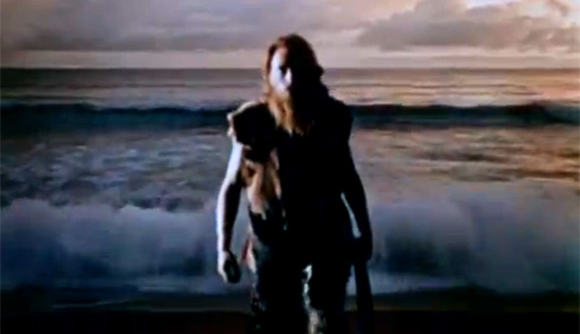
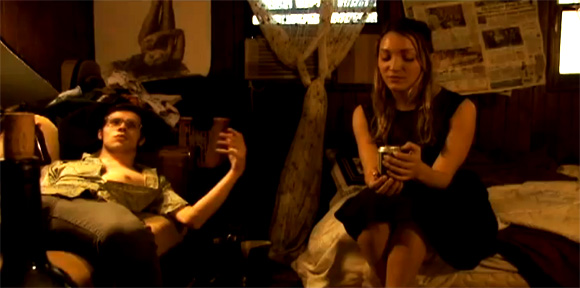
It’s nearly impossible to find film adaptations of Thomas Pynchon novels anywhere. I frankly don’t know why anyone would even try to film such books. It seems almost suicidally foolish. But this plucky fellow, Jeff Hoyt, has at least given it a small go. He’s filmed a sort-of version of the opening pages of Pynchon’s silly little lightweight piffle of a book, ‘Inherent Vice.’ This is where the lead detective/loafer/drug user/hippie/surfer/beach lounger/semi-retired permanent loser character, Doc, encounters his mysterious ex who presents him with a strange possibility for detective work. I like this little piece of film because it really tries to do Pynchon. The actors are Orien Longo and Rachel Kadison. The role of Doc is a very difficult thing to tackle because it really seems to require little effort. Actors who aren’t solid in their experiences always want to work at getting it down. You can’t do that with a character like Doc. If you aren’t him, you can’t play him. Simple as that. But the role of Shasta as played by Ms. Kadison is a sweet surprise. She’s damn good. She can do this work.

The Mad Ones: A Brief History of the Beat Generation

Krystal Cannon (PersonTV) made this short documentary about the Beat Generation in which she not only narrates as Queen Elizabeth, but also plays various roles including Allen Ginsberg, Joan Vollmer, Bob Dylan, Jack Kerouac, John Lennon, Edie Sedgwick and Abbie Hoffman. She gives a clear account of the Beat movement then moves into the general social reaction. She also makes some very interesting points about how women were sidelined even though many of them made great contributions to Beat culture. I think that what the Beats were working on is in very fine hands indeed with Ms. Cannon at work.

Thanks to Marc Campbell at Dangerous Minds.

Henry Miller Discusses Life, Love, Sex, Art, Writing, Jung and Enlightenment in His Bathroom

MATURE CONTENT – NUDITY:

The great American writer, Henry Miller, walks into his bathroom in 1973 and talks about all the fascinating pictures on the walls. Here’s a guy who can kill zombies with his words. I’ve always considered him to be an antidote to the lifeless people one must engage with on a daily basis. The people who get into cars and make their way to offices, then return to relax with a television and cook at the barbecue built into the island on the patio. You can reconnect with life by reading Miller’s books. You can once again feel that the world is actually a place where art and passion exist. Miller excites imagination. He makes you want to live harder and better. Listen to him talk in his bathroom! Anyone who can be this fantastic in his bathroom has got something marvelous going on.  The film was shot and directed by Tom Schiller.

Take This Opportunity to Deface My Art

My latest artwork is an image that is never quite the same twice. I worked hard on it. Framed it. Hung it in a gallery. Now you come along with your paints and markers and mess it all up. I’m curious to see what you decide to do. So when you deface my best work ever just hit the ‘upload art’ button to send your artwork to me. You can get a copy for yourself by clicking the ‘download’ button. You get 3 uploads, so try to make it count.

Have fun destroying one of my proudest creations!

The Secret Identity of Author B. Traven

B. Traven was the mysterious best-selling author of the novel, The Treasure of the Sierra Madre, which was made into a classic film by director John Huston in the 1940s. But who was B. Traven? The mystery surrounding his identity remains fascinating to this day. There have been many theories about who he was, whether he was several people, whether he was an expatriate German or perhaps even the President of Mexico. People in the film world apparently thought they would have meetings with him, but were then informed that a representative would show up. But was the representative actually B. Traven?

When an artist hides his or her identity many theories develop. Modern figures who have cribbed from Traven’s playbook are the novelist Thomas Pynchon and the painter Banksy who really have no reasons for remaining anonymous beyond the artistic jolt that a secret identity personally gives them. It’s not the crooks that interest Batman after all – it’s the secret identity. A secret identity makes you better in every way because it turns you immediately into a work of art. All artists should be mysteries. At the very least, they should tell lots of lies.

I present this post and its excellent documentary as part of my preparations for an upcoming film. Getting the right mood.

Part 2

Parts 3 – 6 after the jump.

Continue reading

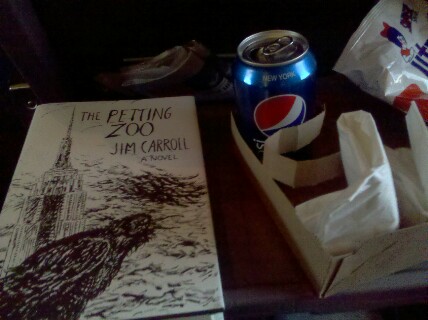
The Petting Zoo by Jim Carroll

image

Oh boy have I found a great book!  Poet Jim Carroll was finishing this thing up when he passed away in 2009.  I have only read 73 pages so far but I recognize this as one of the greatest novels I have ever read.  A New York painter reacts strongly to some paintings by Velazquez, stumbles into Central Park and winds up in the looney bin where he finds some time to think straight.  Simple and magnificent.  What a damn great writer!  I think this will actually be the first novel I write a review of.  Now back to reading.

Comics Author Harvey Pekar Has Passed Away

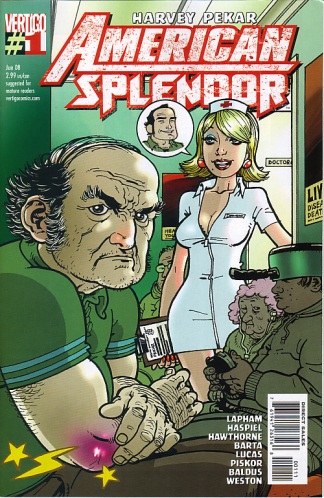
American comics genius Harvey Pekar has passed away at the age of 70.  I think Pekar was the greatest writer of comics because he treated the form as literature – for real – not like most of the dimwits writing ‘graphic novels.’ Pekar was serious and nervous and funny and angry, with very little separation between. His observations of everyday life run a full range from fixing a flat tire in a snow storm to surviving cancer to trying to find a file folder at work.  He looked at his life and wrote it all down for his comic books.

His comic books appeared in a series called American Splendor.

A Barefoot Reader of Ulysses

That’s Marilyn Monroe reading James Joyce’s Ulysses.  That look on her face – a mix of befuddled interest and confused determination – is exactly how I read Ulysses.  Monroe apparently kept a copy of the book in her car and stuck with the damn thing for a long time.  You’ve got to wonder about this woman.  She probably should have stayed far away from Kennedy and stuck a little closer to the things she really liked.

Strangely enough, it happens to be June 16th which is worldwide Bloomsday, when Ulysses is celebrated with public readings.

Via Dangerous Minds

CellStories Brings Short Fiction to Your Phone

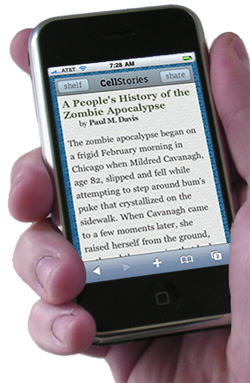
CellStories is a ridiculously simple service that brings you a little story each day.  You just open up the link to the CellStories.net site in your cell phone browser and the story shows up, well-formatted and easy to read.  The site was started by former magazine editor Daniel Sinker, who has used his many contacts in the publishing field to acquire a continuing stream of worthwhile and entertaining stories.

The main problem for me that this service solves is my inability to remember to keep reading long-form works on a cell phone.  I just can’t remember to keep going, no matter what the book.  It’s something to do with the small screen and my feeling that all handheld units are for very temporary work and pleasure.  When I read long works I use a book or a Kindle e-reader.  I have no problems with continuity there.  But CellStories only offers short fiction.  It’s the perfect little pocket literature gizmo.  I actually feel a tiny sense of accomplishment when I finish a short story on my Droid phone.  I feel that I have filled some time well that might otherwise have been spent checking my hair.

So if you want some grown-up short fiction, try CellStories.