The Fantastic Flying Books of Mr. Morris Lessmore: Oscar Winning Short Animation

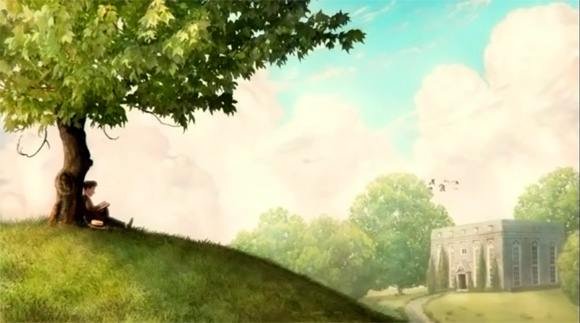
This is the 2011 Oscar winning short animation, ‘The Fantastic Flying Books of Mr. Morris Lessmore.’ It’s the first film from Moonbot Studios in Shreveport, Louisiana. It was co-directed by William Joyce and Brandon Oldenburg

The film is also an iPad app that combines animation with an interactive picture book narrative.

Here’s a Cartoon Brew interview with the filmmakers..

Pereval: 1988 Soviet Science Fiction Animation by Vladimir Tarasov


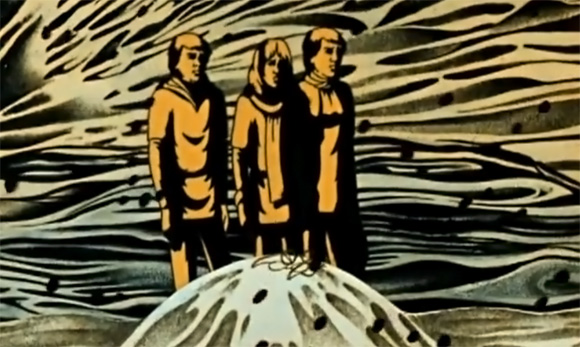
Humans have crash-landed on an alien planet. Sixteen years later, they send a small search party consisting of their children – born at the time of the crash – back toward the broken ship. The young members of the party make their way through a hostile and surreal landscape that holds surprises for them. Finding the ship well-preserved gives one of the young people an important connection to his past and to his origin.

This film was directed by Vladimir Tarasov and was adapted from a novel by Kir Bulychev.

A Colour Box: 1935 Abstract Direct Paint on Film Animation by Len Lye

Len Lye’s 1935 film, ‘A Colour Box,’ was made by painting and applying dye directly to the film surface. It is apparently the first direct paint film to gain a general public release and has been widely seen ever since. The film is an odd way to advertise for cheap parcel post and this message starts popping up near the end. The cheerfully infectious music is ‘La Belle Créole’ by Don Baretto and his Cuban Orchestra. Lye’s work must have been hugely influential for the later work of direct paint filmmaker Stan Brakhage.

The Birth of the Robot: 1936 Experimental Advertising Film by Len Lye for Shell Oil Company


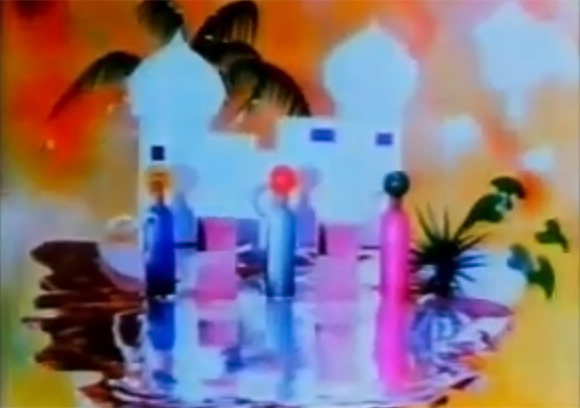
In 1936, experimental filmmaker Len Lye made this short surreal animation to advertise the benefits of Shell oil for lubricating things. The film is a hyper-saturated stop-motion extravaganza that involves a mechanical world turning on some sort of hand crank. There’s an adventurer driving around the sands of Egypt. His car winds down and konks out leaving the man dead in the desert. The angel of oil rains drops of lubricating crude down on the Egyptian landscape bringing the parched skeleton to life as the Shell Oil robot. Fascinating. It’s got that awkward, shiny, naive beauty that could only be achieved in the 30s. Parts of this thing look like they might be influenced by Salvador Dali’s work. Something about that dead skeleton and the desert looks like it could fit right into the Surrealist master’s paintings.

Lye was from New Zealand and worked not only as an experimental filmmaker but also in newsreels and advertising. He was a kinetic sculptor, poet, painter and a writer of essays on artistic theory and philosphy. He made a 1935 short film called ‘A Colour Box’ which was the first generally exhibited film made by painting directly on the film emulsion. It’s a brilliant experimental animation posing as an advertisement for cheaper parcel post.  I’m sure the great direct paint filmmaker Stan Brakhage must have been familiar with Lye’s work.

Here’s a gallery site with information and examples of his artwork.

How Walt Disney Cartoons Are Made: 1939 Documentary Film

Here’s a wonderful glimpse into the animation techniques that were pioneering at the time of Disney’s first feature-length animation, ‘Snow White and the Seven Dwarfs.’ You get to see some shots of Snow White being drawn and photographed, sound effects being recorded, and people arriving at the premiere. You also get a good dose of the Disney sexism in which all women who work on a film are referred to as ‘pretty girls.’ It’s basically an advertisement for the film, but it’s a good one.


The Thomas Beale Cipher

This excellent short film was made by Andrew S. Allen, utilizing a form of rotoscoping that creates a flat paper cutout look. The story follows the strange and suspenseful activities of a Professor White who sets out to decode one of the famous Thomas Beale ciphers which supposedly reveals the location of an enormous stash of gold that has remained a secret since 1820.

The director is also a founding member of the Short of the Week web site which has more information about the film.

There’s screening and press information at ThomasBealeCipher.com.

The Fantastic Adventures of Cloudman

Look at this! Will you just trust me and watch this thing all the way through? It’s absolutely brilliant! It mixes techniques like they are child’s play! Stop-motion, hand-drawn, live action super 8, claymation, psychedelic explosions, fireworks exploding from the heads of alien attackers when they die, forest battles, miniature model sets! It’s incredible. It deals with mythical forces at battle. The director, Phoebe Parsons, has enormous talent and filmmaking know-how and is going be making very excellent films well into the future. Look out for this young filmmaker.

So this Cloudman is created when a pilot gets shots down and his blood mixes with a cloud.  That’s the gorgeous opening animation that sets our crazy story rolling.

This film is… well… I love to use a cliché, but it’s mind-bending! Super cool and totally far out!

This is one of my favorite films online I think. Spectacular.

There’s a PhoebeParsons.com.
Interplanetary Revolution – 1924 Soviet Animation

Paul Gallagher at Dangerous Minds posted this 1924 Russian propaganda masterpiece. It’s a wild, science fiction, abstract work of art that just keeps pumping out wondrous images, one after the other. I love the ragged edges and mix of photographs, hand-drawn animation and cutouts.

Short Documenatry Film About Animator Mary Ellen Bute

The National Film Preservation Board of The Library of Congress has added a film to its National Film Registry by Mary Ellen Bute called Tarantella (1940). Here’s a short documentary about this animator and her total dedication to her art. Cartoon Brew has more information about the recent additions to the Registry.

The Fabulous World of Jules Verne: 1958 Film by Karel Zeman

Czechoslovakian animator Karel Zeman made The Fabulous World of Jules Verne in 1958 and it is, without exception, the finest example of Verne on film that I have ever seen.  It is an adaptation of Verne’s novel, Facing the Flag.   The combination of live action and Mysti-Mation (sets and animation painted to look like illustrations) not only evokes the atmosphere of old book illustrations, but it evokes the visual act of imagination that happens when I read a Jules Verne book. This film is perfection. I’m somewhat distrustful of the ‘steampunk’ movement but I would certainly imagine that this film must be one of its holy grail objects of worship.  It should be for sure.  Disney could never come close to this, then or now, because they are focused solely upon happiness.

Parts 2 through 8 after the jump!

Continue reading