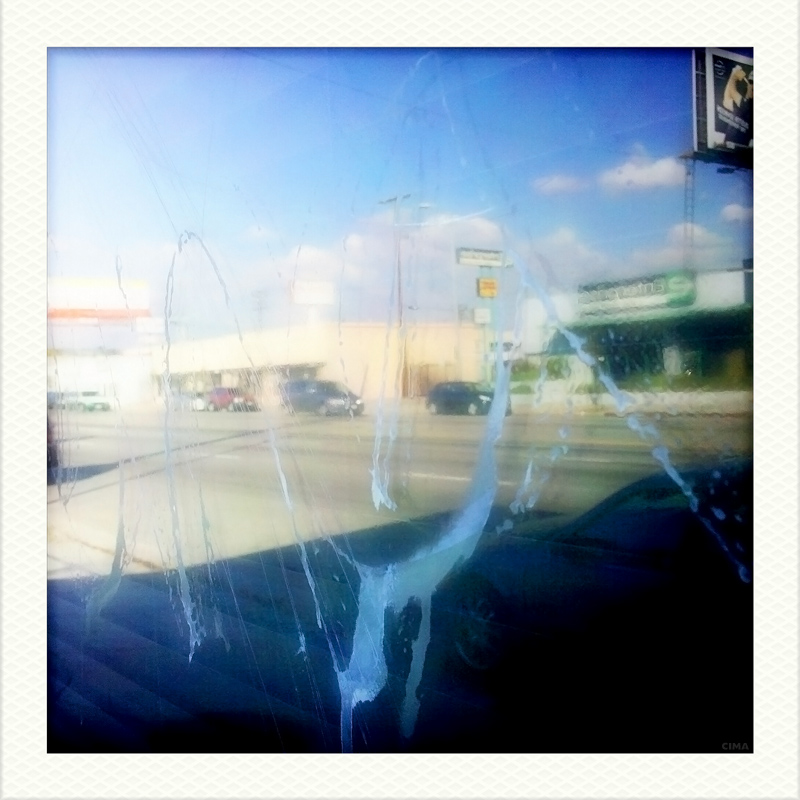
Photo: She Was Barely Even There
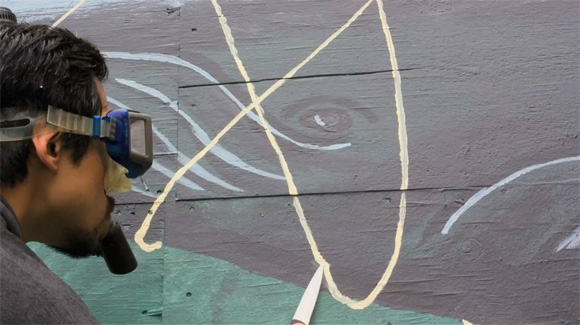
The Great Wall of Los Angeles is one of the longest murals in the world. It was begun in 1974 and took five summers of work by students to complete. It tells about the history of California. This short film was made by Donna Deitch.
 Artist and filmmaker Raymond Salvatore Harmon has written an inspiring and thought-provoking book that insists on changing the way art is perceived and approached by artists, viewers and the ever-problematic gallery world. Harmon presents several stories of his own brushes with law enforcement that are both funny and rather harrowing. He consistently recommends behaving as if you have every business being exactly where you are even if you have no permission to paint the front of a building. Confidence and apparent command of a situation will often get a clever artist out of a jam. Harmon is a very likeable guy and I can’t imagine there would be too many police all that interested in arresting this particular artist whose work always seems to have good intentions behind it.
Here’s an important quote from the book:
Ultimately, corporations play the biggest part in designing our modern world. Corporations sell goods, make cars, pump oil and make medicines. They design city planning and develop urban neighborhoods in order to make profit. They create ghettos to house those people that they pay so little they are unable to afford to live anywhere else. Making them exist at the most nominal part of financial need, particularly outside of the white picket fences of the 1st world nations.
Yet, in the darkness of the city night there are those that go out and change the urban landscape without planning permission of a performance license. These people vary in intent and talent but they collectively do what they do against society and against the law.
I like this book. I find it generally inspiring and agitating in the best possible way. However, I do have arguments with it. In general, I tend to prefer looking at street art that does not actually destroy or harm property. Artists who violate laws by gluing things on walls should I think be treated rather lightly. However, I can certainly imagine scenarios in which a business – even a corporate one – could be seriously harmed by the placement of street art on its walls. Not all corporations are British Petroleum. I don’t see any logical link between artistic statement and one’s attitude about a public or corporate wall. If art should in fact be more focused on the act of creation and viewing by the public without concern for how quickly the art is removed, as Harmon’s book suggests, then street artists should be content with painting their work on paper or cloth and hanging it from those corporate walls. Why is there a link between the making of an image and the destruction of a blank corporate wall? Why not make the art and preserve the blank wall?
Harmon has some harsh words for the art world that links itself inextricably with the art schools, identifying artists it likes, feeding them into a network of wealthy friends and collectors, creating an insular world of wealthy back slappers and promoters. You can see this world in operation all over New York and even in Los Angeles. However, I would point out that crony networks are notoriously good at finding and publicizing actual brilliance.
Elsewhere in the book, famed artist/street prankster Banksy is quoted as saying:
Remember, crime against property is not real crime.
Banksy is of course not someone I would want to be taking very seriously since it is more than likely that he is little more than an employee or creative group working at Urban Outfitters. Thankfully, one of Harmon’s stories about copyright leads right into an episode that reveals Mr. Urban… sorry… Banksy, to be just as copyright-obsessed as any corporation. Banksy is apparently working hard on a piece in model Kate Moss’s bathroom… you kind of get the picture?
You’d do much better reading this marvelous and good-natured jab-in-the-ribs art manifesto than paying attention to Banksy, that’s for sure.
Elsewhere in the book is a thoroughly amusing account of an assault on a major art world event that involves video cameras, dark suits and some very CIA-type stuff going on. Read it and enjoy.
Here is the entire book:
More artists should do this. Make their own documentary about themselves. Great idea. I like the jazz paintings. Harold Smith is a visual artist who just likes painting.
Ryan Spring Dooley (aka MarvinTiberious on YouTube) and Juppy Nash made a catchy little tune and played it on an Italian rooftop where they could enjoy the place they were in and become infected with art. Dooley’s films are a constant stream of creativity and artistic perception unlike anything else. He combines old and new and creates works so easily expressive that you wonder why anyone needs anything more than paper, paint and a camera to do anything. Watch this film and wonder at just how good it really is. Masterful.
The filmmaker is also using Kickstarter to fund a bigscreen project:
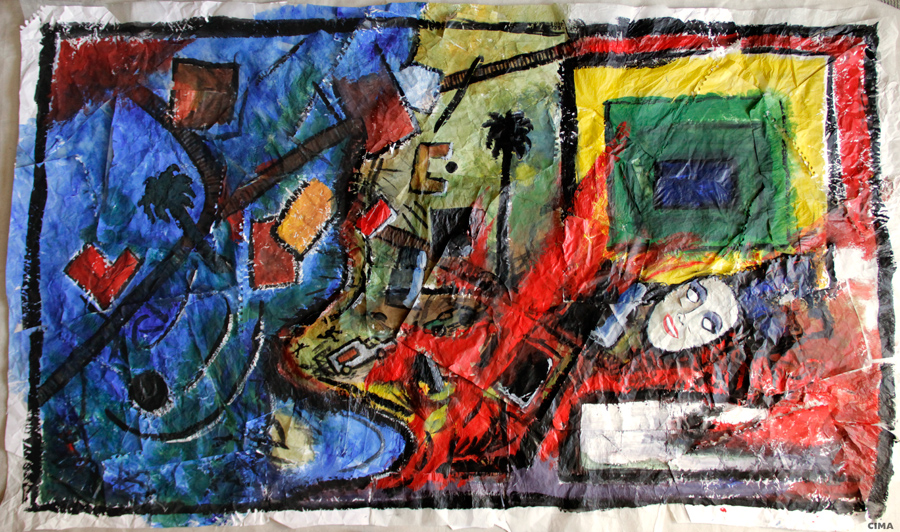
For Japan via Los Angeles. I photographed the painting in morning light today to try and show the details better than in last night’s photo. The painting is not quite finished yet, but I wanted to post something. It’s acrylic on various types of paper. Dimensions are approximately 6′ x 3 1/2′.
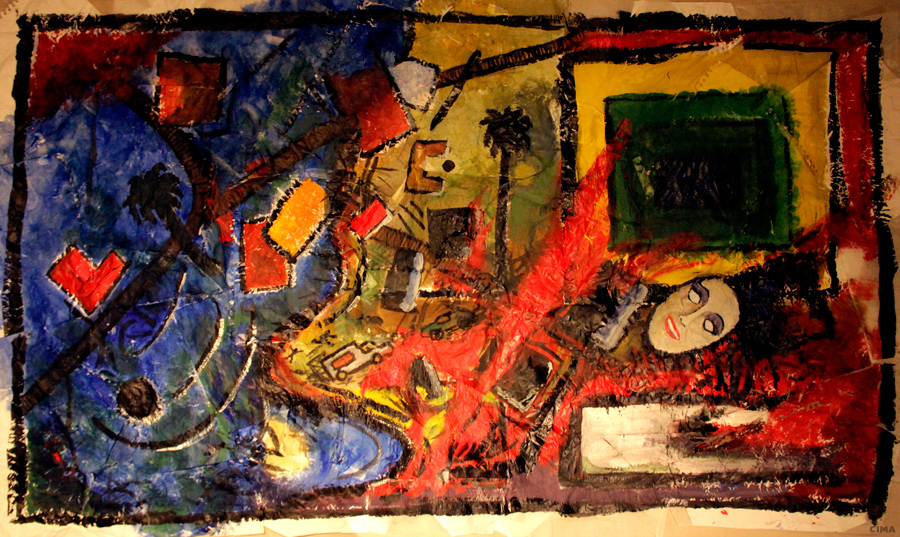
For Japan. The painting is not quite finished yet, but I wanted to post something. It’s acrylic on various types of paper. About 6′ x 3 1/2′.
Ryan Spring Dooley (aka MarvinTiberious on YouTube) made this animated art film about home and what that means. He does lots of these free-form works that are actually the current state of the art as far as I’m concerned. The artist lives and works in Italy, painting on nearly everything.
While visiting Your Daily Cartoon, I watched an animated film by Hungarian painter György Kovásznai. I liked the calm mishmash of drawing styles and quiet humor. The 1965 film is called Mesék a m?veszet világából (Tales From the World of Art). It has no subtitles but is pretty easy to follow, taking a bemused look at several kinds of art. The first part is an action movie, the second is a theatrical piece, the third is a piano recital.
This one is called Várakozni jó (Waiting for Good). It’s about a traffic jam with a truck that suddenly opens its back doors and explodes into a 1969 rock & roll jam. The wild sketchy ever-changing animation style is more psychedelic than most commercialized sixties psychedelia could ever be.
This one is Gitáros fiú a régi képtárban (Boy Guitarist of the Old Hits) from 1964. It’s simply a guitarist playing and dancing his way through artworks by old masters presented in a very avant-garde fashion. Understanding the art is one thing, but the person who can truly enjoy it is far ahead in the game.
My latest artwork is an image that is never quite the same twice. I worked hard on it. Framed it. Hung it in a gallery. Now you come along with your paints and markers and mess it all up. I’m curious to see what you decide to do. So when you deface my best work ever just hit the ‘upload art’ button to send your artwork to me. You can get a copy for yourself by clicking the ‘download’ button. You get 3 uploads, so try to make it count.
Have fun destroying one of my proudest creations!
This beautiful film by Joe Martino features painter Landon Richmond working and talking about his perspective on the pursuit of one’s art and expression. It’s a very direct and moving film. I agree with every word that comes out of the painter’s mouth. And I like the way he says it without a trace of pretension or irony. He’s interested in facing the darkness in his art and he recommends this fearless approach as a general principal. You have to be able to look directly at anything. Richmond also acknowledges the place that chaos occupies in his work – the willingness to not necessarily understand where it is that you are going but to go nonetheless. I really enjoyed hearing this painter’s words today and will keep them in mind for quite some time.
You can see lots of Landon Richmond’s paintings and a web comic at KnowNoTruth.com.
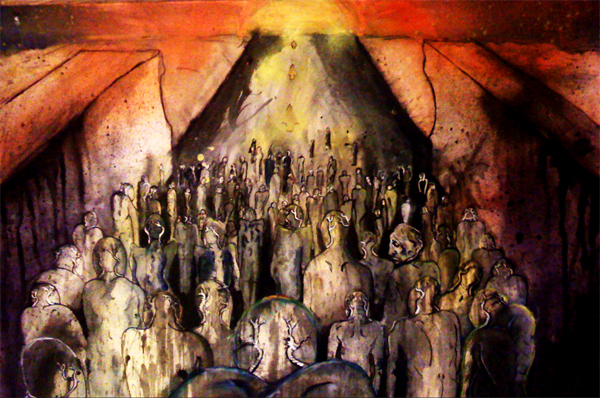
How to paint a wall in less than a week. By BLU.
If you don’t know anything about being a painter, Andy Warhol clears it all up in this short film clip. This is the entire 20th century in art summed up to perfection by a raving genius.
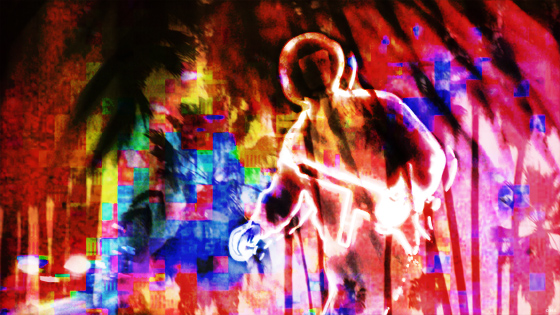
This is the latest version of a print I’ve been working on that’s loosely based on my Yellow Plastic Raygun film. I printed what I thought was my final version on a large canvas and looked at it for several weeks until I decided that it was timid and boring. So I went back to work and tried to let loose with the image and not worry about mooring the thing in some kind of reality. So this is what I’ve got to show for the effort. I like it much better this way.
I also renamed it from Don’t Turn Back to Don’t Look Now!
Here are the first two versions of the print.