Bob Dylan’s Interactive Video for Like a Rolling Stone

DylanRollingStoneVideo

Bob Dylan has seen fit after 48 years to create a music video for his brilliant song, ‘Like a Rolling Stone.’ He’s made an interactive television channel-surfing nightmare of an interactive video that takes you into the basement den to slouch on the couch and watch hours of scintillating daytime television. It’s the perfect thing for anyone driven to insanity by daily app updates and 24 hour breaking news.

The producers of Dylan’s video, Interlude, have built the interactive piece with Flash. The interface is simple and effective. You may get into trouble with the heavy video streaming if you start pausing and restarting. If you do, reload the page and start again. Flash won’t play on Apple mobile devices, but Interlude has a free iPad app that will play the video… sort of. In reality, the iPad app is unusable and presents the user with no intelligible interface whatsoever. So if you are trying to watch Dylan’s bombshell of a music video on an iPad, you’re just out of luck.

I appreciate this because it’s been an obnoxious few years of listening to idiots whine about the bugs of Flash while hearing scant mention of how the powerful animation and coding environment empowered many young people with small or no budget to produce incredible visual stories, some of which spawned television shows. In the history of the web there has been no piece of software that even comes close to the creative explosion set off by Flash.

Dylan’s video gives us many channels on what appears to be daytime television that we can hop between while watching every anchor, actor, athlete, reality TV moron, pundit or spokesperson lip-synch to his song. It’s as if some maniacal hacker got into the airwaves and plastered Dylan’s song on top of every broadcast. Or perhaps the viewer is simply distracted and the multiple inputs of song and television merge into one general dream impression. It’s depressingly brilliant. It turns the TV into the internet.

You can also watch it on Bob Dylan’s official web site. It was produced by Interlude.



Worldwide Protest as U.S. Government Threatens to Censor Internet


Today Candlelight Stories joins with other sites to protest two proposed laws in the United States, called SOPA and the PROTECT IP Act. On January 24th, the U.S. Senate will vote on the PROTECT IP Act to censor the Internet, despite opposition from the vast majority of Americans. These laws give corporations the ability to sue any web site they feel threatens their copyrights in some way. They could essentially shut down any site simply by pointing a finger. So corporations would use this power to harm smaller competitors. The U.S. government could shut down any site or blog it had the slightest problem with. Censorship as practiced in places like China would suddenly become the norm here in the United States. China is a nightmare. We don’t want to do things like they do.

A free, open, uncensored Internet is a basic and fundamental right that must be preserved here in the United States if it is to have any chance at all on a worldwide basis.

Join us to protect our rights to free speech, privacy, and prosperity.

Here’s a massive list at the Center For Democracy & Technology of organizations, companies, web sites, blogs and individuals who are opposed to the censorship bills.

At the links below you can send your protest to Congress and learn much more about these bills and how they seek to end the open Internet.

Take action by contacting Congress via the Electronic Frontier Foundation.

AmericanCensorship.org has a large selection of ways you can take action and black out your web site in protest.

Take action by contacting Congress via Google.

Sally Saves Christmas

Some of the readers of this site will know that this story is the original piece of material behind Candlelight Stories. Back in 1994, I sat at a very flimsy folding table in a Los Angeles apartment with a box of pastels, crayons and ballpoint pens to scratch out a pile of illustrations that vaguely added up to some kind of Christmas tale. I still have all those original drawings in a big department store box. The interesting thing about the illustrations for me is the series of actions that they caused which led me directly into the various skills and technologies that I have used and made a living from ever since. After finishing the illustrations and creating a large bound book to give as a Christmas gift, I scanned the pictures and decided to try to put them into a slide show. I had an early version of the Mosaic web browser and soon realized that I could use my AOL account to post things in a folder that could be accessed by the web browser. Having done that and been very impressed with myself I showed it to my non-technical friends and received some half-hearted congratulations and was asked how I could ever hope to make any money that way. Within a few months I received a letter in the actual mail from the USA Today newspaper requesting permission to put an illustration and a web link in a listing of good things on the web. So I said they could and they printed their thing. So I began to add new things to the web site as I could.

It’s pretty much the same today. You just make a little thing and stick it on the web to see who likes it. But back then it was a little like magic. My web experiment grew quickly and when the higher-speed DSL technology first came into Los Angeles I jumped on it and got myself a Digital Alpha server and put it at the end of a DSL line in my own home to serve the web site. According to the company which was the first one up and running in L.A., I was the first person to attempt running a web server over the DSL technology in Southern California! They gave me totally free ISP service for several years in exchange for a little advertising. I’d actually have late night conversations with their engineers – sometimes from their cars as they made their way to hubs and switches in the dead of night to fix something. Imagine that kind of technical support today with your blog host! Won’t happen! This all worked well for a time. But then the DSL technology began to fail and I quickly realized it was a dead-end technology with too many players involved on the back end who could not adequately maintain the service without blaming each other for failures. But my point is that during that time, with that kind of approach, one could really get a sense of being visited by the world. I could watch the lights blink as people came onto the server to visit. There were times, during serious outages of some sort or other, when I’d throw the big Alpha server into my car and drive it to some other location for a temporary connection. Amazing. Fun.

It’s still fun today. That’s why I still post this odd little story every Christmas. It’s the original first thing of this site.

Sally Saves Christmas


Some of the readers of this site will know that this story is the original piece of material behind Candlelight Stories. Back in 1994, I sat at a very flimsy folding table in a Los Angeles apartment with a box of pastels, crayons and ballpoint pens to scratch out a pile of illustrations that vaguely added up to some kind of Christmas tale. I still have all those original drawings in a big department store box.
Continue reading

Boing Boing, Censorship, and Hypocrisy: Commenters, Watch Your Language!

This article incorporates adult themes and language.

This is a flat-out attack on the hypocrisy and thin-skinned holiness of a major blog that purports to stand for freedom of expression and open ideas.  The blog is BoingBoing.net.  I’ve had my problems with the site before, having made comments that their moderators found to be excessive or too foul-mouthed for their rather puritanical tastes.  I say puritanical and I mean exactly that.

Boing Boing has a problem with genitalia.  You’ll see why in a few moments.

Continue reading

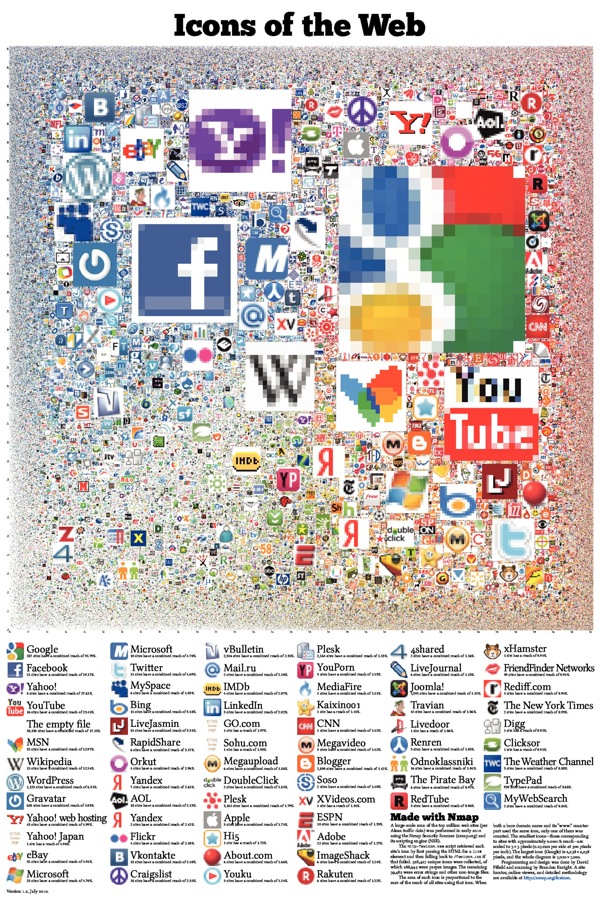
Image Showing The Top One Million Web Sites

This is a visualization of the top one million web sites in the world according to Alexa traffic data.  You can go to Icons of the Web at NMap.org to search for domain names that might be included in the image.  Candlelight Stories is there!  We are ranked 517,582 in the world!  So our tiny little flame logo is buried in there just below the lower right corner of the big CNN logo on the righthand side of the image.

Check it out.  It’s fun.

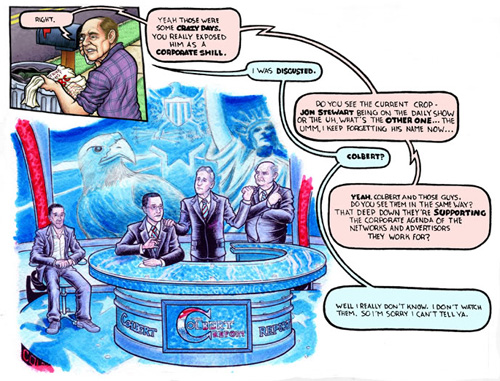
Harvey Pekar Comic on Corporatism

Smith Magazine has a new Harvey Pekar comic strip about how corporatism influences everything people do and think.

Can one work honestly inside a corporate system?  Can you write a book criticizing corporations and have it published by a corporation?

Are comedians Jon Stewart and Stephen Colbert completely owned by corporations?  My own answer is yes.  That’s why they are so boring.

Khan Academy Teaches Math and Science on YouTube

Salman Khan teaches math and science via YouTube video lessons.  It’s called Khan Academy.  He teaches a wide variety of subjects including algebra, calculus, biology, physics, chemistry and statistics.  He thinks everyone should be able to get an education for free and he does not think universities are doing it properly.  The education model needs to be rethought and rebuilt.  Many people think so and that’s why Kahn Academy has so many students and is attracting venture capital money.  He’s getting more viewers than most university web sites.  Here’s a PBS NewsHour piece about him:

Here’s a lesson on adding and subtracting fractions:

Delete Your Facebook Account

See the insipid goober just to the left.  That’s Mark Zuckerberg.  He runs Facebook, the site that gathers tons of your personal and public information to form what he hopes will be an all-pervasive social network.  Being young is no excuse for this guy.  A young a-hole grows into an old a-hole very quickly.  This is what the Web’s leading a-hole said recently:

And then in the last 5 or 6 years, blogging has taken off in a huge way and all these different services that have people sharing all this information. People have really gotten comfortable not only sharing more information and different kinds, but more openly and with more people. That social norm is just something that has evolved over time.

We view it as our role in the system to constantly be innovating and be updating what our system is to reflect what the current social norms are.

A lot of companies would be trapped by the conventions and their legacies of what they’ve built, doing a privacy change – doing a privacy change for 350 million users is not the kind of thing that a lot of companies would do. But we viewed that as a really important thing, to always keep a beginner’s mind and what would we do if we were starting the company now and we decided that these would be the social norms now and we just went for it.

Do you learn to talk like a corporate dick by accident or is it something they teach in business school?

In other words: Facebook thinks making your information public is the new default norm.  Private information is a thing of the past.  They’ve basically just taken away users’ ability to keep their information private.  Public is Facebook’s new ‘norm.’

So let’s show this pre-pubescent nincompoop that we like our privacy.  Delete your Facebook account.  I did.  Start a blog.  It’s much more fun than struggling through a crappy interface just to tell people about your latest haircut.

Some students at New York University have funding and are working on a new open-source social network with freely distributed code.  You know, like the Firefox browser.  Their service is called Diaspora.  That’s the best idea I’ve heard about in years.  Open source social networking… with privacy.

Here’s the WikiHow article on how to permanently delete your Facebook account.

Here’s an update: The students working on Diaspora have raised over $115,000 via online donations.  This is a great start for their development project and means they don’t have to answer to a corporate investor.

Another open-source effort at social networking is OneSocialWeb which actually has working open-source code.  Their software works sort of like the open-source blogging software, WordPress.  You can install your own version of it on a web server if you want.

Here’s an excellent Wired article on the up and coming alternatives to Facebook.

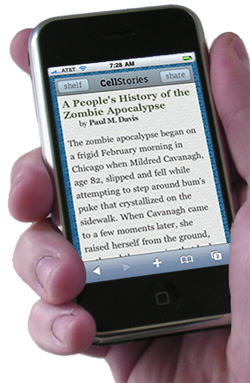
CellStories Brings Short Fiction to Your Phone

CellStories is a ridiculously simple service that brings you a little story each day.  You just open up the link to the CellStories.net site in your cell phone browser and the story shows up, well-formatted and easy to read.  The site was started by former magazine editor Daniel Sinker, who has used his many contacts in the publishing field to acquire a continuing stream of worthwhile and entertaining stories.

The main problem for me that this service solves is my inability to remember to keep reading long-form works on a cell phone.  I just can’t remember to keep going, no matter what the book.  It’s something to do with the small screen and my feeling that all handheld units are for very temporary work and pleasure.  When I read long works I use a book or a Kindle e-reader.  I have no problems with continuity there.  But CellStories only offers short fiction.  It’s the perfect little pocket literature gizmo.  I actually feel a tiny sense of accomplishment when I finish a short story on my Droid phone.  I feel that I have filled some time well that might otherwise have been spent checking my hair.

So if you want some grown-up short fiction, try CellStories.

Popular Science Magazine Archives Go Online For Free

Popular Science magazine has put its entire 137-year history of issues online for free.  In partnership with Google, the magazine is offering a search tool that will allow you to read anything it ever published.  Here’s an example of a publisher who actually knows what it is doing in the 21st century.  There are very few magazines staffed by people who understand which century they are playing in.  Popular Science is apparently staffed by people who can read, write and tell time.

Apple Declares War on Free Web Content

It’s hit me what I really can’t stand about the new Apple iPad.  It’s been mentioned by most of the reviews of this new tablet device, but I don’t think people are really getting the scope of what Apple is up to.  The iPad, like the iPhone and iPod Touch before it, does not support Flash.  You know, Flash, perhaps the single greatest technical innovation on the Web since the invention of the Web itself.  Flash is what brought us nearly universal moving images on the Internet. Flash brought us YouTube.  Flash has created almost every single good game you have ever played in your browser.  Flash is responsible for the greatest explosion of animation talent in the history of the art form.  There is not another single piece of browser software that has brought so much to the web browsing experience as the little Flash player that’s installed on nearly every computer on the planet.  Here’s a blog entry by one of the Adobe Photoshop developers that explains why Flash is so great.

But Apple does not allow Flash on its iPad, iPod Touch, or iPhone.  Won’t allow it to run.  That’s why you get a broken plugin icon whenever you encounter a web page with Flash in it.  The company says silly things about Flash being too slow, or Flash hogging CPU cycles.  Complete horse radish.  Apple doesn’t want you to have Flash because Apple wants you to buy apps in its App Store instead.  That’s what this is all about.

So, essentially, Apple is fighting for a closed and walled-up Internet where all your cool moving images and games come straight out of their App Store and nowhere else.  When you behave this way with a small-screened device like an iPhone or iPod Touch it’s one thing.  But when you blow the whole thing up onto a big fat glorious iPad screen it’s another thing entirely.  Now it really shows up as a flagrant attempt to disable every creative piece of Web work that any artist, animator, filmmaker or game designer has ever done and force people to accept your little library of 140,000 little applications, most of which cost good money.

Try visiting this web site on an iPhone, iPad or iPod Touch.  See all our games and movies in the drop-down menus?  Not a single one will work.  Not one.  Because of dear old super-genius Steve Jobs.  Mr. Dingbat gets up in front of reporters at the public iPad unveiling and says idiotic things about having ‘the Web in your hands.’  He presents his new iPad device as a Web browser.  It can’t be a Web browser if it disables half the Web.  It simply defies logic.

This is really all anyone should need to know about Apple and its devices.  They are building little cash registers that limit your view of the Web and lead you to one final destination: the App Store.  They are trying to make you pay for the World Wide Web.  Great technology.  Very dark plan.  I’m on Flash’s side.  Go Flash!  Apple, you suck.

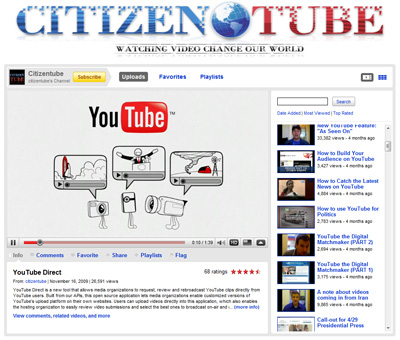
YouTube Launches Open-Source Application for Citizen Journalism

CitizenTubeYouTube has built an open-source application called YouTube Direct that allows news organizations to request and accept uploaded videos from citizen journalists anywhere in the world.  The idea is to give news organizations the ability to put out a call for videos on a specific news story and then review the direct uploads to select the ones they want to broadcast on their web sites or even over the air.  The video creators get to keep their videos on YouTube for access just like any other video on the site.  There’s more information available in their Citizen Tube information area.

The camera in the hands of the average citizen has proven to be an extraordinarily powerful tool for news-gathering over the past few years.  Instances of police abuse, natural disasters, and political turmoil have been captured by cell phone cameras all over the world.  This seems like a very smart move by YouTube that could have a profound effect on the news.  I can see this as a major benefit to smaller start-up news organizations that mostly rely on the web.

It remains to be seen, however, if YouTube makes this widely available to small sites and creative outlets, or if they stick to a larger scale more corporate membership.  That would be disappointing, but it would still broaden the availability of citizen journalism.