Trauma: A Video Poem Triptych by Swoon

Swoon is a Belgian poet filmmaker who makes films that try to blur the boundary between written poem and moving image. He mixes his own footage with found footage and sometimes mixes his own words with others. I like the quiet easy tone of his work. I like his manipulation of imagery. His work is a very difficult kind of work because it tries to make something new from two different things. Poetry is a perfect form all by itself. But film is never satisfied. It’s always looking for something to include within it. So it’s natural for film to go looking for poetry and try to bring it in. But poetry resists all alliances. Poetry seems content and willing to wait for centuries. It requires nothing. It doesn’t care what film wants. It will sit on a dry page in some crowded shelf somewhere waiting six hundred years for just a single pair of eyes to come along in boredom, open to the page, glance in, read half-way down and then slap the book shut for another six hundred years until someone decides to finish reading the goddamn thing. That’s patience. Film doesn’t have that. Film must be seen now or it withers. It begins to rot. Even if it’s digital. Digital films become confused and get lost in the forest of other digits. They may never find their way out again. So working with the two things and trying to get them together is very difficult but may actually make perfect sense.

This is a film poem triptych that is Swoon’s first work to include his own words. There’s a site for the film with more information.

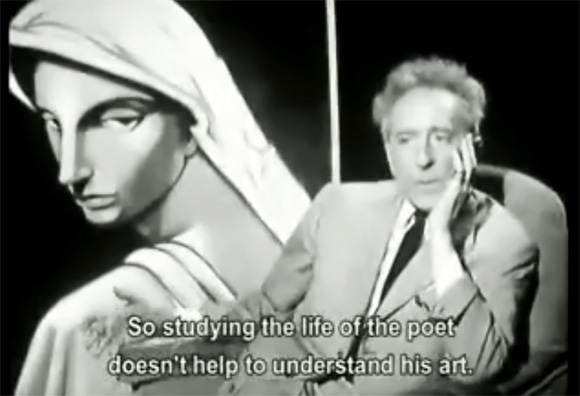
Jean Cocteau – Lies and Truths: 1996 French Documentary


This is a 1996 documentary by Noël Simsolo, featuring many interviews with Jean Cocteau himself, Jean-Luc Godard and actor Jean Marais. The great French director of films like ‘Blood of a Poet,’ ‘Orpheus,’ and ‘Beauty and the Beast,’ was also an essayist, poet, artist, and playwright. When I was a kid I read the book he wrote about filming ‘Beauty and the Beast.’ I understood little of it except that there was the general impression of someone working against constant hardship to attain a mysterious something. The book detailed his struggles with the subtleties of light, weather and performance in the pursuit of a mysterious quality that must be present in the fairytale. I knew that his efforts had worked because I had seen the film on television and understood that it was simply the most convincing fairytale I had ever seen. Another film with this totally mysterious quality is ‘Orpheus,’ which is Cocteau’s modern version of the Greek myth in which the great musician/poet descends into the underworld to bring his wife back to the world of the living. Cocteau’s telling of the tale is at once ancient and modern, always mysterious and always trying to get close to poetry. Whenever I see that film I feel that I am seeing an important picture of French artistic life in the late 1940s told through the prism of ancient Greek myth. The film sits in that fascinating period of artistic ferment and dawning of a new cinematic movement that was a reaction to the end of World War II. Possibilities in films of that period seem limitless. There is a calmness of the image, an almost casual approach to creating scenes. Things are becoming more fluid and less studio-bound. Films are beginning to lean toward poetry and art.

Even though I never really understood what was being said in the ‘Orpheus’ film, it is probably one of the most important influences on the little bits of work that I do in film and video. Various images and scenes from ‘Orpheus’ regularly pop into my head as I work.

One of the best things I think an artist can learn from looking at Jean Cocteau is to follow one’s own interests without worrying about being unqualified – pretending can eventually get you where you want to go if you do it absolutely.

Continue reading

The Mad Ones: A Brief History of the Beat Generation

Krystal Cannon (PersonTV) made this short documentary about the Beat Generation in which she not only narrates as Queen Elizabeth, but also plays various roles including Allen Ginsberg, Joan Vollmer, Bob Dylan, Jack Kerouac, John Lennon, Edie Sedgwick and Abbie Hoffman. She gives a clear account of the Beat movement then moves into the general social reaction. She also makes some very interesting points about how women were sidelined even though many of them made great contributions to Beat culture. I think that what the Beats were working on is in very fine hands indeed with Ms. Cannon at work.

Thanks to Marc Campbell at Dangerous Minds.

Poetry: Azeem

It’s National Poetry Month and here is my favorite poet of the month.   Azeem.  We see a lot of writing about cute poets with education credentials and then someone like this brilliant Azeem fellow comes along and says a few things into a camera and reminds everybody that poets can shoot word bullets. I watch this video and my heart starts pumping and I get fidgety and I want to leave my chair and get to know words as well as this guy knows them.  I noticed Azeem because he is one of the few subscribers to my YouTube film channel and so I checked him out.  I’m extremely impressed.  You want people to be interested in poetry?  Show them this guy and they’ll be interested in about 5 seconds flat.  I think what makes most poets uninteresting to the American reading public is that they all secretly have an image of a bookshelf in mind.  Bookshelves are fine if you are browsing for a book, but they are death for anyone who’s making something.  Azeem is also working with some hugely talented filmmakers who make fantastic imagery and do it with ease.  If he comes to Los Angeles, I want to know about it and go see him play.

Set a Blaze:

Continue reading

I’m Gonna Beat You With My Poem

I’m about to show you why I have so few friends.  It’s because I don’t put up with ‘team mentality.’  Hey kids, come over here and join my poetry team!  Yeah dudes!  Get with it!  Get hip to my dang poetry team, bro!  We could win!  We could take the whole prize, sista!  Yeah, baaaaaaby!

I’m the kid eating the Twinkies, picking my nose, twirling the Frisbee on my finger and looking at you like you’ve got a gun.  That’s me.  You scare me, poetry dude.

For some reason, in our young national culture, we enjoy teaching our children to compete via talent shows of all stripes.  Since it’s National Poetry Month, the Louder Than a Bomb demo video caught my somewhat jaundiced eye.  I put up with it all the way through even though it made me squirm.  Poetry as in your face talent competition doesn’t fit my world view.

Right away the video starts out with total obnoxiousness.  The guy says, ‘We de-emphasize the competition, but you want to win!’  A-hole.  What an idiot.  Kids, remember, always run from a guy that says something like that.  Run and don’t look back.

I feel the same way about film festivals, American Idol, Dancing with the Stars and the Academy Awards.  I even feel the same way about online writing contests, though I’ve hosted them myself.  They are intended to boost traffic on a web site.  They serve no real purpose and offer no true value at all.  Contests are held to make mediocrities feel like they can hand out prizes.  A kid who is going to be a poet is going to leave by the back door every time.

Animation: Khabrahol (From Russia’s Toonbox Studio)

From Russian animation studio Toonbox comes this marvelous animation based on a poem by Sasha Svirsky. I don’t understand a word of it but I love the sound of it. I really must find the woman who does the voice-over.  She is just magnificent and totally fearless.  The drawings are fascinating.  The rhythm is catchy.  Toonbox does so many of the best animations that I see.  They seem to balance their commercial projects with artistic ones very well.

Via Cold Hard Flash

Film: Typography

In Ronnie Bruce’s short film Typography, poet Taylor Mali lets it all hang out about how people talk today. Hipsters. Kids. Cooliodoolios who don’t want to sound too committal about anything. Every utterance is just a little fart with a question mark at the end. ‘You know?’

I don’t happen to have this problem with sounding non-committal and all like you know laid back. I get in trouble because I talk too much like a guy who’s swinging a baseball bat. But, uh, you know, in an era of fake Bush wars and a ‘liberal’ president who tells me I’m going to have to buy insurance from a murderous private company or else… well, hmmm, like, dude, I’m swingin’ my verbal bat just as hard as I want and I’m hoping to hit someone in authority. The Tea Party folks are idiots, but there’s one thing they’ve got right. Obama is so over, he’s, like, you know… done.  Obama reminds me of a school principal.  Never says anything worth listening to.  He’s got the dullest eyes I’ve ever seen on a president.  Notice that?  Blank.  Even Bush had expression.  Always terror.  Sheer stark raving terror radiated out of Bush’s little monkey eyes.  Obama radiates the pause between pre-planned comments – the ‘umm’ moment.

Of course, when people suddenly get very clear, direct, self-assured and forceful in their statements you know what happens, right?  You get Hitler.

Poetry Is? It’s a Stupid Question, That’s What.

In my poetic web adventures I went and found this big long movie by George Quasha about poets trying to tell everybody what poetry is. What is poetry? It’s not an unanswerable question. It’s a stupid question. But these poets do try to answer it. It’s a rather long movie and I always look for a bad guy in every movie. Without a bad guy, a movie just makes me hungry and I get up to go to the bathroom a lot. These poets are all so nice and content looking. So friendly and comfortable. I can’t find out which one is the bad one. Someone once asked me a really stupid question and I ran away with his camera and threw it in the river. Why aren’t any of these poets nasty and depressed? What makes them so pleasant? They all sound like their favorite piece of furniture is a podium.

Here’s a guy who if you ask him what poetry is will very likely give you a good reason to never ask that question again:

Get what I mean?

Planisphere: New Book of Poems by John Ashbery

PlanispherePoet John Ashbery has published a new book of poems called Planisphere.  Boy, I hated this guy’s poems a few years ago.  But I kept reading them because of some instinct for self-inflicted mental damage.  And I kept reading him.  Not understanding him at all.  But I liked the words as they passed me by.  They sort of slide on by you.  Smooth, but switching and becoming something totally unexpected, unrelated to what just happened before.  His poems sort of shimmer and seem a bit brittle, like glass.  When you read this guy you certainly know that you are not reading someone else.  He’s in his eighties, but his work seems like a young man’s.  He has a gently rebellious foolishness that I greatly admire.

His publisher, Harper Collins, has a preview of his new book that offers quite a few of the poems.

So does this sound like the writing of an eighty-year-old?

I dream of married couples having sex, shopping, everything,
and often get the giggles, staying here,
expecting something new to come along every five seconds.
That’s new to me, I expect others will have heard about it.

B—’s Mysterious Greeting

And here’s the guy:

Poem: Number Crunchers Adore Me

I am a clipped in user
of information keyed and shining
on a glass partition with an ascending
staircase behind the twitching
lozenges

My fingers hunt
the sleek and they twirl
along the draped wires
to find the pressed-in
prong which is
bent

You cannot throw me
or catch my attention
from the sideview
just remember
that I passed the pickup
and won

Number crunchers adore me
because the arguments
are bluffing really
people don’t use them
without qualifications

Remember the Book?

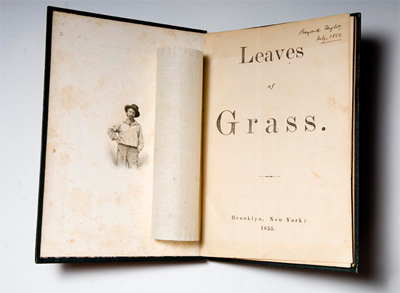
LeavesOfGrassBookRemember the book?  Of course you do, because you have plenty of them in shelves, half-read, dusty, bent, torn, coffee-stained, wine-colored, smudged, smelly, misprinted, broken and cherished. They catch your glance as you walk from one room to another, reminding you of a year or a moment when you were doing something else but had that book in your bag or backseat and meant to finish it or did in fact, and put it away and moved it several times in a box, cursing its weight and trying not to bend it.  So there it sits now, quite possibly closed until the day you die.  But you know it’s there and it’s a marker in your life.  Remember this thing with books?

And LPs of vinyl?  Mine used to function like books in my shelf.  But I put them into a closet years ago because of CDs.  Now I can’t stand searching a shelf of CDs, so I mainly use MP3 files.  My albums no longer work as markers of life and time.  The same thing is happening to books.  All of mine are still on the shelves.  But the world is changing and books are beginning to look a lot like information that wants to weigh less. It doesn’t matter how one feels about this, whether it makes us sad or not.  It’s a creeping fact.  Our books are turning into wonderful collector’s items. I can tell this is happening partly from all the excitement and business surrounding these e-reader devices.  Books will continue to play an important role in literature but they will gradually be eclipsed by some other technology.  The current e-readers are not necessarily it, but they are the harbingers of things to come.  We are lightening our load because we can’t carry it around forever.  We’ll have to travel light.  Walt Whitman wouldn’t mind though, because he’d want to travel with us.

But this fellow, Raymond Danowski, has amassed the largest collection of 20th Century English poetry books in the world.  He collected over 70,000 books, periodicals, and artifacts.  The collection includes a first edition of Whitman’s Leaves of Grass, printed by the poet himself.  It also has a first edition of T.S. Eliot’s Prufrock and Other Observations.  There are so many books that when he donated the entire collection to Emory University in Atlanta, it took volunteers over a year just to unbox all the volumes.  The university is now the major center for researching 20th Century English poetry books.

I’d like to see that collection.  It must be fascinating.  And anything is worth touching that Walt Whitman touched.  Seeing books is the thing.  They have a presence in a room, lining its walls and giving it enormous depth.  But we are engaged in a process of making our books invisible.  What will we put in their place?  I’m not really too worried about that because when you turn all those words into digital form you present yourself with infinite possibility.  When words float around in the air you are in the realm of magic beyond anything any book could have ever accomplished.  Then again, sometimes just touching a book is enough to send your mind wandering down an unexpected path.  Can touching a virtual keyboard have the same effect?  Does it have to have the same effect?  Maybe not.  I’m sure banging a chisel into a clay tablet did things to a mind that ancient peoples were loath to part with.

Does the emergence of a world without books frighten or worry you?  Do you see something wrong with a world in which literature is simply information that travels wirelessly?  Do you think that ink is inherently superior to bits?

Eventually, we will read War and Peace by passing someone on the street and glancing into their eyes for a brief moment.  That person will give us the book as nothing more than a polite ‘How do you do?’  At that point, we will remember books the way we remember the clay tablet.