Fantastic Visual Explorations in the Films of Michele Smith

MicheleSmith1

Filmmaker Michele Smith has been exploring the relationships between film and video for many years. Her work is – to say the least – brilliant and voluminous, ranging from found footage movie trailers to family beach films, commercials, street video, newspaper, View-Master slides, bits and pieces of plates and plastic. If you visit the filmmaker’s YouTube channel and decide to list everything available, you are going to be amazed. There’s so much there. It’s like digging through a museum of filmic ideas. Make no mistake, the ideas come at you in a dizzying array, too much to absorb immediately as the images pop and crackle like a slowly exploding bomb. Split seconds are all that are necessary for Smith to make a point, breaking footage into mere 2-frame segments that play against each other to form brand new images in the mind’s persistence of vision. You’ll know what I mean if you use the pause button to do a little digging into Smith’s complex constructions. I doubt she would mind. The reality of video on the web and how we use it seems to be something she is more than comfortable with.

I always enjoy filmmakers who look at cinema as it really is.

I also enjoy filmmakers who pursue the messy art of images. Sites like YouTube and Vimeo are depressingly overloaded with filmmakers who have gotten very excited about their super-glide floating camera rigs and long DSLR lenses. They make shiny, gleaming, gliding, perfect little advertisements for themselves and include tastefully typed title sequences.

Michele Smith is the filmmaker who takes their lunch money and spends it on a hamburger, not a tripod.

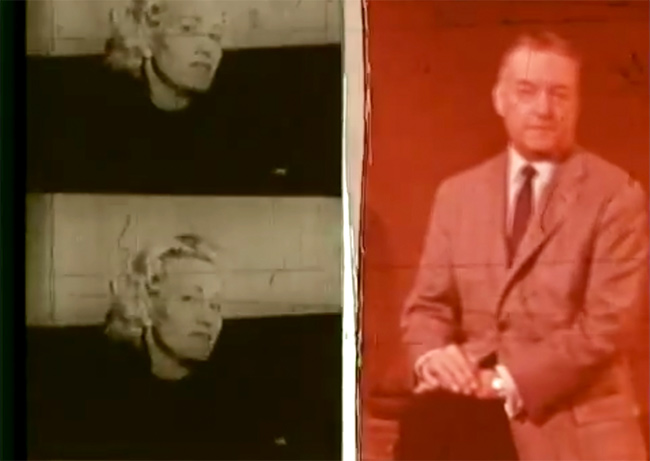
In this first film from 2003, ‘Like All Bad Men He Looks Attractive – They Say,’ Smith uses found 16mm footage from several films to not only intercut various images, but to construct animations out of the footage laid out in various patterns, sometimes along with other cutout images or materials which are then photographed to video. She often reanimates the celluloid by photographing frames in sequence. I consistently get the impression of two cinematic forms playing off each other. Some of this found footage was rescued from a fire and you can see the melted edge of the filmstrip.

Film captures light. Video captures ideas.

These are ideas Smith is offering. The images are most often gorgeous, sometimes jarring. They unsettle. Sometimes they irritate. She has that knack for constantly returning to something, working it under the skin.

In this film, we see things of beauty as advertised – constantly expecting a promised perfection, but always seeing through to threat and decay. In spite of its underlying darkness, the film is a celebration of art and cinema, constantly using one to build the other. Strips of perforated film are arranged to form individual artworks. Photographs are shredded and arranged alongside torn away optical sound strips. Advertisement or catalog images of statues and vases pass by, attempting to become film. One form is always vying for a place in the overall structure, always trying to be something other than itself.

Even though it was shot to video, the film is built with rapid cuts between fleeting images. The short durations and constant cutting from shot to shot create superimpositions in the mind of the viewer. Toward the end of the film, around the 1:08:00 mark, a woman appears standing on a small boat. She seems to drift through a sea of hazy, flickering decay. But she doesn’t. The images that seem so intertwined are completely separate.

Here is ‘Like All Bad Men He Looks Attractive – They Say:’


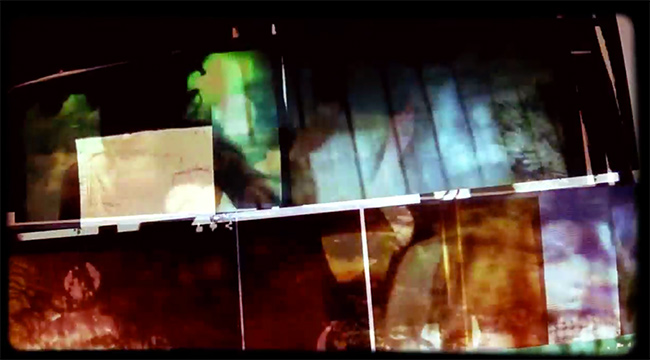
Here’s another film called ‘Things.’ This is a more recent one in which Smith points a camera at a computer monitor showing a web page with many of her films embedded. She then scrolls up and down the page, creating a film frame flicker effect. She ups the ante continually by layering the video.

The point I am making is that there is intense experimentation going on here with what constitutes the primary differences between film and video. It seems almost a casual mockery of filmmakers who go to great lengths to get old filmic effects into their videos. Hairs and scratches and jitters that have no meaning whatsoever in modern cinema. But it’s also a look at how mimicry of an old form leads to new things when used consciously.
MicheleSmith5

I think it was Godard who said some years ago that superimposition is the great new language made possible by video. Only video makes layering of images as simple and direct as the frame to frame cut once was with celluloid.

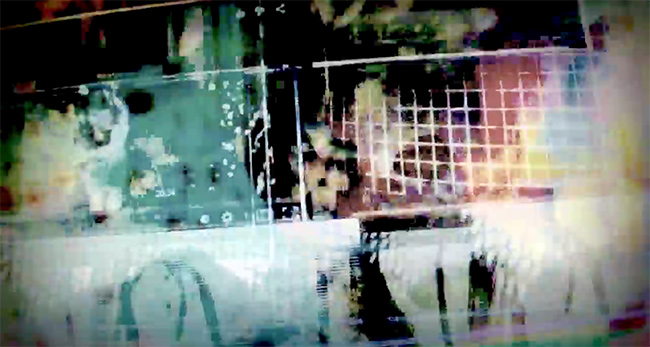
Smith presses into the new cinema/internet idea further in other films as she begins using internet shopping sites with long image arrays selling jewelry and watches. She scrolls through them, seeming to wonder at how we create cinema for ourselves without realizing it. We bombard ourselves with a flurry of images every day, overloading and completely enveloping ourselves in our own self-reflecting movies.

Here is ‘Things:’


The computer monitor superimposition effect is used again here in a film called Things 3.
MicheleSmith4

Here is ‘Things 3:’


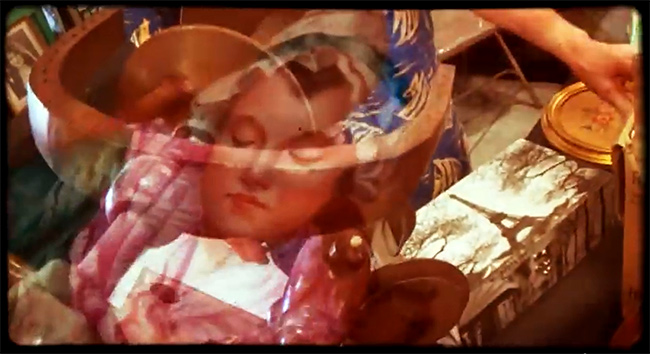
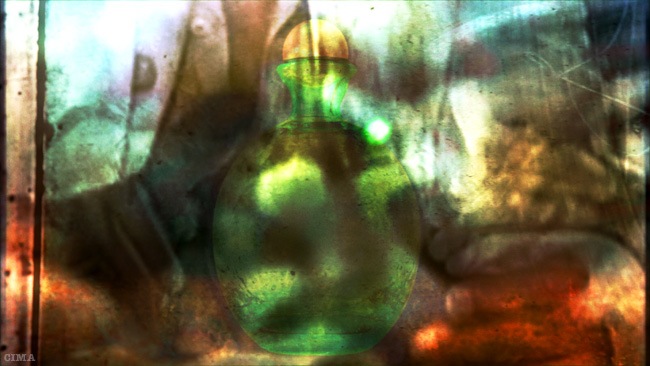
Another film, ‘Spinning Wheel Medusa, Drama Between a Monkey and a Nude,’ uses techniques that come naturally to video. Shot with a hand held video camera inside what appears to be some kind of crafts expo or bazaar, the film layers images of a spinning wheel, decorative plates, embroideries, vases, statues and various bric a brac.
MicheleSmith6

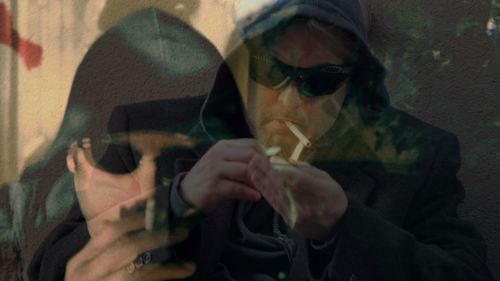
Always aware of the history of art, the film seems intent on elevating decorative objects to a realm of higher purpose. Here we see the rapid cutting of previous films losing favor to the more languid drift of layered video images. My own view is that the layering of images is much more difficult than frame to frame cutting. Layering presents the problem of making a single image from multiple images while gaining power instead of losing it.

Here is ‘Spinning Wheel Medusa, Drama Between a Monkey and a Nude:’

Michele Smith’s films have been shown at many international film festivals, including The New York Film Festival, The Times BFI London Film Festival, Chicago Onion City Film Festival, and Anthology Film Archives Screenings.

The filmmaker’s web site is Actipes Films.
Short Experimental Western Film: The Magical Dead Sunstroke Valley

Sunstroke-Valley-Final-2

A film combining the mythology of the Hollywood/Spaghetti western, Tarot, magic, occult, Jungian psychology, and mysticism with flamboyant, multi-layered, supersaturated imagery.

Multiple narratives conflict and adhere. Meanings emerge and contradict. Music and dialog tell another layered story, sometimes agreeing with the images, sometimes trying to subvert them.

A film should be a container for the psychic unconscious energy of its creator. That is what this is.

There is also a commercial.

Blank City: Documentary About a Time When New York Had Artists

Celine Danhier's 2010 documentary covers a time in the late 1970s when New York was exploding with music and filmmaking energy. Young artists were unafraid to take to the streets without budgets. They were paying low rents and had a community to thrive within. Watching this makes one wonder what exactly New York is for today. It seems more corporate than creative. More trendy than artsy. I think the cops shoot people who don't have budgets now. That's if they aren't too lazy to strangle them to death. Where are young artists going now? Detroit? Newark? Or do they just decide to look down, keep walking and go buy a latte?


Spirit is a Killer: A Short Film by Joewi Verhoeven

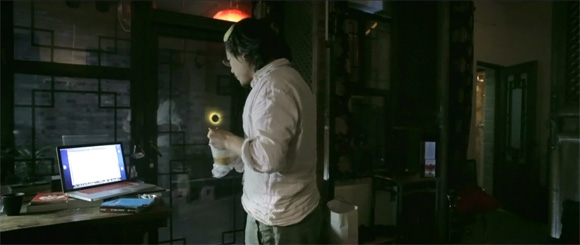
Here’s a short film from Beijing, China directed by Joewi Verhoeven. It’s an odd and discomforting tale about a solitary writer whose fictional world is intruding upon the real world. The film is a quiet and focused examination of a writer’s creative doubts and fears. I particularly like the bit where a Chinese policeman who is a friend of the writer comes over and can’t seem to see the dead body that is perhaps a result of the unrestricted imagination of the writer. The film also has a lovely soft celluloid look even though it was shot entirely on a Canon DSLR.  Also, pay attention to the beautiful and eerie background audio.

Filmmakers of Our Time: John Cassavetes – 1968 French Documentary

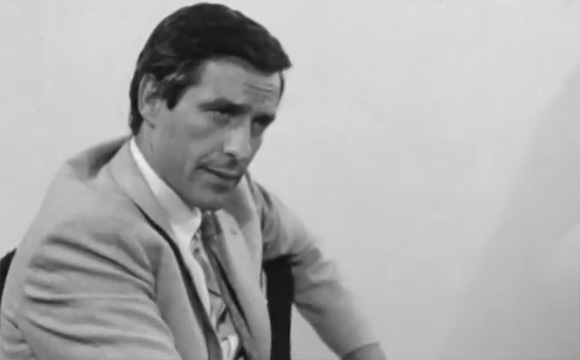
John Cassavetes’ first film was called ‘Shadows.’ It was made in 1959 and I think it might be the greatest film about race in America that’s ever been made. Cassavetes has always struck me as having an element of that required con-man aspect of the personality that is present in many good actors. When he talks he seems impressed with what he is saying and he knows how to deliver it with just the right amount of humor and a few self-deprecating remarks. But he means every goddamn word of it and he puts all of his thoughts into his film works. He’s one of those rare objects of confusion that sometimes crop up in American art. I’ve been watching a bunch of his films lately and I don’t think I’ve ever seen a filmmaker so interested in looking at the inability of the American adult to understand or even perceive the meaning of their habitual mannerisms. For me, his films illuminate what it means to be a grownup and how the performance required of grownups contrasts with what they really want to be.

Cassavetes on making ‘Shadows:’

That people can go out with nothing and through their own will and through their determination make something that exists… out of nothing. Out of no technical know-how, no equipment. There wasn’t one technician on the entire film. There wasn’t anybody who knew how to run a camera… walked in and started to read the directions of how to reload it. Got a Movieola and looked at it. Did all the things in the world and we made eight million mistakes. But it was exciting and fun.

This is a 1968 French documentary that was probably shot just after or during the making of his great marriage disaster film, ‘Faces.’

Trauma: A Video Poem Triptych by Swoon

Swoon is a Belgian poet filmmaker who makes films that try to blur the boundary between written poem and moving image. He mixes his own footage with found footage and sometimes mixes his own words with others. I like the quiet easy tone of his work. I like his manipulation of imagery. His work is a very difficult kind of work because it tries to make something new from two different things. Poetry is a perfect form all by itself. But film is never satisfied. It’s always looking for something to include within it. So it’s natural for film to go looking for poetry and try to bring it in. But poetry resists all alliances. Poetry seems content and willing to wait for centuries. It requires nothing. It doesn’t care what film wants. It will sit on a dry page in some crowded shelf somewhere waiting six hundred years for just a single pair of eyes to come along in boredom, open to the page, glance in, read half-way down and then slap the book shut for another six hundred years until someone decides to finish reading the goddamn thing. That’s patience. Film doesn’t have that. Film must be seen now or it withers. It begins to rot. Even if it’s digital. Digital films become confused and get lost in the forest of other digits. They may never find their way out again. So working with the two things and trying to get them together is very difficult but may actually make perfect sense.

This is a film poem triptych that is Swoon’s first work to include his own words. There’s a site for the film with more information.

The Living Want Me Dead: Short Horror Film by Bill Palmer


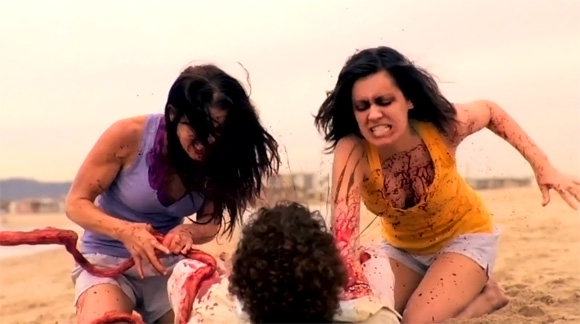
The Living Want Me Dead‘ is a short independent horror film that’s won a bunch of awards at festivals because it deserves to. I enjoyed every minute of this wild ride along with a desperate slacker as he realizes that he’s been contaminated with a substance that causes everyone within sniffing distance to want to disembowel, devour, decapitate and dismember him. He’s hounded by vomiting, mouth-foaming lunatics who simply won’t rest until he’s dead. It’s a clever commentary on the overdone zombie genre that manages somehow to be frightening and hilarious at the same time. The film was written and directed by Bill Palmer who employes techniques typically seen in independent feature films. Vimeo is full of filmmakers who want to strut their pro-quality stuff, but very few of them make anything I can watch for more than several seconds. I’m sure that director of photography Jeremy Hayward had a lot to do with this because the camera work is fluid and clear, even when following intense action and movement.

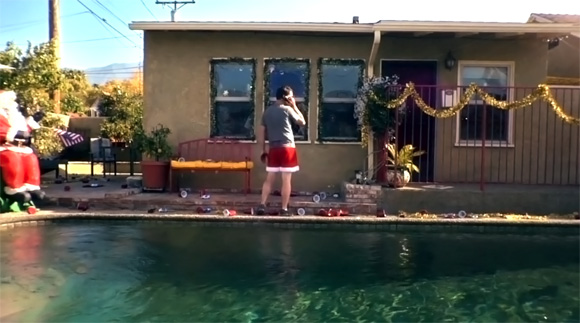
Director Palmer handles his equipment, crew and actors without letting the job overwhelm his natural instinct for telling a ripping good story and making us want to know what’s going to happen next. In fact, he made much of his own equipment, including a simple rig for filming underwater! He used water guns to shoot fake blood. I love that kind of filmmaking. And I love that he did it all without ridiculous shooting permits. He just hit the side streets with his little crew and turned the whole neighborhood into what I imagine was a hell of fun time. He has created a tight little view into a California suburb at Christmas time by littering the landscape with decorations that lend a sort of lunatic and false joy to the dark comedy and spurting blood.

So the main character, played to intense and despairing perfection by Adam Conger, tries to get away from his attackers by lying low at a friend’s house. Conger really hits his role on the money. He’s perfect as the overwhelmed slacker-type dude who’s actually fairly driven and maniacal in survival mode. But he just can’t seem to find a good way to explain the desperate situation to his friend who is played with great comic ability by Tony Nunes. I believe that during the violent proceedings in his backyard, this friend is primarily engaged with heating up a HotPocket. Needless to say, the hero’s plan for lying low does not work out very well!

Celles Qui S’En Font: 1928 Short Film by Germaine Dulac

Germaine Dulac was one of the original French film ‘auteurs.’ She was also a film theorist and feminist. She had a relatively short career as an avant-garde filmmaker, making such works as ‘The Smiling Madam Beaudet (1923) and ‘The Seashell and the Clergyman’ (1928) which is often credited as being the first Surrealist film.

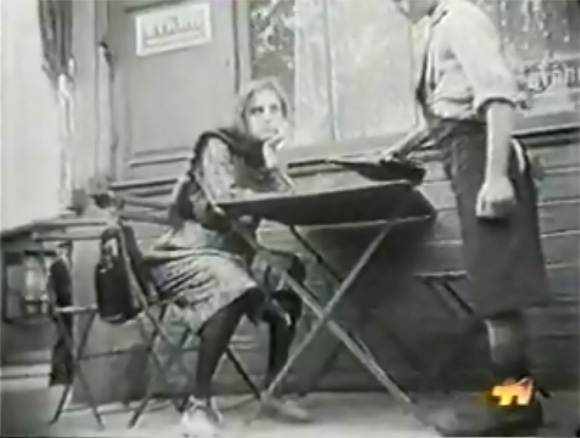
In this film, the title translated as ‘Those Who Make Themselves,’ we follow a destitute drunk woman who appears to yearn for the life of a prostitute or to engage in some sort of tryst. It is also possible that she is simply despondent over rejection by a lover. She appears to fail at everything she tries and eventually walks down a staircase into the Seine river. It’s a very simple film that manages to convey a deep sense of loneliness.

Dulac insisted on being credited as the author of her films, not accepting the standard partnership between a screenwriter and director.

Here’s a 1923 quote from Dulac:

I believe that cinematographic work must come out of a shock of sensibility, of a vision of one being who can only express himself in the cinema. The director must be a screenwriter or the screenwriter a director. Like all other arts, cinema comes from a sensible emotion … To be worth something and “bring” something, this emotion must come from one source only. The screenwriter that “feels” his idea must be able to stage it. From this, the technique follows.

Here’s a Senses of Cinema article on Germaine Dulac entitled ‘The Importance of Being a Film Author: Germaine Dulac and Female Authorship.’

7362: 1967 Experimental Film by Pat O’Neill

Patrick O’Neill is one of the Los Angeles artists currently featured in the huge citywide exhibit known as ‘Pacific Standard Time.‘ He has made many experimental films using techniques perfected with an optical printer. This film incorporates footage of oil derricks in Venice, California and nude models filmed in the artist’s studio. Its synthesizer score is by Joseph Byrd. I don’t know much about optical printers, but I do know that they allow images or films to be projected and rephotographed by a movie camera. So my guess is that one could set up multiple layers of screens and projections to film them and blend them into a single image. Optical printers were used to create special effects in Hollywood films. I think perhaps the most famous use of the printer was in the creation of the light show sequence near the end of Stanley Kubrick’s ‘2001: A Space Odyssey.’

O’Neill is one of the people who form the incredible fabric of the Los Angeles art scene post World War II. I did not know of him until I found his work through the Pacific Standard Time exhibit which is really something remarkable and I think that its effects will be felt in the art world for quite some time. Its broad scope, grouping and explanation of the Los Angeles art history and its significance cannot help but influence artists here in the city and far beyond. It’s essentially saying, ‘Look, here’s a great and fascinating body of work inspired by a city for the second half of the twentieth century. Here’s how it all happened, who the people were and what they were trying to do.’ It’s a very strong impression to make on a city. It must be a very great honor for an artist to be included in it.

O’Neill from a 1997 Millennium Film Journal interview:

I finished my first film in 1962. Then I started doing abstract or composite films. I began to use the camera as a sort of gathering device to provide elements for manipulation through re-photography. This led to 7362 which was finished in 1967. I didn’t have much knowledge about the history of the medium at that time. I’d had maybe three film classes at UCLA and beyond that the midnight screenings at the Coronet and the Cinema Theater were my education. That series at the Cinema Theater was going on from the early sixties.

The artist’s Lookout Mountain Studios has a web site.

Das Kleine Chaos: 1966 Short Film by Rainer Werner Fassbinder


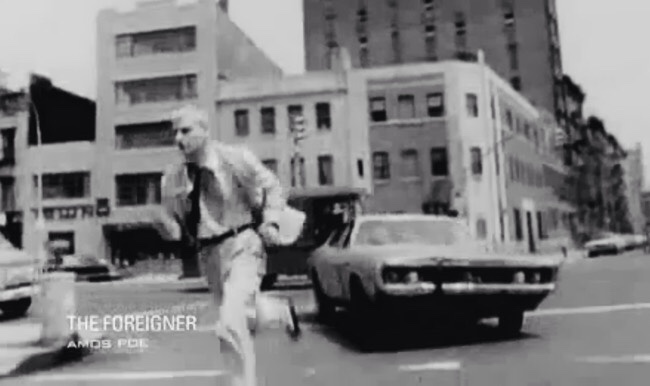
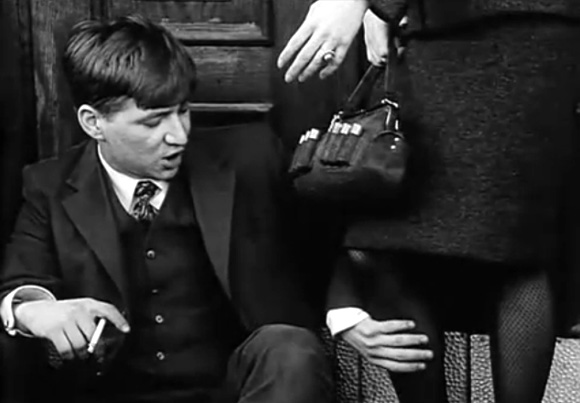
Here’s a 1966 short crime film by a young and learning Rainer Werner Fassbinder. The great and too-soon-departed German filmmaker actually plays one of the three young criminals who decide to invade a woman’s home to terrorize and rob her. The film is relentlessly cool and begins at around the 3 minute mark to really show how deeply Fassbinder was mining the work of Jean Luc Godard. Those shots in the apartment with Fassbinder reading the novel out loud in front of a wall of pinned art prints is straight up Godard stuff. But it’s just fine to imitate other filmmakers as long as your real intention is to destroy them from the inside. Fassbinder was just that kind of filmmaker.

Here’s an article about Fassbinder on the Senses of Cinema site.

Camera: A Short Film by David Cronenberg


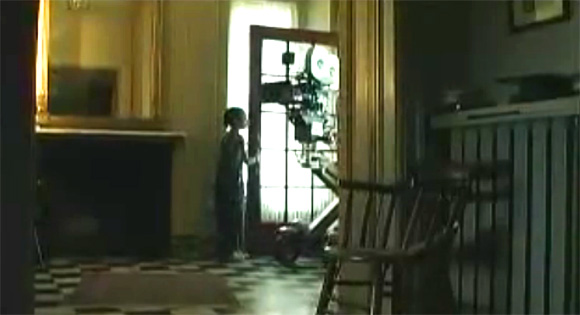
This is a short film made in 2000 for the Toronto International Film Festival by David Cronenberg. ‘Videodrome’ actor Les Carson talks about how afraid he is of the movie camera while children bring one into the house and set up to shoot their own movie with professional equipment. The actor’s fear and doubt contrast sharply with the enthusiasm of the kids. But of course they are interested in him as subject matter because they know that he is real. This is an excellent and moving study of time, creativity and how all art is an unfathomable mixture of enthusiasm and terror.

Opening Scene Film Adaptation of Thomas Pynchon’s Inherent Vice Filmed by Jeff Hoyt

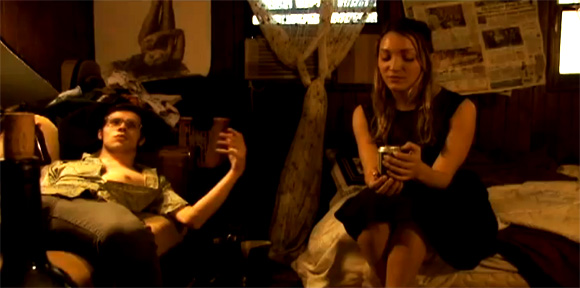
It’s nearly impossible to find film adaptations of Thomas Pynchon novels anywhere. I frankly don’t know why anyone would even try to film such books. It seems almost suicidally foolish. But this plucky fellow, Jeff Hoyt, has at least given it a small go. He’s filmed a sort-of version of the opening pages of Pynchon’s silly little lightweight piffle of a book, ‘Inherent Vice.’ This is where the lead detective/loafer/drug user/hippie/surfer/beach lounger/semi-retired permanent loser character, Doc, encounters his mysterious ex who presents him with a strange possibility for detective work. I like this little piece of film because it really tries to do Pynchon. The actors are Orien Longo and Rachel Kadison. The role of Doc is a very difficult thing to tackle because it really seems to require little effort. Actors who aren’t solid in their experiences always want to work at getting it down. You can’t do that with a character like Doc. If you aren’t him, you can’t play him. Simple as that. But the role of Shasta as played by Ms. Kadison is a sweet surprise. She’s damn good. She can do this work.

Detective City Angel: A Film by Alessandro Cima


MATURE CONTENT AND LANGUAGE
First, here’s a nice review and interview about the film at Dangerous Minds. Want to follow a secret identity artist through a dangerous Los Angeles as he escapes and hits like a criminal? Hang on and watch carefully. You may need to watch it 14 times to catch the drift. But you’ve probably got that kind of time anyway. This is a Los Angeles crime film. But it’s as if several films on celluloid fused together and what you end up with is an art film that gets overwhelmed by urban documentary and then collapses into a narrative thriller. It’s filled with hints, clues, evidence and misdirection. Images, ideas and sounds bounce off each other, mirror each other. There are secrets in this film. You have to watch carefully, through layers to catch things. I’ve tried to make a film that moves like disjointed thoughts toward the preordained ending. Continue reading

Attempt: A Short Film by Jennifer Sharpe

The film seems almost out of time. It could have been filmed fifty years ago. The gently swaying palms of Los Angeles fit between buildings easily but seem to have a romantic life in this film. The music, a piece for theremin and string quartet by Herbert A. Deutsch, fits the imagery in Jennifer Sharpe’s film to perfection. This kind of filmmaking, done with a small camera and then edited and colored in a relatively simple digital editor, is very close to the simplicity of the poet working in a notepad or the artist sketching from her window. Sharpe’s films are deeply felt poetic expressions that seem to exist in the only possible form that they could have. She turns her video images into something close to painting, extending time and finding mystery in simple movements. She has a very gentle approach but with strength in her observation and emotional ability, sort of like a butterfly with steel wings.

You can find out more about Jennifer Sharpe’s digital videos and paintings at her web site.