Rabbit Ears: Experimental Film by Alessandro Cima

Rabbit-Ears-Frame-1

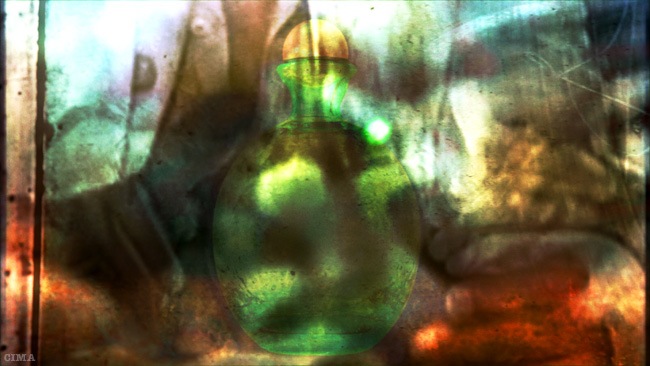
Imagine an insane alien astronaut who tunes into earth’s radiating television signals originating in the analog days of the twentieth century. The alien receives our entire TV culture in seconds, processing the sounds and images instantly, watching them all simultaneously… and the alien is crazy enough to find a message within.

This is an experimental film that is for all intents and purposes a continuation of my previous film, “The Magical Dead Sunstroke Valley,” which has been screening for the past year at the Los Angeles Center for Digital Art (LACDA).

Short Experimental Western Film: The Magical Dead Sunstroke Valley

Sunstroke-Valley-Final-2

A film combining the mythology of the Hollywood/Spaghetti western, Tarot, magic, occult, Jungian psychology, and mysticism with flamboyant, multi-layered, supersaturated imagery.

Multiple narratives conflict and adhere. Meanings emerge and contradict. Music and dialog tell another layered story, sometimes agreeing with the images, sometimes trying to subvert them.

A film should be a container for the psychic unconscious energy of its creator. That is what this is.

There is also a commercial.

Jeff Keen’s Dreams of the Archduke Sketchbook

JeffKeen1

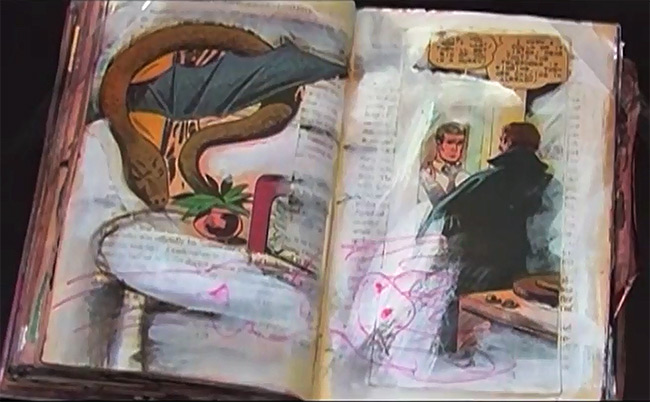
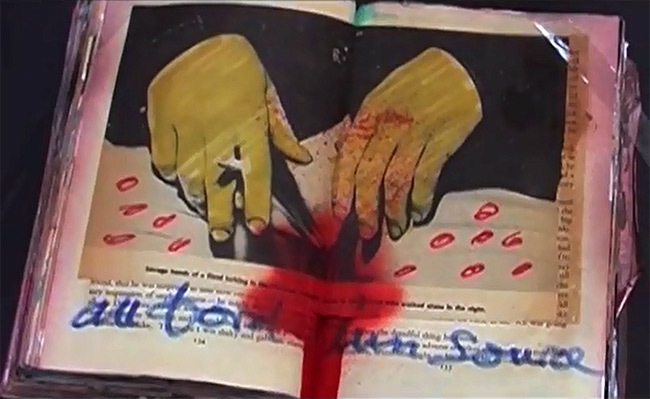
This is a short film made for a gallery showing of works by the late great British artist and filmmaker, Jeff Keen. It’s a soundless page turn through a series of brilliant and inspiring pages in a sketchbook. If you are at all familiar with his amazing film work, you will see how directly connected to that work these pages really are.


JeffKeen2

If you are unfamiliar with Keen’s incredible and very influential film work, here is a treat for you. It’s his ‘Marvo Movie’ from 1967.


Trauma: A Video Poem Triptych by Swoon

Swoon is a Belgian poet filmmaker who makes films that try to blur the boundary between written poem and moving image. He mixes his own footage with found footage and sometimes mixes his own words with others. I like the quiet easy tone of his work. I like his manipulation of imagery. His work is a very difficult kind of work because it tries to make something new from two different things. Poetry is a perfect form all by itself. But film is never satisfied. It’s always looking for something to include within it. So it’s natural for film to go looking for poetry and try to bring it in. But poetry resists all alliances. Poetry seems content and willing to wait for centuries. It requires nothing. It doesn’t care what film wants. It will sit on a dry page in some crowded shelf somewhere waiting six hundred years for just a single pair of eyes to come along in boredom, open to the page, glance in, read half-way down and then slap the book shut for another six hundred years until someone decides to finish reading the goddamn thing. That’s patience. Film doesn’t have that. Film must be seen now or it withers. It begins to rot. Even if it’s digital. Digital films become confused and get lost in the forest of other digits. They may never find their way out again. So working with the two things and trying to get them together is very difficult but may actually make perfect sense.

This is a film poem triptych that is Swoon’s first work to include his own words. There’s a site for the film with more information.

Les Mystères du Château de Dé: 1929 Film by Man Ray

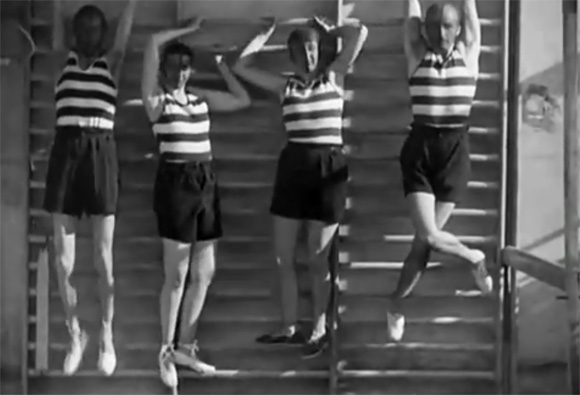
Surrealist art great, Man Ray, made this film in 1929. It follows a pair of indecisive travelers who base all their action on chance. They head out to a fabulous chateau in the hills and wander around inside and out. They run into four odd persons who enjoy swimming and running about as if the place is their private gym. But what is Man Ray doing here? Why all these shots of windows, lamps, sculptures? He is finding the abnormal in the normal. Wherever he happens to be with a camera he can make the surreal. He’s functioning as an artist, looking for odd angles, shadows, contrasts. He is also diving into the great current of his culture. The house is a castle filled with fine objects and great art. Man Ray is expressing his enthusiasm. This is an extremely childish film. I mean that as a compliment, though I really see nothing exceptional in works for children. But for an artist to function as a child for a certain amount of time is extraordinary and beneficial I think. But that kind of thinking must end and lead to its own destruction. In other words, I do not think any children’s author or illustrator should ever continue to work in that way for more than a few years. Then it is time to think about serious things and to make things that upset people. Perhaps that is my main criticism for most of the things I have seen by Man Ray. He seems a little bit too pleasant. I might be wrong about that. I have to look a little more.

Celles Qui S’En Font: 1928 Short Film by Germaine Dulac

Germaine Dulac was one of the original French film ‘auteurs.’ She was also a film theorist and feminist. She had a relatively short career as an avant-garde filmmaker, making such works as ‘The Smiling Madam Beaudet (1923) and ‘The Seashell and the Clergyman’ (1928) which is often credited as being the first Surrealist film.

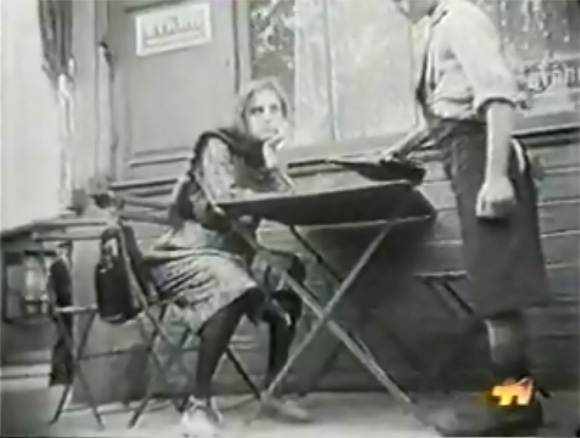
In this film, the title translated as ‘Those Who Make Themselves,’ we follow a destitute drunk woman who appears to yearn for the life of a prostitute or to engage in some sort of tryst. It is also possible that she is simply despondent over rejection by a lover. She appears to fail at everything she tries and eventually walks down a staircase into the Seine river. It’s a very simple film that manages to convey a deep sense of loneliness.

Dulac insisted on being credited as the author of her films, not accepting the standard partnership between a screenwriter and director.

Here’s a 1923 quote from Dulac:

I believe that cinematographic work must come out of a shock of sensibility, of a vision of one being who can only express himself in the cinema. The director must be a screenwriter or the screenwriter a director. Like all other arts, cinema comes from a sensible emotion … To be worth something and “bring” something, this emotion must come from one source only. The screenwriter that “feels” his idea must be able to stage it. From this, the technique follows.

Here’s a Senses of Cinema article on Germaine Dulac entitled ‘The Importance of Being a Film Author: Germaine Dulac and Female Authorship.’

The Birth of the Robot: 1936 Experimental Advertising Film by Len Lye for Shell Oil Company


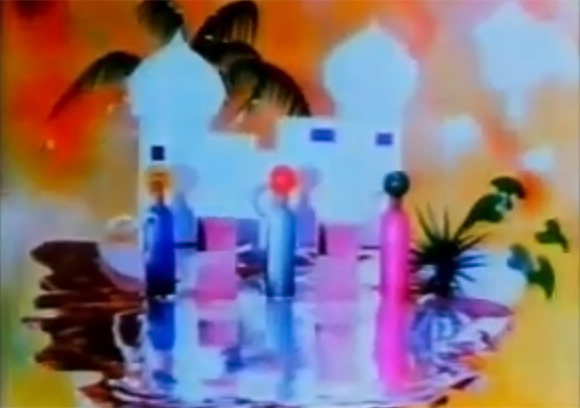
In 1936, experimental filmmaker Len Lye made this short surreal animation to advertise the benefits of Shell oil for lubricating things. The film is a hyper-saturated stop-motion extravaganza that involves a mechanical world turning on some sort of hand crank. There’s an adventurer driving around the sands of Egypt. His car winds down and konks out leaving the man dead in the desert. The angel of oil rains drops of lubricating crude down on the Egyptian landscape bringing the parched skeleton to life as the Shell Oil robot. Fascinating. It’s got that awkward, shiny, naive beauty that could only be achieved in the 30s. Parts of this thing look like they might be influenced by Salvador Dali’s work. Something about that dead skeleton and the desert looks like it could fit right into the Surrealist master’s paintings.

Lye was from New Zealand and worked not only as an experimental filmmaker but also in newsreels and advertising. He was a kinetic sculptor, poet, painter and a writer of essays on artistic theory and philosphy. He made a 1935 short film called ‘A Colour Box’ which was the first generally exhibited film made by painting directly on the film emulsion. It’s a brilliant experimental animation posing as an advertisement for cheaper parcel post.  I’m sure the great direct paint filmmaker Stan Brakhage must have been familiar with Lye’s work.

Here’s a gallery site with information and examples of his artwork.

Detective City Angel: A Film by Alessandro Cima


MATURE CONTENT AND LANGUAGE
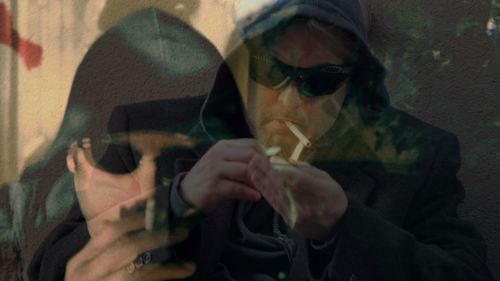
First, here’s a nice review and interview about the film at Dangerous Minds. Want to follow a secret identity artist through a dangerous Los Angeles as he escapes and hits like a criminal? Hang on and watch carefully. You may need to watch it 14 times to catch the drift. But you’ve probably got that kind of time anyway. This is a Los Angeles crime film. But it’s as if several films on celluloid fused together and what you end up with is an art film that gets overwhelmed by urban documentary and then collapses into a narrative thriller. It’s filled with hints, clues, evidence and misdirection. Images, ideas and sounds bounce off each other, mirror each other. There are secrets in this film. You have to watch carefully, through layers to catch things. I’ve tried to make a film that moves like disjointed thoughts toward the preordained ending. Continue reading

Attempt: A Short Film by Jennifer Sharpe

The film seems almost out of time. It could have been filmed fifty years ago. The gently swaying palms of Los Angeles fit between buildings easily but seem to have a romantic life in this film. The music, a piece for theremin and string quartet by Herbert A. Deutsch, fits the imagery in Jennifer Sharpe’s film to perfection. This kind of filmmaking, done with a small camera and then edited and colored in a relatively simple digital editor, is very close to the simplicity of the poet working in a notepad or the artist sketching from her window. Sharpe’s films are deeply felt poetic expressions that seem to exist in the only possible form that they could have. She turns her video images into something close to painting, extending time and finding mystery in simple movements. She has a very gentle approach but with strength in her observation and emotional ability, sort of like a butterfly with steel wings.

You can find out more about Jennifer Sharpe’s digital videos and paintings at her web site.

Seizure: A Magnificent Cry for Art by David Vaipan

At the start, I’ll say that this is one of the most magnificent films I have seen in years. David Vaipan has made this relentless and fully-committed scream of artistic intent, desire, confusion, effort and love. This is a film about being an artist. It is a film about fear and confidence. About effort, will and failure. Vaipan simply takes the entire history of art and all that it has given him and dumps it out on his desk and turns it all into his own material. All of art, music, film, literature and poetry become Vaipan’s crayons and he uses them to tell his own personal story.
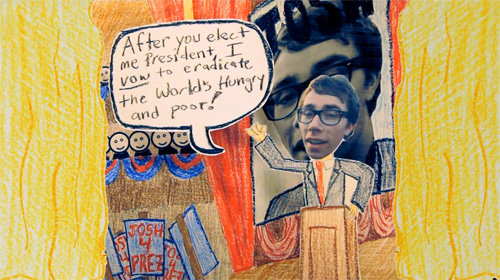
The film bombards with imagery. Just gaze in wonder at the crayon animated memoir that’s presented like a little puppet theater show. It moves from birth to boarding schools to Wall Street and beyond with effortless skill. The drawings are amazing and funny. Just when you think you’ve seen plenty Vaipan moves into a stick figure run through the history of art and it just keeps coming at you. He cuts and chops and mixes and slides and just keeps streaming the grandeur of art at us like a force of nature. He’s completely lost inside the world of inspiration. He sees the fear of getting lost in the pile – the fear of being ignored – and he literally revels in the fear itself. He makes the fear seem like something to seek. This is a grand and important statement from someone who I think is a young artist. The tools of his trade are digital and he uses them freely with a wild eagerness to explore that is extremely difficult to maintain. The unabashed use of video effects and computer equipment as if they are the oil paints and charcoals inside a painter’s box is one of the hallmarks of the emerging American video art movement. I can see the influence of Ryan Trecartin’s work in this. There’s a familiarity with digital layers that is of primary significance in this recent art. There’s a hard-edged willingness to allow the digital processes to show through. It’s sort of a freedom with the computer and video that means one doesn’t have to make anything necessarily look the right way or look like something it isn’t.
You have to really watch this film very closely and try to catch the pieces of the roaring mass of art thrown at you. Even the ending credits are a complete statement in themselves with the director drunkenly singing the Rolling Stones’ ‘Sympathy For the Devil’ in the background.

So many people are part of this film. Kenneth Anger, Stan Brakhage, Jean Luc Godard, Maya Deren, Luis Bunuel, Stanley Kubrick, David Foster Wallace, Michael Snow, Agnes Varda, to name but a few.

I know that the intertitles and other things flash by too quickly to grasp and maybe that intimates something about the info-age and attention spans, it’s why your lord Hiesos Kristos, magician of the beautiful, invented the pause button and that’s also why the real Creator (one D. Vaipan) put this on the internet rather than wherever, because you have control.

See? That’s one of the little treasure waiting for you in the end credits of this gigantic and raving epileptic fit of a film that should ultimately bring you close to tears and make you want to explode in all directions and actually truly and finally… make something!

Here is the artist’s web site.
Ready (Re’Search Wait’S), 2009-2010: A Film by Ryan Trecartin

Do you know who Ryan Trecartin is? You better. He’s making the wildest and best videos to be found online or in a gallery anywhere. This piece is about to open with six others to form an epic at the Museum of Modern Art P.S.1 in New York. It’s a warped and wicked view of corporate career life and behavior as practiced by characters whom I suspect would not even want to be considered normal. They spout company lingo and get it all twisted back inside of itself until it starts to sound like perfect sense and is just as valid as what you hear daily in the offices of any company. Trecartin is onto the fact that our economy has failed and millions of people are out of work because their jobs were bullshit to begin with. At minimum, 75% of jobs in corporate America are completely unnecessary. They are a busy-work scam based on particular rhythms and mannerisms and they produce nothing at all. The characters in this video revel in their uselessness. They gloat, the whine, they insult, they mock. They are amped up to be as irritating as possible. Their voices grate like demented cartoon characters. These videos are like the visions of a child computer in orbit that scans human beings and then tries to reproduce them but gets it wrong. These are digital creatures more than they are actual human characters.

Not to mention the fact that Trecartin’s intentionally clumsy and cheeseball imagery is simply gorgeous. The videos are extremely deceptive. They are so freely expressive as to be nearly psychotic. But always just enough under control to imply meanings with great subtlety. Right now these films of Ryan Trecartin represent the avant-garde’s leading edge.

Elegìa: A Film by Fred. L’Epee and Dimitra Pouliopoulou

Filmmakers Fred L’Epee and Dimitra Pouliopoulou deal with the emotions of video. Their short films are visual poems in the most real sense. I like the way they flirt with the techniques of celluloid while remaining firmly anchored in video. The two things, rather than cancelling each other, work together to offer a filmmaker more tools for opening eyes and insisting that people fully observe. This kind of film dances between reality and abstraction. The ships are placed so that they traverse a line between light and dark, high and low, space and time.

The Animated Films of Painter György Kovásznai

While visiting Your Daily Cartoon, I watched an animated film by Hungarian painter György Kovásznai.  I liked the calm mishmash of drawing styles and quiet humor. The 1965 film is called Mesék a m?veszet világából (Tales From the World of Art). It has no subtitles but is pretty easy to follow, taking a bemused look at several kinds of art. The first part is an action movie, the second is a theatrical piece, the third is a piano recital.

This one is called Várakozni jó (Waiting for Good). It’s about a traffic jam with a truck that suddenly opens its back doors and explodes into a 1969 rock & roll jam. The wild sketchy ever-changing animation style is more psychedelic than most commercialized sixties psychedelia could ever be.

This one is Gitáros fiú a régi képtárban (Boy Guitarist of the Old Hits) from 1964. It’s simply a guitarist playing and dancing his way through artworks by old masters presented in a very avant-garde fashion. Understanding the art is one thing, but the person who can truly enjoy it is far ahead in the game.