Category Archives: Painting
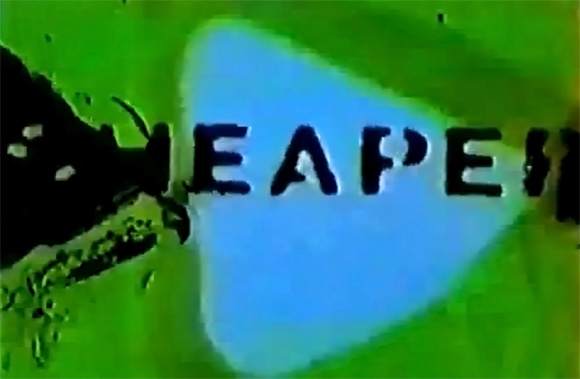
A Colour Box: 1935 Abstract Direct Paint on Film Animation by Len Lye

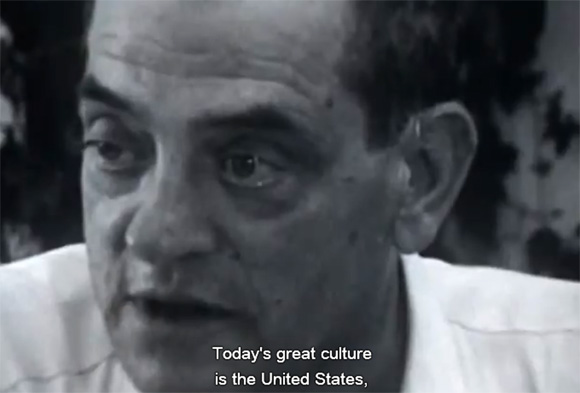
1964 Documentary on Spanish Surrealist Film Director Luis Buñuel

Luis Buñuel was the great Spanish film director who made ‘Un Chien Andalou’ and ‘L’Age d’Or,’ two of the original surrealist films. This documentary, directed by Robert Valey, was made in 1964. The director talks freely and with a certain charming guile about his influences, friends, paranoias, enjoyments and his impressions of various countries. He once smacked Salvadore Dali down on 5th Avenue in New York city!
I enjoy listening to people like him talk about their work because they talk about how they see things – how they interpret the world. Compare the way he talks in this film to what you normally see coming from people like Steven Spielberg or Martin Scorsese. Those people don’t seem real. They don’t seem to have any point of view. Notice how people in the film consistently associate Buñuel’s filmmaking with the work of painters. It is the continual grinding down of art into business that destroys real culture. One should immerse one’s self in better ideas and more subtle things if one wants to avoid the dullness that permeates most film work currently going on in the United States. I have found it to be a general rule that people with real talent who are artists answer questions in a slightly confusing manner. Clarity is another word for fake. Buñuel appears to me to fit this general principal.
Buñuel wrote a short and very beautiful autobiography called ‘My Last Sigh.’ I recommend it very highly if you want to know more about the mind behind Surrealist film.
And of course, here is the great Surrealist short film, ‘Un Chien Andalou,’ made by Buñuel in 1929.
Detective City Angel: A Film by Alessandro Cima
This is a Los Angeles crime film. But it’s as if several films on celluloid fused together and what you end up with is an art film that gets overwhelmed by urban documentary and then collapses into a narrative thriller. It’s filled with hints, clues, evidence and misdirection. Images, ideas and sounds bounce off each other, mirror each other. There are secrets in this film. You have to watch carefully, through layers to catch things. I’ve tried to make a film that moves like disjointed thoughts toward the preordained ending. Continue reading
Crosscurrents: Film About Pacific Standard Time Art Exhibits Focused on Los Angeles Art From 1945 – 1980
Pacific Standard Time is a massive overview of Los Angeles art from 1945 to 1980. At least sixty galleries and museums are taking part over the next few months. I have already been to the largest exhibits at the Museum of Contemporary Art, Los Angeles County Museum of Art, and the Getty Center. The whole thing is a lot of fun and I have discovered artists I never knew about before. There are magnificent things on display and the curators have also published big books to go along with each exhibit. I seriously recommend that you always get the books because they have far more information in them than the exhibits themselves. I view it as my own effort to compile a record of this unique regional art show.
You can find almost everything you need at the Pacific Standard Time web site.
This film was put together for the Getty Center’s flagship exhibit, Crosscurrents, which covers 1950 to 1970. It’s a very nice little documentary about some of the major art developments in Los Angeles.
Behind The Wall: The Battle for LA’s Murals
Oliver Riley-Smith made this short documentary about the disappearing mural art of Los Angeles. It features a prominent muralist complaining about how murals have been ‘bludgeoned by graffiti’ and ‘censored by the city.’ Perhaps so. The city does make it difficult to get permits for murals. But I don’t really like murals. They tend to be stiff and unoriginal. I like the murals that have been vandalized by the graffiti artists. Sorry but I do. They are much more interesting than the clean murals which are entirely unimaginative and offer nothing to move art in any direction whatsoever. If muralists want to preserve their images, they should paint indoors. Look at the mural on the highway underpass wall that’s covered with graffiti at the 42 second mark in the film. Beautiful. Much better than the mural ever was. The muralist in the film says, ‘Museums are for the dead. I want life.’
Bullshit.
There’s a guy in this film called ‘Ghost One.’ I like what he says about art. He’s realistic and open to whatever comes along. He says that taggers mark up murals because they assume that their marks will have more longevity that way. That’s a very interesting thought. An artists seeks longevity by making his mark inside the work of another artist. Fascinating. Much more interesting than the murals. Such thinking shows possibility.
But then the film draws the two sides together and our muralist says he ‘hopes our two styles can work together.’ Well, they can’t really, but it’s a nice thought.
Pacific Standard Time: Anthony Kiedis Celebrates Ed Ruscha
Red Hot Chili Pepper, Anthony Kiedis rides along with L.A. artist, Ed Ruscha. They talk about using words for art and how that inspires them. I like shooting L.A. this way. The film uses the car and the streets well. I think I even see some duct tape holding Kiedis’ passenger door mirror together.
Pacific Standard Time Celebrates Artist John Baldessari
Pacific Standard Time, the roaringly cheerful celebration by Southern California of its own art from the late 40s through the early 80s is releasing short videos to pump everyone up for its brand of art. I should be horrified by this silly video, but I’m not. I kind of like Baldessari’s big ass head on the wall. It works all the way up until he says ‘Art should be fun.’ Yeah, really? I dunno. Sounds like the kind of thing you say to an idiot.
But whatever. I’m going to see a lot of the exhibitions that are part of this festival. Should be really great.
BOMB: A Manifesto of Art Terrorism
Artist and filmmaker Raymond Salvatore Harmon has written an inspiring and thought-provoking book that insists on changing the way art is perceived and approached by artists, viewers and the ever-problematic gallery world. Harmon presents several stories of his own brushes with law enforcement that are both funny and rather harrowing. He consistently recommends behaving as if you have every business being exactly where you are even if you have no permission to paint the front of a building. Confidence and apparent command of a situation will often get a clever artist out of a jam. Harmon is a very likeable guy and I can’t imagine there would be too many police all that interested in arresting this particular artist whose work always seems to have good intentions behind it.
Here’s an important quote from the book:
Ultimately, corporations play the biggest part in designing our modern world. Corporations sell goods, make cars, pump oil and make medicines. They design city planning and develop urban neighborhoods in order to make profit. They create ghettos to house those people that they pay so little they are unable to afford to live anywhere else. Making them exist at the most nominal part of financial need, particularly outside of the white picket fences of the 1st world nations.
Yet, in the darkness of the city night there are those that go out and change the urban landscape without planning permission of a performance license. These people vary in intent and talent but they collectively do what they do against society and against the law.
I like this book. I find it generally inspiring and agitating in the best possible way. However, I do have arguments with it. In general, I tend to prefer looking at street art that does not actually destroy or harm property. Artists who violate laws by gluing things on walls should I think be treated rather lightly. However, I can certainly imagine scenarios in which a business – even a corporate one – could be seriously harmed by the placement of street art on its walls. Not all corporations are British Petroleum. I don’t see any logical link between artistic statement and one’s attitude about a public or corporate wall. If art should in fact be more focused on the act of creation and viewing by the public without concern for how quickly the art is removed, as Harmon’s book suggests, then street artists should be content with painting their work on paper or cloth and hanging it from those corporate walls. Why is there a link between the making of an image and the destruction of a blank corporate wall? Why not make the art and preserve the blank wall?
Harmon has some harsh words for the art world that links itself inextricably with the art schools, identifying artists it likes, feeding them into a network of wealthy friends and collectors, creating an insular world of wealthy back slappers and promoters. You can see this world in operation all over New York and even in Los Angeles. However, I would point out that crony networks are notoriously good at finding and publicizing actual brilliance.
Elsewhere in the book, famed artist/street prankster Banksy is quoted as saying:
Remember, crime against property is not real crime.
Banksy is of course not someone I would want to be taking very seriously since it is more than likely that he is little more than an employee or creative group working at Urban Outfitters. Thankfully, one of Harmon’s stories about copyright leads right into an episode that reveals Mr. Urban… sorry… Banksy, to be just as copyright-obsessed as any corporation. Banksy is apparently working hard on a piece in model Kate Moss’s bathroom… you kind of get the picture?
You’d do much better reading this marvelous and good-natured jab-in-the-ribs art manifesto than paying attention to Banksy, that’s for sure.
Elsewhere in the book is a thoroughly amusing account of an assault on a major art world event that involves video cameras, dark suits and some very CIA-type stuff going on. Read it and enjoy.
Here is the entire book:
Artist Profile: X – A Film by Adolfo J. Lara
Here’s some action art complete with painters scaling buildings at night, secret identities and even a police chase. Artist X made the beautiful ‘Thank You Andy Warhol’ images that went up across L.A a few months ago. I drove by one that was attached to one of the pillars holding up a major highway overpass and was struck by it immediately. I even tried to video it with limited success through my windshield.
The film is by Adolfo J. Lara.
CHAD MU$KA x CYRCLE presented by AJL: An Art Film
I was filming a ton of shots on Melrose Avenue this past Friday and I stopped purely by chance in front of this piece at the De La Barracuda wall where I took closeups of various parts of the image. I didn’t realize it had just gone up and was a collaboration by artists Chad Muska and Cyrcle. This fun art film is by Adolfo J Lara.
Found the film via Melrose & Fairfax.
Wall – Ethos: A Film by Alessandro Cima
Brazilian artist Claudio Ethos works on his first Los Angeles art piece. I happened upon him down on Main Street and thought he was a worker about to paint over a painting of a face. I started shooting and after several minutes realized that he was the artist.
Harold Smith – Visual Artist
More artists should do this. Make their own documentary about themselves. Great idea. I like the jazz paintings. Harold Smith is a visual artist who just likes painting.
Five Artists: 1971 Documentary Film
Here’s a 1971 art documentary featuring five black artists. Compare this to a bloodless piece of work like the NOVA documentary I posted yesterday where artists are posed on a red pillow in front of a blue wall to spout off about their ‘brands’ and the business of art while a DSLR camera puts them either to the right or the left of frame because that’s what good composition looks like in 2011.
The artists featured are:
Barbara Chase-Riboud, a sculptor living in Paris
Charles White, a painter in Los Angeles
Betty Blayton, a painter-collage artist and director of the Moma Art School In Harlem
Richard Hunt, a sculptor in Chicago
Romare Bearden, a New York painter who uses collages and cut-outs
Enjoy these five artists who actually sound like artists.
NOVA: An Art Documentary That Entirely Excludes Black Artists
I wanted to like this film. I tried really hard. It was filmed during the Nova Contemporary Culture which happened in July and August 2010, at the MIS-Museum of Image and Sound, and SESC Pompeia, in São Paulo, Brazil.
It put me off with a few too many artist comments about art being a business and branding. There are a few real pretentious twits running through this art documentary. There’s also a lot of very nice, clean, well-behaved, pleasant, comfortable, easygoing, precise, smooth, color-balanced art going on here. I’ll be clear and remind my hesitant readers that I’m really quite the shining example of a creep. When I walk into a gallery I’m looking for the artist who is capable of throwing dirt into my eyes and laughing at me while I wipe it off. Most of the art in this film looks like it has been pre-approved for use by IBM in their next commercial.
I’m not looking for an artist who can tape off their lines straight and make them intersect at the farthest corner of the room. Draw crooked why don’t they? There’s so much goddam masking tape in this film it could wrap the Empire State Building six times over.
But if you watch this thing all the way through you just have to notice that out of all these young up-and-comers there’s apparently not a single black artist involved. I couldn’t find one. Maybe I missed something. But I went back and checked. How do you achieve something like that in 2011? Seriously? Don’t you have to work overtime hours to purposely exclude black artists from a documentary or a major art show like this? Can it be true that there are no black artists capable of sticking masking tape to a museum wall and painting inside the lines? Don’t black artists travel to Brazil?
It may not be director Isaac Niemand’s or producer ROJO‘s fault that the cast excludes black artists, but then perhaps they should have filmed a different art show. Maybe it’s Brazil’s fault.
I feel a little bad about criticizing a documentary film on Vimeo because their service is so based on mutual support and respect between artists. But that kind of thing has severe limits in the world of grownups and serious people.
Art is not preschool. It’s not about support and encouragement of creativity. Self-help bullshit doesn’t have a place in art. Art is about beauty, ugliness and thought that gets up in front of you and is willing to knock you unconscious without apology, willing to scare you, horrify you, enrage you, enrapture you, unsettle you, save you, uplift you, insult you, smash you, whither you, confuse you, ennoble you, or destroy you. But it does not ever want to please you.
Keep the pleasant art in Brazil thank you.