Today, for the first time since the retirement of the Space Shuttle program in 2011, US astronauts launch into space on a SpaceX Falcon rocket. Watch the live NASA TV feed.
Category Archives: Technology
World Community Grid App By IBM Lets You Help Find Covid-19 Treatments
Illustris: Incredible New Universe Simulation Built with Supercomputer

Using a supercomputer, scientists have built a 3-dimensional model of how the universe evolved after the big bang. Apparently, the model is so complex that a normal desktop computer would have required 2,000 years to do all the calculations.
It is a breathtakingly beautiful and detailed model, allowing viewers to find galaxies and dive into them. It shows the spreading of cosmic gasses, the distribution of both dark and ordinary matter, and the formation of galaxies. No such model has ever been built before. It’s the result of a collaboration known as the Illustris Project.
1964 Bell Labs Film About How to Make Films with a Computer
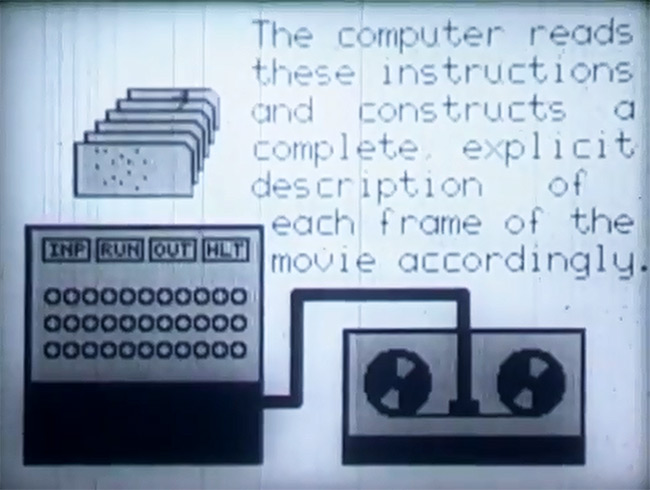
This fascinating film was produced at AT&T’s Bell Labs in 1964. It was made by Ken Knowlton to describe the use of computers to make animated films. The film itself was created entirely on a computer. This is a glimpse into the groundbreaking work that led to the computer graphics we all enjoy so frequently today. Knowlton was both an artist and a computer graphics programmer who developed several programming languages for producing bitmap animations.
Interestingly, Ken Knowlton worked closely with pioneering experimental filmmaker Stan Vanderbeek at the Bell Labs on many early computer animations. Vanderbeek is the subject of my prior post about his short film, ‘Science Friction.’
Seeing the Digital Future: 1961 AT&T Corporate Film

Here’s a 1961 corporate film from AT&T that tries to predict the wonderful digital world of the future, including online shopping!
SpaceX Dragon Capsule Docks with International Space Station
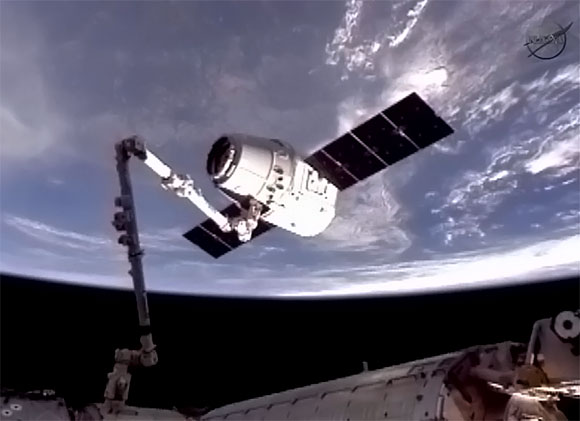
The Dragon capsule from SpaceX has become the first privately operated spaceship to dock with the International Space Station. Early this morning astronauts aboard the ISS used the station’s robotic grappling arm to snag the capsule after its successful close approach. The arm then pulled the capsule in to berth with station’s Harmony module. This is another incredible achievement in space and should begin a new era of private space travel and support for the ISS.
You can watch video of the robotic arm capture.
Worldwide Protest as U.S. Government Threatens to Censor Internet

Today Candlelight Stories joins with other sites to protest two proposed laws in the United States, called SOPA and the PROTECT IP Act. On January 24th, the U.S. Senate will vote on the PROTECT IP Act to censor the Internet, despite opposition from the vast majority of Americans. These laws give corporations the ability to sue any web site they feel threatens their copyrights in some way. They could essentially shut down any site simply by pointing a finger. So corporations would use this power to harm smaller competitors. The U.S. government could shut down any site or blog it had the slightest problem with. Censorship as practiced in places like China would suddenly become the norm here in the United States. China is a nightmare. We don’t want to do things like they do.
A free, open, uncensored Internet is a basic and fundamental right that must be preserved here in the United States if it is to have any chance at all on a worldwide basis.
Join us to protect our rights to free speech, privacy, and prosperity.
Here’s a massive list at the Center For Democracy & Technology of organizations, companies, web sites, blogs and individuals who are opposed to the censorship bills.
At the links below you can send your protest to Congress and learn much more about these bills and how they seek to end the open Internet.
Take action by contacting Congress via the Electronic Frontier Foundation.
Congressional Effort to Censor the Internet
The ‘Protect IP’ bill before Congress would give corporations and the government the power to completely shut down internet sites without any due process just for posting a single copyright infringing link. So for a site like Facebook, if a single user posted a single copyrighted something or other, the government could simply pull the plug on Facebook and turn it off.
But chances are the law would be used to stifle expression and ideas from smaller sites. The government would simply have to accuse a site of being engaged in piracy and that site would be effectively terminated.
That’s a terrifying abuse of power. It would complete destroy the internet and anything resembling freedom of communication. This is a glaring example of how a small number of large corporations have taken total control of the Unites States government.
You can sign a petition and learn more at fightforthefuture.org/pipa.
First Video Images Ever Reconstructed From the Human Brain
UC Berkeley scientists have recorded the first images ever generated by a human brain. Amazing. They exposed subjects to video images while recording visual activity in their brains. When they played the recorded data back they got images corresponding closely to what the subjects had just seen. What I notice about the images in the video is that faces seem to work the best. That is interesting on many levels. Perhaps facial recognition is so hard-wired into humans that we are able to generate those images more clearly than all others. This work opens the door to the ability to reconstruct imagery from dreams and memories. It’s a staggering achievement. Magnificent. I simply cannot wait to try this sometime.
Thank you to Rob Smart on Facebook.
NASA Captures Images of Apollo Astronaut Moon Tracks
NASA’s Lunar Reconnaissance Orbiter has captured images of astronaut tracks, lunar landers, and left behind equipment from the Apollo 12, 14 and 17 moon missions. These are the sharpest images ever taken of the moon and should give fake moon landing conspiracy nuts a whole new bag of clues to play with. We can’t rebuild what we once understood and get ourselves back to the moon, but we can take pictures of our past glory.
1969 British Documentary on the Development of the Computer
Here’s a 1969 British documentary on the development of the computer beginning with the code-breaking work by Alan Turing during World War II.
NASA Begins its End
The final landing of a NASA space shuttle yesterday, though hailed as the final act of a great technical achievement over the past 30 years, actually represents a complete failure on the part of the United States to build upon the work of scientists and technicians from the 1960s and 70s. It should shock most of the world that the leading superpower, with the world’s most advanced space exploration systems, could not figure out a way to even build a second version of the space shuttle. I’ve never seen a product of technology that stays with version 1.0 for thirty years. There is no viable plan in existence for launching human beings off the earth by the United States. There’s a lot of vaporware and talk. There are models of crew capsules that will maybe one day launch people toward an asteroid or even to Mars. Maybe. None of it works. None of it even has a working toilet. There are no rockets being designed that could even launch the miraculous capsule into orbit. And that crew capsule? If you’ve seen it you then realize that NASA is simply building the Apollo system all over again with extra bunks for three more astronauts. But they can’t build the thing. It doesn’t exist.
There are no longer any means available to the United States for getting people to the International Space Station. There are no means available for getting any equipment up there. The U.S. must rely on rides hitched aboard Russian spacecraft for an indefinite period of time that many NASA experts are now saying could extend to 10 years.
Russia has a more advanced and reliable space exploration system than the United States.
In the mid 1990s I went to a boring Hollywood party and wandered around with a drink in my hand for about half an hour before running into an older couple sitting alone. They seemed uncomfortable and out of place. So I said hello and sat down next to them. The man turned out to be a retired engineer who worked on the design for the Lunar Landing Module during the Apollo years. I asked him why NASA had been unable to return to the moon. His answer was: ‘Because they can’t.’
He explained that NASA had been been decimated by enormous loss of technical knowledge due to retirement. He said that the agency had not properly stored its accumulation of knowledge. He said that if engineers wanted to build a rocket, command module and lander to get back to the moon, they would be completely unable to do so and would be forced to relearn almost everything that had been learned during Apollo. He then said that this would become very clear to the nation sometime within the next 15 to 20 years as existing technology wore out and could not be replaced. I told him that he seemed very depressed about it. He nodded and said the situation was much worse than he could explain. He said that technical notes from engineers hadn’t even been saved. The knowledge was just totally lost.
I think that guy was right. I don’t think NASA could build a new shuttle even if it tried.
NASA’s insistence on transferring launch responsibilities over to private space companies would perhaps make some sense if we had seen it being phased in alongside the existing shuttle technology. But to shut down our only means of space transport and hope for the best with future private launches is simply begging for disaster. How tested will this new private space launch technology be? Why would an astronaut climb into a rocket built by some company run by PayPal’s founder? It’s insane and stupid. What if the first private launch vehicle with astronauts explodes on liftoff? What happens then? Is there even a backup plan?
U.S. Effectively Abandons Human Space Flight
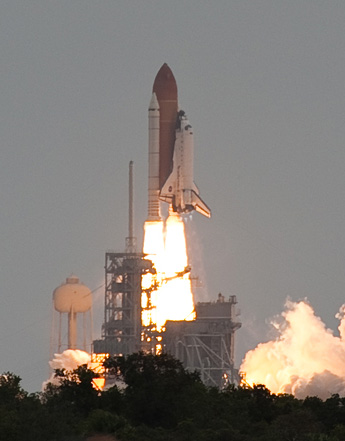 So the United States today launched its last space shuttle mission ever, leaving the task of supporting the International Space Station to Russia, a country ruled for all intents and purposes by a dictator.
NASA, along with its international partners, apparently thought it would be a good idea to build a space station and then retire its fleet of transport vehicles without any replacement in existence.
In about a week, after the final shuttle flight lands, the United States will no longer have the technical ability to put a single human being into earth orbit.
How’s that for leadership in technology and science? That’s your current president at work who was supposed to possess some magical form of science awareness.
Onward presses NASA with its plan to privatize space station supply launches… sometime… perhaps… in the next five years.
The shuttle was expensive to operate and sometimes dangerous, but it was a successful machine. No such thing exists now. Typically, when I’m ready to replace my automobile I go buy the new one first. Then I bring it home, park it in the driveway and think about how best to dispose of the old clunker. That’s how it works with me. I’m just sayin’…
Photography Breakthrough Allows Image Focusing Outside of Camera
The soon-to-be-available Lytro camera allows picture taking without focusing. The photos can be focused later by simply clicking on any part of the image to bring that area into primary focus. It’s a pretty historic achievement in photography. I don’t think anyone has done it before.
The camera uses something called a light field sensor. It captures the color, intensity and vector direction of the rays of light. This directional information is completely lost with traditional camera sensors, which simply add up all the light rays and record them as a single amount of light. So you can snap a picture without focusing at all and then later focus the image the way you want to.
Try clicking around on these images:
Killing the Net: A Film by Duncan Elms
This short film by Duncan Elms explores the danger of an Internet that can be shut down quite easily by governments that want to suppress free expression or crack down on popular movements toward freedom. The recent experience of Egyptians trying to stage a revolution and spread information about it amongst themselves and to the world should be very informative. The Mubarak government was able to turn off Internet access throughout the nation. Even in the U.S., President Obama has sought the power to switch off the Internet if he declares an emergency. That effort has since been watered down, but it is clear that the U.S. government does in fact seek a method for shutting down the Internet. The continued treatment of China, a nation that monitors every single word typed into a web site, as even remotely civilized is an embarrassment to the entire world. Those people won’t even allow a person to think freely, much less post freely on the web. There must be a way to maintain worldwide access to the Internet that is beyond the control of any national government, including the United States government.