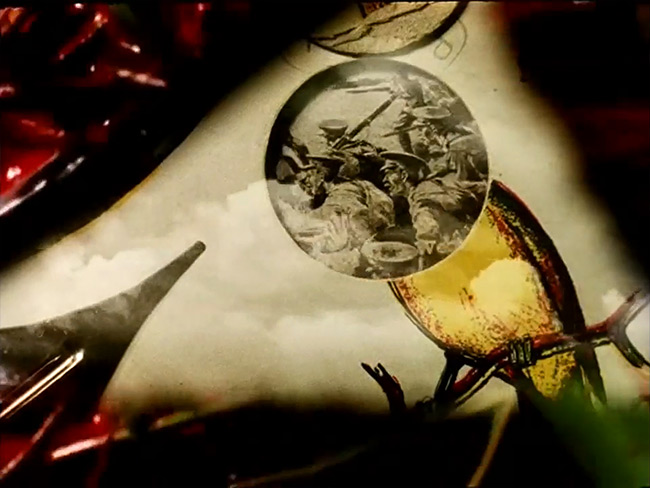
This is a brilliant animation from Janie Geiser who is a renowned theater and film artist specializing in the use of inanimate objects and toys to create unsettling and evocative films and performances. Her work has been screened worldwide, including at the Whitney, Guggenheim, Museum of Modern Art, and the Los Angeles County Museum of Art. The film investigates the origins of the word ‘algebra,’ which turn out to be somewhat interesting. Frankly, I had never once even considered the word before watching this film.
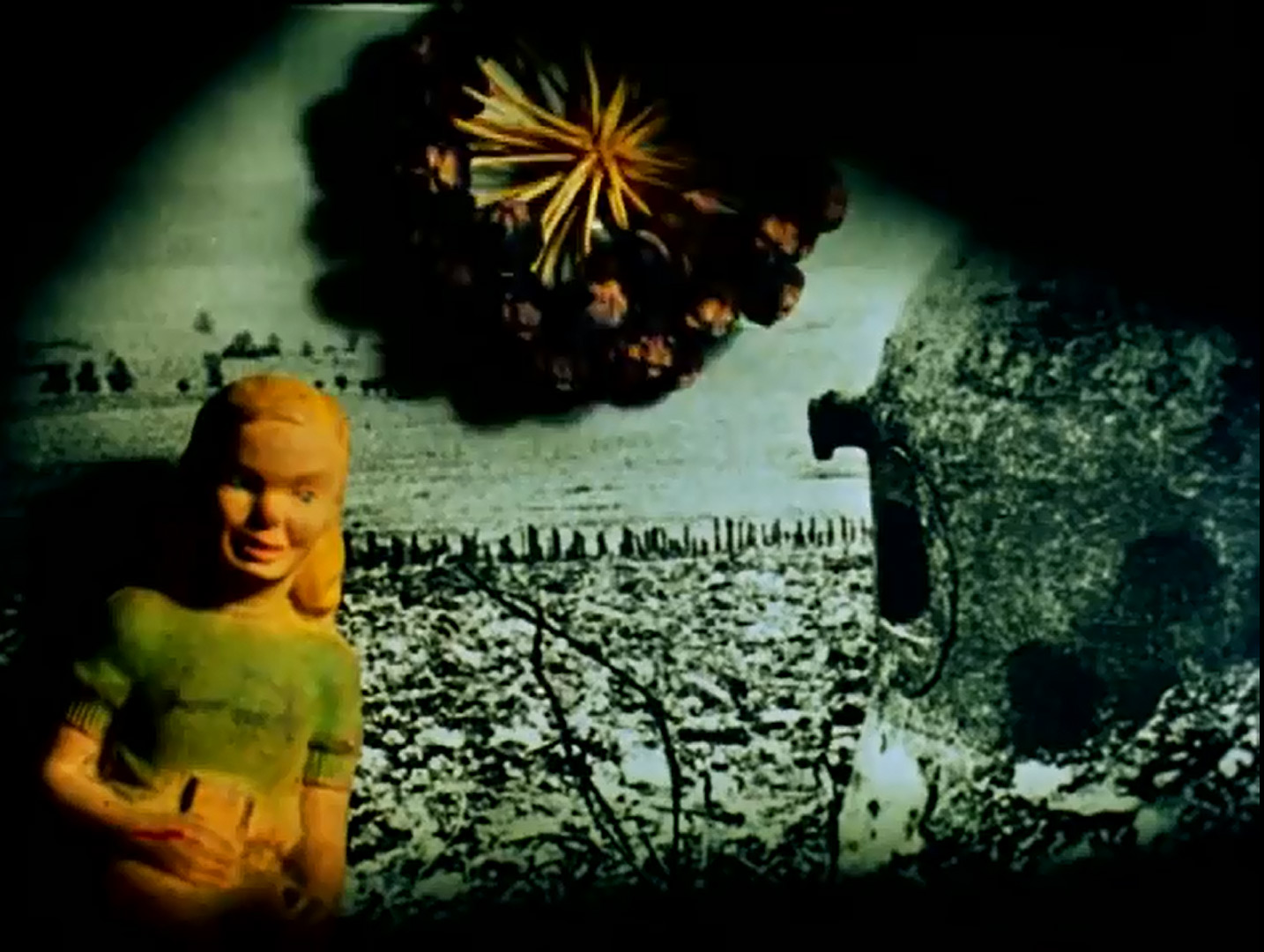
It’s a subtle film. A beautiful but difficult film. Let’s think about this experimental film, shall we? What do we see in this film? Holes. Lots of them. Holes for looking through. There’s a little plastic doll who looks very 1940s, some birds, numerals, trees, and lots of grass. Blades of grass. When I see a little plastic girl doll looking into holes I see a filmmaker looking into a camera to investigate the world, or rather the mind, or perhaps the unconscious. This doll approaches an odd stone bunker on a hill and she peers into a small opening into darkness. It looks a bit like an old Nazi gun bunker. Carl Jung would approve! All experimental films should dig into the unconscious mind, I think. People throw ‘dreamlike’ around quite often these days when talking about films. There are very few dreamlike films. What most people mean by dreamlike is simply blurry. Anyway, our plastic doll sees things in storybook fashion that suggest nature and Nazis. There’s warfare going on. The precision of battle maps. The doll’s vision puts conflicting images of tamed nature description together with extreme violence. Nothing is attached properly to anything. Ideas do not lead to logical conclusions. Instead, they lead to odd constructions, more like what is required by the creative mind.
Geiser’s ‘algebra’ theme seems to peek through at times in images of severed limbs or broken bones, teeth, spilled blood, and of course the various number machines that pop up. The word algebra apparently used to have a meaning related to restoration or reunion, sometimes applying to the setting of broken bones which was often done in medieval times by a dentist who also performed bloodlettings. Interesting. But this film is not really about mathematics. At least not the usual kind. It’s about piecing together a vision of the world. Immersion.
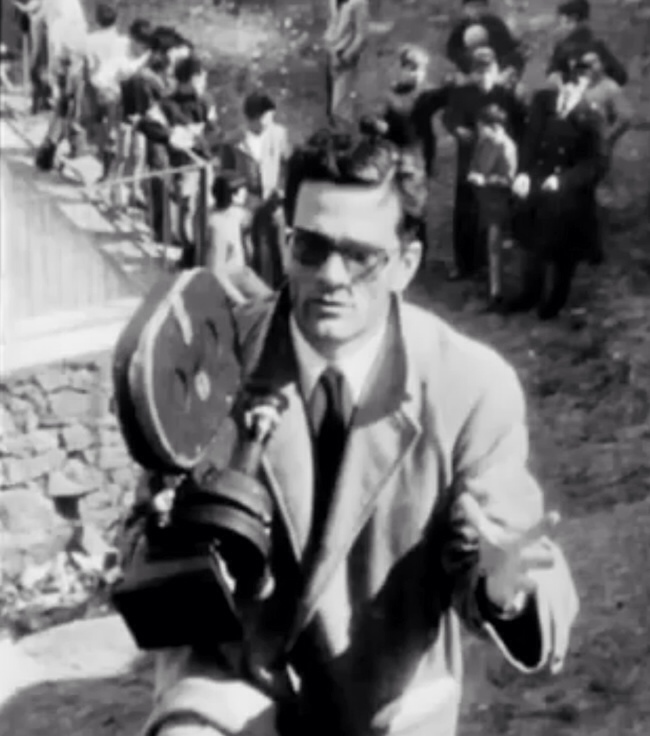
This is a Dutch documentary about dangerously anti-establishment Italian poet and filmmaker Pier Paolo Pasolini, who was brutally murdered in 1975 under extremely suspicious and unexplained circumstances. The Italian justice system – if such a phrase doesn't make you bust a hernia with too much laughing – dismissed his death as the act of a single young man upset about the filmmaker's sexual advances. This film points out that Pasolini was utterly smashed, his body broken and shattered everywhere. He'd been beaten and run over with a car. The evidence does suggest that he was slain by a group. Director Philo Bregstein attempts to draw a connection between the outrage caused by Pasolini's leftist, harshly critical works and his death. It's a tough connection to fit together because there is really very little good police work done by the Italians to provide any reliable information. I remember going to Italy as a boy and upon seeing an Italian policeman saying to my father, “But that's not a real policeman!” That was one year before Pasolini was killed.
There's just something always ridiculous about an Italian who either thinks they are a cop or a soldier. The country is absurd. It elects Berlusconi, a man who is actually a monkey, as if the entire nation just wants to make a big joke and cause the world to laugh at its expense.
My main reaction to this documentary is nostalgia for a time when the work and thinking of filmmakers and poets was taken seriously enough to warrant a documentary that immerses one in the mind of an artist. We don't see that anymore. We get jokey pop nonsense about what people are up to, but nothing approaching an understanding of a director's viewpoint. We are spoon-fed pablum about the moronic Martin Scorsese's eternal and cuddly love of cinema. The guy is a chipper little dolt who cannot function without De Niro's slightly winded masculinity nearby. A documentary about such a clown would not be worth making. I imagine him with a collection of old popcorn makers in his living room. Pasolini was engaged, angry, excited, subtle, harsh, contradictory, confused, dangerous, and beautifully unlikable. We don't allow those people to work now. What we get through an endless comment feedback loop are feeble protests about Tarantino's massive ego as he thinks he can be white and make a film about slavery. Tarantino's Django Unchained is actually the closest thing to Pasolini that this country may have ever produced. The present day outrage and the joy of expressing it is like a bomb going off throughout the length of that film which I consider a masterpiece.
A documentary like this makes me feel as if the world needs these people like Pasolini to show us how beautiful is a lack of common sense. How insightful contradiction can be. How anger and violence are really the material of poetry.
By the way, the story told by Bernardo Bertolucci about how he first met Pasolini is worth the entire film. That moment of doubt, of thinking that someone is a thief, a suspicious person, is at the heart of what an artist is. Listen to that part carefully and then think about how most artists now want to do something good for you. Take those artists out in the alley and shoot them. Leave only the bad guys alive.
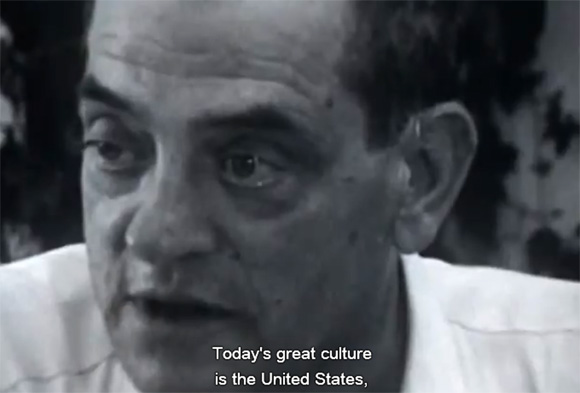
I enjoy listening to people like him talk about their work because they talk about how they see things – how they interpret the world. Compare the way he talks in this film to what you normally see coming from people like Steven Spielberg or Martin Scorsese. Those people don’t seem real. They don’t seem to have any point of view. Notice how people in the film consistently associate Buñuel’s filmmaking with the work of painters. It is the continual grinding down of art into business that destroys real culture. One should immerse one’s self in better ideas and more subtle things if one wants to avoid the dullness that permeates most film work currently going on in the United States. I have found it to be a general rule that people with real talent who are artists answer questions in a slightly confusing manner. Clarity is another word for fake. Buñuel appears to me to fit this general principal.
Buñuel wrote a short and very beautiful autobiography called ‘My Last Sigh.’ I recommend it very highly if you want to know more about the mind behind Surrealist film.
And of course, here is the great Surrealist short film, ‘Un Chien Andalou,’ made by Buñuel in 1929.
I did not know this filmmaker, Paolo Gioli, existed until yesterday. And that really bothers me because I feel a very strong kinship with this filmmaker just on the basis of having seen two of his pieces. What can a filmmaker do with his own backyard? That is the question that comes to my mind as I watch his films. Can a filmmaker take his camera out back and make something astounding? Of course. In fact, that skill is central to being a creative filmmaker. It is the feeling I get from Gioli. He makes films that have a guiding concern but he is not afraid to slip a little off of the main track and let you see him experimenting. One can observe his enthusiasm for a new mechanical technique and he allows his film to wander into the territory of the new machine or splicing method for a while. And then he comes back to the main thing. He never lets this get out of control and it is a miracle to watch. One can learn how to experiment by watching a brilliant experimentalist. It’s that simple.
There are many filmmakers I wish I could meet and perhaps work with. Gioli is one of them. In fact, this brings to mind again my thought that things like YouTube are the greatest cinematic development of the past half century. The reason has nothing to do with screen format or size or image quality. It has to do with intimacy. The feeling of connection one can get by watching a filmmaker’s work on the computer is far more intimate than could be achieved in a theater. It is this quality that is the most important contribution of online film to world cinema. Intimate connection to the artist. It has a powerful effect on artists and communicates ideas and inspiration from generation to generation far more effectively than any prior cinematic display technology.
Here is a nice long article by Bart Testa about this wonderful Italian filmmaker.
Here is an article by David Bordwell on how Gioli’s hand-made cameras influence his ‘vertical cinema’ technique.
Canadian filmmaker Guy Maddin made this short in 2009 with Isabella Rossellini in the lead role of a woman who finds ecstasy in an electric chair. The film moves beautifully with its music and entertains with its silent film mystery and accelerated movement. However, I will say that Maddin’s films seem to me overly concerned with silent film technique. This tends to turn the films into curiosities rather than genuine works of art. That’s a tricky area because the films put so much virtuosity on display. But you can hide enormous failures behind that ‘old film look.’ I’m not sure that’s what Maddin is doing, but my suspicions are growing. Maddin might be interested at some point in working with less budget.
Thank you to filmmaker Fred. L’Epée.
Between 1988 and 1998 filmmaker Jean-Luc Godard made a film called ‘Histoire(s) du cinéma.’ Though it purports to be a sort of cinema history, reflecting on how cinema intersects with the 20th century, I think it is more likely a vision of how cinema works in the mind of one filmmaker. The images drift in and out, overlapping and complimenting one another just as they would in the mind. Don’t look for accuracy or understanding. Just watch the film. It’s very difficult to find pieces of this lengthy work online. But these are three good chunks and they certainly stand up as a taste.
More about the film at Mubi.
I have not had any interest in the work of Terrence Malick over the years. His films tend toward nature and beautifully composed shots that seem much too still for my tastes. I like things that move in sloppier fashion than Malick is willing to show. For instance, the clip shown here makes me want to go see ‘The Tree of Life’ because is looks magnificently gorgeous and might in fact tend toward the non-narrative end of the spectrum. However, look at those ‘hand-held’ shots. Like almost every Hollywood movie, Malick’s hand-held shots look as though they are calculated, calibrated and buffered by sophisticated computer programs designed to give just the right sense of hand-held without being too hand-held. Hand-held on hydro-greased pistons with balancing weights and counter movement devices. Look at how, when he shows the kid’s feet kicking the can on the street, he tilts the horizon line just so. Fussy. Trying to make an interesting shot out of nothing. There’s something too smooth going on with the camera person. Malick needs to punch the camera operator in the mouth just before a shot. I don’t think great film directors can work with the standard kit Hollywood film crew… ever. Everything in this clip moves with a limp swaying quality. Maybe that’s why I sleep through Malick films.
If it were up to me, I’d tell Malick to remake this film with no more than five people helping him aside from the actors.
Rachel Tejada shot and edited this film about independent and underground film in China. It was produced by dGenerate Films. It’s in six short parts and covers the basics of independent film festivals and efforts to make films that will somehow survive the oversight of the repressive government. I post this out of a measured interest, but I cannot overlook the depressingly passive sadness of everyone who so much as glances into the camera. They consistently refer to themselves as independent filmmakers or underground filmmakers. Underground they may be out of necessity, but they are most certainly not independent. They are comfortably passive and have an absolute zero level of confrontation or rebellion in them.
I cannot muster significant respect for billions of people who want to express themselves and flourish but do not ever make the decision to pick up their totalitarian government leaders and drown them in the sea. You can talk to me until you are blue in the face about your independent cinema, but until your cameras shoot something I’m not listening.
Parts 2 – 6 after the jump
If you live in Los Angeles you’ve probably seen it many times: the caravan of white trucks parked along the block and around the corner, diesel generators roaring, cables strung along the gutters, piles of lights, rolls of cables, racks of costumes, makeup trailers, bored extras, bored crew members, bored motorcycle police, and fascinated passersby.
That’s all you need to see to know that something mainstream – feature film, TV show, or commercial – is being made.
But what’s an underground film?
Bad Lit, my favorite site devoted to underground film, has an article about the problem of defining something as slippery as ‘underground film’ in which several definitions are offered by different people. Mike Everleth, the site’s editor, defines underground film this way:
Essentially, I believe it is a film that is a personal statement by one person and a film that dissents radically in form, or in technique, or in content, or perhaps in all three. However, that dissension can take on any number of forms.
I agree with that, but would add the requirement of hostility. There should be an element of combativeness which attempts to counter a much larger established force. There must be some rebellion in the work. It can be very subtle – nearly imperceptible – but it’s usually there somewhere. In fact, I think the hostility should even tend to include the general culture surrounding the filmmaker/s. Dissent, by itself, can be rather subdued, soft-spoken and shy. I think underground film requires a willingness not only to dissent but to kick apart.
While thinking about all this mainstream versus underground stuff, I went searching around on YouTube for something that might fit the discussion. I found this peculiar British documentary film about filmmaker Donald Cammell who co-directed, along with Nicolas Roeg, the 1968 film Performance. The film is one of those odd mixtures of underground and mainstream. It features Mick Jagger and involves a lot of mind-bending drugs, sex and criminal underworld shenanigans. It’s actually impossible to forget once you have seen it.
This film contains adult subject matter, language, nudity and sexual situations.
Part 2
Part 3
Part 4
Part 5
Part 6
Part 7
The documentary, Donald Cammell: The Ultimate Performance, describes a time when a group of intensely creative artists from various disciplines could operate on the fringes of the mainstream to create an essentially underground film with something resembling support from a mainstream production company. It’s a scenario that does not exist today. If you watch all 7 parts of the film, you will be immersed in that strange hybrid world of the ‘popular underground’ that defines much of what was happening in the 1960s and 70s. Today, if it cannot be jammed into a mall and sold with Sour Patch Kids, it won’t get any money. That holds as true for ‘independent’ films as it does for summer blockbusters.
Watching this documentary makes me wonder why so many filmmakers seem to have such trouble making the films they really want to make. After all, one can purchase a cheap camera and make exactly what one wants regardless of what one’s career and money-earning responsibilities might be. Tormented filmmakers who are battling studois for creative freedom should simply make films with video cameras during their spare time. This would not only foster a healthy underground, but it would quite possibly prevent a few tragic endings.
Jeff Alu is a photographer making films who I met at the Downtown Film Festival Los Angeles a couple of weeks ago. Cool guy. He’s also made this perfectly dream-like dream sequence that’s a part of his in-production film, 12 Dreams. I look forward to seeing all twelve! We had a brief discussion at the opening night of the film festival about the cameras we use and the filming of dream sequences. I said I thought they were kind of difficult, but Jeff clearly stated that no, I was wrong, they are easy! Well, they are easy for him and I like what he ends up with. The Fellini thing comes through clearly. Alu is onto it somehow. The pillow fight is extraordinary and I think the inclusion of the tabletop city model is brilliant.
During the film festival week in downtown L.A. they played Alu’s film on a video monitor in one of the galleries at the Los Angeles Center for Digital Art. I love watching gallery films and Fellini’s Death look great there.