A Virtual Reality Space War for iPhone

You can get more app developer updates and game support at aliengemwar.com.

Now available in the App Store!

Battle alien saucers and harvest energy gem towers in this retro sci-fi action shooter that will demand all your VR fighting skills!

Made for freely available Google Cardboard VR, this game is a whirlwind of space war survival that incorporates combat shooting, movement tactics, clock management, and balancing various skills to outwit the enemy aliens and transport energy gems off the planet surface.

You’ll have to stay in constant motion and fend off attacks that come from all directions as you attempt to fly around the battle zone shooting down alien saucers and bombs while protecting and harvesting your gem towers.

This game is deceptively simple but extremely difficult to master. Survive as long as you can against increasing difficulty and figure out how to get the score bonuses.

No ads. No in-game purchases. Just simple straight ahead fun.

No hand controller is required for this game, just a simple and inexpensive Google Cardboard VR viewer. It works without even needing to pull the trigger on your Cardboard viewer. It’s almost entirely shoot and move by aiming. You can choose to use the trigger for firing your main gun and a special extra skill test that you can discover, but the trigger is not required.

Get yourself an inexpensive Google Cardboard compatible VR viewer like the ‘View-Master Deluxe VR Headset’ or ‘Merge VR Goggles’ and have a blast that will get you feeling like you are living inside a classic science fiction adventure world.

You can also play in non-VR mode.

This game has been tested on iPhones as old as the 6s.

A Game Center leaderboard is included.

This game requires a high amount of physical movement and uses the full 360 degree range of VR.

Children should play with adult supervision. Play VR games in a safe open area, free of obstructions, obstacles, and hazards. For increased safety, play while sitting in a swivel chair.


Aelita Queen of Mars: First Russian Science Fiction Film 1924

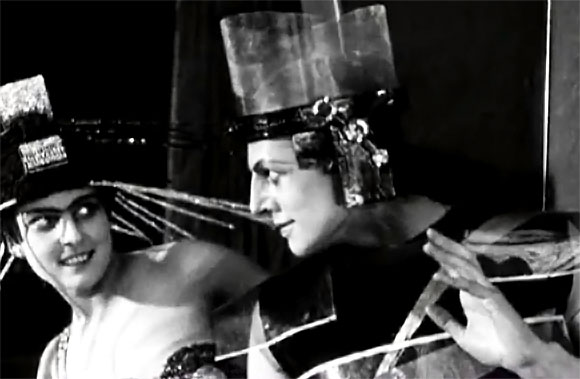
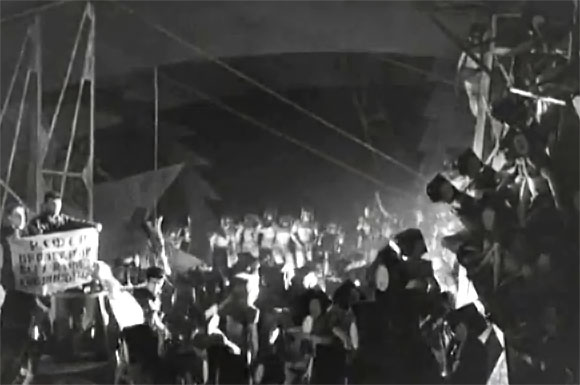
This is regarded as being the first Soviet science fiction film. Made in 1924, it’s an operatic scenario involving a mysterious radio signal sent toward earth, a scientist who builds a spaceship to get to the red planet only to find a totalitarian state, and a dictator’s daughter who wants to lead a revolution. There’s even a hammer and sickle to go along with the establishment of a socialist republic on Mars.

The film combines outlandish stage scenery representing Mars with the gritty streets and factories of Moscow. There’s some really beautiful photography and truly absurd costumes throughout.

Directed By Yakov Protozoan
Written By Aleksei Fajko and Fyodor Otsep
Based On A Play By Aleksei Tolstoy

All six parts of the film can be seen in this YouTube playlist.

Pereval: 1988 Soviet Science Fiction Animation by Vladimir Tarasov


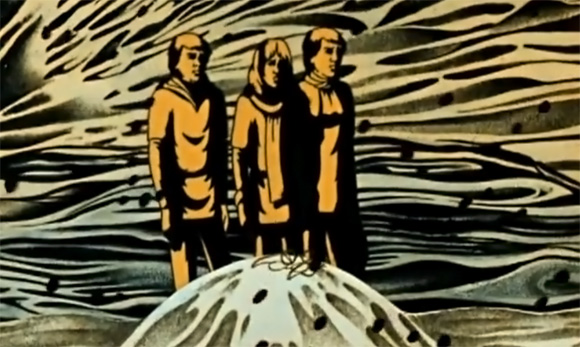
Humans have crash-landed on an alien planet. Sixteen years later, they send a small search party consisting of their children – born at the time of the crash – back toward the broken ship. The young members of the party make their way through a hostile and surreal landscape that holds surprises for them. Finding the ship well-preserved gives one of the young people an important connection to his past and to his origin.

This film was directed by Vladimir Tarasov and was adapted from a novel by Kir Bulychev.

Nova Express: Epic Online Film Adaptation of the William S. Burroughs Novel by Andre Perkowski

Filmmaker Andre Perkowski is working on a huge 3 hour plus adaptation of the novel ‘Nova Express‘ by William S. Burroughs. It’s a wild, ragged, disjointed, warped, damaged, serious and funny mashup of found footage, original film and Burroughs’ reading voice along with others. It’s got those incoherently combined sci-fi and thriller elements that Burroughs so easily manipulated as if in a delirium. The film is itself a kind of cutup, mirroring the technique Burroughs used that involved gathering unrelated bits and pieces of other books and newspaper articles to formulate sentences that somehow ramble on without necessarily leading anywhere specific. The novel is about exposing the secrets of those who attempt to control all thought and life with virus-like ideas, machines and drugs.

Perkowski is a filmic oddball who delights in making things that are messy. He draws and collages to create new images, purposely ruining his images to create the unexpected. I think his mental immersion into Burroughs is leading him through his wonderful film with great assurance. Apparently, Perkowski is constantly adding to the film and changing it. He has at least six different ‘drafts’ of the film. As he goes, he posts chunks of the film on his YouTube channel which I happen to think is a fantastic idea. There are similarities between the way he works and the way I work on films like my ‘Yellow Plastic Raygun.’ I have often told people that I suspect the video scrubber button in non-linear video editors that allows a filmmaker to fly through a full length feature film in seconds is perhaps the single most important cinematic tool of the last thirty years. It is this little tool that allows for the searching and matching of cinematic elements that could never have been found in a human lifetime before the non-linear editor. So it leads to entirely new form of cinema. That’s what you are watching here with Perkowski’s film. It is a powerful work of new cinema and may well be the best adaptation of a Burroughs work that I have ever seen.

Here’s a great interview with the filmmaker that focuses on this film.

Part 2

 
Parts 3 – 10 after the jump…
Continue reading

Trip to Moon: Bizarre Bollywood Sci-Fi Spectacle

Oh dear! What have we here? This is a Bollywood science fiction (and I use that term very lightly!) film that was apparently made in 1967, though it looks more 1950s to me. It was directed by one T.P. Sundaram. It is ostensibly about an astronaut who gets kidnapped to the moon and then has to fight for the moon princess and her kingdom when martians try to invade. The movie is a roaring low-fi spectacle with songs, fights and cheesy cardboard special effects. Spaceship controls are actually steering wheels. If you want some good advice, skip through to the 2 hour 15 minute mark and just watch the glorious action sequence that closes the film. You will see grown men fighting with giant sparklers aboard a crash-landing spaceship. You’ll see robots, a Cyclops, and two men engaged in a lunar surface wrestling match that makes Captain Kirk look like Bruce Lee’s star pupil. You will then see a rhinoceros. If you are not laughing hard enough to burst a vessel of some sort, then I don’t think anything can be done for you!

Documentary On Alejandro Jodorowsky’s Unmade Dune Film

Twitch Film has posted a preview of a documentary that is currently in production on the unmade 1974 Alejandro Jodorowsky version of Dune. It is nice to see a man talk about making something the way Jodorowsky does in this short clip.  When I see that kind of open enthusiasm I want to be in the same room.  Quite frankly, I would much rather have the Jodorowsky film of Dune than the piece of vapid nonsense that was actually made by David Lynch.  The general rule is if you see a movie with Sting in it… run for the exits. Documentaries are wonderful, but Jodorowsky really should make his version of the book now.

Artificial: A Short Science Fiction Film by Mónia Camacho

Mónia Camacho of Portugal made this short science fiction piece about a fragmentary broadcast from an alien artificial intelligence. There’s some talent here. The film is made in the simplest possible fashion but conveys some interesting emotions and ideas. I think the film should be expanded into something quite a bit longer. The odd, almost out of place expressions of the character make me curious. I want the AI to ramble on for a while. That final landscape shot is fantastic. You could almost take this short film and drop it right into a Tarkovsky film like Solaris. It would fit.

Solaris: 1972 Science Fiction Classic by Andrei Tarkovsky

Have you ever watched Andrei Tarkovsky’s brilliant 1972 Russian science fiction film, Solaris? Well, you should. It’s long and it moves at its own leisure, but you’ll be richly rewarded with an unforgettable cinematic experience. When I was a kid I was a huge fan of Kubrick’s 2001: A Space Odyssey. So when I went to see this film I was very cranky about it because it just didn’t have the same look as 2001. But Tarkovsky was not interested in spaceships or realistic zero gravity. He was looking for the soul. Solaris is a deeply emotional film that points the way toward a science fiction that does not rely on science or technology for its visuals.  If you have seen the recent version of Solaris by Steven Soderbergh, you really should consider watching this one.  Tarkovsky was not afraid to dismantle the normal narrative drive and pacing of the majority of Hollywood films.  He allowed time to play itself out in his films.  No scene was ever cut to spare an audience’s attention span.  Soderbergh, for all his efforts to look independent, is completely at the mercy of the prevailing winds of Hollywood and makes every film to suit the intellectual capacities of a thirteen year old audience. This is usually apparent in the editing, not the writing. Hollywood filmmakers edit films as if they are flashcards for the slow learners.  You can’t call yourself an independent filmmaker if you are really just a prostitute.  Tarkovsky was, in spite of the constant oversight by the authoritarian Soviet government, a true unbending independent.

The film is an adaptation of the novel by the great Polish science fiction writer, Stanislaw Lem.

It has been made available by Mosfilm for free viewing on their new YouTube channel.


Part 1:


Part 2:

Blinky – Science Fiction Film by Ruairi Robinson

This short science fiction film about a robot playmate/servant by Ruairi Robinson is disturbing because it forces the viewer to be shocked by what happens to a repellent leading character. Personally, I cannot watch the film without silently cheering the little robot on.  In fact, more robots should be programmed just like him.

Visions of the Future – Science Fiction Art of the Second Golden Age

This is an amazing and obsessive immersion in science fiction illustrations from what is known as the Second Golden Age. It’s mainly lots of cool science fiction imagery from the 1970s and 1980s.

Part 2

Parts 3 – 5 after the jump

Continue reading

Paul Starr – 1964 Science Fiction Puppet Series

Humorous, cheesy and somewhat difficult to sit through!  It’s got robots that are Dalek imitations, Gerry Anderson-style figures, vehicles and headquarters! This is the 1964 pilot episode for a puppet science fiction TV show that never aired. Paul Starr featured Ed Bishop, the actor who later played Commander Straker in the classic 70s UFO series, in the lead role.  The show was created by Roberta Leigh who had already produced Space Patrol.  In this episode, atomic power plants on Mars begin to explode and Paul Starr must investigate a threat to take over the red planet.