The Tale of the Dead Princess and the Seven Knights: Russian Fairytale Animation

RussianSnowWhite

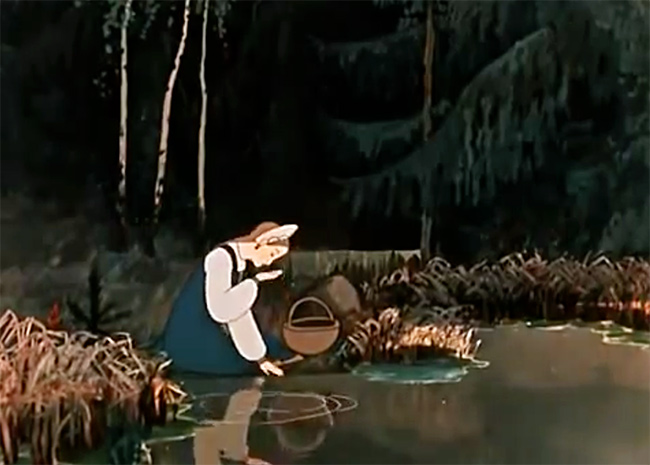
This is a 1951 Russian animation of an 1833 fairytale poem written by Alexander Pushkin that is based upon the classic Grimms tale, Snow White and the Seven Dwarfs. It was directed by Ivan Pyetrovich Ivanov-Vano, known as the ‘patriarch of Soviet animation.’

You can read Pushkin’s The Tale of the Dead Princess and the Seven Knights.

The film is in Russian so you can use the YouTube settings to turn on English subtitles.

Happily Ever Over: An Epic Illustrated Fairy Tale by C Merry

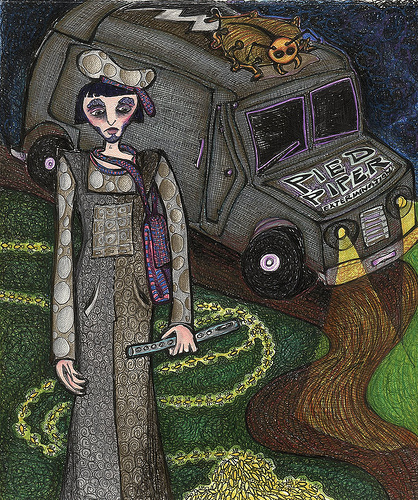
C Merry has created an epic rambling fairy tale that weaves her own modern perspective through the classic stories that children have been familiar with for centuries. The result is both humorous and unsettling. C Merry combines these tales with mythology and Christmas to explain things that have been long forgotten. It’s a beautiful way to start the holidays. You’ll find out that the Pied Piper had money troubles and was working out of his van. Santa Clawz is a wormhole-travelling wildman who began the holiday tradition of sneaking into houses to counteract the effects of war. Instead of dropping bombs, he dropped gifts. He was also descended from grizzly bears.

The story unfolds over a series of partially animated illustrations that are gorgeously detailed, showing squiggly pen lines inside every detail. These pictures are backed by a dense and mysterious soundscape.

What C Merry seems to be doing is connected the world’s most charming tales for children to the much deeper and darker subterranean world of mythology. It works. She has created a mystical world of danger and beauty.

You can also read the entire illustrated tale at the author’s blog.

Hansel and Gretel Animated by Ray Harryhausen

Ray Harryhausen, the great stop-motion animator of dinosaurs, sea creatures and dancing skeletons made this version of Hansel and Gretel in 1951. The dolls are a bit off-putting if I must be honest about it. But it’s got some great movement and settings.  This is one of a series of films he made for children after World War II.

Grimms’ Fairy Tales: The Mouse, the Bird and the Sausage

Once on a time a mouse, a bird, and a sausage became companions, kept house together, lived well and happily with each other, and wonderfully increased their possessions. The bird’s work was to fly every day into the forest and bring back wood. The mouse had to carry water, light the fire, and lay the table, but the sausage had to cook.

Continue reading

Grimms’ Fairy Tales: The Riddle

There was once a King’s son who was seized with a desire to travel about the world, and took no one with him but a faithful servant. One day he came to a great forest, and when darkness overtook him he could find no shelter, and knew not where to pass the night. Then he saw a girl who was going towards a small house, and when he came nearer, he saw that the maiden was young and beautiful. He spoke to her, and said, “Dear child, can I and my servant find shelter for the night in the little house?” “Oh, yes,” said the girl in a sad voice, “that you certainly can, but I do not advise you to venture it. Do not go in.” “Why not?” asked the King’s son. The maiden sighed and said, “My step-mother practices wicked arts; she is ill-disposed toward strangers.”

Continue reading

Grimms’ Fairy Tales: Cinderella

The wife of a rich man fell sick, and as she felt that her end was drawing near, she called her only daughter to her bedside and said, “Dear child, be good and pious, and then the good God will always protect thee, and I will look down on thee from heaven and be near thee.” Thereupon she closed her eyes and departed. Every day the maiden went out to her mother’s grave, and wept, and she remained pious and good. When winter came the snow spread a white sheet over the grave, and when the spring sun had drawn it off again, the man had taken another wife.

Continue reading

Grimms’ Fairy Tales: The Brave Little Tailor

One summer’s morning a little tailor was sitting on his table by the window; he was in good spirits, and sewed with all his might. Then came a peasant woman down the street crying, “Good jams, cheap! Good jams, cheap!” This rang pleasantly in the tailor’s ears; he stretched his delicate head out of the window, and called, “Come up here, dear woman; here you will get rid of your goods.” The woman came up the three steps to the tailor with her heavy basket, and he made her unpack the whole of the pots for him. He inspected all of them, lifted them up, put his nose to them, and at length said, “The jam seems to me to be good, so weigh me out four ounces, dear woman, and if it is a quarter of a pound that is of no consequence.”

Continue reading

Grimms’ Fairy Tales: The Fisherman and His Wife

There was once on a time a Fisherman who lived with his wife in a miserable hovel close by the sea, and every day he went out fishing. And once as he was sitting with his rod, looking at the clear water, his line suddenly went down, far down below, and when he drew it up again he brought out a large Flounder. Then the Flounder said to him, “Hark, you Fisherman, I pray you, let me live, I am no Flounder really, but an enchanted prince. What good will it do you to kill me? I should not be good to eat, put me in the water again, and let me go.” “Come,” said the Fisherman, “there is no need for so many words about it — a fish that can talk I should certainly let go, anyhow,” with that he put him back again into the clear water, and the Flounder went to the bottom, leaving a long streak of blood behind him. Then the Fisherman got up and went home to his wife in the hovel.

Continue reading

Grimms’ Fairy Tales: Straw, Coal and Bean

In a village dwelt a poor old woman, who had gathered together a dish of beans and wanted to cook them. So she made a fire on her hearth, and that it might burn the quicker, she lighted it with a handful of straw. When she was emptying the beans into the pan, one dropped without her observing it, and lay on the ground beside a straw, and soon afterwards a burning coal from the fire leapt down to the two. Then the straw began and said, “Dear friends, from whence do you come here?” The coal replied, “I fortunately sprang out of the fire, and if I had not escaped by main force, my death would have been certain, — I should have been burnt to ashes.” The bean said, “I too have escaped with a whole skin, but if the old woman had got me into the pan, I should have been made into broth without any mercy, like my comrades.” “And would a better fate have fallen to my lot?” said the straw. “The old woman has destroyed all my brethren in fire and smoke; she seized sixty of them at once, and took their lives. I luckily slipped through her fingers.”

Continue reading

Grimms’ Fairy Tales: The White Snake

A long time ago there lived a king who was famed for his wisdom through all the land. Nothing was hidden from him, and it seemed as if news of the most secret things was brought to him through the air. But he had a strange custom; every day after dinner, when the table was cleared, and no one else was present, a trusty servant had to bring him one more dish. It was covered, however, and even the servant did not know what was in it, neither did anyone know, for the King never took off the cover to eat of it until he was quite alone.

Continue reading

Grimms’ Fairy Tales: The Three Snake Leaves

There was once on a time a poor man, who could no longer support his only son. Then said the son, “Dear father, things go so badly with us that I am a burden to you. I would rather go away and see how I can earn my bread.” So the father gave him his blessing, and with great sorrow took leave of him. At this time the King of a mighty empire was at war, and the youth took service with him, and with him went out to fight. And when he came before the enemy, there was a battle, and great danger, and it rained shot until his comrades fell on all sides, and when the leader also was killed, those left were about to take flight, but the youth stepped forth, spoke boldly to them, and cried, “We will not let our fatherland be ruined!” Then the others followed him, and he pressed on and conquered the enemy. When the King heard that he owed the victory to him alone, he raised him above all the others, gave him great treasures, and made him the first in the kingdom.

Continue reading

Grimms’ Fairy Tales: Hansel and Gretel

Hard by a great forest dwelt a poor wood-cutter with his wife and his two children. The boy was called Hansel and the girl Gretel. He had little to bite and to break, and once when great scarcity fell on the land, he could no longer procure daily bread. Now when he thought over this by night in his bed, and tossed about in his anxiety, he groaned and said to his wife, “What is to become of us? How are we to feed our poor children, when we no longer have anything even for ourselves?” “I’ll tell you what, husband,” answered the woman, “Early to-morrow morning we will take the children out into the forest to where it is the thickest, there we will light a fire for them, and give each of them one piece of bread more, and then we will go to our work and leave them alone. They will not find the way home again, and we shall be rid of them.” “No, wife,” said the man, “I will not do that; how can I bear to leave my children alone in the forest? — the wild animals would soon come and tear them to pieces.” “O, thou fool!” said she, “Then we must all four die of hunger, thou mayest as well plane the planks for our coffins,” and she left him no peace until he consented. “But I feel very sorry for the poor children, all the same,” said the man.

Continue reading

Where Do Fairy Tales Come From?

The traditional notion of where fairy tales come from suggests that people like the Brothers Grimm listened to oral folktales handed down through the generations and wrote them down with little embellishments.  But now, in a book called Fairy Tales: A New History, Ruth B. Bottigheimer argues that fairy tales have a much more literary genesis than has been commonly thought.  The Chronical Review has an interesting article about the different theories on the origin of some of the world’s most retold stories.  The article points out how confusing and complex the history of fairy tales becomes when you consider that many of the most familiar tales are shared across different cultures.  Jack Zipes, a leading translator and adapter of fairy tales says that “It’s absurd to create a dichotomy. The literary and the oral thrive off one another.”

Purchase Fairy Tales: A New History (Excelsior Editions)