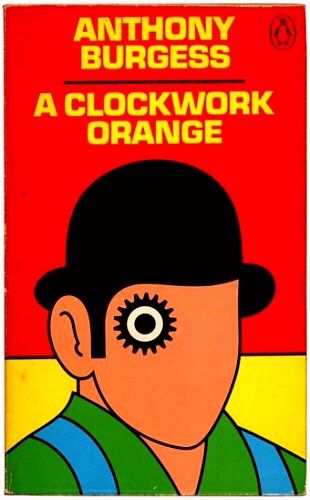
A Clockwork Orange: BBC Radio Drama of the Novel by Anthony Burgess

This is a BBC radio dramatization of A Clockwork Orange by Anthony Burgess. The book is still a shocking satire of Western culture gone to the youthful dogs of violence and mayhem. Burgess played with language by inventing a detailed and comically expressive slang for his criminal hero and the gang he leads.
 
The best info I can find about this recording dates it somewhere around 1997. It stars Jason Hughes as the murderous 'droog,' Alex.


Documentary Film: Secrets of the Arabian Nights

Of all the pages here on Candlelight Stories, the page devoted to the tales of the Arabian Nights is the single most popular. I love to post about these fantastic and free-wheeling adventures. Here’s a wonderful BBC documentary that communicates not only the far-flung and enduring history of the tales, but also the wild sense of imagination allowed to roam freely. Reading the Arabian Nights gives one a sense of how brilliant, winding, layered and abandoned literature can be.

BBC New York Punk Rock Documentary

Here’s an excellent BBC documentary on the origins of punk, hip hop and disco in the New York City of the 1970s. It was a hard time in the city but it held a wild energy that kept pressing up and inventing new things. What hit me about this film is how good Patti Smith really is.

New York since then, however, seems to have signed an unlimited contract with the Gap as a retail outlet. I think anyone with a streak of punkishness in them moves out to Los Angeles.

I found this via the excellent curatorial efforts of Rob Smart on Facebook.

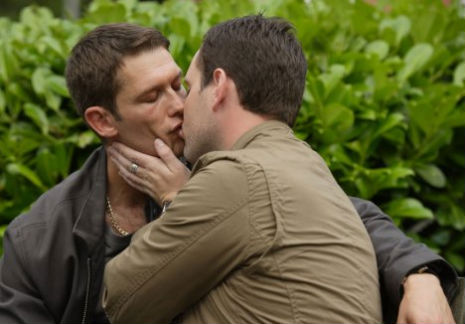
Facebook Appears to Delete Photos and Pages Related to Gay Men Kissing

If this photo upsets you or offends you, then kiss my ass.  Facebook appears to have deleted a page set up to organize a protest over two gay men who were thrown out of a British pub for kissing at their table.  (Update: It turns out that the protest organizer made the page private.  But it still looks as though Facebook removed some other posts and pics related to this issue.)  Over the course of my life I have observed many men and women kissing in restaurants, bars, taxis, airplanes, streets, theaters, Ferris wheels, boats, beaches and on television.  It’s a simple act of affection that is practiced by all cultures worldwide.

If a man and a woman feel something for one another, they kiss.  If two men feel something for one another, they kiss.  If two women feel something for one another, they kiss.

Facebook doesn’t seem to see it that way.  They appear to consider it offensive.  Objectionable.  Perverse.

This is what’s wrong behind the scenes with corporate control of major communications tools.  You get some unevolved, intellectually limited, vapid, sexually repressed jackasses running the show and suddenly no one is really allowed to communicate freely anymore.  This is a sure indicator that we need to move off of services like Facebook and into fully open-source social networking tools.

Mark Zuckerberg may be one of these mental midgets (Don’t be fooled by the movie.  It doesn’t take much to code Facebook really.  It’s just MySpace with a white background.) with problems in the sexual arena.  Those dull watery eyes might be a dead giveaway.  At any rate, he presides over a company that is apparently banning photos of men kissing while fully clothed.

Candlelight Stories supports the rights of all gay, lesbian, transgender and bisexual persons.  Those rights include the right to kiss and the right to marry and the right to carry on in any way they see fit.

It does not escape me that some of Candlelight’s slower readers will find this post surprising and perhaps offensive.  To those readers I say, get the hell out of here, take your kids with you and don’t let the door hit your expanding ass on the way out.  I don’t publish for you.  Never have.  Never will.  I consider you monkey people.  Unattractive, limp, unschooled, unappealing and quite frankly disgusting.  If you were to read another word of my writing, I think I would vomit.

For those others of you who understand that we all have the same right to kiss, go onto Facebook and share this photo.

Lovely Lovely: Art Documentary by Matthew Collings

Mature Content and Language

This is another episode in the art documentary series, This is Modern Art, by Matthew Collings.  In this episode, Collings explores the place of beauty in modern art.  How does beauty fit into art that tries to shock?  What is the purpose of beauty in art?  Doesn’t most conceptual art try to dispense with beauty entirely?  Is beauty something we need for comfort?  Does it have something to say in art or is it just a distraction?

Part 2

Parts 3 – 5 after the jump

Continue reading

A is for Atom – Nuclear Documentary by Adam Curtis

This is a five-part documentary by British filmmaker Adam Curtis about the rise of nuclear energy in the United States. These sections make up A is for Atom which is a 1-hour segment of a much longer science and politics television series called Pandora’s Box.  It chronicles the development of the nuclear power industry and shows clearly how little was ever understood about what would happen or what should be done during a nuclear accident.

Parts 2 – 5 after the jump

Continue reading

The Living Dead – Adam Curtis Documentary About Cold War Mind Control

Adam Curtis makes fascinating documentary films for the British Broadcasting Corporation. This one is about the manipulation of memory, or the attempt to manipulate it, by governments during the Cold War era. It features several scientists and psychology experts who worked for either the U.S. or Soviet governments trying to figure out how to control minds.

I post the work of Curtis because his filmmaking is actually quite a lot like my own in several ways. This film bears a relationship to my latest film, Yellow Plastic Raygun, which is also about memory and how it influences the future. Curtis dwells in the domain of documentary, a form that I have serious misgivings about, while I dwell in the domain of art – or direct mind control if you will! I like Curtis’ use of corporate, military, instructional, and entertainment films as his raw visual material. He mixes it up with what is actually a rather simplistic script relating information that is not especially insightful. The film seems to suggest something more under the surface because of its imagery which often bears no relationship whatsoever to the information being related by the voice-over. This is a tricky area for documentary that brings it perilously close to the realm of art. You don’t quite know what it is that you are actually watching. I like that but I also distrust it.  But Curtis appears to me to be making a documentary about his own feelings and artistic interpretations of the factual material.  He is not trying to teach or inform at all.  He is simply trying to create an impression.  The words of the documentary could be replaced with gibberish.  In fact, it would probably be a slightly better film if they were!

The Living Dead – Part 1 (watch the next 5 parts after the jump)

Memory is perhaps the single most important quality of existence. We are simply memory machines walking around and recording. All of our activities point toward an ever-increasing ability to record and remember. We are building memory. The idea, pursued in the first half of this documentary, of wiping out unpleasant memories that are assumed to be destroying the health of an individual, seems to me to be misguided and foolish. I have always viewed it as the job of every human to be able to stare straight into the most horrific scene, remember it, and not allow it to take control. Very simple. You must be able to look at anything… and continue to eat your ice cream.

Continue reading

Thinking About Underground Film – Part 1

If you live in Los Angeles you’ve probably seen it many times: the caravan of white trucks parked along the block and around the corner, diesel generators roaring, cables strung along the gutters, piles of lights, rolls of cables, racks of costumes, makeup trailers, bored extras, bored crew members, bored motorcycle police, and fascinated passersby.

That’s all you need to see to know that something mainstream – feature film, TV show, or commercial – is being made.

But what’s an underground film?

Bad Lit, my favorite site devoted to underground film, has an article about the problem of defining something as slippery as ‘underground film’ in which several definitions are offered by different people. Mike Everleth, the site’s editor, defines underground film this way:

Essentially, I believe it is a film that is a personal statement by one person and a film that dissents radically in form, or in technique, or in content, or perhaps in all three. However, that dissension can take on any number of forms.

I agree with that, but would add the requirement of hostility. There should be an element of combativeness which attempts to counter a much larger established force.  There must be some rebellion in the work.  It can be very subtle – nearly imperceptible – but it’s usually there somewhere.  In fact, I think the hostility should even tend to include the general culture surrounding the filmmaker/s.  Dissent, by itself, can be rather subdued, soft-spoken and shy.  I think underground film requires a willingness not only to dissent but to kick apart.

While thinking about all this mainstream versus underground stuff, I went searching around on YouTube for something that might fit the discussion.  I found this peculiar British documentary film about filmmaker Donald Cammell who co-directed, along with Nicolas Roeg, the 1968 film Performance. The film is one of those odd mixtures of underground and mainstream.  It features Mick Jagger and involves a lot of mind-bending drugs, sex and criminal underworld shenanigans.  It’s actually impossible to forget once you have seen it.

This film contains adult subject matter, language, nudity and sexual situations.

Part 2
Part 3
Part 4
Part 5
Part 6
Part 7

The documentary, Donald Cammell: The Ultimate Performance, describes a time when a group of intensely creative artists from various disciplines could operate on the fringes of the mainstream to create an essentially underground film with something resembling support from a mainstream production company. It’s a scenario that does not exist today. If you watch all 7 parts of the film, you will be immersed in that strange hybrid world of the ‘popular underground’ that defines much of what was happening in the 1960s and 70s. Today, if it cannot be jammed into a mall and sold with Sour Patch Kids, it won’t get any money.  That holds as true for ‘independent’ films as it does for summer blockbusters.

Watching this documentary makes me wonder why so many filmmakers seem to have such trouble making the films they really want to make.  After all, one can purchase a cheap camera and make exactly what one wants regardless of what one’s career and money-earning responsibilities might be. Tormented filmmakers who are battling studois for creative freedom should simply make films with video cameras during their spare time. This would not only foster a healthy underground, but it would quite possibly prevent a few tragic endings.
Shakespeare Animated: Macbeth

Shakespeare: The Animated Tales was a BBC television series of the 1990s that produced 30-minute versions of Shakespeare’s plays with animation done by well-known Russian animators at the Christmasfilms studio.  This version of ‘The Scottish Play’ stars Brian Cox.

Click the continue reading link for parts 2 and 3.

Continue reading

Animation: The Lighthouse Keeper’s Lunch

This is a film made in a workshop run by Quirky Pictures for the BBC Children in Need at the Downsview Special School in the U.K. It’s just insanely beautiful. These kids are learning to be free with various artistic modes and they have made something that is mysterious, magical and wonderful. They are 9 – 12 years old and they make all their paper cutouts, puppets, and props. They storyboard and watercolor and narrate. They have their own little movie studio going into operation. These workshops must be something to see because these results are something very rare. I think the BBC should put together a television show and get all these things on the air.

Animation: The Magic Fish

Shaun Clark and Kim Noce at Mew Lab made The Magic Fish for broadcast on a BBC television show for children. It’s an Italian folk tale about a couple who have very little but get some assistance from an ancient chestnut tree and a magic fish. The animation is full of mixed media painting, paper, and photographs.  My favorite part is the ocean with the little boat near the end.

Film by Children: The Sword in the Stone

Children at West Lea School made this animated version of the King Arthur legend in their Quirky Pictures animation workshop.  It’s a marvelous telling of the tale of how Arthur is able to pull the sword from the stone and become king.  These kids have created a wonderful film that tells its story fearlessly and with great imagination.  I will find many more of these animations to post here.

Shakespeare Animated: The Winter’s Tale

Shakespeare: The Animated Tales was a BBC television series of the 1990s that produced 30-minute versions of Shakespeare’s plays with animation done by well-known Russian animators at the Christmasfilms studio. This version of The Winter’s Tale is Shakespeare’s dark comedy about a king’s jealousy run wild.  This little animated version is loaded with gorgeous wintry scenes.

Click the continue reading link for parts 2 and 3.

Continue reading

Shakespeare Animated: The Tempest

Shakespeare: The Animated Tales was a BBC television series of the 1990s that produced 30-minute versions of Shakespeare’s plays with animation done by well-known Russian animators at the Christmasfilms studio. This version of The Tempest from 1992 is a masterpiece. It’s simply one of the best film adaptations of Shakespeare I’ve ever seen. The island setting is wonderfully romantic and diffused. The characters are unbelievably expressive in movement. The voice work is superb. Though the script is pared down to 30 minutes, it preserves the essential fun of Shakespeare’s magical work.

Click the continue reading link for parts 2 and 3.

Continue reading