A Virtual Reality Space War for iPhone

You can get more app developer updates and game support at aliengemwar.com.

Now available in the App Store!

Battle alien saucers and harvest energy gem towers in this retro sci-fi action shooter that will demand all your VR fighting skills!

Made for freely available Google Cardboard VR, this game is a whirlwind of space war survival that incorporates combat shooting, movement tactics, clock management, and balancing various skills to outwit the enemy aliens and transport energy gems off the planet surface.

You’ll have to stay in constant motion and fend off attacks that come from all directions as you attempt to fly around the battle zone shooting down alien saucers and bombs while protecting and harvesting your gem towers.

This game is deceptively simple but extremely difficult to master. Survive as long as you can against increasing difficulty and figure out how to get the score bonuses.

No ads. No in-game purchases. Just simple straight ahead fun.

No hand controller is required for this game, just a simple and inexpensive Google Cardboard VR viewer. It works without even needing to pull the trigger on your Cardboard viewer. It’s almost entirely shoot and move by aiming. You can choose to use the trigger for firing your main gun and a special extra skill test that you can discover, but the trigger is not required.

Get yourself an inexpensive Google Cardboard compatible VR viewer like the ‘View-Master Deluxe VR Headset’ or ‘Merge VR Goggles’ and have a blast that will get you feeling like you are living inside a classic science fiction adventure world.

You can also play in non-VR mode.

This game has been tested on iPhones as old as the 6s.

A Game Center leaderboard is included.

This game requires a high amount of physical movement and uses the full 360 degree range of VR.

Children should play with adult supervision. Play VR games in a safe open area, free of obstructions, obstacles, and hazards. For increased safety, play while sitting in a swivel chair.


Cosmic Voyage: 1936 Soviet Science Fiction Film About a Moon Landing

SovietSpaceFlight2

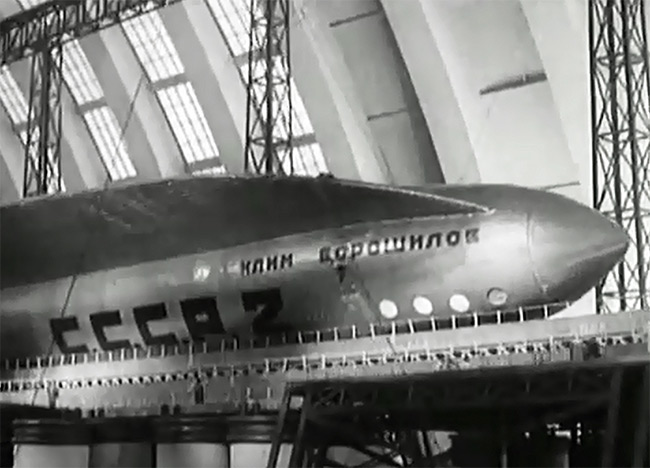
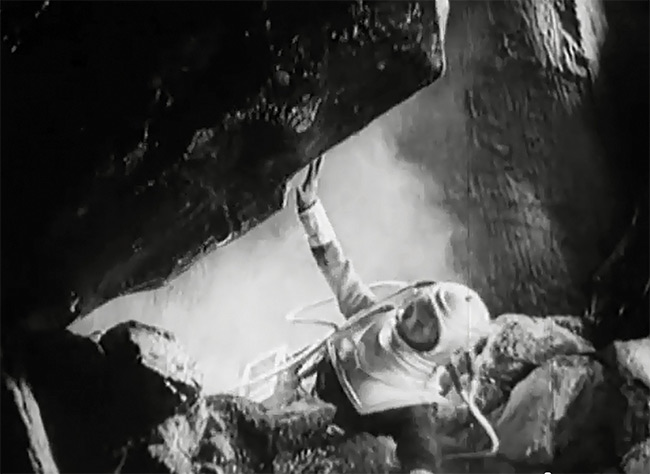
This is an absolutely fascinating and rather beautiful 1936 Soviet science fiction film that foretold how a future 1946 moon mission would work. It’s got incredible zero gravity effects, miniature models of a fantastic space ship on a launch ramp, and very cool technical details like filling the cockpit with fluid to buffer the cosmonauts from launch forces. Then there’s a marvelous sequence on the surface of the moon with excellent stop motion animation inter-cut with live actors. Apparently, the Soviet censors banned the film after a short but successful first run because they felt the cosmonauts were having too much fun on the moon. They were right. These characters go hopping and bounding about with so much joy it’s almost an embarrassment. Citizens of the Soviet Union were not supposed to be happy.

Don’t worry about understanding Russian. The film was shot as a silent and is more or less a completely visual experience.

It was directed by Vasili Zhuravlov, but what’s really most interesting about the production history is that Constantin Tsiolkovski, a Soviet scientist and professor, became enthusiastic about putting some of his theories on space travel into a film. He consulted with the filmmakers in an attempt to lend verisimilitude to the moon voyage. Many years later, Werner von Braun credited Tsiolkovski’s calculations as having been correct.

So here is a old Soviet film that went to great lengths to get many of its details right.


Here is an interesting article about the film.

SovietSpaceFlight3

Pereval: 1988 Soviet Science Fiction Animation by Vladimir Tarasov


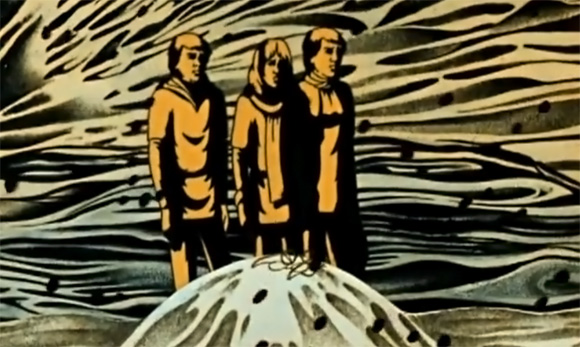
Humans have crash-landed on an alien planet. Sixteen years later, they send a small search party consisting of their children – born at the time of the crash – back toward the broken ship. The young members of the party make their way through a hostile and surreal landscape that holds surprises for them. Finding the ship well-preserved gives one of the young people an important connection to his past and to his origin.

This film was directed by Vladimir Tarasov and was adapted from a novel by Kir Bulychev.

Ikarie XB-1: 1963 Czechoslovak Science Fiction Film of a Stanislaw Lem Novel

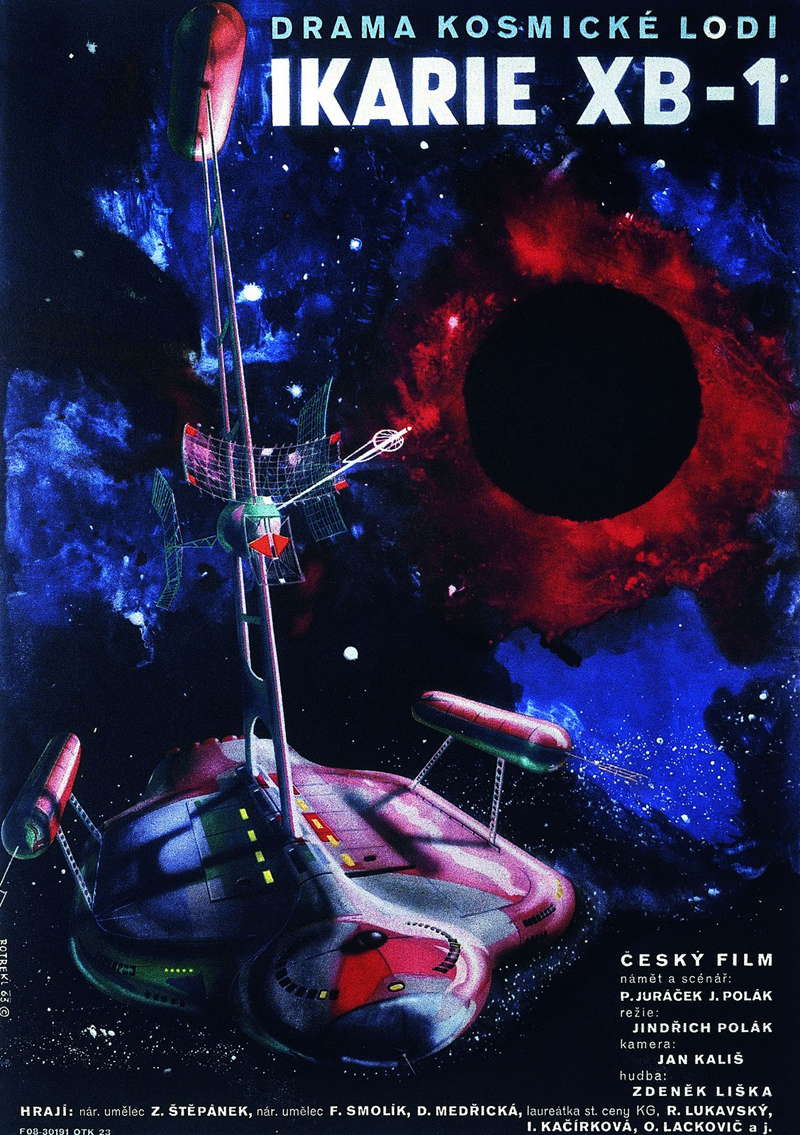
This 1963 Czechoslovak science fiction film directed by Jindrich Polák is an adaptation of a Stanislaw Lem novel called ‘The Magellanic Cloud.’ Reflexively, one tries to find similarities between this film and Kubrick’s ‘2001: A Space Odyssey.’ But I think the better place to look for influence is in Andrei Tarkovsky’s 1972 film, ‘Solaris,’ which was also a Lem adaptation. ‘Ikarie XB-1‘ follows the crew of a ship sent to investigate a planet orbiting Earth’s nearest star, Alpha Centauri. On the way, they encounter a derelict space ship from 1987 Earth which appears to originate from the United States and carries a load of deadly poison and nuclear weapons. Crew members begin to inexplicably fall asleep. The ship also finds a giant dark star that emits an unknown type of radiation from which the humans are mysteriously rescued. The end of the film is a stunning sequence of mental breakdown leading to fantastic and life-affirming discovery.

But the various events do not matter as much as the way the film dwells on the people within their technological surroundings. It’s the focus on the mental status of the crew as opposed to exciting episodes that makes for the strength of this film and its influence on ‘Solaris.’ The film has a calm and quiet approach, simply trying to let us feel the vast distances traveled by the crew. The sets and visual effects hover between beautiful and unconvincing. But they work and are often effective. It’s really a pretentious art film in space. If you like Eastern Bloc science fiction and Stanislaw Lem’s peculiar writing, this is a must see.

Sally Saves Christmas

Some of the readers of this site will know that this story is the original piece of material behind Candlelight Stories. Back in 1994, I sat at a very flimsy folding table in a Los Angeles apartment with a box of pastels, crayons and ballpoint pens to scratch out a pile of illustrations that vaguely added up to some kind of Christmas tale. I still have all those original drawings in a big department store box. The interesting thing about the illustrations for me is the series of actions that they caused which led me directly into the various skills and technologies that I have used and made a living from ever since. After finishing the illustrations and creating a large bound book to give as a Christmas gift, I scanned the pictures and decided to try to put them into a slide show. I had an early version of the Mosaic web browser and soon realized that I could use my AOL account to post things in a folder that could be accessed by the web browser. Having done that and been very impressed with myself I showed it to my non-technical friends and received some half-hearted congratulations and was asked how I could ever hope to make any money that way. Within a few months I received a letter in the actual mail from the USA Today newspaper requesting permission to put an illustration and a web link in a listing of good things on the web. So I said they could and they printed their thing. So I began to add new things to the web site as I could.

It’s pretty much the same today. You just make a little thing and stick it on the web to see who likes it. But back then it was a little like magic. My web experiment grew quickly and when the higher-speed DSL technology first came into Los Angeles I jumped on it and got myself a Digital Alpha server and put it at the end of a DSL line in my own home to serve the web site. According to the company which was the first one up and running in L.A., I was the first person to attempt running a web server over the DSL technology in Southern California! They gave me totally free ISP service for several years in exchange for a little advertising. I’d actually have late night conversations with their engineers – sometimes from their cars as they made their way to hubs and switches in the dead of night to fix something. Imagine that kind of technical support today with your blog host! Won’t happen! This all worked well for a time. But then the DSL technology began to fail and I quickly realized it was a dead-end technology with too many players involved on the back end who could not adequately maintain the service without blaming each other for failures. But my point is that during that time, with that kind of approach, one could really get a sense of being visited by the world. I could watch the lights blink as people came onto the server to visit. There were times, during serious outages of some sort or other, when I’d throw the big Alpha server into my car and drive it to some other location for a temporary connection. Amazing. Fun.

It’s still fun today. That’s why I still post this odd little story every Christmas. It’s the original first thing of this site.

Stopover: Animation by Neil Stubbings

I like this fast-paced and funny little cartoon about a driving emergency in outer space. The characters are expressive and silly. The ‘I have to pee urgently’ walk is hysterical. The computer animation has that nice cartoony/drawn look that always catches my eye. Neil Stubbings directed the film for LeMob Animation.  Via Neatorama.

Podcast Novel: A Princess of Mars (Chapter 28 – Conclusion)

DOWNLOAD MP3 AUDIO

A Princess of Mars

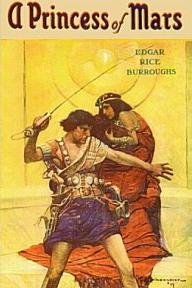
This is the first John Carter of Mars novel by Edgar Rice Burroughs, the author of the Tarzan books. It was his first novel, published in 1917 and it’s a work of rip-roaring science fiction that has inspired many of the great writers in the genre.

Chapter 28 (Conclusion): We reach the final chapter of our story in which John Carter finds himself on a strange new world.

You can find all the previous chapters of the book here.

You’ll find regular podcasts of all the chapters over the next couple of months. Subscribe to our feed.

Duration: 00:04:28
Read by Alessandro Cima

All audio stories are Copyright © Candlelight Stories, Inc., All Rights Reserved.
 

Podcast Novel: A Princess of Mars (Chapter 27)

DOWNLOAD MP3 AUDIO

A Princess of Mars

This is the first John Carter of Mars novel by Edgar Rice Burroughs, the author of the Tarzan books. It was his first novel, published in 1917 and it’s a work of rip-roaring science fiction that has inspired many of the great writers in the genre.

Chapter 27: The martian atmosphere begins to die and John Carter struggles to save an entire planet.

You can find all the previous chapters of the book here.

You’ll find regular podcasts of all the chapters over the next couple of months. Subscribe to our feed.

Duration: 00:11:29
Read by Alessandro Cima

All audio stories are Copyright © Candlelight Stories, Inc., All Rights Reserved.
 

Podcast Novel: A Princess of Mars (Chapter 26)

DOWNLOAD MP3 AUDIO

A Princess of Mars

This is the first John Carter of Mars novel by Edgar Rice Burroughs, the author of the Tarzan books. It was his first novel, published in 1917 and it’s a work of rip-roaring science fiction that has inspired many of the great writers in the genre.

Chapter 26: John Carter leads part of the battle to free Helium and Zodanga. He meets the father of Dejah Thoris.

You can find all the previous chapters of the book here.

You’ll find regular podcasts of all the chapters over the next couple of months. Subscribe to our feed.

Duration: 00:13:22
Read by Alessandro Cima

All audio stories are Copyright © Candlelight Stories, Inc., All Rights Reserved.
 

Podcast Novel: A Princess of Mars (Chapter 25)

DOWNLOAD MP3 AUDIO

A Princess of Mars

This is the first John Carter of Mars novel by Edgar Rice Burroughs, the author of the Tarzan books. It was his first novel, published in 1917 and it’s a work of rip-roaring science fiction that has inspired many of the great writers in the genre.

Chapter 25: John Carter crashes the wedding ceremony of Dejah Thoris and fights for her.

You can find all the previous chapters of the book here.

You’ll find regular podcasts of all the chapters over the next couple of months. Subscribe to our feed.

Duration: 00:10:52
Read by Alessandro Cima

All audio stories are Copyright © Candlelight Stories, Inc., All Rights Reserved.
 

Podcast Novel: A Princess of Mars (Chapter 24)

DOWNLOAD MP3 AUDIO

A Princess of Mars

This is the first John Carter of Mars novel by Edgar Rice Burroughs, the author of the Tarzan books. It was his first novel, published in 1917 and it’s a work of rip-roaring science fiction that has inspired many of the great writers in the genre.

Chapter 24: John Carter crashes in the midst of a battle, finds a friend, and finally confronts Tal Hajus.

You can find all the previous chapters of the book here.

You’ll find regular podcasts of all the chapters over the next couple of months. Subscribe to our feed.

Duration: 00:15:41
Read by Alessandro Cima

All audio stories are Copyright © Candlelight Stories, Inc., All Rights Reserved.
 

Podcast Novel: A Princess of Mars (Chapter 23)

DOWNLOAD MP3 AUDIO

A Princess of Mars

This is the first John Carter of Mars novel by Edgar Rice Burroughs, the author of the Tarzan books. It was his first novel, published in 1917 and it’s a work of rip-roaring science fiction that has inspired many of the great writers in the genre.

Chapter 23: John Carter and Kantos Kan escape Zodanga and fly toward the city of Helium to rescue Dejah Thoris.

You can find all the previous chapters of the book here.

You’ll find regular podcasts of all the chapters over the next couple of months. Subscribe to our feed.

Duration: 00:12:06
Read by Alessandro Cima

All audio stories are Copyright © Candlelight Stories, Inc., All Rights Reserved.
 

NASA Begins its End

The final landing of a NASA space shuttle yesterday, though hailed as the final act of a great technical achievement over the past 30 years, actually represents a complete failure on the part of the United States to build upon the work of scientists and technicians from the 1960s and 70s. It should shock most of the world that the leading superpower, with the world’s most advanced space exploration systems, could not figure out a way to even build a second version of the space shuttle. I’ve never seen a product of technology that stays with version 1.0 for thirty years. There is no viable plan in existence for launching human beings off the earth by the United States. There’s a lot of vaporware and talk. There are models of crew capsules that will maybe one day launch people toward an asteroid or even to Mars. Maybe. None of it works. None of it even has a working toilet. There are no rockets being designed that could even launch the miraculous capsule into orbit. And that crew capsule? If you’ve seen it you then realize that NASA is simply building the Apollo system all over again with extra bunks for three more astronauts. But they can’t build the thing. It doesn’t exist.

There are no longer any means available to the United States for getting people to the International Space Station. There are no means available for getting any equipment up there. The U.S. must rely on rides hitched aboard Russian spacecraft for an indefinite period of time that many NASA experts are now saying could extend to 10 years.

Russia has a more advanced and reliable space exploration system than the United States.

In the mid 1990s I went to a boring Hollywood party and wandered around with a drink in my hand for about half an hour before running into an older couple sitting alone. They seemed uncomfortable and out of place. So I said hello and sat down next to them. The man turned out to be a retired engineer who worked on the design for the Lunar Landing Module during the Apollo years. I asked him why NASA had been unable to return to the moon. His answer was: ‘Because they can’t.’

He explained that NASA had been been decimated by enormous loss of technical knowledge due to retirement. He said that the agency had not properly stored its accumulation of knowledge. He said that if engineers wanted to build a rocket, command module and lander to get back to the moon, they would be completely unable to do so and would be forced to relearn almost everything that had been learned during Apollo. He then said that this would become very clear to the nation sometime within the next 15 to 20 years as existing technology wore out and could not be replaced. I told him that he seemed very depressed about it. He nodded and said the situation was much worse than he could explain. He said that technical notes from engineers hadn’t even been saved. The knowledge was just totally lost.

I think that guy was right. I don’t think NASA could build a new shuttle even if it tried.

NASA’s insistence on transferring launch responsibilities over to private space companies would perhaps make some sense if we had seen it being phased in alongside the existing shuttle technology.  But to shut down our only means of space transport and hope for the best with future private launches is simply begging for disaster.  How tested will this new private space launch technology be?  Why would an astronaut climb into a rocket built by some company run by PayPal’s founder?  It’s insane and stupid.  What if the first private launch vehicle with astronauts explodes on liftoff?  What happens then?  Is there even a backup plan?