Les Mystères du Château de Dé: 1929 Film by Man Ray

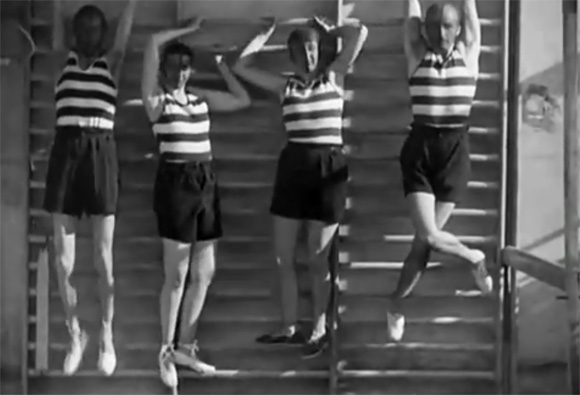
Surrealist art great, Man Ray, made this film in 1929. It follows a pair of indecisive travelers who base all their action on chance. They head out to a fabulous chateau in the hills and wander around inside and out. They run into four odd persons who enjoy swimming and running about as if the place is their private gym. But what is Man Ray doing here? Why all these shots of windows, lamps, sculptures? He is finding the abnormal in the normal. Wherever he happens to be with a camera he can make the surreal. He’s functioning as an artist, looking for odd angles, shadows, contrasts. He is also diving into the great current of his culture. The house is a castle filled with fine objects and great art. Man Ray is expressing his enthusiasm. This is an extremely childish film. I mean that as a compliment, though I really see nothing exceptional in works for children. But for an artist to function as a child for a certain amount of time is extraordinary and beneficial I think. But that kind of thinking must end and lead to its own destruction. In other words, I do not think any children’s author or illustrator should ever continue to work in that way for more than a few years. Then it is time to think about serious things and to make things that upset people. Perhaps that is my main criticism for most of the things I have seen by Man Ray. He seems a little bit too pleasant. I might be wrong about that. I have to look a little more.
Celles Qui S’En Font: 1928 Short Film by Germaine Dulac

Germaine Dulac was one of the original French film ‘auteurs.’ She was also a film theorist and feminist. She had a relatively short career as an avant-garde filmmaker, making such works as ‘The Smiling Madam Beaudet (1923) and ‘The Seashell and the Clergyman’ (1928) which is often credited as being the first Surrealist film.

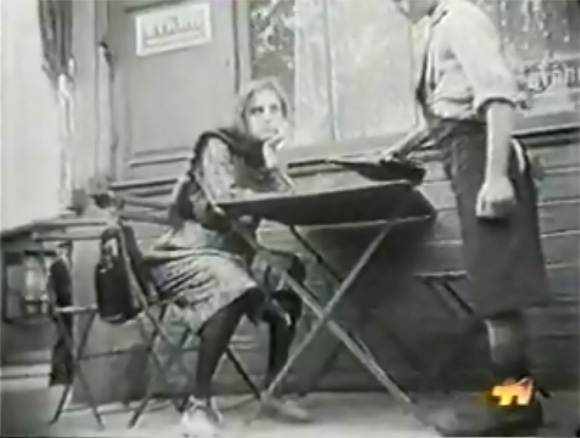
In this film, the title translated as ‘Those Who Make Themselves,’ we follow a destitute drunk woman who appears to yearn for the life of a prostitute or to engage in some sort of tryst. It is also possible that she is simply despondent over rejection by a lover. She appears to fail at everything she tries and eventually walks down a staircase into the Seine river. It’s a very simple film that manages to convey a deep sense of loneliness.

Dulac insisted on being credited as the author of her films, not accepting the standard partnership between a screenwriter and director.

Here’s a 1923 quote from Dulac:

I believe that cinematographic work must come out of a shock of sensibility, of a vision of one being who can only express himself in the cinema. The director must be a screenwriter or the screenwriter a director. Like all other arts, cinema comes from a sensible emotion … To be worth something and “bring” something, this emotion must come from one source only. The screenwriter that “feels” his idea must be able to stage it. From this, the technique follows.

Here’s a Senses of Cinema article on Germaine Dulac entitled ‘The Importance of Being a Film Author: Germaine Dulac and Female Authorship.’

Jean Renoir’s 1928 Version of The Little Match Girl


This is a 1928 version of Hans Christian Andersen’s ‘The Little Match Girl,’ directed by French film great Jean Renoir and Jean Tédesco. The story is a simple one about the visions of a poor match girl as she freezes to death in the snow. It’s a loose adaptation that actually seems rather rigid and too involved with its sets and props to really give any feeling of the fantastic. It is also pro-forma in its pathos or portrayal of the match girl’s despair. Also, the leading actress, Catherine Hessling, is completely unappealing. Apparently, one of the toy soldiers was played by Lucia Joyce, the daughter of author James Joyce.

Tribune-American Dream Picture – 1924 Surrealist Film Contest Winner

In 1924, the Oakland Tribune and American Theatre held a contest in which people submitted their dreams. The winning dreams got made into films and the dreamers won $25. This surreal piece came from a dream submitted by Mrs. L.L. Nicholson. It more closely resembles a dream than many films since then, including Hitchcock’s Spellbound.  It involves a couple on a trip and a missing baby.

Trailer for Metropolis with Restored Lost Footage

Hey! I thought I had the darned movie already! But now there’s yet another ‘restored’ version of Fritz Lang’s 1927 science fiction masterpiece, Metropolis. Boy is that a gorgeous trailer though! Wow! And the music is far better than what’s on my DVD. This is the movie that just keeps making itself over and over and over.

I want to make a feature film and I’ll release the 2-hour version, but there will be 17 hours of ‘lost footage’ hidden in various places around the globe so that the movie can recompile itself over the decades into an ‘official version’ which bears absolutely no resemblance to the original movie. Or better yet, I’m going to start shooting fake Metropolis footage and then discover it in the broom closet of an old bus depot in the middle of Kansas. So the movie will suddenly expand to 4 and a half hours.

First Sci-Fi Film: A Trip to the Moon

Today is the 107th anniversary of the first science fiction film ever made, A Trip to the Moon. It was directed in France by Georges Méliès who had been inspired by the novels From Earth to the Moon by Jules Verne, and by The First Men in the Moon by H.G. Wells.  This is the film with the famous image of the spaceship landing in the eye of the moon’s face.