Kenneth Anger Makes a New Film for Missoni Fashion House

The great American filmmaker, Kenneth Anger, has made a new film called Missoni. He shot it for the Italian fashion house Missoni as part of their Fall 2010 advertising campaign.  The film includes members of the Missoni family engaged in dance-like movement and poses. Can advertising be art? Yes, when it’s done by an artist.

Anger has made another beautiful and mysteriously layered film. Apparently, he has gone digital, using something called a RED digital camera. It has some characteristics in common with 35mm cameras. Anger appears to be using it as freely as he used 16mm cameras.

What’s really interesting about this whole project is its reason for existing.  I think the Missoni advertising angle is just an excuse.  I think they just wanted to be in a film by Kenneth Anger.

Film: The 1910 Challenge

As the 2010 Tour de France bike race winds its way through the French Pyrenees mountains, cyclists and fans everywhere are celebrating the 100th anniversary of the first time a stage of the race went up the Pyrenees. The range is rugged and steep, presenting the riders with a greater challenge than the more gradual ascents of the Alps. In 1910, riders first hazarded the devastating climbs. Now, bike clothing manufacturer Rapha has produced this beautiful film about four riders celebrating the Tour’s Pyrenees anniversary by riding up a mountain called the Col du Tourmalet. That’s the mountain that the current Tour de France race is on at the moment. These four riders pay their respects to the 1910 racers and their equipment by enjoying every hardship presented to them by the mountain and the wet weather.

I do a lot of mountain road riding in California and I can appreciate the difficulty of this incredible Col du Tourmalet climb.  I’d love to do it myself.  Equipping yourself with water, food and repair items to set out over remote slopes is a very focused and exciting thing to do.  I recommend it to anyone.

Film: Outer Space

Marc Campbell posted this 1999 film called Outer Space by Australian avant-garde filmmaker Peter Tscherassky. Using found footage from something featuring actress Barbara Hershey, Tscherassky creates a jumping and jittering psychotic version of a haunted house movie. The simplest of shots showing a woman entering a house, sitting down, looking into a mirror, looking out a window, are turned into extravagant, multi-layered cubist visions from a nightmare.

Film: From a Land of Ashes and Mist

From an Italian master of short film memory, Fabio Scacchioli, comes this beautiful 23-minute work that expresses the illusion of solid permanence and the heroic attempt to build a reality based on fragments of memory. Even found memories and images can become part of one’s own person. This fleeting and subtle idea becomes more discernible as the film progresses.  The impressive imagery revolves around the recent earthquake in L’Aquila, Italy and compares the desolation of a town reduced to rubble with the lives that once literally danced through home movies.  It is a film about looking for ghosts.

The Mona Lisa Curse: Do High Prices Ruin the Art World?

This is a 12-part film on YouTube called The Mona Lisa Curse by art critic Robert Hughes. The film is fascinating for its overview of the art scene in New York since the 1960s. Hughes, the art critic for Time Magazine, goes on an extended diatribe against the fast-paced and overpriced world of art collectors and auctions that he says have debased recent art. He hates Damien Hirst because, according to him, the work does not merit the inflated prices. He hates Andy Warhol and thinks he was stupid and stole ideas from Robert Rauschenberg.  He thinks wealthy collectors have become simple investors without a thought in their heads about why the art is important.

But I think Mr. Hughes is a giant bore.  He walks around with a comical scowl on his block-like face.  He lumbers into a collector’s home to question him about why he would want to own 800 Andy Warhol pieces.  The collector gives him decent and somewhat thoughtful answers that are soundly rejected by the ogre in the room because he thinks Warhol was ‘one of the stupidest people he ever met in his life.’  Why?  ‘Because he had nothing to say.’

Nothing to say.  First of all, if you are waiting for someone to say something, you are going to waste half of your life doing so.  Warhol never said a damn thing that I can recall reading anywhere except that when asked why another artist was so good he said that it was because he made good lunches.  But Mr. Hughes is looking for something else.  Warhol had nothing to say.  In fact, I met him at a bookstore in Manhattan once and he just said, ‘Hi.’  It fit the occasion quite nicely in fact.  There’s your answer, Mr. Hughes.  The quietest voice in the museum must be Andy Warhol’s.

But if Hughes insists on asking some uninspired collector about what made Warhol so good, he is only going to get an answer culled from some brochure.  He needs a real answer.  Here’s mine.  Andy Warhol was great because he tried to destroy meaning.

Hughes’ most scathing remarks are saved for the wheeler dealer art auctioneers and representatives in New York.  They run around selecting high-priced art for their clients and hold bidding wars at places like Sotheby’s and Christie’s.  This pushes art prices up into the stratosphere, making every artist want to earn the big bucks.

So what?  Who cares?

The money people are having much more fun than tiresome old Mr. Hughes.  This guy should live under a bridge.  Who cares if a painter does something that costs $400 one day and $40,000,000 the next?  Where’s the problem?  It’s fun to trade money for art.  The more expensive it is the more well cared for it will be.  If you don’t want to spend large sums on art you don’t have to.  There are plenty of fine artists selling for a few hundred dollars.

I like Mr. Hughes’ film, but I don’t accept his views.

For instance, he despises this huge sculpture by Damien Hirst:
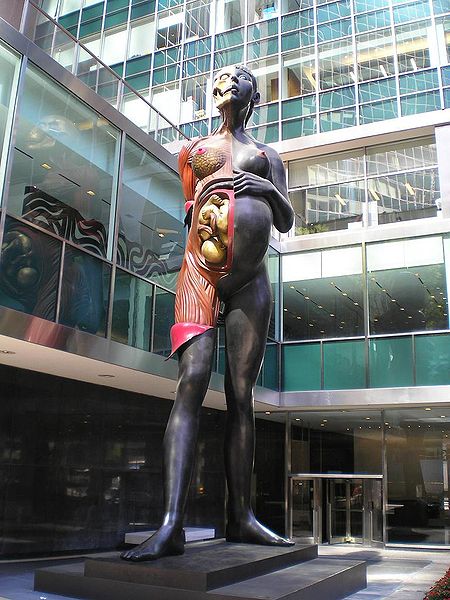
Why?  It’s an astounding statue.  Reminds me of ancient Egypt.  Look at the feet.  And those cut off fingers!  Look at what that face is doing.  It’s a face!  I would jam this thing into my backyard if I could unseat it from its pedestal.

But watch the film all the way through.  It’s very unusual and I have to love Mr. Hughes for making it and for being so willing to be so cranky.  Cranks are always fun.  I say stupid things just to make them mad.

Go here for part 2 and you’ll find the other 10 parts as well.
Trailer for Metropolis with Restored Lost Footage

Hey! I thought I had the darned movie already! But now there’s yet another ‘restored’ version of Fritz Lang’s 1927 science fiction masterpiece, Metropolis. Boy is that a gorgeous trailer though! Wow! And the music is far better than what’s on my DVD. This is the movie that just keeps making itself over and over and over.

I want to make a feature film and I’ll release the 2-hour version, but there will be 17 hours of ‘lost footage’ hidden in various places around the globe so that the movie can recompile itself over the decades into an ‘official version’ which bears absolutely no resemblance to the original movie. Or better yet, I’m going to start shooting fake Metropolis footage and then discover it in the broom closet of an old bus depot in the middle of Kansas. So the movie will suddenly expand to 4 and a half hours.

Film: Objets Oubliés

Italian filmmaker, Fabio Scacchioli, works with zero budget and creates masterpieces of Italian cinema.  I think the great movement of cinema in the 21st century is underway and it looks to me like Italy is riding the top of the wave.  We are finally reaching the point where an artwork is created with a ‘zero budget,’ just like a painting is.  Picasso painted for just the cost of his canvas, his paints, and his own time.  Filmmakers can now work the same way, enjoying the privacy of their studios and making things with their hands and their computers and their cameras.  Filmmaking has finally become a visual art.  Online cinema is the most powerful movement in all of art today.  It is alive and aware of its potential.  Artists like Scacchioli are going to take it very far indeed and they are going to become the Picassos of the future.  It is time to start paying attention to this cinema, not as a silly form of entrance into the moribund feature film studio career, but as a major art form in and of itself.

This film, Objets Oubliés, is built upon four pieces of film found on the street.  The filmmaker attempts to connect the unknown images into some sort of coherent whole.  The narrating voice exists only in relationship to this attempt to create life and continuity from unknown materials discovered by pure chance.  There is something like a form of grace and true love of film or cinema in this act.  It seems to me to represent the very life of film.  It also seems like an effort that would quite obviously and most certainly originate in Italy.  It is mindful romance.  It is the literal taking of the baton from an unknown hand and carrying it forward to make something unexpected and marvelous.  One person makes something without knowing it is part of an artwork that has not come into existence yet.  But it will and it does.  The artist comes along and picks it up and shows us that the artwork existed even before he arrived.

Film: World’s Most Boring Musician Proves It

I’ve always said that the world’s most boring musician is John Mayer and now the accommodating fellow has gone and proven my point.  He’s made a film about his average day during a tour.  From the looks of this film he could be attending a corporate seminar to give a PowerPoint presentation.  Shiny hotel fixtures and breakfast buffets laid out in one’s room certainly must go far toward making exciting music.  And look!  Sneakers!  He’s wearing sneakers!  How charmingly boyish.  And he finishes the film with ‘Fin.’  Just like the French do!  Gosh!  Fin!  And look at that audience of his!  My goodness!  They look like they’re at a Bed Bath & Beyond shopping for a new duvet cover.

I think the best shot in the movie is the elevator man opening the doors and ushering Mr. Mayor out into the lobby.  But John Mayer should stay in the elevator.  And play there.

Every once in a while I like to post something I hate.  It keeps things real.

Film: Look at that fire! Oh boy!

Sit down, turn off your cell phone, close the door. You are about to see something magnificent. Several days ago, I posted a film, Yellow Plastic Raygun, on Vimeo. And today I catch this big fish of a filmmaker from Italy who made a comment about the film and who has made a gorgeous and moving statement about war and destruction. It grabs you and just won’t let you go until it finishes.  The use of old images, combined, layered and cut into pieces to form new images and artworks fascinates me when applied to video.  This is an example of the art form at its finest.

Fabio Scacchioli made this.  He’s made others, but this is the first one I’ve viewed and I’m convinced already.  Italy appears to be very healthy in its cinema heart.

The filmmaker has a web site.

Horror Film: The Nightmare

Joseph Chrisitiana made this excellent low-budget short horror film. His lead actor is his young son who does a wonderful job under truly creepy and nightmarish circumstances. The film moves with the horrifying logic of a true nightmare, with one certain death situation leading illogically but believably into another. This film had me totally with it the whole way through to its brilliant ending.

Joseph Christiana, producer and founder of Christiana Productions, is a self-taught New York-based guerrilla writer/director. He has produced no-budget feature and short films which have been received enthusiastically at various film festivals, on indie film websites and on short film cable television shows.

I found this via Bad Lit: The Journal of Underground Film which has a review of the film.

Film: The Hippo’s Tears

A film by Peter Mack that tells the story of how the tears of a hippopotamus brought water to a village. It turns out to be an advertisement for a rolling water drum that actually looks like a brilliant invention. The girl’s English is some of the most beautifully spoken English I’ve ever heard. I think that the way she says ‘cry’ is particularly lovely.