Red Hot Chili Pepper, Anthony Kiedis rides along with L.A. artist, Ed Ruscha. They talk about using words for art and how that inspires them. I like shooting L.A. this way. The film uses the car and the streets well. I think I even see some duct tape holding Kiedis’ passenger door mirror together.
Tag Archives: gallery
Pacific Standard Time: Los Angeles Art From 1945 to 1980
Don’t let anyone ever tell you that it doesn’t matter where you are when you make art. It matters very much. You have to know who’s buried in the ground that you’re dancing on. You have to know what’s in the air. You have to know who walked where you are walking now. If you don’t know those things, you might as well be working via modem from an igloo in the antarctic. This Pacific Standard Time thing is a bunch of galleries in Southern California working under the general umbrella of the Getty Center to put on exhibits of post World War II through 1980 art by Southern California artists. Los Angeles is the only great American city that hasn’t been entirely bombed by corporations yet. New York has been a dead zone since 1980. I lived there for almost ten years. Every footstep taken in that city was like a death march for me. The oppression of mind that goes on in New York is akin to being trapped inside some sort of giant grinding machine that keeps on working even though all its parts are broken. Coming to Los Angeles was like seeing the horizon for the first time. The city opens out and spreads with a psychotically unhinged freedom and chaos that is the very essence of creativity. It is the perfect antidote to the black death of New York. This is apparently the first art exhibition of its kind ever. An entire region is presenting its art and imagination for all the world to see. There are going to be roughly sixty different shows happening over the six months of this thing.
Pacific Standard Time is a collaboration of more than sixty cultural institutions across Southern California, coming together for six months beginning in October 2011 to tell the story of the birth of the Los Angeles art scene and how it became a major new force in the art world. Each institution will make its own contribution to this grand-scale story of artistic innovation and social change, told through a multitude of simultaneous exhibitions and programs. Exploring and celebrating the significance of the crucial post-World War II years through the tumultuous period of the 1960s and 70s, Pacific Standard Time encompasses developments from L.A. Pop to post-minimalism; from modernist architecture and design to multi-media installations; from the films of the African American L.A. Rebellion to the feminist activities of the Woman’s Building; from ceramics to Chicano performance art; and from Japanese American design to the pioneering work of artists’ collectives. Initiated through $10 million in grants from the Getty Foundation, Pacific Standard Time involves cultural institutions of every size and character across Southern California, from Greater Los Angeles to San Diego and Santa Barbara to Palm Springs.
Write Like a Pretentious Artist! The Arty Bollocks Generator!

German film director, Werner Herzog.
If you simply must hang your work in a gallery, then here is the tool you’ll need to make just the right impression on your viewing public: The Arty Bollocks Generator.
It’ll flawlessly create your entire artist’s statement for any truly serious and irreproachably artistic endeavor.
Some samples: ‘My work explores the relationship between the tyranny of ageing and skateboard ethics.’
‘As shifting phenomena become frozen through emergent and personal practice, the viewer is left with a statement of the limits of our world.’
Please be serious, donate to a charity, write a manifesto, and for god’s sake go to a gallery for some bloody education! Then take yourself to see a fine German movie… film, I meant ‘film.’ Okay?
Now get going.
And for further sublime examples of pretentious statement-making, try Werner Herzog’s film school!
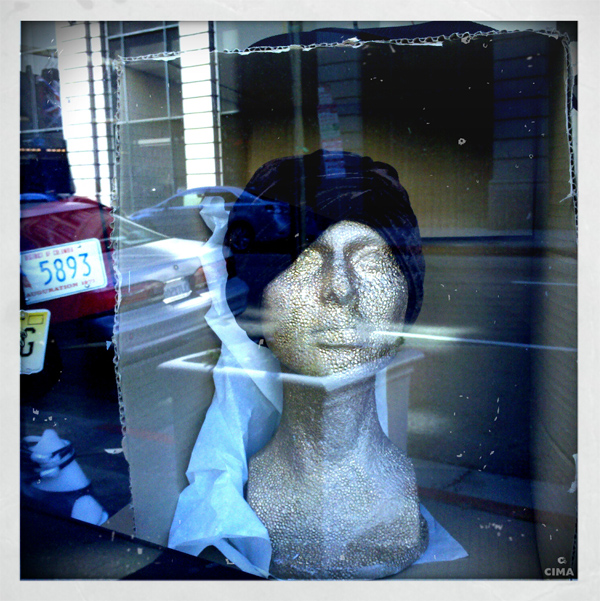
Photo: Golden Head Dressed
Take This Opportunity to Deface My Art
My latest artwork is an image that is never quite the same twice. I worked hard on it. Framed it. Hung it in a gallery. Now you come along with your paints and markers and mess it all up. I’m curious to see what you decide to do. So when you deface my best work ever just hit the ‘upload art’ button to send your artwork to me. You can get a copy for yourself by clicking the ‘download’ button. You get 3 uploads, so try to make it count.
Have fun destroying one of my proudest creations!
Printing Banksy: Modern Multiples Creates the LA Prints
The art is thin, but secret identities are always fascinating. No artist needs one. They are always put in place to cover up a glaring weakness. In Banksy’s case, the weakness is that he is simply a mildly talented, professionally skilled illustrator with some measure of showmanship. The showmanship is the primary industry in his case. He draws for people who are texting. There is absolutely no art being produced. None at all. But that is one hell of grand joke if you ask me! Banksy naked would simply be the emperor with no clothes. I do however believe that the energy and impulses behind the current explosion of street art will lead directly into the next great movement in art. But that movement will most assuredly not include Banksy.
This is a video about the Los Angeles fine art printer, Richard Duardo, who worked with Banksy to prepare for a 2006 gallery show. The film was made by Brad Beyer and Robert Dragan. There’s an official website.
http://www.youtube.com/watch?v=xUzUQfyA1sg&feature=player_embedded&w=560
Gallery of Pinhole Camera Photos
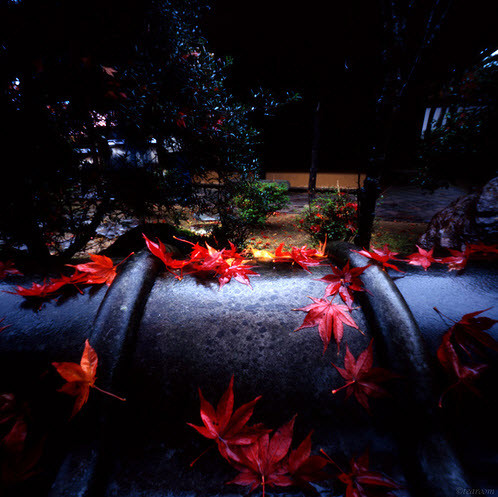 Here’s a gallery of photographs made by pinhole cameras. This image is by Noriko Ohba.
Making a pinhole camera is pretty simple. In some cases you can simply take the lens off of a camera and replace it with some tape that has a hole in it. Here are some instructions.
Via Submitterator
Art: Don’t Turn Back (Two Versions)
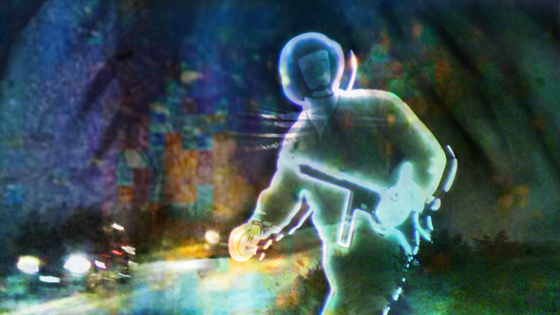
Don’t Turn Back (Final Version)
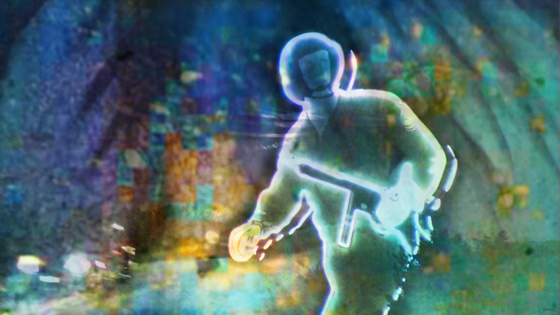
Don’t Turn Back (First Version)
Here’s the little art problem I’ve been working on for the past few weeks. It’s one of those things where I have no theory or rule to fall back on in order to make the decision. Aside from some small touches like removing the Sergeant stripes from the figure’s shoulder, I was mainly trying to decide whether the right side of the image should be dark or light. Ultimately, after scrutinizing the picture from a distance time after time, I decided that it was more dramatic if it depicted a night scene and if the figure was moving away from a more painterly zone toward a more digitized one. I also made the road on the left a little more defined. But canvas isn’t that expensive and I might just decide to hang both versions right next to each other in a gallery.
My own favorite part of the picture is right around the figure’s legs where you can see through to the landscape with that slight glow on the ground and how the shrubbery overlaps the neon line of the leg. The image is about fear. It is also connected directly to Jean Cocteau and the myth of Orpheus. The figure looking back is from a single frame of video I shot of a store sign while walking along Hollywood Boulevard at night. The road is a sharp bend in Laurel Canyon Boulevard near Mulholland Drive above Los Angeles that I shot through a windshield. The background landscape is a shoreline I shot from a moving car near Rehoboth Beach, Delaware. The dark palm fronds hanging down are from some throw-away footage I shot in high winds. The pixelation is the product of blowing up a frame of a digital copy of decomposed celluloid film until the digital artifacts became pronounced. I made all of these things individual layers and then went in with a digital pen and worked on a trial and error basis to make things come out the way they did. What is interesting to me about making such an image is how I begin with an initial image – the glowing figure – and shuffle parts of other images on top of and underneath it to build a new image. It requires an extreme confidence that you will know what you need exactly when you see it. So you start going through piles of video or photos both on screen and in your head and pull out the pieces that snap into place for a new picture. It’s like walking up to a leaf on a tree and taking it as the basis for a painting. You know that from the leaf you will be able to connect to other things and end up with exactly the right final result.
This print measures 68″ x 38″. It’s an original work created from elements used in my film Yellow Plastic Raygun.
Art: Don’t Turn Back
Don’t Turn Back
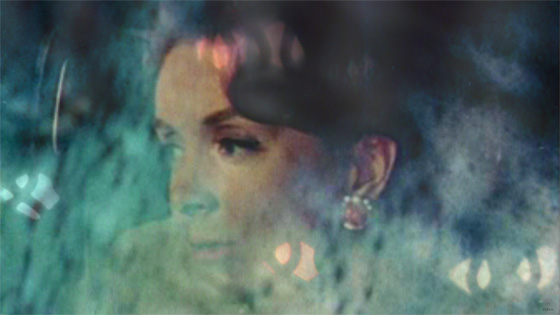
This is my next large canvas print. I’ve been making original artist prints through a gallery in Los Angeles. They measure 68″ x 38″. They are original works created from images used in my film Yellow Plastic Raygun. They are not exact frames from the film, but rather artworks based on segments of the film.
Dennis Hopper on Art Collecting
These are some of the most intelligent comments on art collecting I’ve ever heard.
Art: Digital Prints on Canvas
I Was Thinking
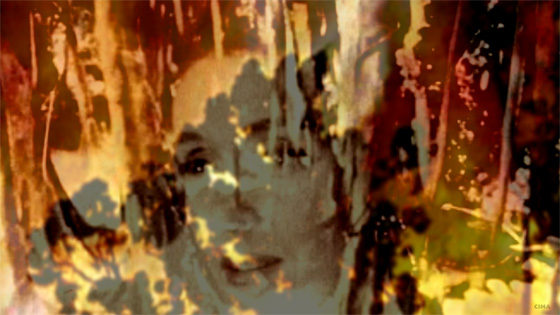
I’ve been making large original artist prints of these images through a gallery in Los Angeles. They measure 68″ x 38″. They are original works created from images used in my film Yellow Plastic Raygun. They are not exact frames from the film, but rather artworks based on fragments of the film. I make the film, then I mine it for artworks that will stand on their own. So the film becomes a sort of a paintbox or a scrapbox that I dig through and manipulate. I could go on working like this forever. It’s an endless trove to explore.
Wave Rider
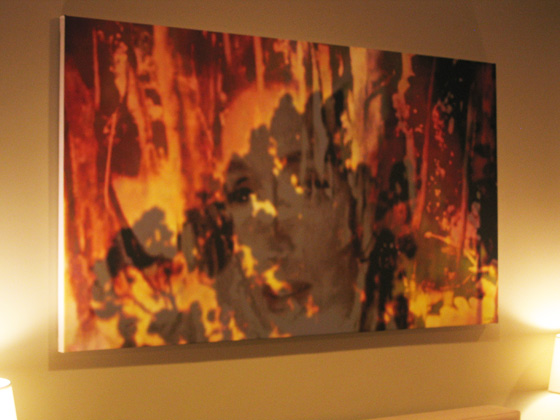
I Was Thinking hanging on a wall:
Painter: Andrew Abbott
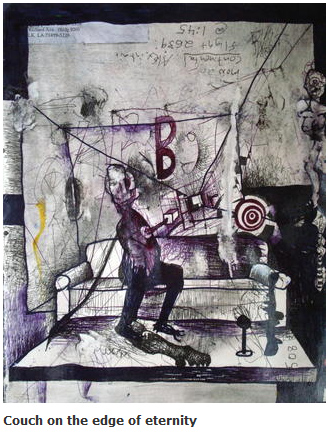 One of my favorite sites is The Rumpus, an online culture magazine that covers literature, art, film, politics, sex, comics, music and generally excellent and useful ideas. One of their writers, Julie Greicius, did a piece on a painter I’ve never seen before: Andrew Abbott. I really liked his paintings as soon as I saw them. They are harsh and beautiful at the same time. I have no idea how much they cost or anything like that. Probably a lot. They’re really good and I imagine they are hanging in a lot of fancy living rooms right at this moment.
But his web site is plenty of fun for me and this guy can paint like some serious business.
All the Paintings in the Museum of Modern Art
Someone at YouTube named Chrspck went into the Museum of Modern Art in New York City on April 10 and shot a photograph of every painting. Museums and galleries have no business forbidding photography as long as it doesn’t use a flash or get in the way of visitors. I love seeing all the paintings go by. It makes me want to go to the museum.
The Cool School: LA Art Scene Film
This video is from a PBS Independent Lens documentary about the Ferus Gallery that shaped much of the Los Angeles art scene in the early 1960s. It’s short but it conveys some of the sense of LA’s wild, nervy, uncontrolled art attitude that is still in force today. I love the zoom in on Andy Warhol who’s standing in front of one of his works and he just says, ‘Oh.’ LA still has that sense of offering the individual artist the clear opportunity to walk into a gallery, shake hands, say ‘How’s it going?’ and end up with an art showing a few weeks later. It’s a city of entrepreneurs. New York is a city of deeply knowledgeable and experienced people who understand that there is a system in place that’s been there forever. That’s why people walk fast in New York. They’re all trying to stay on schedule so the system keeps running. In LA, everyone is throwing crowbars into the system and breaking it so that they can make their own. The gallery scene in downtown LA is really interesting these days. You can walk for blocks, stopping in at the galleries for a wide variety of offerings. There are a couple of galleries that have copped an arrogant New York attitude and they are the ones I stay away from. In general, you get a real feeling of the art being right there and totally accessible to you. Everything is for sale. The artists are interested in your money. It’s very simple and healthy. When I buy a piece of art in LA I feel like I’ve pulled a fast one on the art world somehow. I feel complicit in something with underground tones.
