Here’s a stop-motion film about the making of a book called The Complex of All These. It was made at the Women’s Studio Workshop in Rosendale, New York and consists of 3,000 photographs taken over a 2-month period.
Via Dangerous Minds
Here’s a stop-motion film about the making of a book called The Complex of All These. It was made at the Women’s Studio Workshop in Rosendale, New York and consists of 3,000 photographs taken over a 2-month period.
Via Dangerous Minds
This is an odd post and I’m not entirely sure I can pull it off. The film above is called Montparnasse. It was made in 1929 by Eugene Deslaw. I watched the film and want to write about it cold, without looking up Mr. Deslaw on Google. I’ll check up on him after I’ve posted this and see if I’m even in the ballpark.
Watch the film all the way through. If you think it’s just a collection of boring tourist shots in Paris with nothing happening, then stop reading and leave now because this post is for the four out of one hundred who catch the drift of the camera work. Deslaw was shooting in the Paris of Pablo Picasso and Matisse. He appears to have had a close connection to art and the cafe life of the city. His film is full of odd angles and closeups. He runs up onto a balcony in order to shoot straight down at some tabletops. He catches a woman applying makeup at about the 13-minute mark and makes a shot that is worth paying for. He films traffic and buildings, windows, curbs, chairs, newspapers, smokers, drinkers, snake-handlers, paintings, and water. He’s fascinated by his city and by his camera. He’s making art. He set out one morning with his camera and went around making art. Everyone was happy to be alive there in Paris in 1929 and he was playing his part in it. Films made at that time tend to have this cheerful experimental quality. Deslaw is nearly drawing with his camera. It’s an immediate act of finding visual meaning. He was walking and was struck by something and filmed it in an excited state. He was consciously being an artist.
The film he made is beautiful. It’s very hard to make a film with its kind of beauty today. Think about it a little. What would you do? Go to a Best Buy and look around for a brand new digital camera. You know, one of those shiny silver things with the HD viewfinder and all the buttons. One of those? Then what? You’d march out into the neighborhood with this gleaming tourist gizmo and look like a ninny bending over to film trash as it floated down into a storm drain? You’d walk up to a guy behind a news stand and ask to film him? Really?
Yes. That’s what you’d do. You’d get a little camera and do just that. And here’s your assignment: you must do this with the total conviction that you are about to make the greatest film ever made about your subject matter. Set out for a particular street corner and make a magnificent short film or a long one about that corner and everything on it. Spend an entire day doing only that. Skip lunch. Just stay there and make your film without ever entertaining even the slightest doubt that you are working on something of incredible importance and value. It’s going to be very hard to do. Some people will walk by and giggle. Some will become belligerent and tell you to stop. Film those people. Run away if they chase you. Then come back and continue your work. Remember that you are an artist on a mission to make something and absolutely nothing will stop you. Then come back home and figure out how to edit it and then put it online. Tell me about it even and I’ll watch it.
In 1929 it would have been recognized by the maker of this film that a camera is a camera and it will make your film if you want it to. Ever wonder why you don’t ever see Steven Spielberg out and about with his little camera making a movie for himself? It’s strange isn’t it? Could you imagine Pablo Picasso or David Hockney never carrying a sketchbook to make some quick pictures while having coffee or dinner? I couldn’t imagine such a thing? So when was the last time you ever heard of a Spielberg or Scorsese out with a camera making little films for their web site?
You could almost think of all the decades of massive budget film production and the studio structures built to support the film industry and film schools as an organized effort to confuse the issue and make people forget what a film actually is. We think of screenwriters and producers and agents and superstars and all the talk shows. But it’s very hard for the artist to walk out with the camera and go make a film the way a painter would work alone on a canvas. The Montparnasse film should help to illuminate the proper use of the camera for anyone who’s interested.
 The Electronic Frontier Foundation (EFF) has just started a new Copyright Watch site which will monitor developments in copyright law around the world. With a confusing world of corporations trying to prevent us from copying our own DVDs, books, and games, we need all the help we can get to try to keep corporations, lobbyists and politicians in line with something resembling common sense. The best argument I can think of against ebooks, in favor of paper books, is that you actually own your paper books. You can sell them to the shop on the corner if you want to. That simple right is being removed by all the user licenses and copyright lawsuits being brought against people who are just doing innocent things like tinkering with their own game machines, making personal copies of things they own, or trying to lend a book to a friend.
EFF will try to bring together the most recent copies of laws, track proposals, conferences, and discussions about new copyright regulations that could have a profound effect on all of us.
Our animated film, Velocity, has just been featured as a Hidden Gem in the Newgrounds Treasure Hunt experimental films category. The Newgrounds site is the best Flash animation and gaming site in the world because it is open to all comers. Submissions are then voted on by the viewers and stay in the library if they maintain a certain level of popularity. Being picked as a ‘Hidden Gem’ is an honor and we are proud to have our little film there.
 If you’re planning on heading to the moon any time soon, you’ll at least be able to get a drink. NASA announced today that the Lunar CRater Observation and Sensing Satellite has discovered water on the moon. The mission intentionally crashed a rocket stage onto the moon’s surface, creating an enormous plume of ejecta. When the plume was analyzed by spectrometers on board the satellite, the evidence of water became clear. In the photograph, you can see the debris plume showing up as the little gray fuzzy area inside the black boxes.
There are many ways the water could have gotten there. It could have come via solar winds, comets, giant molecular clouds or some kind of internal activity. Scientists say that it could even have come from Earth.
 Remember the book? Of course you do, because you have plenty of them in shelves, half-read, dusty, bent, torn, coffee-stained, wine-colored, smudged, smelly, misprinted, broken and cherished. They catch your glance as you walk from one room to another, reminding you of a year or a moment when you were doing something else but had that book in your bag or backseat and meant to finish it or did in fact, and put it away and moved it several times in a box, cursing its weight and trying not to bend it. So there it sits now, quite possibly closed until the day you die. But you know it’s there and it’s a marker in your life. Remember this thing with books?
And LPs of vinyl? Mine used to function like books in my shelf. But I put them into a closet years ago because of CDs. Now I can’t stand searching a shelf of CDs, so I mainly use MP3 files. My albums no longer work as markers of life and time. The same thing is happening to books. All of mine are still on the shelves. But the world is changing and books are beginning to look a lot like information that wants to weigh less. It doesn’t matter how one feels about this, whether it makes us sad or not. It’s a creeping fact. Our books are turning into wonderful collector’s items. I can tell this is happening partly from all the excitement and business surrounding these e-reader devices. Books will continue to play an important role in literature but they will gradually be eclipsed by some other technology. The current e-readers are not necessarily it, but they are the harbingers of things to come. We are lightening our load because we can’t carry it around forever. We’ll have to travel light. Walt Whitman wouldn’t mind though, because he’d want to travel with us.
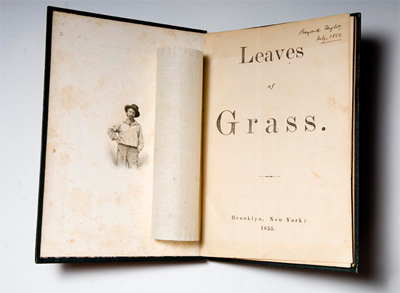
But this fellow, Raymond Danowski, has amassed the largest collection of 20th Century English poetry books in the world. He collected over 70,000 books, periodicals, and artifacts. The collection includes a first edition of Whitman’s Leaves of Grass, printed by the poet himself. It also has a first edition of T.S. Eliot’s Prufrock and Other Observations. There are so many books that when he donated the entire collection to Emory University in Atlanta, it took volunteers over a year just to unbox all the volumes. The university is now the major center for researching 20th Century English poetry books.
I’d like to see that collection. It must be fascinating. And anything is worth touching that Walt Whitman touched. Seeing books is the thing. They have a presence in a room, lining its walls and giving it enormous depth. But we are engaged in a process of making our books invisible. What will we put in their place? I’m not really too worried about that because when you turn all those words into digital form you present yourself with infinite possibility. When words float around in the air you are in the realm of magic beyond anything any book could have ever accomplished. Then again, sometimes just touching a book is enough to send your mind wandering down an unexpected path. Can touching a virtual keyboard have the same effect? Does it have to have the same effect? Maybe not. I’m sure banging a chisel into a clay tablet did things to a mind that ancient peoples were loath to part with.
Does the emergence of a world without books frighten or worry you? Do you see something wrong with a world in which literature is simply information that travels wirelessly? Do you think that ink is inherently superior to bits?
Eventually, we will read War and Peace by passing someone on the street and glancing into their eyes for a brief moment. That person will give us the book as nothing more than a polite ‘How do you do?’ At that point, we will remember books the way we remember the clay tablet.
The Rauch Brothers made this animation that follows a story told by 86-year-old World War II veteran Joseph Robertson who fought in the Battle of the Bulge. It concerns his memory of killing a single German soldier.
Art Director Tommy Kane went to Lebanon and made a film about his wanderings. He also drew magnificent illustrations of what he saw. Those are in the film too. The combination of the beautiful street scenes and the cheerfully expressive drawings make me want to get on a plane and go visit this stunning country.
I found this via Drawn!
Nick Cross has made an animation seems to be mainly about 9/11. I’ve read quite a bit of nonsense around the web about this cartoon. Animation blogs that should know better do their best to avoid the brutal politics of the film even though those politics are its entire reason for existing. In fact, I find that most of the animation world on the web is shockingly conservative, embarrassingly non-diverse, and mind-numbingly infatuated with Walt Disney. In this creepy little film the fat cats need the little cakes that the bakers make in their village. For the life of me, I can’t figure out what kind of tiny animal the bakers are supposed to be. Little featherless tweety-birds maybe. Anyway, the fat cats take all the cakes under threat of annihilation and sell them in their city. When the bakers can’t stand the slavery anymore they blow up a house full of fat cats. Then the fat cats become extremely security-conscious and attack the bakers with bombs and slaughter them all. The end.
That’s my description of the film.
I like people who are nasty and drive their anger through their work. This film is off-balance and awkward. It’s unpleasant and crude. Why are the titles off-center? I do respect its attitude and its simple perspective on the reality behind the events of 9/11, but nevertheless it annoys me. Why do animators persist in trying to reproduce the quality of animation from the 1930s? I’d prefer less cute flip-floppiness from the animator. Give me the politics. Leave out the throat lozenge.
Ever wondered just what you’d do if you found someone on the ground unconscious? Here’s what you’d do. CPR. But there’s a new, simpler way to do it that works better than the old way. The video shows you how to do it.
This film was made by Franck Deron. On his blog he says that he filmed it without a lens, using a pinhole through some aluminum foil. I’m not exactly sure what that means. I’d be curious to know more about exactly how he set that up. But I like the results. It’s a mysterious and moving film. I watched it with total absorption and the blurry glowing camera work reminds me of old super 8 movie cameras. The director has quite an accomplished list of films he’s made as music videos and promo spots. They are very well shot and edited. But I always like a director’s more personal films, made with no other client in mind than his or her own demanding internal artist. This is just such a film.
I found this on a beautiful web site called The Rumpus.
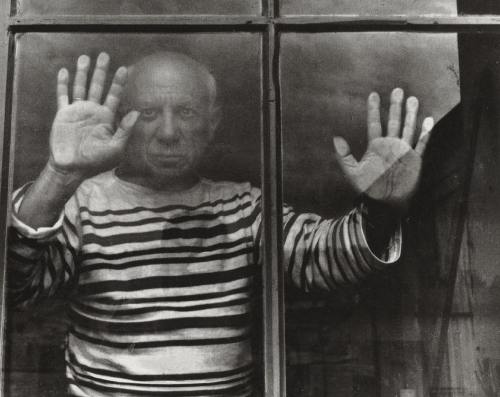
We artists are indestructible; even in a prison, or in a concentration camp, I would be almighty in my own world of art, even if I had to paint my pictures with my wet tongue on the dusty floor of my cell.
Pablo Picasso
Do you think this guy is scared of Swine Flu?
And have you seen Keith Richards stop for a moment to hit a guy in the face with his guitar?
John Grisham on NBC’s Today Show discusses his new book, writing novels versus short stories, and so-called predatory book pricing by large retailers like Walmart, Target and Amazon.com. I like Grisham in this interview. He’s a good interview and he seems sharp. He talks about how it’s much more difficult to fix a problem in the middle of writing a novel than to do so with a short story. So he advises writers to ‘not have a problem.’ The trick is to thoroughly outline your entire novel before you even start to write it so that you know every single thing that happens along the way. Pretty sound advice in most cases. Not all. Some of the greatest novels in the world were written by writers who had absolutely no idea where the novel was going from page one. It depends on what kind of book you’re writing. I think his advice is perfectly good for most books that are intended for sale in a grocery store. Certainly. But writers should never listen to famous writers. They’re full of crap. You write what makes you sweat and drink lots of coffee late into the night and bang your fingers on your keyboard until they hurt. Or not. Whatever. I hate outlines. Especially in word processors. Awful things. They destroy good minds and belong mostly in PowerPoint presentations for corporate managers. I’m not sure what the hell Grisham is talking about quite frankly. But then again, I’m not selling thrillers in the grocery store either.
But what mainly interests me in this interview is the discussion about ‘predatory pricing’ by the giant retailers. Apparently, if you listen to publishers, this spells doom for publishing and book selling as we know it. When asked what he thinks about his latest book being available for nine dollars at Target, Grisham says:
It’s shortsighted. Short term, they know what they are doing, I think. But if a book is worth $10 then suddenly the whole industry is going to change. You are going to lose publishers and book stores, and though I’ll probably be alright, aspiring authors are going to find it difficult to get published.
Yeah? So what. So we lose publishers and book stores. Who cares? The key in Grisham’s statement is where he says, ‘…and though I’ll probably be alright.’ He means writers will be alright. The big scary fact of the matter is that we simply don’t give a tiny damn whether or not a publisher prints a book or an author does. Publishers read, accept, edit, design, print and promote books. At least they used to. I don’t care what anyone tells you, but we do not need the editors. Writers can do that. You write the book and you edit it and you’re done with it. Readers are getting used to reading writers without editors. That’s why blogs are so popular. No editors. If you have an editor poking around in a blog, trust me, it’s not a blog. It’s a corporate front-end. A writer can also design and print a book. And sell it. Writers are publishers. No reader cares about Penguin. They care about the guy holding the gun. The guy holding the gun is put there by the writer. Writers will make guys, guns and gals forever. It’s what they do and it’s what readers want.
I don’t care if the guy with the gun says, ‘I’ve been looking for you for a long time, Mr. Peabody. Smile, because it’s the last thing you’ll ever do.’ Or if he says, ‘I’ve been looking for you. Smile. It’s your last.’
The writer can pick. The editor can go watch Kitchen Nightmares.
There is absolutely no excuse for a writer to work hard on a story, hammering it into existence from nothing, polishing it and making it exactly what he or she wants it to be… and then sit around to wait for some agent or publisher to get back via the U.S. mail so that said writer can be allowed to move on and send out yet another plea for acceptance. This is old technology. Twentieth century. It’s gone. In this century a writer writes and edits and publishes and sells. His book can sell in Target for nine dollars or three dollars. Magnificent. Literature available to people who don’t make lots of money. What a novel idea! If you’re griping about Target selling books for nine dollars, you must not be buying books. Go watch His Girl Friday and pretend that typewriters still make newspapers.
And you know something else? The guy with the gun doesn’t care. He’ll always be there. He’s not going anywhere. All the publishers and book stores could burn and all the editors could go to their early graves, and you know what? The guy with the gun is still gonna getcha. He’s going to find you wherever you go. He’s alive.
This is a short documentary called The Gospel According to Reverend Billy, from an outfit called Syndicate of Human Image Traffickers. This guy looks like a preacher but he’s decidedly against what most preachers seem to be preaching in our angelic little country. He’s Reverend Billy and he’s running for mayor in New York City. He thinks Mayor Bloomberg is a corporate Wall Street guy who represents the takeover of the monoculture. He’s right. I lived in New York for eight years in the 1980s. I remember it as being rough, exciting, nervous, overly work-oriented, and dirty. I visited just a few months ago. It’s now an open-air mall with a Starbucks and a Gap. Gee, thanks Rudi Guiliani for your cleanup. Micky Mouse would feel right at home on Times Square. New York is also home to the several thousand creeps on Wall Street who are personally responsible for trashing the U.S. economy and running criminal scams on a worldwide scale. Well, at least we know where they all live, right? When I lived in the city I worked with many different types of people in many businesses. I would always give the same advice to my friends and acquaintances who were looking for jobs: Never Never Never work for the money people. They are vicious and very poorly educated. I recall working for one of the biggest real estate investors in all of New York. He owned some of the famous big buildings. He was also prone to throwing insults around and yelling at employees. He spent eight hours per day for a full week having meetings in his office about the design for his new closet at home. On Friday at about 1:00 pm he emerged to ask me about a pile of papers I was supposed to have finished that week. I had put them all untouched in a pile that I labeled ‘Complete.’ He picked them up and riffled through them for several minutes. Then he threw them at me and screamed, ‘What the f— do you think you’re doing?’ I picked up the phone while giving him a giant smile and called my employment agency. I said, ‘I’m going to put you on the phone with Mr.____ and I’d like you to tell him to kiss my ass.’
As I walked down the hall, he was screaming at the top of his lungs, ‘Don’t you people ever even think about sending an a-hole like that over here again!’
Yep, that’s the kind of New York SOB I was back in the 80s. And I haven’t learned a thing. I’d still do it on any sunny Friday afternoon.
New York has about as much cultural energy now as Dallas, Texas. It’s like a zombie apocalypse in Manhattan. Everyone looks like they’re trudging to the office on a Sunday. The East Side – Woody Allen’s favorite – is the land of strange men in khaki dockers who buy baskets in small stores. I’m not sure why Reverend Billy would give a damn about being mayor of a dead city but he’s got my vote of confidence if he wants it.
As for the preacher bit, I’m not sure I like it. It’s some kind of a joke or then again maybe not. He likes the vocal patterns of the preacher for sure, but that’s not all of it. Couldn’t he borrow the vocal technique of the preacher without the costume? Oh nevermind, that would be Bill Clinton.
Via Coilhouse