Cosmic Voyage: 1936 Soviet Science Fiction Film About a Moon Landing

SovietSpaceFlight2

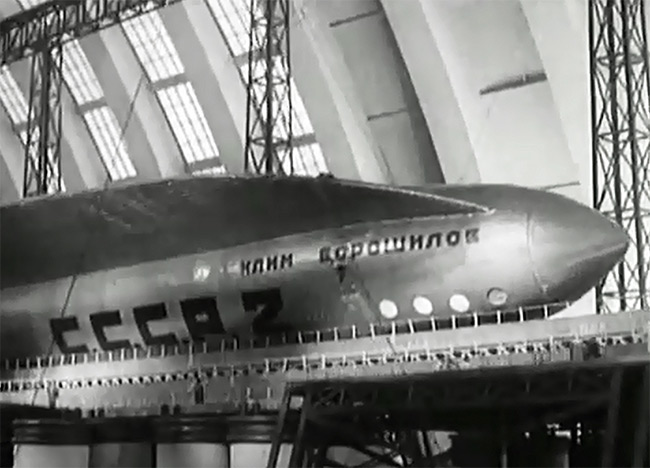
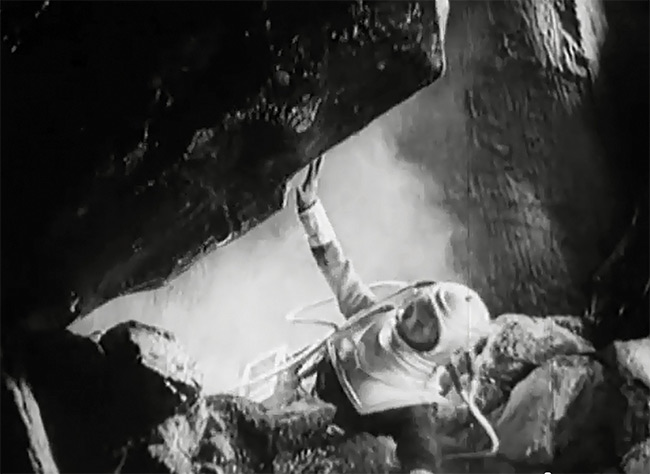
This is an absolutely fascinating and rather beautiful 1936 Soviet science fiction film that foretold how a future 1946 moon mission would work. It’s got incredible zero gravity effects, miniature models of a fantastic space ship on a launch ramp, and very cool technical details like filling the cockpit with fluid to buffer the cosmonauts from launch forces. Then there’s a marvelous sequence on the surface of the moon with excellent stop motion animation inter-cut with live actors. Apparently, the Soviet censors banned the film after a short but successful first run because they felt the cosmonauts were having too much fun on the moon. They were right. These characters go hopping and bounding about with so much joy it’s almost an embarrassment. Citizens of the Soviet Union were not supposed to be happy.

Don’t worry about understanding Russian. The film was shot as a silent and is more or less a completely visual experience.

It was directed by Vasili Zhuravlov, but what’s really most interesting about the production history is that Constantin Tsiolkovski, a Soviet scientist and professor, became enthusiastic about putting some of his theories on space travel into a film. He consulted with the filmmakers in an attempt to lend verisimilitude to the moon voyage. Many years later, Werner von Braun credited Tsiolkovski’s calculations as having been correct.

So here is a old Soviet film that went to great lengths to get many of its details right.


Here is an interesting article about the film.
SovietSpaceFlight3

Sally Saves Christmas

Some of the readers of this site will know that this story is the original piece of material behind Candlelight Stories. Back in 1994, I sat at a very flimsy folding table in a Los Angeles apartment with a box of pastels, crayons and ballpoint pens to scratch out a pile of illustrations that vaguely added up to some kind of Christmas tale. I still have all those original drawings in a big department store box. The interesting thing about the illustrations for me is the series of actions that they caused which led me directly into the various skills and technologies that I have used and made a living from ever since. After finishing the illustrations and creating a large bound book to give as a Christmas gift, I scanned the pictures and decided to try to put them into a slide show. I had an early version of the Mosaic web browser and soon realized that I could use my AOL account to post things in a folder that could be accessed by the web browser. Having done that and been very impressed with myself I showed it to my non-technical friends and received some half-hearted congratulations and was asked how I could ever hope to make any money that way. Within a few months I received a letter in the actual mail from the USA Today newspaper requesting permission to put an illustration and a web link in a listing of good things on the web. So I said they could and they printed their thing. So I began to add new things to the web site as I could.

It’s pretty much the same today. You just make a little thing and stick it on the web to see who likes it. But back then it was a little like magic. My web experiment grew quickly and when the higher-speed DSL technology first came into Los Angeles I jumped on it and got myself a Digital Alpha server and put it at the end of a DSL line in my own home to serve the web site. According to the company which was the first one up and running in L.A., I was the first person to attempt running a web server over the DSL technology in Southern California! They gave me totally free ISP service for several years in exchange for a little advertising. I’d actually have late night conversations with their engineers – sometimes from their cars as they made their way to hubs and switches in the dead of night to fix something. Imagine that kind of technical support today with your blog host! Won’t happen! This all worked well for a time. But then the DSL technology began to fail and I quickly realized it was a dead-end technology with too many players involved on the back end who could not adequately maintain the service without blaming each other for failures. But my point is that during that time, with that kind of approach, one could really get a sense of being visited by the world. I could watch the lights blink as people came onto the server to visit. There were times, during serious outages of some sort or other, when I’d throw the big Alpha server into my car and drive it to some other location for a temporary connection. Amazing. Fun.

It’s still fun today. That’s why I still post this odd little story every Christmas. It’s the original first thing of this site.

NASA Captures Images of Apollo Astronaut Moon Tracks

NASA’s Lunar Reconnaissance Orbiter has captured images of astronaut tracks, lunar landers, and left behind equipment from the Apollo 12, 14 and 17 moon missions. These are the sharpest images ever taken of the moon and should give fake moon landing conspiracy nuts a whole new bag of clues to play with.  We can’t rebuild what we once understood and get ourselves back to the moon, but we can take pictures of our past glory.

Trip to Moon: Bizarre Bollywood Sci-Fi Spectacle

Oh dear! What have we here? This is a Bollywood science fiction (and I use that term very lightly!) film that was apparently made in 1967, though it looks more 1950s to me. It was directed by one T.P. Sundaram. It is ostensibly about an astronaut who gets kidnapped to the moon and then has to fight for the moon princess and her kingdom when martians try to invade. The movie is a roaring low-fi spectacle with songs, fights and cheesy cardboard special effects. Spaceship controls are actually steering wheels. If you want some good advice, skip through to the 2 hour 15 minute mark and just watch the glorious action sequence that closes the film. You will see grown men fighting with giant sparklers aboard a crash-landing spaceship. You’ll see robots, a Cyclops, and two men engaged in a lunar surface wrestling match that makes Captain Kirk look like Bruce Lee’s star pupil. You will then see a rhinoceros. If you are not laughing hard enough to burst a vessel of some sort, then I don’t think anything can be done for you!

Have a Drink on the Moon

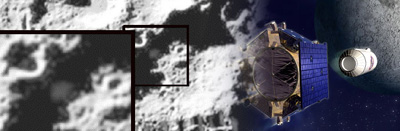
moonwaterIf you’re planning on heading to the moon any time soon, you’ll at least be able to get a drink.  NASA announced today that the Lunar CRater Observation and Sensing Satellite has discovered water on the moon.  The mission intentionally crashed a rocket stage onto the moon’s surface, creating an enormous plume of ejecta.  When the plume was analyzed by spectrometers on board the satellite, the evidence of water became clear.  In the photograph, you can see the debris plume showing up as the little gray fuzzy area inside the black boxes.

There are many ways the water could have gotten there.  It could have come via solar winds, comets, giant molecular clouds or some kind of internal activity.  Scientists say that it could even have come from Earth.

NASA Makes a Free iPhone App

390825main_missions_160NASA has released a free app for the iPhone that offers dynamically updated information, images, and video from many of its ongoing missions.  NASA seems to be suffering through a confused decade in which it wonders what vehicle should replace its aging shuttle fleet, whether to dump the International Space Station into the ocean to save money, whether to go back to the moon, or whether Mars might be a suitable destination for a manned visit.

I think it’s probably safe to say that NASA is learning an enormous amount through its telescopes, satellites and rovers.  I suspect that very little is really learned from sending three or four humans to the moon other than how to keep three or four humans alive on the moon for a few weeks.  Perhaps NASA should just relax a little and stop worrying about making people interested in what it’s doing.  Perhaps they should just worry about collecting information.

First Sci-Fi Film: A Trip to the Moon

Today is the 107th anniversary of the first science fiction film ever made, A Trip to the Moon. It was directed in France by Georges Méliès who had been inspired by the novels From Earth to the Moon by Jules Verne, and by The First Men in the Moon by H.G. Wells.  This is the film with the famous image of the spaceship landing in the eye of the moon’s face.

Interactive Moon Mission Underway

MoonMission

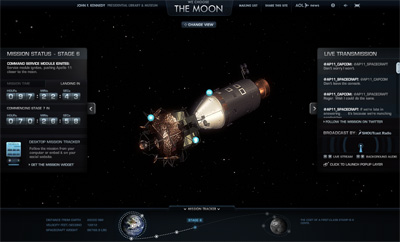
Yesterday I posted about the JFK Presidential Library’s interactive recreation of the 1969 Apollo 11 moon landing mission. The mission has now reached stage 6 with the command module at a distance of 22,000 nautical miles from earth. The site is doing an absolutely marvelous job of making you feel as if you are riding along with the historic Apollo 11 mission. They have all the real-time radio communications between the astronauts and Mission Control. So you can listen to exactly what was happening through every second of the entire mission! They also have video clips that fit the current point you are watching in the mission.

This was an excellent web idea and it is extremely well executed. I can’t wait until they reach the part with the Lunar LEM trying to find its landing spot on the moon!  Go see the We Choose the Moon site right away!

Real-Time Interactive Recreation of 1969 Trip to Moon

WeChooseMoon

At 8:02 am Pacific Time, Thursday July 16, the John F. Kennedy Presidential Library’s We Choose the Moon project recreates the launch of the Apollo 11 moon rocket.  The interactive site will recreate the entire mission to the moon down to the minute, complete with status reports, images, 3D animations and even Twitter updates.  The site is very  slick and recreates the anticipation before a launch at the space center quite well.  You even hear the seagulls flying around the launchpad as you watch the rocket on waiting for liftoff.

This is about as close to the moon as we’re likely to get for quite some time since the national ‘let’s go to the moon again’ quagmire persists in spite of the fact that Nasa has no more spaceships to fly once the shuttle heads for the junkyard.  The International Space Station is quite possibly going to be dumped into the ocean in 2016 due to lack of interest.  But a space agency that can run radio-controlled cars on the surface of Mars is at least doing something with its money.

Moon: A Science Fiction Film Trailer

Moon is a new science fiction film directed by Duncan Jones. It stars Sam Rockwell as a man administering a lonely moon base for a shift that lasts several years. The trailer looks pretty good, but I’m not sold on it. I do like to see a serious science fiction film getting projected in theaters after the horrific damage that’s been done to the genre by clever little men like George Lucas.  In fact, I blame Lucas more than Tolkien for the fact that every bookstore loads its science fiction shelves with sword fantasy books.  As soon as the idiotic Obi Wan Kenobi pulled out a lightsaber, the sci-fi film genre was doomed. But this thing looks from its trailer to be a mashup of homages to 2001: A Space Odyssey, Silent Running and Solaris. I just don’t get into ‘homage’ movies.  A little subtle homage is fine.  But this trailer is just packed to the gills with barely altered rips right out of these classic films. No serious science fiction director makes a movie that’s an homage to other movies. Stanley Kubrick would have choked on a chess piece if someone had suggested such a thing to him.  So, I’m sure I’ll give this movie a chance and go see it, but I fear that it will be exactly the movie it appears to be in its trailer.  The effects do have that wonderful super-reality quality to them that 2001 and television show Space 1999 had.