The Neglected: A Film About the Street Children of Ukraine by David Gillanders

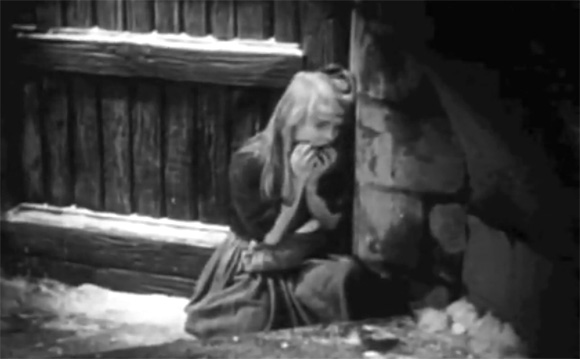
Photographer David Gillanders of Scotland made this film from his work photographing the homeless children of Ukraine. It was produced by Britain’s Channel 4. The drug addiction and desperate living conditions make for a very upsetting experience. It is difficult to imagine how children can be allowed to slip below the streets to live in sewers. It is an unforgivable sin in any civilization to allow this to happen to its children. Most of these kids are now dead.

It seems to me a worthy form of journalism that straightforwardly documents suffering that is being experienced by the most helpless members of a population.

Thank you to Paul Gallagher at Dangerous Minds.

Spirit is a Killer: A Short Film by Joewi Verhoeven

Here’s a short film from Beijing, China directed by Joewi Verhoeven. It’s an odd and discomforting tale about a solitary writer whose fictional world is intruding upon the real world. The film is a quiet and focused examination of a writer’s creative doubts and fears. I particularly like the bit where a Chinese policeman who is a friend of the writer comes over and can’t seem to see the dead body that is perhaps a result of the unrestricted imagination of the writer. The film also has a lovely soft celluloid look even though it was shot entirely on a Canon DSLR.  Also, pay attention to the beautiful and eerie background audio.

Trauma: A Video Poem Triptych by Swoon

Swoon is a Belgian poet filmmaker who makes films that try to blur the boundary between written poem and moving image. He mixes his own footage with found footage and sometimes mixes his own words with others. I like the quiet easy tone of his work. I like his manipulation of imagery. His work is a very difficult kind of work because it tries to make something new from two different things. Poetry is a perfect form all by itself. But film is never satisfied. It’s always looking for something to include within it. So it’s natural for film to go looking for poetry and try to bring it in. But poetry resists all alliances. Poetry seems content and willing to wait for centuries. It requires nothing. It doesn’t care what film wants. It will sit on a dry page in some crowded shelf somewhere waiting six hundred years for just a single pair of eyes to come along in boredom, open to the page, glance in, read half-way down and then slap the book shut for another six hundred years until someone decides to finish reading the goddamn thing. That’s patience. Film doesn’t have that. Film must be seen now or it withers. It begins to rot. Even if it’s digital. Digital films become confused and get lost in the forest of other digits. They may never find their way out again. So working with the two things and trying to get them together is very difficult but may actually make perfect sense.

This is a film poem triptych that is Swoon’s first work to include his own words. There’s a site for the film with more information.

Les Mystères du Château de Dé: 1929 Film by Man Ray

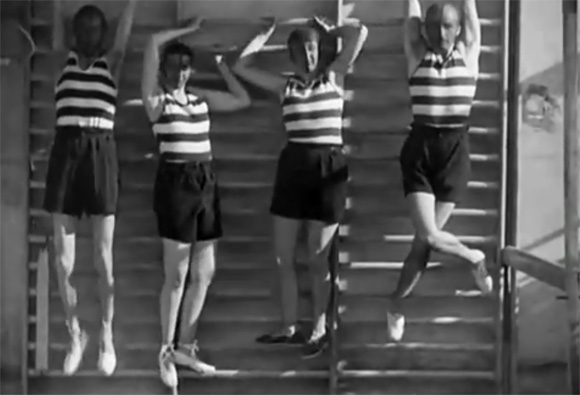
Surrealist art great, Man Ray, made this film in 1929. It follows a pair of indecisive travelers who base all their action on chance. They head out to a fabulous chateau in the hills and wander around inside and out. They run into four odd persons who enjoy swimming and running about as if the place is their private gym. But what is Man Ray doing here? Why all these shots of windows, lamps, sculptures? He is finding the abnormal in the normal. Wherever he happens to be with a camera he can make the surreal. He’s functioning as an artist, looking for odd angles, shadows, contrasts. He is also diving into the great current of his culture. The house is a castle filled with fine objects and great art. Man Ray is expressing his enthusiasm. This is an extremely childish film. I mean that as a compliment, though I really see nothing exceptional in works for children. But for an artist to function as a child for a certain amount of time is extraordinary and beneficial I think. But that kind of thinking must end and lead to its own destruction. In other words, I do not think any children’s author or illustrator should ever continue to work in that way for more than a few years. Then it is time to think about serious things and to make things that upset people. Perhaps that is my main criticism for most of the things I have seen by Man Ray. He seems a little bit too pleasant. I might be wrong about that. I have to look a little more.

The Living Want Me Dead: Short Horror Film by Bill Palmer


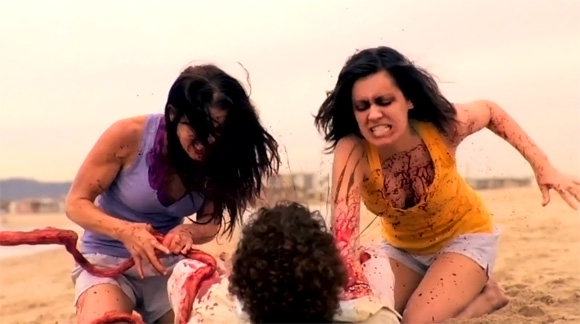
The Living Want Me Dead‘ is a short independent horror film that’s won a bunch of awards at festivals because it deserves to. I enjoyed every minute of this wild ride along with a desperate slacker as he realizes that he’s been contaminated with a substance that causes everyone within sniffing distance to want to disembowel, devour, decapitate and dismember him. He’s hounded by vomiting, mouth-foaming lunatics who simply won’t rest until he’s dead. It’s a clever commentary on the overdone zombie genre that manages somehow to be frightening and hilarious at the same time. The film was written and directed by Bill Palmer who employes techniques typically seen in independent feature films. Vimeo is full of filmmakers who want to strut their pro-quality stuff, but very few of them make anything I can watch for more than several seconds. I’m sure that director of photography Jeremy Hayward had a lot to do with this because the camera work is fluid and clear, even when following intense action and movement.

Director Palmer handles his equipment, crew and actors without letting the job overwhelm his natural instinct for telling a ripping good story and making us want to know what’s going to happen next. In fact, he made much of his own equipment, including a simple rig for filming underwater! He used water guns to shoot fake blood. I love that kind of filmmaking. And I love that he did it all without ridiculous shooting permits. He just hit the side streets with his little crew and turned the whole neighborhood into what I imagine was a hell of fun time. He has created a tight little view into a California suburb at Christmas time by littering the landscape with decorations that lend a sort of lunatic and false joy to the dark comedy and spurting blood.
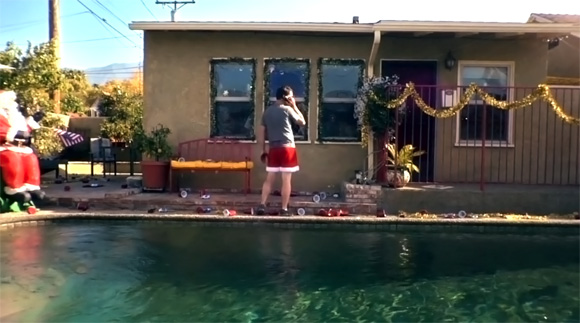
So the main character, played to intense and despairing perfection by Adam Conger, tries to get away from his attackers by lying low at a friend’s house. Conger really hits his role on the money. He’s perfect as the overwhelmed slacker-type dude who’s actually fairly driven and maniacal in survival mode. But he just can’t seem to find a good way to explain the desperate situation to his friend who is played with great comic ability by Tony Nunes. I believe that during the violent proceedings in his backyard, this friend is primarily engaged with heating up a HotPocket. Needless to say, the hero’s plan for lying low does not work out very well!
Celles Qui S’En Font: 1928 Short Film by Germaine Dulac

Germaine Dulac was one of the original French film ‘auteurs.’ She was also a film theorist and feminist. She had a relatively short career as an avant-garde filmmaker, making such works as ‘The Smiling Madam Beaudet (1923) and ‘The Seashell and the Clergyman’ (1928) which is often credited as being the first Surrealist film.

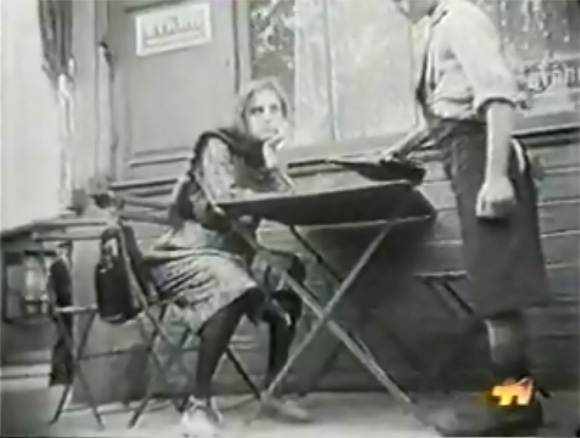
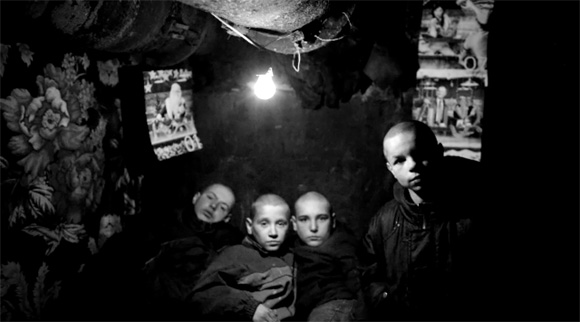
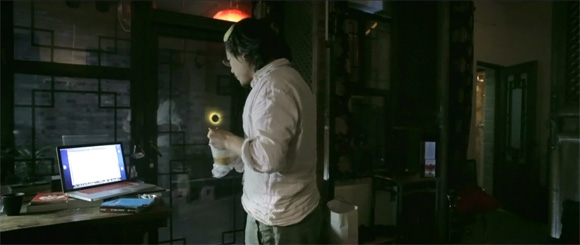
In this film, the title translated as ‘Those Who Make Themselves,’ we follow a destitute drunk woman who appears to yearn for the life of a prostitute or to engage in some sort of tryst. It is also possible that she is simply despondent over rejection by a lover. She appears to fail at everything she tries and eventually walks down a staircase into the Seine river. It’s a very simple film that manages to convey a deep sense of loneliness.

Dulac insisted on being credited as the author of her films, not accepting the standard partnership between a screenwriter and director.

Here’s a 1923 quote from Dulac:

I believe that cinematographic work must come out of a shock of sensibility, of a vision of one being who can only express himself in the cinema. The director must be a screenwriter or the screenwriter a director. Like all other arts, cinema comes from a sensible emotion … To be worth something and “bring” something, this emotion must come from one source only. The screenwriter that “feels” his idea must be able to stage it. From this, the technique follows.

Here’s a Senses of Cinema article on Germaine Dulac entitled ‘The Importance of Being a Film Author: Germaine Dulac and Female Authorship.’

A Colour Box: 1935 Abstract Direct Paint on Film Animation by Len Lye

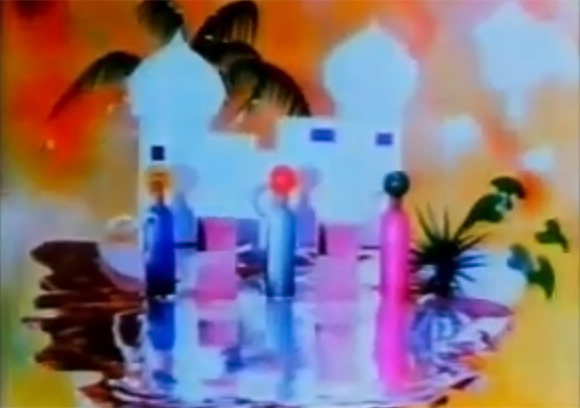
Len Lye’s 1935 film, ‘A Colour Box,’ was made by painting and applying dye directly to the film surface. It is apparently the first direct paint film to gain a general public release and has been widely seen ever since. The film is an odd way to advertise for cheap parcel post and this message starts popping up near the end. The cheerfully infectious music is ‘La Belle Créole’ by Don Baretto and his Cuban Orchestra. Lye’s work must have been hugely influential for the later work of direct paint filmmaker Stan Brakhage.

The Birth of the Robot: 1936 Experimental Advertising Film by Len Lye for Shell Oil Company


In 1936, experimental filmmaker Len Lye made this short surreal animation to advertise the benefits of Shell oil for lubricating things. The film is a hyper-saturated stop-motion extravaganza that involves a mechanical world turning on some sort of hand crank. There’s an adventurer driving around the sands of Egypt. His car winds down and konks out leaving the man dead in the desert. The angel of oil rains drops of lubricating crude down on the Egyptian landscape bringing the parched skeleton to life as the Shell Oil robot. Fascinating. It’s got that awkward, shiny, naive beauty that could only be achieved in the 30s. Parts of this thing look like they might be influenced by Salvador Dali’s work. Something about that dead skeleton and the desert looks like it could fit right into the Surrealist master’s paintings.

Lye was from New Zealand and worked not only as an experimental filmmaker but also in newsreels and advertising. He was a kinetic sculptor, poet, painter and a writer of essays on artistic theory and philosphy. He made a 1935 short film called ‘A Colour Box’ which was the first generally exhibited film made by painting directly on the film emulsion. It’s a brilliant experimental animation posing as an advertisement for cheaper parcel post.  I’m sure the great direct paint filmmaker Stan Brakhage must have been familiar with Lye’s work.

Here’s a gallery site with information and examples of his artwork.

7362: 1967 Experimental Film by Pat O’Neill

Patrick O’Neill is one of the Los Angeles artists currently featured in the huge citywide exhibit known as ‘Pacific Standard Time.‘ He has made many experimental films using techniques perfected with an optical printer. This film incorporates footage of oil derricks in Venice, California and nude models filmed in the artist’s studio. Its synthesizer score is by Joseph Byrd. I don’t know much about optical printers, but I do know that they allow images or films to be projected and rephotographed by a movie camera. So my guess is that one could set up multiple layers of screens and projections to film them and blend them into a single image. Optical printers were used to create special effects in Hollywood films. I think perhaps the most famous use of the printer was in the creation of the light show sequence near the end of Stanley Kubrick’s ‘2001: A Space Odyssey.’

O’Neill is one of the people who form the incredible fabric of the Los Angeles art scene post World War II. I did not know of him until I found his work through the Pacific Standard Time exhibit which is really something remarkable and I think that its effects will be felt in the art world for quite some time. Its broad scope, grouping and explanation of the Los Angeles art history and its significance cannot help but influence artists here in the city and far beyond. It’s essentially saying, ‘Look, here’s a great and fascinating body of work inspired by a city for the second half of the twentieth century. Here’s how it all happened, who the people were and what they were trying to do.’ It’s a very strong impression to make on a city. It must be a very great honor for an artist to be included in it.

O’Neill from a 1997 Millennium Film Journal interview:

I finished my first film in 1962. Then I started doing abstract or composite films. I began to use the camera as a sort of gathering device to provide elements for manipulation through re-photography. This led to 7362 which was finished in 1967. I didn’t have much knowledge about the history of the medium at that time. I’d had maybe three film classes at UCLA and beyond that the midnight screenings at the Coronet and the Cinema Theater were my education. That series at the Cinema Theater was going on from the early sixties.

The artist’s Lookout Mountain Studios has a web site.

Das Kleine Chaos: 1966 Short Film by Rainer Werner Fassbinder


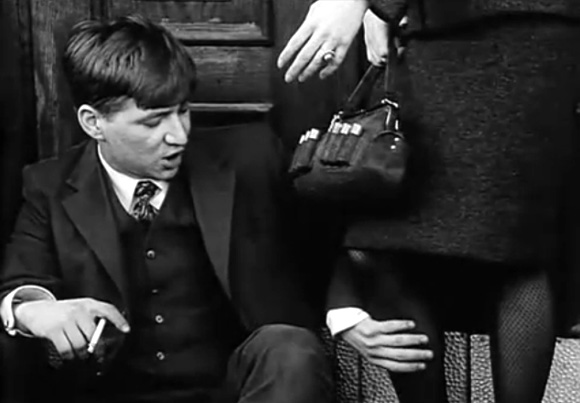
Here’s a 1966 short crime film by a young and learning Rainer Werner Fassbinder. The great and too-soon-departed German filmmaker actually plays one of the three young criminals who decide to invade a woman’s home to terrorize and rob her. The film is relentlessly cool and begins at around the 3 minute mark to really show how deeply Fassbinder was mining the work of Jean Luc Godard. Those shots in the apartment with Fassbinder reading the novel out loud in front of a wall of pinned art prints is straight up Godard stuff. But it’s just fine to imitate other filmmakers as long as your real intention is to destroy them from the inside. Fassbinder was just that kind of filmmaker.

Here’s an article about Fassbinder on the Senses of Cinema site.

Camera: A Short Film by David Cronenberg


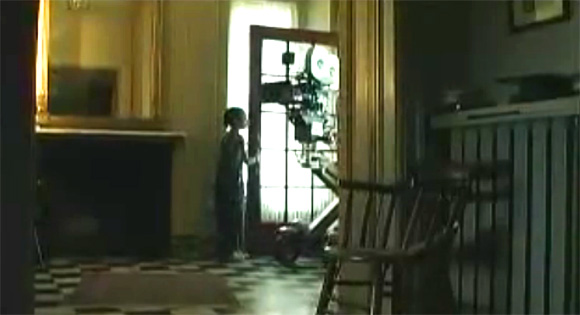
This is a short film made in 2000 for the Toronto International Film Festival by David Cronenberg. ‘Videodrome’ actor Les Carson talks about how afraid he is of the movie camera while children bring one into the house and set up to shoot their own movie with professional equipment. The actor’s fear and doubt contrast sharply with the enthusiasm of the kids. But of course they are interested in him as subject matter because they know that he is real. This is an excellent and moving study of time, creativity and how all art is an unfathomable mixture of enthusiasm and terror.

Opening Scene Film Adaptation of Thomas Pynchon’s Inherent Vice Filmed by Jeff Hoyt

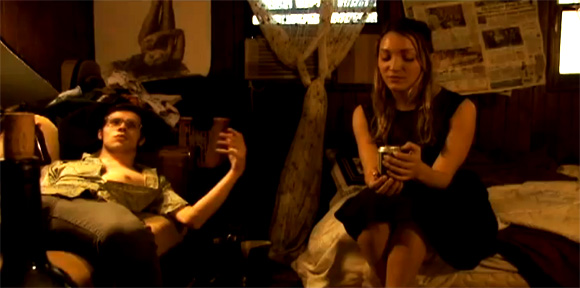
It’s nearly impossible to find film adaptations of Thomas Pynchon novels anywhere. I frankly don’t know why anyone would even try to film such books. It seems almost suicidally foolish. But this plucky fellow, Jeff Hoyt, has at least given it a small go. He’s filmed a sort-of version of the opening pages of Pynchon’s silly little lightweight piffle of a book, ‘Inherent Vice.’ This is where the lead detective/loafer/drug user/hippie/surfer/beach lounger/semi-retired permanent loser character, Doc, encounters his mysterious ex who presents him with a strange possibility for detective work. I like this little piece of film because it really tries to do Pynchon. The actors are Orien Longo and Rachel Kadison. The role of Doc is a very difficult thing to tackle because it really seems to require little effort. Actors who aren’t solid in their experiences always want to work at getting it down. You can’t do that with a character like Doc. If you aren’t him, you can’t play him. Simple as that. But the role of Shasta as played by Ms. Kadison is a sweet surprise. She’s damn good. She can do this work.