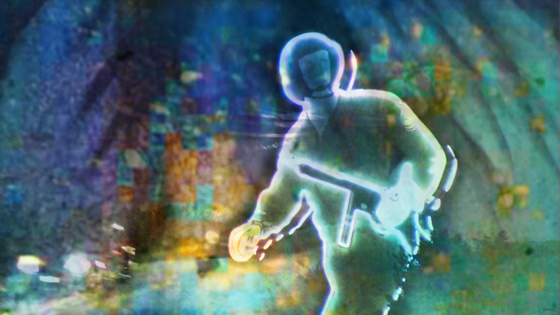
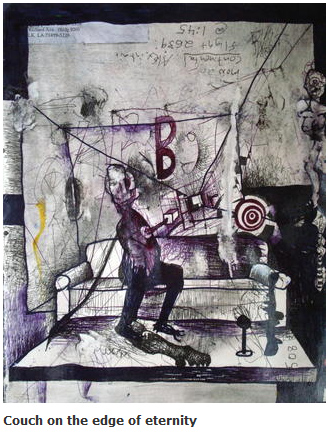
Justus 2: A Film by Ryan Spring Dooley

Ryan Spring Dooley (aka MarvinTiberious on YouTube) and Juppy Nash made a catchy little tune and played it on an Italian rooftop where they could enjoy the place they were in and become infected with art. Dooley’s films are a constant stream of creativity and artistic perception unlike anything else. He combines old and new and creates works so easily expressive that you wonder why anyone needs anything more than paper, paint and a camera to do anything. Watch this film and wonder at just how good it really is. Masterful.

The filmmaker is also using Kickstarter to fund a bigscreen project:

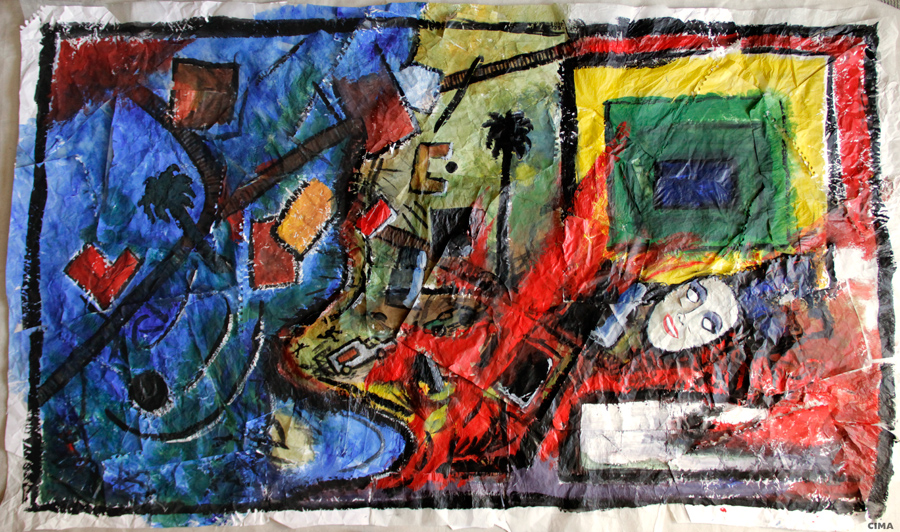
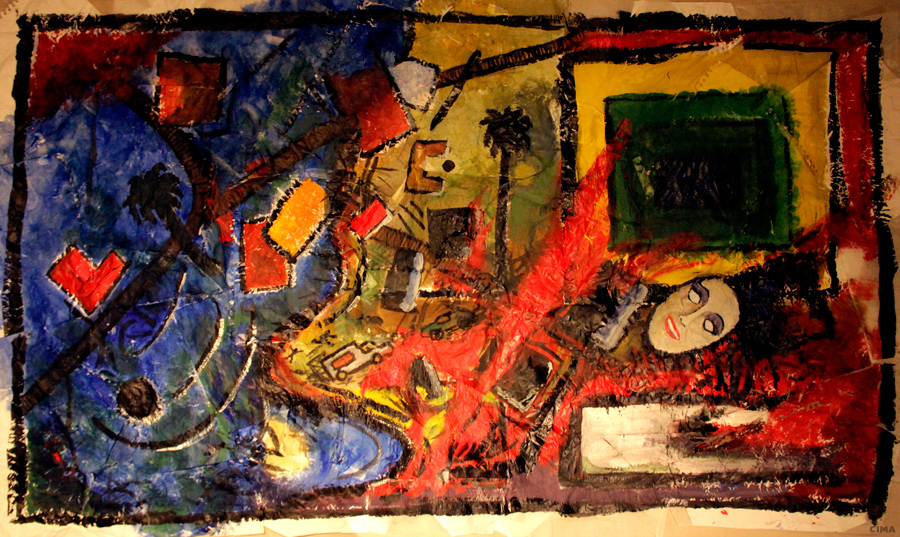
Painting: Japanese Widescreen

For Japan via Los Angeles. I photographed the painting in morning light today to try and show the details better than in last night’s photo. The painting is not quite finished yet, but I wanted to post something. It’s acrylic on various types of paper. Dimensions are approximately 6′ x 3 1/2′.

Lovely Lovely: Art Documentary by Matthew Collings

Mature Content and Language

This is another episode in the art documentary series, This is Modern Art, by Matthew Collings.  In this episode, Collings explores the place of beauty in modern art.  How does beauty fit into art that tries to shock?  What is the purpose of beauty in art?  Doesn’t most conceptual art try to dispense with beauty entirely?  Is beauty something we need for comfort?  Does it have something to say in art or is it just a distraction?

Part 2

Parts 3 – 5 after the jump

Continue reading

This is Modern Art – A Documentary Film by Matthew Collings

Mature content and language:

So this is a 1990s documentary about modern art. Matthew Collings, an artist himself, leads us through Picasso, Pollock and Warhol to try to get some glimmer of an idea on what modern art might be. I like the approach of admitting confusion and investigating the various possibilities. I must admit that I’ve always held Picasso in the highest position among artists, but the quotes attributed to him are seeming more threadbare with each repetition. I feel that Pollock was some kind of accidental moron who produced absolutely magnificent works. The first time I ever approached a Pollock at the Museum of Modern Art in New York, I was quite literally blown away and actually said out loud, ‘Oh holy fucking shit! That’s what it is.’ The painting was enormous with lots of black and white in it. But the size was not really significant. What hit me in the head about it was that it suddenly went 3D on me. It almost made me dizzy. I saw all the layers and complexities and they were overwhelming.  But nevertheless, Pollock is moronic and doesn’t hold the interest.

I’ve always felt that the sly, insulting, flippant intelligence of Andy Warhol was an extremely important aspect of art in the 20th century. His odd repetitive behavior, both verbal and visual, makes the great statement of modern art. I think Warhol’s art can only exist in its relationship to film. In fact, I think Warhol’s work is entirely filmic. There is probably not a single painting in his entire body of mature work. It is easy for many people to insult Warhol and dismiss him as junk. I suspect that would make him very happy. Warhol is kind of like Los Angeles. The good stuff is hidden in the dumpy shop at the end of the strip mall you’re driving past. You have to go inside and look around a bit or you won’t find it. Most people move to LA and drift through it with their second-hand little dream and a part-time job while they try to become someone they once saw in a magazine. Meanwhile, they’re just a person from Iowa who’s never even looked at LA. They’ll go back to die in Iowa while watching soap operas and smoking American Spirits. Warhol knew that almost everyone you meet is that person from Iowa who doesn’t have any eyes and his art is code for how to avoid them. He wanted you to watch him on television and think he was an idiot.  He was actually in the wrong city.  New York was over in the fifties.  He should have moved to LA.

Part 2:

Watch parts 3 – 5 after the jump

Continue reading

The Animated Films of Painter György Kovásznai

While visiting Your Daily Cartoon, I watched an animated film by Hungarian painter György Kovásznai.  I liked the calm mishmash of drawing styles and quiet humor. The 1965 film is called Mesék a m?veszet világából (Tales From the World of Art). It has no subtitles but is pretty easy to follow, taking a bemused look at several kinds of art. The first part is an action movie, the second is a theatrical piece, the third is a piano recital.

This one is called Várakozni jó (Waiting for Good). It’s about a traffic jam with a truck that suddenly opens its back doors and explodes into a 1969 rock & roll jam. The wild sketchy ever-changing animation style is more psychedelic than most commercialized sixties psychedelia could ever be.

This one is Gitáros fiú a régi képtárban (Boy Guitarist of the Old Hits) from 1964. It’s simply a guitarist playing and dancing his way through artworks by old masters presented in a very avant-garde fashion. Understanding the art is one thing, but the person who can truly enjoy it is far ahead in the game.

Know No Truth – A Film About a Painter by Joe Martino

This beautiful film by Joe Martino features painter Landon Richmond working and talking about his perspective on the pursuit of one’s art and expression. It’s a very direct and moving film. I agree with every word that comes out of the painter’s mouth. And I like the way he says it without a trace of pretension or irony. He’s interested in facing the darkness in his art and he recommends this fearless approach as a general principal. You have to be able to look directly at anything.  Richmond also acknowledges the place that chaos occupies in his work – the willingness to not necessarily understand where it is that you are going but to go nonetheless.  I really enjoyed hearing this painter’s words today and will keep them in mind for quite some time.

You can see lots of Landon Richmond’s paintings and a web comic at KnowNoTruth.com.


Maybe One Day Everything Will be Beautiful – by Landon Richmond

Art: Don’t Turn Back (Two Versions)

Don’t Turn Back (Final Version)

Don’t Turn Back (First Version)

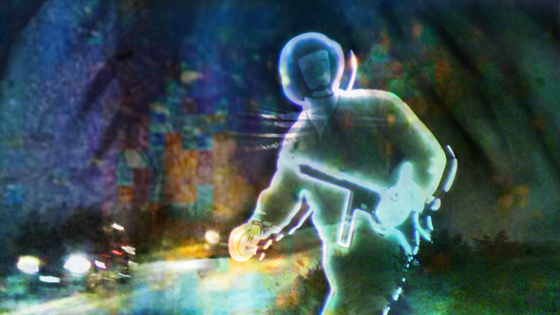
Here’s the little art problem I’ve been working on for the past few weeks.  It’s one of those things where I have no theory or rule to fall back on in order to make the decision.  Aside from some small touches like removing the Sergeant stripes from the figure’s shoulder, I was mainly trying to decide whether the right side of the image should be dark or light.  Ultimately, after scrutinizing the picture from a distance time after time, I decided that it was more dramatic if it depicted a night scene and if the figure was moving away from a more painterly zone toward a more digitized one.  I also made the road on the left a little more defined.  But canvas isn’t that expensive and I might just decide to hang both versions right next to each other in a gallery.

My own favorite part of the picture is right around the figure’s legs where you can see through to the landscape with that slight glow on the ground and how the shrubbery overlaps the neon line of the leg.  The image is about fear.  It is also connected directly to Jean Cocteau and the myth of Orpheus.  The figure looking back is from a single frame of video I shot of a store sign while walking along Hollywood Boulevard at night.  The road is a sharp bend in Laurel Canyon Boulevard near Mulholland Drive above Los Angeles that I shot through a windshield.  The background landscape is a shoreline I shot from a moving car near Rehoboth Beach, Delaware.  The dark palm fronds hanging down are from some throw-away footage I shot in high winds.  The pixelation is the product of blowing up a frame of a digital copy of decomposed celluloid film until the digital artifacts became pronounced.  I made all of these things individual layers and then went in with a digital pen and worked on a trial and error basis to make things come out the way they did.  What is interesting to me about making such an image is how I begin with an initial image – the glowing figure – and shuffle parts of other images on top of and underneath it to build a new image.  It requires an extreme confidence that you will know what you need exactly when you see it.  So you start going through piles of video or photos both on screen and in your head and pull out the pieces that snap into place for a new picture.  It’s like walking up to a leaf on a tree and taking it as the basis for a painting.  You know that from the leaf you will be able to connect to other things and end up with exactly the right final result.

This print measures 68″ x 38″. It’s an original work created from elements used in my film Yellow Plastic Raygun.

Art: Don’t Turn Back

Don’t Turn Back

This is my next large canvas print.  I’ve been making original artist prints through a gallery in Los Angeles. They measure 68″ x 38″. They are original works created from images used in my film Yellow Plastic Raygun.  They are not exact frames from the film, but rather artworks based on segments of the film.

Painter: Andrew Abbott

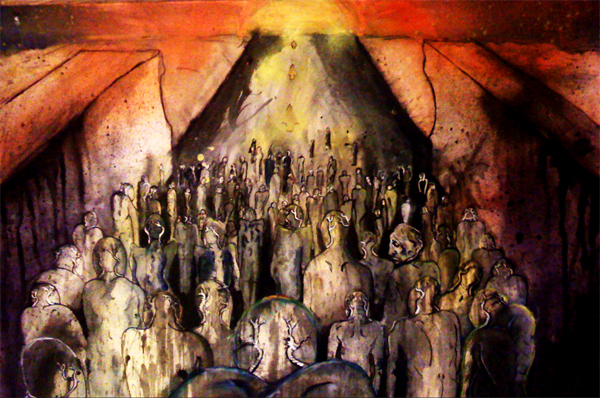
One of my favorite sites is The Rumpus, an online culture magazine that covers literature, art, film, politics, sex, comics, music and generally excellent and useful ideas.  One of their writers, Julie Greicius, did a piece on a painter I’ve never seen before: Andrew Abbott.  I really liked his paintings as soon as I saw them.  They are harsh and beautiful at the same time.  I have no idea how much they cost or anything like that.  Probably a lot.  They’re really good and I imagine they are hanging in a lot of fancy living rooms right at this moment.

But his web site is plenty of fun for me and this guy can paint like some serious business.

Go visit Andrew Abbott’s paintings.