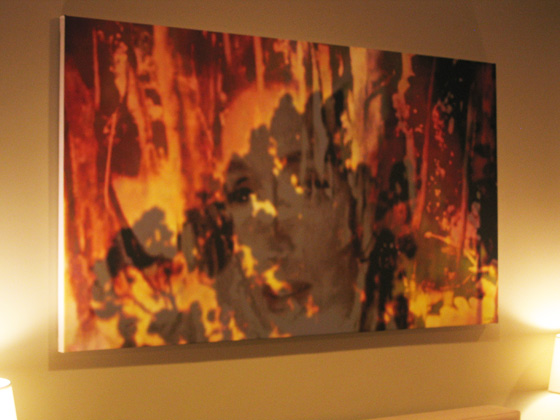
Harry Smith was an American artist, experimental filmmaker, folk music collector and mystic. His film work is considered to be some of the greatest avant-garde work of the 20th century. Here are the first 2 parts of 4 showing some of his early animation from 1941 – 1957.
Tag Archives: Film
Silent Film Footage of Destroyed San Francisco in 1906
As neighborhoods in the United States begin to explode and disappear off the face of the earth due to a rapidly disintegrating infrastructure, distract yourself for moment and watch this film of how San Francisco looked just after the earthquake and fire of 1906. Incredible footage. These days stuff like this happens without even having an earthquake. You’re just sitting at home in America watching your TV and suddenly your children are on fire in their bedrooms and your entire neighborhood is an inferno.
Animation: Kahani
Meg Park, a final year student at Duncan of Jordanstone College of Art & Design, made this short film that reminds me of how to be a kid. Fantastic animation of the characters and their movements.
Via Cartoon Brew
Thinking About Underground Film – Part 1
If you live in Los Angeles you’ve probably seen it many times: the caravan of white trucks parked along the block and around the corner, diesel generators roaring, cables strung along the gutters, piles of lights, rolls of cables, racks of costumes, makeup trailers, bored extras, bored crew members, bored motorcycle police, and fascinated passersby.
That’s all you need to see to know that something mainstream – feature film, TV show, or commercial – is being made.
But what’s an underground film?
Bad Lit, my favorite site devoted to underground film, has an article about the problem of defining something as slippery as ‘underground film’ in which several definitions are offered by different people. Mike Everleth, the site’s editor, defines underground film this way:
Essentially, I believe it is a film that is a personal statement by one person and a film that dissents radically in form, or in technique, or in content, or perhaps in all three. However, that dissension can take on any number of forms.
I agree with that, but would add the requirement of hostility. There should be an element of combativeness which attempts to counter a much larger established force. There must be some rebellion in the work. It can be very subtle – nearly imperceptible – but it’s usually there somewhere. In fact, I think the hostility should even tend to include the general culture surrounding the filmmaker/s. Dissent, by itself, can be rather subdued, soft-spoken and shy. I think underground film requires a willingness not only to dissent but to kick apart.
While thinking about all this mainstream versus underground stuff, I went searching around on YouTube for something that might fit the discussion. I found this peculiar British documentary film about filmmaker Donald Cammell who co-directed, along with Nicolas Roeg, the 1968 film Performance. The film is one of those odd mixtures of underground and mainstream. It features Mick Jagger and involves a lot of mind-bending drugs, sex and criminal underworld shenanigans. It’s actually impossible to forget once you have seen it.
This film contains adult subject matter, language, nudity and sexual situations.
Part 2
Part 3
Part 4
Part 5
Part 6
Part 7
The documentary, Donald Cammell: The Ultimate Performance, describes a time when a group of intensely creative artists from various disciplines could operate on the fringes of the mainstream to create an essentially underground film with something resembling support from a mainstream production company. It’s a scenario that does not exist today. If you watch all 7 parts of the film, you will be immersed in that strange hybrid world of the ‘popular underground’ that defines much of what was happening in the 1960s and 70s. Today, if it cannot be jammed into a mall and sold with Sour Patch Kids, it won’t get any money. That holds as true for ‘independent’ films as it does for summer blockbusters.
Watching this documentary makes me wonder why so many filmmakers seem to have such trouble making the films they really want to make. After all, one can purchase a cheap camera and make exactly what one wants regardless of what one’s career and money-earning responsibilities might be. Tormented filmmakers who are battling studois for creative freedom should simply make films with video cameras during their spare time. This would not only foster a healthy underground, but it would quite possibly prevent a few tragic endings.
Animation: Velocity
Official selection at CINEME, 2003 Chicago International Animation Film Festival.
This is a short film that I started back in 2001. 9/11 happened and I put the film on hold for almost 2 years. When I returned to it I was able to finish it in several months of hard effort. I was working with Flash and my process was kind of awkward. The drawing is actually very crude. But the film came out decently. It got into a Chicago film festival in 2003 and it has remained in its Flash form on CandlelightStories.com ever since. It was recently shown by NewGrounds.com as part of their ‘Treasure Hunt’ festival of animation.
But getting the film out of the Flash ghetto and into video proved to be more work than I thought. So I’ve made a few little updates and improved some of the film effects a little. So now the film is actually closer to the film I was imagining back in 2001.
Yellow Plastic Raygun Wins Best Experimental Film Award at Downtown Film Festival Los Angeles

Well I’m just very pleased about this. The Downtown Film Festival Los Angeles has given my film, Yellow Plastic Raygun, the award for Best Experimental Film. I was having quite a nice week attending various parties and screenings at the festival. Its use of multiple locations in the heart of downtown Los Angeles gives one a real sense of taking part in the life of the city and being involved with something that’s helping to foster the exploding art and film scene in downtown. Most of the short films were screened in the new Civic Center Theater at the intersection of First and Main Streets, in the shadow of the famous City Hall tower that has appeared in so many crime shows and film noir classics. I attended the screening of my own film this past Saturday evening and was amazed at seeing it large since I had put so much work into it on small monitors. What’s great about the Downtown Film Festival is that it shows a wide range of filmmaking styles, crew sizes and budgets. They show films made with lots of production resources right alongside films made by individual artists working with inexpensive HD cameras and even cell phone cameras. I am very proud to have won this and I look forward to more great festivals in downtown Los Angeles from the people who put this together.
Yellow Plastic Raygun Selected for Downtown Film Festival Los Angeles

The Downtown Film Festival Los Angeles has made my latest short film, Yellow Plastic Raygun, part of their official selection! So if you are in Los Angeles on Saturday, September 11, 2010 and you want to see an evening of short films, come by the Civic Center Theater at First and Main Street right across from the City Hall building. The shorts program starts at 10:00 pm. Here’s a link to the festival schedule.
I am very happy about this. I like the idea of a film festival right here at home where I can go and hang around with some other insane filmmakers. It should be an interesting Saturday night.
Film Noir: The Big Combo
A great old film noir from 1955 starring Cornel Wilde. The Big Combo, directed by Joseph H. Lewis is about a tormented detective, Leonard Diamond, who becomes obsessed with taking down a nasty gangster called Mr. Brown. There’s a woman stuck in the middle and Diamond wants to save her.
The film is loaded with superb noir imagery and maintains a good level of tension all the way through. There are also lots of choice tough-guy lines.
Kenneth Anger Makes a New Film for Missoni Fashion House
The great American filmmaker, Kenneth Anger, has made a new film called Missoni. He shot it for the Italian fashion house Missoni as part of their Fall 2010 advertising campaign. The film includes members of the Missoni family engaged in dance-like movement and poses. Can advertising be art? Yes, when it’s done by an artist.
Anger has made another beautiful and mysteriously layered film. Apparently, he has gone digital, using something called a RED digital camera. It has some characteristics in common with 35mm cameras. Anger appears to be using it as freely as he used 16mm cameras.
What’s really interesting about this whole project is its reason for existing. I think the Missoni advertising angle is just an excuse. I think they just wanted to be in a film by Kenneth Anger.
Film: Outer Space
Marc Campbell posted this 1999 film called Outer Space by Australian avant-garde filmmaker Peter Tscherassky. Using found footage from something featuring actress Barbara Hershey, Tscherassky creates a jumping and jittering psychotic version of a haunted house movie. The simplest of shots showing a woman entering a house, sitting down, looking into a mirror, looking out a window, are turned into extravagant, multi-layered cubist visions from a nightmare.
Can a Video Game be Art?
 Here’s a relatively uninteresting article by Grant Tavinor called Video Games and the Philosophy of Art. Can video games be art? I don’t know. Can a tree be art? Can a car be art? Can a rear end be art? Certainly, under certain circumstances they can all be art. But forgive my asking why do people spend so much time discussing a question that is equivalent to, ‘Can a hairbrush be art?’
In most cases I think a video game can only be art because of the player. Any video game, no matter how crappy, can be art in the hands of… well… an artist. Artists make art. If you ain’t an artist you can’t get no art. An artist can load up a copy of Grand Theft Auto on their Xbox 360 and walk into that gigantic world of violence and stand perfect still on a virtual street corner doing nothing but stare at a lamp post for days on end and turn that video game into art. It’s magic. Not theory. Magic. You know it when you see it.
Here’s a film with my own use of a video game as art. Well, I think it’s art, but you may think it’s idiotic. Check it out. You’ll know it when you see it. It contains extreme violence and nudity (just like video games!). It’s intended for an adult audience. There’s my disclaimer. Here’s the film.
Art: Don’t Turn Back (Two Versions)
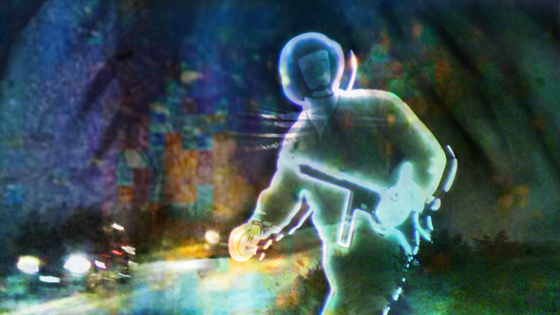
Don’t Turn Back (Final Version)
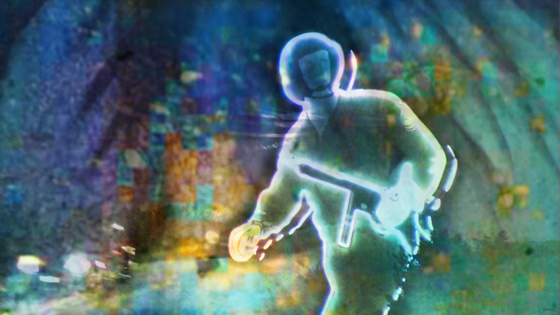
Don’t Turn Back (First Version)
Here’s the little art problem I’ve been working on for the past few weeks. It’s one of those things where I have no theory or rule to fall back on in order to make the decision. Aside from some small touches like removing the Sergeant stripes from the figure’s shoulder, I was mainly trying to decide whether the right side of the image should be dark or light. Ultimately, after scrutinizing the picture from a distance time after time, I decided that it was more dramatic if it depicted a night scene and if the figure was moving away from a more painterly zone toward a more digitized one. I also made the road on the left a little more defined. But canvas isn’t that expensive and I might just decide to hang both versions right next to each other in a gallery.
My own favorite part of the picture is right around the figure’s legs where you can see through to the landscape with that slight glow on the ground and how the shrubbery overlaps the neon line of the leg. The image is about fear. It is also connected directly to Jean Cocteau and the myth of Orpheus. The figure looking back is from a single frame of video I shot of a store sign while walking along Hollywood Boulevard at night. The road is a sharp bend in Laurel Canyon Boulevard near Mulholland Drive above Los Angeles that I shot through a windshield. The background landscape is a shoreline I shot from a moving car near Rehoboth Beach, Delaware. The dark palm fronds hanging down are from some throw-away footage I shot in high winds. The pixelation is the product of blowing up a frame of a digital copy of decomposed celluloid film until the digital artifacts became pronounced. I made all of these things individual layers and then went in with a digital pen and worked on a trial and error basis to make things come out the way they did. What is interesting to me about making such an image is how I begin with an initial image – the glowing figure – and shuffle parts of other images on top of and underneath it to build a new image. It requires an extreme confidence that you will know what you need exactly when you see it. So you start going through piles of video or photos both on screen and in your head and pull out the pieces that snap into place for a new picture. It’s like walking up to a leaf on a tree and taking it as the basis for a painting. You know that from the leaf you will be able to connect to other things and end up with exactly the right final result.
This print measures 68″ x 38″. It’s an original work created from elements used in my film Yellow Plastic Raygun.
Film: From a Land of Ashes and Mist
From an Italian master of short film memory, Fabio Scacchioli, comes this beautiful 23-minute work that expresses the illusion of solid permanence and the heroic attempt to build a reality based on fragments of memory. Even found memories and images can become part of one’s own person. This fleeting and subtle idea becomes more discernible as the film progresses. The impressive imagery revolves around the recent earthquake in L’Aquila, Italy and compares the desolation of a town reduced to rubble with the lives that once literally danced through home movies. It is a film about looking for ghosts.
Art: Don’t Turn Back
Don’t Turn Back
This is my next large canvas print. I’ve been making original artist prints through a gallery in Los Angeles. They measure 68″ x 38″. They are original works created from images used in my film Yellow Plastic Raygun. They are not exact frames from the film, but rather artworks based on segments of the film.
Art: Digital Prints on Canvas
I Was Thinking
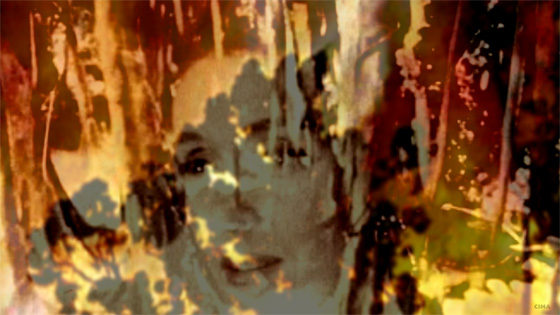
I’ve been making large original artist prints of these images through a gallery in Los Angeles. They measure 68″ x 38″. They are original works created from images used in my film Yellow Plastic Raygun. They are not exact frames from the film, but rather artworks based on fragments of the film. I make the film, then I mine it for artworks that will stand on their own. So the film becomes a sort of a paintbox or a scrapbox that I dig through and manipulate. I could go on working like this forever. It’s an endless trove to explore.
Wave Rider
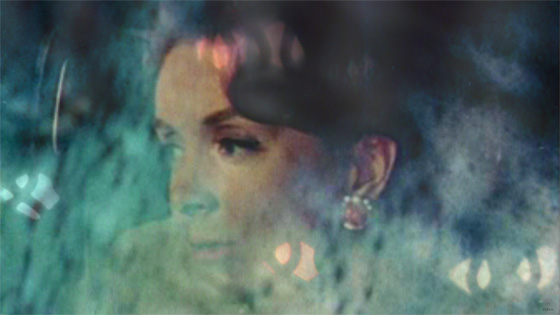
I Was Thinking hanging on a wall: