Extraordinary and crystal clear film of L.A.’s old Bunker Hill neighborhood. The entire area up the hill was blown out completely and basically strip-mined to make way for L.A.’s skyscraper district. On the one hand, it is a damn good thing the city isolated the destruction to the hill and left much of old downtown intact. But neighborhoods are always better than corporate complexes because people can actually do things in them. You can’t do anything in a corporate complex except hold a fake job that nobody needs anyway. You can’t even go for a walk on Bunker Hill anymore. Not really. You may think you can but you’re really just sneaking along next to a cement wall that’s meant to keep you out. Watching this film also makes it clear just how right they got 1948 Los Angeles in the recent L.A. Noir game.
Podcast Novel: A Princess of Mars (Chapter 26)
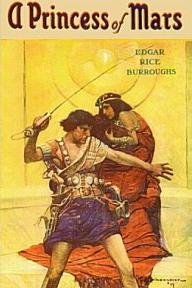
This is the first John Carter of Mars novel by Edgar Rice Burroughs, the author of the Tarzan books. It was his first novel, published in 1917 and it’s a work of rip-roaring science fiction that has inspired many of the great writers in the genre.
Chapter 26: John Carter leads part of the battle to free Helium and Zodanga. He meets the father of Dejah Thoris.
You can find all the previous chapters of the book here.
You’ll find regular podcasts of all the chapters over the next couple of months. Subscribe to our feed.
Duration: 00:13:22
Read by Alessandro Cima
All audio stories are Copyright © Candlelight Stories, Inc., All Rights Reserved.
Podcast Novel: A Princess of Mars (Chapter 25)
This is the first John Carter of Mars novel by Edgar Rice Burroughs, the author of the Tarzan books. It was his first novel, published in 1917 and it’s a work of rip-roaring science fiction that has inspired many of the great writers in the genre.
Chapter 25: John Carter crashes the wedding ceremony of Dejah Thoris and fights for her.
You can find all the previous chapters of the book here.
You’ll find regular podcasts of all the chapters over the next couple of months. Subscribe to our feed.
Duration: 00:10:52
Read by Alessandro Cima
All audio stories are Copyright © Candlelight Stories, Inc., All Rights Reserved.
Podcast Novel: A Princess of Mars (Chapter 24)
This is the first John Carter of Mars novel by Edgar Rice Burroughs, the author of the Tarzan books. It was his first novel, published in 1917 and it’s a work of rip-roaring science fiction that has inspired many of the great writers in the genre.
Chapter 24: John Carter crashes in the midst of a battle, finds a friend, and finally confronts Tal Hajus.
You can find all the previous chapters of the book here.
You’ll find regular podcasts of all the chapters over the next couple of months. Subscribe to our feed.
Duration: 00:15:41
Read by Alessandro Cima
All audio stories are Copyright © Candlelight Stories, Inc., All Rights Reserved.
Podcast Novel: A Princess of Mars (Chapter 23)
This is the first John Carter of Mars novel by Edgar Rice Burroughs, the author of the Tarzan books. It was his first novel, published in 1917 and it’s a work of rip-roaring science fiction that has inspired many of the great writers in the genre.
Chapter 23: John Carter and Kantos Kan escape Zodanga and fly toward the city of Helium to rescue Dejah Thoris.
You can find all the previous chapters of the book here.
You’ll find regular podcasts of all the chapters over the next couple of months. Subscribe to our feed.
Duration: 00:12:06
Read by Alessandro Cima
All audio stories are Copyright © Candlelight Stories, Inc., All Rights Reserved.
The Man of Many Shades: Web Comic Noir
 MATURE CONTENT AND LANGUAGE:
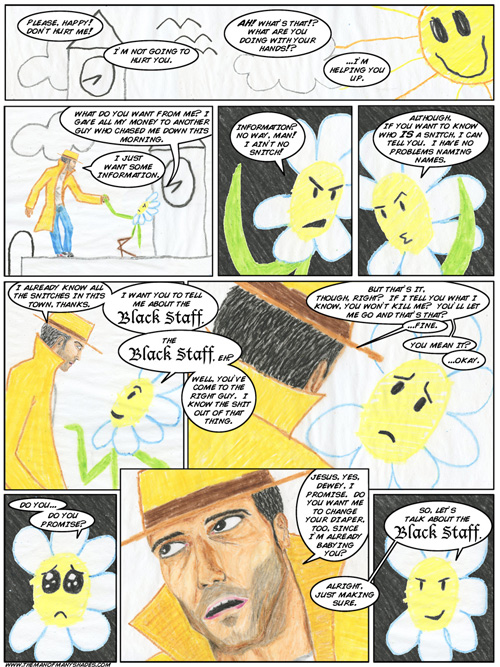
Matt Ellis draws and writes ‘The Man of Many Shades‘ which is a comic noir about a guy named Happy who’s trapped inside some kid’s drawings and uses his private eye investigation skills to find a way out.
Very cool set up for a comic. You can read the whole thing for free online.
Heel: Super 8 Film by Diego Arredondo
Here’s a short film that was made with a Super 8 film camera and all the editing was done entirely in camera. It was part of the Straight 8 festival.
First Video Images Ever Reconstructed From the Human Brain
UC Berkeley scientists have recorded the first images ever generated by a human brain. Amazing. They exposed subjects to video images while recording visual activity in their brains. When they played the recorded data back they got images corresponding closely to what the subjects had just seen. What I notice about the images in the video is that faces seem to work the best. That is interesting on many levels. Perhaps facial recognition is so hard-wired into humans that we are able to generate those images more clearly than all others. This work opens the door to the ability to reconstruct imagery from dreams and memories. It’s a staggering achievement. Magnificent. I simply cannot wait to try this sometime.
Thank you to Rob Smart on Facebook.
Greetings From Los Angeles 1978: Super 8 Film by George Porcari
George Pocari made this film of Los Angeles in 1978. It’s beautiful and it shows the things one sees every day without really noticing. Films like this one turn out to be incredibly valuable glimpses of the past. It’s funny how home movies end up getting closer to art films as they age. But this one actually started off as a kind of art film. It’s very well made.
The Great Wall of Los Angeles: A Film by Donna Deitch
The Great Wall of Los Angeles is one of the longest murals in the world. It was begun in 1974 and took five summers of work by students to complete. It tells about the history of California. This short film was made by Donna Deitch.
Pacific Standard Time: Los Angeles Art From 1945 to 1980
Don’t let anyone ever tell you that it doesn’t matter where you are when you make art. It matters very much. You have to know who’s buried in the ground that you’re dancing on. You have to know what’s in the air. You have to know who walked where you are walking now. If you don’t know those things, you might as well be working via modem from an igloo in the antarctic. This Pacific Standard Time thing is a bunch of galleries in Southern California working under the general umbrella of the Getty Center to put on exhibits of post World War II through 1980 art by Southern California artists. Los Angeles is the only great American city that hasn’t been entirely bombed by corporations yet. New York has been a dead zone since 1980. I lived there for almost ten years. Every footstep taken in that city was like a death march for me. The oppression of mind that goes on in New York is akin to being trapped inside some sort of giant grinding machine that keeps on working even though all its parts are broken. Coming to Los Angeles was like seeing the horizon for the first time. The city opens out and spreads with a psychotically unhinged freedom and chaos that is the very essence of creativity. It is the perfect antidote to the black death of New York. This is apparently the first art exhibition of its kind ever. An entire region is presenting its art and imagination for all the world to see. There are going to be roughly sixty different shows happening over the six months of this thing.
Pacific Standard Time is a collaboration of more than sixty cultural institutions across Southern California, coming together for six months beginning in October 2011 to tell the story of the birth of the Los Angeles art scene and how it became a major new force in the art world. Each institution will make its own contribution to this grand-scale story of artistic innovation and social change, told through a multitude of simultaneous exhibitions and programs. Exploring and celebrating the significance of the crucial post-World War II years through the tumultuous period of the 1960s and 70s, Pacific Standard Time encompasses developments from L.A. Pop to post-minimalism; from modernist architecture and design to multi-media installations; from the films of the African American L.A. Rebellion to the feminist activities of the Woman’s Building; from ceramics to Chicano performance art; and from Japanese American design to the pioneering work of artists’ collectives. Initiated through $10 million in grants from the Getty Foundation, Pacific Standard Time involves cultural institutions of every size and character across Southern California, from Greater Los Angeles to San Diego and Santa Barbara to Palm Springs.
How Walt Disney Cartoons Are Made: 1939 Documentary Film
Here’s a wonderful glimpse into the animation techniques that were pioneering at the time of Disney’s first feature-length animation, ‘Snow White and the Seven Dwarfs.’ You get to see some shots of Snow White being drawn and photographed, sound effects being recorded, and people arriving at the premiere. You also get a good dose of the Disney sexism in which all women who work on a film are referred to as ‘pretty girls.’ It’s basically an advertisement for the film, but it’s a good one.
Light Up: Animation by Aveline Stoquart and David Duvieusart
‘Light Up’ is a short animation by Aveline Stoquart and David Duvieusart. Students at the Haute École Albert Jacquard in Namur, Belgium also worked on the film. A girl who is into astronomy lives in a totally starless world. One evening she sees something new and gets into her little flying machine to investigate. I love the scene in the little plane. It’s a very simple charming little story, gently told and well-animated.
NASA Captures Images of Apollo Astronaut Moon Tracks
NASA’s Lunar Reconnaissance Orbiter has captured images of astronaut tracks, lunar landers, and left behind equipment from the Apollo 12, 14 and 17 moon missions. These are the sharpest images ever taken of the moon and should give fake moon landing conspiracy nuts a whole new bag of clues to play with. We can’t rebuild what we once understood and get ourselves back to the moon, but we can take pictures of our past glory.
Trip to Moon: Bizarre Bollywood Sci-Fi Spectacle
Oh dear! What have we here? This is a Bollywood science fiction (and I use that term very lightly!) film that was apparently made in 1967, though it looks more 1950s to me. It was directed by one T.P. Sundaram. It is ostensibly about an astronaut who gets kidnapped to the moon and then has to fight for the moon princess and her kingdom when martians try to invade. The movie is a roaring low-fi spectacle with songs, fights and cheesy cardboard special effects. Spaceship controls are actually steering wheels. If you want some good advice, skip through to the 2 hour 15 minute mark and just watch the glorious action sequence that closes the film. You will see grown men fighting with giant sparklers aboard a crash-landing spaceship. You’ll see robots, a Cyclops, and two men engaged in a lunar surface wrestling match that makes Captain Kirk look like Bruce Lee’s star pupil. You will then see a rhinoceros. If you are not laughing hard enough to burst a vessel of some sort, then I don’t think anything can be done for you!