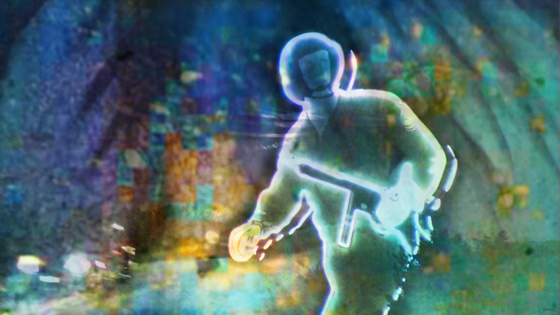
Don’t Turn Back (Final Version)
Don’t Turn Back (First Version)
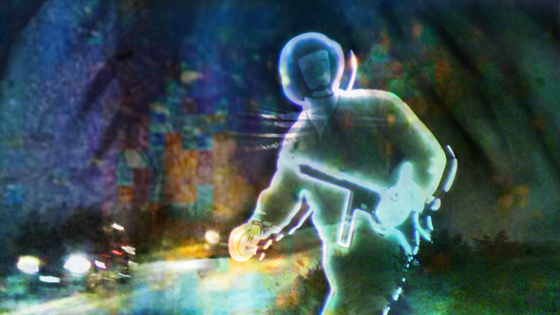
Here’s the little art problem I’ve been working on for the past few weeks. It’s one of those things where I have no theory or rule to fall back on in order to make the decision. Aside from some small touches like removing the Sergeant stripes from the figure’s shoulder, I was mainly trying to decide whether the right side of the image should be dark or light. Ultimately, after scrutinizing the picture from a distance time after time, I decided that it was more dramatic if it depicted a night scene and if the figure was moving away from a more painterly zone toward a more digitized one. I also made the road on the left a little more defined. But canvas isn’t that expensive and I might just decide to hang both versions right next to each other in a gallery.
My own favorite part of the picture is right around the figure’s legs where you can see through to the landscape with that slight glow on the ground and how the shrubbery overlaps the neon line of the leg. The image is about fear. It is also connected directly to Jean Cocteau and the myth of Orpheus. The figure looking back is from a single frame of video I shot of a store sign while walking along Hollywood Boulevard at night. The road is a sharp bend in Laurel Canyon Boulevard near Mulholland Drive above Los Angeles that I shot through a windshield. The background landscape is a shoreline I shot from a moving car near Rehoboth Beach, Delaware. The dark palm fronds hanging down are from some throw-away footage I shot in high winds. The pixelation is the product of blowing up a frame of a digital copy of decomposed celluloid film until the digital artifacts became pronounced. I made all of these things individual layers and then went in with a digital pen and worked on a trial and error basis to make things come out the way they did. What is interesting to me about making such an image is how I begin with an initial image – the glowing figure – and shuffle parts of other images on top of and underneath it to build a new image. It requires an extreme confidence that you will know what you need exactly when you see it. So you start going through piles of video or photos both on screen and in your head and pull out the pieces that snap into place for a new picture. It’s like walking up to a leaf on a tree and taking it as the basis for a painting. You know that from the leaf you will be able to connect to other things and end up with exactly the right final result.
This print measures 68″ x 38″. It’s an original work created from elements used in my film Yellow Plastic Raygun.
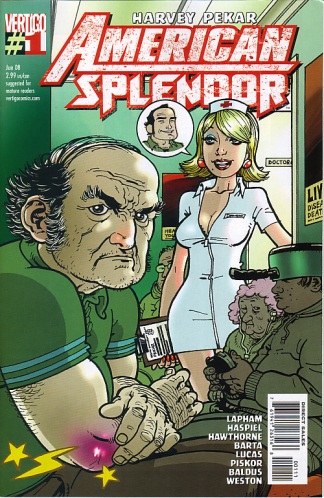
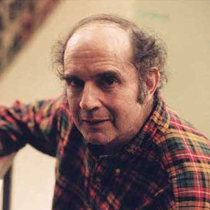 American comics genius Harvey Pekar has passed away at the age of 70. I think Pekar was the greatest writer of comics because he treated the form as literature – for real – not like most of the dimwits writing ‘graphic novels.’ Pekar was serious and nervous and funny and angry, with very little separation between. His observations of everyday life run a full range from fixing a flat tire in a snow storm to surviving cancer to trying to find a file folder at work. He looked at his life and wrote it all down for his comic books.