Happily Ever Over: An Epic Illustrated Fairy Tale by C Merry

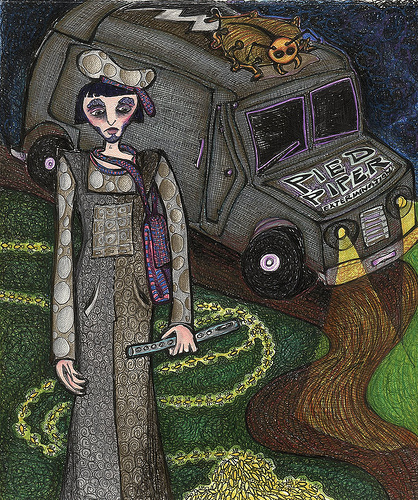
C Merry has created an epic rambling fairy tale that weaves her own modern perspective through the classic stories that children have been familiar with for centuries. The result is both humorous and unsettling. C Merry combines these tales with mythology and Christmas to explain things that have been long forgotten. It’s a beautiful way to start the holidays. You’ll find out that the Pied Piper had money troubles and was working out of his van. Santa Clawz is a wormhole-travelling wildman who began the holiday tradition of sneaking into houses to counteract the effects of war. Instead of dropping bombs, he dropped gifts. He was also descended from grizzly bears.
The story unfolds over a series of partially animated illustrations that are gorgeously detailed, showing squiggly pen lines inside every detail. These pictures are backed by a dense and mysterious soundscape.

What C Merry seems to be doing is connected the world’s most charming tales for children to the much deeper and darker subterranean world of mythology. It works. She has created a mystical world of danger and beauty.

You can also read the entire illustrated tale at the author’s blog.

The Mad Ones: A Brief History of the Beat Generation

Krystal Cannon (PersonTV) made this short documentary about the Beat Generation in which she not only narrates as Queen Elizabeth, but also plays various roles including Allen Ginsberg, Joan Vollmer, Bob Dylan, Jack Kerouac, John Lennon, Edie Sedgwick and Abbie Hoffman. She gives a clear account of the Beat movement then moves into the general social reaction. She also makes some very interesting points about how women were sidelined even though many of them made great contributions to Beat culture. I think that what the Beats were working on is in very fine hands indeed with Ms. Cannon at work.

Thanks to Marc Campbell at Dangerous Minds.

Girls: A Violent and Gorgeous Film by Maureen O’Connell

This film’s writer and director, Maureen O’Connell, is a student at the Royal Academy of Dramatic Art in London. The school doesn’t make a good first impression with all its diction and dialects. But her film does. I’m a bit of a jerk about British drama training. Derek Jacobi once made an offer of employment that I refused while asked for another beer. That’s my general attitude about the Kenneth Branagh tribe. Nobody’s ever produced duller Shakespeare than Mr. I-Am-a-Hard-Working-Shakespearean-Dammit! O’Connell comes from Ireland… usually an ace up an actor’s sleeve… except in Mr. Branagh’s case. If O’Connell can keep RADA off of her back, she might just have something very fine going on as a director. She’s made a great film here. There are some technical issues with sound that annoy me, but they seem easily solvable by simply converting a stereo track to mono and blending a few audio transitions together. Someone could fix that up in a few minutes for her.

The film is about a comfortably middle-class girl who seems disconnected from her family and friends. She takes a sudden turn toward what I can only call suburban violence. The film builds quietly toward a surprising viciousness that seems very real. O’Connell darts around the action like she’s making a documentary. She works well with actors, somehow getting large groups of them to create scenes that are shockingly realistic and disturbing. There’s not a hint of awkwardness in her camera work. In fact, she seems, along with director of photography Arthur Mulhern, to revel in what I call the messy image. It is my belief that only people who seek out messy images can become great filmmakers. I will not explain that too much. It should be obvious to any filmmaker. The film contains a crystallizing and gorgeous image where O’Connell points the camera into the sun and tracks a running group of teenagers after a fight. It’s a great image that violates the norms of video photography. In fact, I notice quite a bit of light leaking into the lens during the film. O’Connell’s violence is shocking but also mesmerizing. She approaches it in a slightly off-kilter manner that I can’t quite get a handle on. Just when you think it’s time for her to calm down and quiet things, someone gets kicked in the face. She just has a natural sense of drama.

Her lead performer, Marilyn Bane, conveys her role brilliantly. She is a cross between likeable innocence and brute savage that I want to hit with a baseball bat. Really fine work. All the actors are terrific and the group of ass-kicking girls is just horrifying.

So this Maureen O’Connell is probably going to be making something very fine for the BBC soon. Get ready for it. Because it won’t be pretty. But it’ll leave a big bruise for a long while.  She’ll most likely have to get over all that RADA stuff.  Although, to contradict myself slightly, she does do this nice little Romeo & Juliet thing that I listened to!

Traumatografo: Magnificent and Mysterious 1975 Film by Paolo Gioli

I did not know this filmmaker, Paolo Gioli, existed until yesterday. And that really bothers me because I feel a very strong kinship with this filmmaker just on the basis of having seen two of his pieces. What can a filmmaker do with his own backyard? That is the question that comes to my mind as I watch his films. Can a filmmaker take his camera out back and make something astounding? Of course. In fact, that skill is central to being a creative filmmaker. It is the feeling I get from Gioli. He makes films that have a guiding concern but he is not afraid to slip a little off of the main track and let you see him experimenting. One can observe his enthusiasm for a new mechanical technique and he allows his film to wander into the territory of the new machine or splicing method for a while. And then he comes back to the main thing. He never lets this get out of control and it is a miracle to watch. One can learn how to experiment by watching a brilliant experimentalist. It’s that simple.

There are many filmmakers I wish I could meet and perhaps work with. Gioli is one of them. In fact, this brings to mind again my thought that things like YouTube are the greatest cinematic development of the past half century. The reason has nothing to do with screen format or size or image quality. It has to do with intimacy. The feeling of connection one can get by watching a filmmaker’s work on the computer is far more intimate than could be achieved in a theater. It is this quality that is the most important contribution of online film to world cinema. Intimate connection to the artist. It has a powerful effect on artists and communicates ideas and inspiration from generation to generation far more effectively than any prior cinematic display technology.

Here is a nice long article by Bart Testa about this wonderful Italian filmmaker.

Here is an article by David Bordwell on how Gioli’s hand-made cameras influence his ‘vertical cinema’ technique.

The Dystopian Trilogy: A Film by James Schneider

James Schneider made ‘The Dystopian Trilogy’ in 1993, mainly through the use of found footage. Its three parts, ‘Faerie-Monition,’ ‘Oasis,’ and ‘Median Strip,’ convey modern Americans’ infatuation with closing off entire communities from the rest of the world for some theoretical benefit. The first part deals with the corporatization and homogenization of imagination through eerie footage of Euro-Disney. The second part focuses on a gated community near Las Vegas. The third contrasts and connects the freedom of the modern highway to the growth of our prison system and the fast-growing outrage of private prisons run for profit. This last part, when seen in light of today’s use of immigration law to fill corporate-owned prisons with people who are turned into a slave workforce, is particularly frightening.

Cuadecuc, Vampir: 1970 Spanish Underground Dracula Film Shot as Attack on General Franco

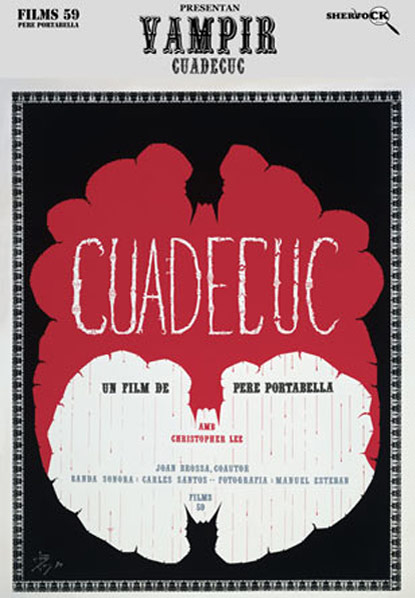
Here’s an extremely rare underground Halloween treat for anyone who loves film.  Ah, but only the very fewest of you will actually watch this all the way through! Give it a try. Not only is this film underground… it’s underhanded. Pere Portabella made ‘Cuadecuc, Vampir’ in 1970 by filming on the set of a Christopher Lee film called ‘Count Dracula’ that was being directed by Jesus Franco.  Portabella’s underground classic is on its surface a silent horror film. But it’s also a documentary about the making of the Dracula film.  It tells its story by stealing scenes from the feature being shot around it, almost as if the film were a mashup of existing footage! The high-contrast black and white photography evokes such cinema greats as Carl Theodor Dreyer’s ‘Vampyr’ and F.W. Murnau’s ‘Nosferatu.’ We see typical horror scenes like a stagecoach racing through the wilderness, or a dusty crypt, interrupted by the arm of a prop person using a fan to blow fake spiderwebs or a cameraman shooting from behind furniture. These slippages from horror into documentary actually produce a weird terror when you realize that the film was being shot under the watchful eyes of Spain’s dictator, General Francisco Franco.  What the film really is underneath all the fantastic and disturbing imagery is a vicious attack on Franco and the false media manipulation that keeps all dictators in power.  The portrait it paints of Franco himself is one of a sad, disturbed and largely ineffective vampire who lives inside a mental construction based on the past.  The other characters in the film seem to be wandering through this psychotic realm, trying to find a way out.

The soundtrack incorporates jet engines, muzak, electronic music, opera singing, jackhammers, stuck records and various other electronic sounds. Don’t let this throw you because the soundtrack is one of the most eerie and unsettling that you will ever hear.

And I’m thinking that Criterion needs to jump on this and make a nice blu-ray release out of it.

Pere Portabella has a web site.

Now, just for kicks, here is a scene from the actual color film of Dracula being shot while Pere Portabella stole his own film right under Christopher Lee’s nose! You decide which film seems scarier.

Hallow’s Eve and the Pumpkin Dream: A Short Film by Adam Sager

Film compositor Adam Sager made this beautiful short film for Halloween with his family. He’s created a perfect old dream film that celebrates the holiday by being mysterious, spooky and gorgeous.  This guy has got some amazing work under his belt, including work credited as paint & roto artist on the feature film ‘Coraline.’

Sagerdigital.com.

On Skid Row: Documentary Film by Sam Slovick

Sam Slovick made this 2008 documentary on skid row in downtown Los Angeles. The area is home to approximately 9,000 homeless people who deal with life on the streets, drugs, crime and serious physical and mental health issues. The film was made just prior to the massive economic collapse of 2008 when the numbers of homeless began to rapidly increase.

Parts 3 through 5 follow the jump.

Continue reading

Nova Express: Epic Online Film Adaptation of the William S. Burroughs Novel by Andre Perkowski

Filmmaker Andre Perkowski is working on a huge 3 hour plus adaptation of the novel ‘Nova Express‘ by William S. Burroughs. It’s a wild, ragged, disjointed, warped, damaged, serious and funny mashup of found footage, original film and Burroughs’ reading voice along with others. It’s got those incoherently combined sci-fi and thriller elements that Burroughs so easily manipulated as if in a delirium. The film is itself a kind of cutup, mirroring the technique Burroughs used that involved gathering unrelated bits and pieces of other books and newspaper articles to formulate sentences that somehow ramble on without necessarily leading anywhere specific. The novel is about exposing the secrets of those who attempt to control all thought and life with virus-like ideas, machines and drugs.

Perkowski is a filmic oddball who delights in making things that are messy. He draws and collages to create new images, purposely ruining his images to create the unexpected. I think his mental immersion into Burroughs is leading him through his wonderful film with great assurance. Apparently, Perkowski is constantly adding to the film and changing it. He has at least six different ‘drafts’ of the film. As he goes, he posts chunks of the film on his YouTube channel which I happen to think is a fantastic idea. There are similarities between the way he works and the way I work on films like my ‘Yellow Plastic Raygun.’ I have often told people that I suspect the video scrubber button in non-linear video editors that allows a filmmaker to fly through a full length feature film in seconds is perhaps the single most important cinematic tool of the last thirty years. It is this little tool that allows for the searching and matching of cinematic elements that could never have been found in a human lifetime before the non-linear editor. So it leads to entirely new form of cinema. That’s what you are watching here with Perkowski’s film. It is a powerful work of new cinema and may well be the best adaptation of a Burroughs work that I have ever seen.

Here’s a great interview with the filmmaker that focuses on this film.

Part 2

 
Parts 3 – 10 after the jump…
Continue reading

Send Me to the ‘Lectric Chair: Short Film by Guy Maddin

Canadian filmmaker Guy Maddin made this short in 2009 with Isabella Rossellini in the lead role of a woman who finds ecstasy in an electric chair. The film moves beautifully with its music and entertains with its silent film mystery and accelerated movement. However, I will say that Maddin’s films seem to me overly concerned with silent film technique. This tends to turn the films into curiosities rather than genuine works of art. That’s a tricky area because the films put so much virtuosity on display. But you can hide enormous failures behind that ‘old film look.’ I’m not sure that’s what Maddin is doing, but my suspicions are growing. Maddin might be interested at some point in working with less budget.

Thank you to filmmaker Fred. L’Epée.


Beauty and Love Are Another Song – Song About the Youth Uprising in England

Michel Montecrossa’s latest video examines the desperation behind the rioting in Great Britain. His direct and heartfelt approach works to cut through all the recent bullshit about the rioters being simple thugs with nothing more on their minds than robbery and destruction. Riots are open wounds that erupt after enormous damage has already been done to a population. The seething pressure is always there for a long time before exploding in everyone’s faces. By definition, riots involve damage and robbery. What else would there be to do at a riot? Riots are anger and desperate hopelessness that cannot be controlled. Yes, of course one must punish people who burn down buildings. But one must also have the intellect and social responsibility to seriously look at why children and adults would feel so awful that the only thing they can think of doing is burning down a city. That is serious rebellion and it is going to spread. The world is under incredible economic pressure and the people who suffer understand that governments tied to extreme wealth and corporate interests are responsible. Populations are going off like bombs. The uprisings in the Middle East are directly connected to the uprisings London because both groups of people have become aware that the same corporations control what happens in both places. The dictators and authoritarian regimes in the Middle East are kept there because they provide certain corporations with efficiency in the region. Assad is exterminating people in Syria because it is convenient for Western companies and politicians that he do so. The Western governments have wanted globalization and now they’ve got it. Globalization of uprisings and riots. One must remember that the riots in Great Britain were started by a policeman who killed a young man. A policeman who chose, just like the policemen in Syria, to point his gun and fire a bullet into the body of a human being. A violent reaction to such an act should be expected in most cases.

Michelmontecrossa.com

The Incredible Remix Films of Cosmotropia de Xam

ADULT CONTENT – NUDITY

When I look for films on the web I always hate it when I find well-produced films on sites like Vimeo that are made by filmmakers who treat their films as business cards leading to bigger things. When I make a film I make it for that little box on the white web page. I work like madman on those films and play them on the web because that is why they are made. This filmmaker submitted work this week to my Vimeo short films group and I was stunned by it.

The filmmaker, Cosmotropia de Xam, makes these beautiful haunting films for a European band called Mater Suspiria Vision. The films have a deep involvement with cinema and exist for themselves. They include transformed shots from 70s horror and exploitation films, but they are reborn in a totally unique and individual art form that stands on its own. Gorgeous. Captivating. This filmmaker is well aware of the great underground work in film going back fifty years. These films have depth and illusion. They seek the magic and the demons. Really fine work.

Many more films by Cosmotropia de Xam can be seen on Vimeo.

Los Angeles Plays Itself: Documentary Through the Eyes of Fiction

This astounding 2003 documentary by Thom Andersen takes what I am certain is the most thorough look ever at how films, both popular and obscure, have depicted the city of Los Angeles. Through the accumulation and precise organizing of clips, Andersen actually describes the essential heart of Los Angeles better than anyone I have seen before. Unfortunately, the film has never been released due to rights issues with some of the clips in the film. I can’t imaging what those issues might be since this all looks like fair use for a documentary to me. This is quite obviously a journalistic essay and he has every right to use the clips in short portions.

The film’s narration has a sort of dry weariness that tends to fit the general tendency toward crime or noirish films and their views of the city. His description of the brutal destruction of Bunker Hill is a masterpiece of documentary filmmaking, illustrating the horror of a corporate dead zone built on top of a once vibrant and colorful community that served as inspiration to many down-at-the-heel artists like John Fante, the great Los Angeles novelist who wrote ‘Ask the Dust.’

Andersen moves through a dizzying array of films including, Point Blank, Zabriskie Point, Double Indemnity, The Outsider, The Exiles, Kiss Me Deadly, Chinatown, The Omega Man, Blade Runner, Heat, Rebel Without a Cause, and many many more. It’s a tour with attitude through Hollywood’s fascination with Los Angeles. It’s also a look at how wrong many depictions of the city have been – how twisted, altered, faked and misrepresented L.A. has been. The film is a lifelong Los Angeles resident who knows what’s missing in the superficial portraits of the city and gets mad about it. But in general, Andersen’s film gradually and unremittingly builds a detailed portrait of the city like no other portrait ever attempted. He reserves some snide comments for a director that I have always considered to be one of the best at portraying L.A., Michael Mann. Andersen’s comments about the characters of ‘Heat’ who live in the hills overlooking the flats of L.A. are accurate but somewhat literal. Here’s an article that Andersen later wrote about Mann’s film ‘Collateral’ which was apparently an improvement on the city’s portrayal.

But Andersen’s irritation with fakery and distortion are what make this film work. He insists on showing the false, exposing it for what it is, and then showing us a contradictory viewpoint. One of the kickers in this magnificent film is when Andersen makes a very obvious and clear note of Steve Martin’s racist perspective on Los Angeles in ‘L.A. Story,’ where any non-white character must work in a restaurant. Frankly, I’m so tired of hearing about how brilliant the idiotic and dull Martin is that I vote for this film on that basis alone! He has scathing remarks for writers like Joan Didion who wrote about car culture, maintaining that nobody walked in L.A., but really meant to say that no rich white people walked in L.A. Meanwhile, the city has always had a huge and fully utilized mass transit system.

A further thought that comes to me while watching this film is that over the past 100 years, racism in the U.S. has in fact been led and encouraged by Hollywood. The mass majority of its product over the decades has portrayed non-whites in demeaning fashion. The treatment of black characters throughout the Hollywood studio heyday is an embarrassment to the nation. All you need to know about Hollywood is on view in any Spencer Tracy/Katherine Hepburn romantic comedy. Just watch the way they treat their household employees. Casual and appalling.

I found this film while working on my own Los Angeles film that looks at the city through the prism of the imagination as conditioned by films. But my film looks at this distortion as actually being the real heart and living soul of the city. What makes Los Angeles the greatest American city is precisely its hidden history, its distorted images, and its ability to exist in different forms entirely within the imaginations of people who think they live there. There are vast numbers of people who live and work in Los Angeles who have never actually seen Los Angeles. When you summon the false gods and demons of L.A. they actually appear.

Part 2:

Parts 3 – 12 after the jump…

Continue reading