Chris Roth animated this little video spot for a new children’s book coming out in August. It’s message is all about books being books and they don’t have anything more to them than the story they’re telling. I love a good e-reader perfectly well, but I still want a real book more than my e-reader. Every good book should have a cover. It’s as simple as that.
Category Archives: Books
Is Stealing eBooks Ethical?
 Is it ethical to steal an eBook if you’ve purchased the hardback version? Sure. Stealing the hardbacks themselves is much more fun though. Is it ethical for a publisher to charge what they charge for hardbacks? No way at all. Sorry publishers, your pricing sucks and you know it. So, certainly it’s ethical to steal an eBook if I’ve been robbed by the hardback price already.
Now of course all the minimum wage proof readers in New York City will pounce on me and call me terrible names because they dread being turned into temp workers.
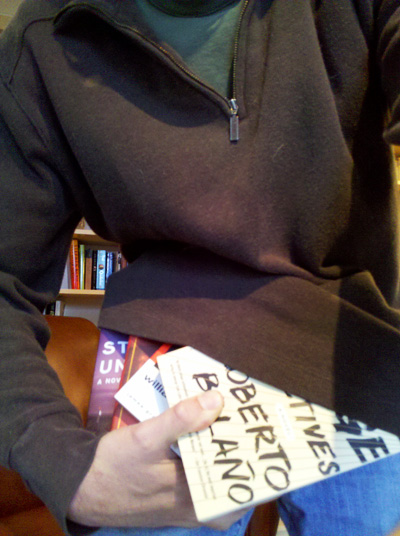
But stealing books is a real talent. You need a big army jacket that has lots of giant pockets inside and out. It’s best to steal them from large grocery and discount stores. eBooks are too easy to steal and you never really know what’s waiting for you on the other end of a download link anyway. The photo is of me demonstrating my own book-stealing technique. I have amassed quite the respectable library this way. But I never lend books out because they seldom make their way back home.
Here is an effort by a New York Times writer to answer the question of whether stealing ebooks is ethical or not if you’ve already bought the hardback.
But here’s a better piece at The Millions about an eBook pirate who’s pretty clear about what he likes.
Also, if you want to see how stealing books actually improves the world and culture, read The Savage Detectives by Roberto Bolaño.

Graphic Novel: It Was the War of the Trenches
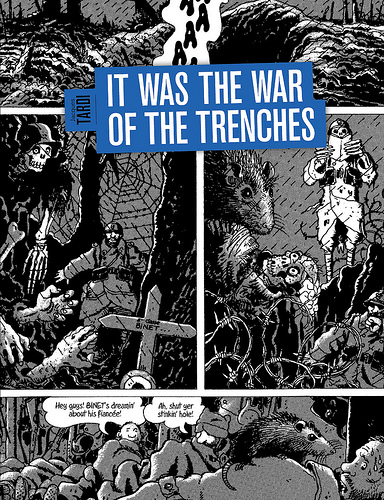 It Was the War of the Trenches, by Jacques Tardi, is available in English for the first time.

The graphic novel depicts the life of the average soldier in the trenches of World War I. The artwork looks gorgeous and the story is apparently quite harrowing. A nice big hardcover version seems the perfect presentation.
Here are more photos of the book.
Reality Hunger: I Think David Shields Missed the Joke
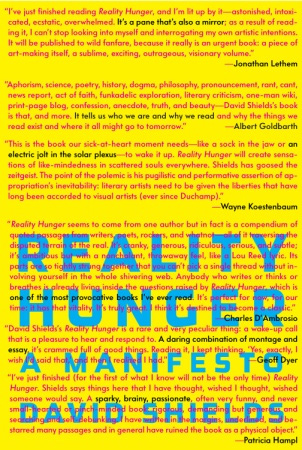 I finished it a couple of weeks ago. Reality Hunger: A Manifesto by David Shields is a fascinating read most of the time. Some quotations are simply better than others. I have my favorites. Hemingway gets quoted for his: “The most essential gift for a good writer is a built-in, shock-proof shit detector.”
What might Ernest have meant by that? Did he mean that a writer should be writing what he/she knows? Writing from reality? David Shields seems to think so. He puts this quote in the chapter called ‘Reality.’ But I don’t know. I think the inclusion of this quote is a weak pin in the framework of Reality Hunger. I don’t think Hemingway had any concern whatsoever with reality. I don’t think Hemingway’s ‘shit’ equals ‘fiction’ or ‘made-up.’ I think Hemingway’s ‘shit’ equals shit. My shit-detector is going off and it’s pointing in Mr. Shields’ direction.
His book pinpoints the weakness of fictional form in today’s reality-obsessed culture. The more real we get in our art, the more real our art will be. We see it all around us, this fixation on reality shows and data and news and of-the-moment information. We want people to write memoirs more than we want them to write fantasies with fictional characters running around dragging us through the usual plot structures of the worn-out novel form.
I’d believe David Shields if he’d tell more lies. His book is a big collection of quotations from writers, artists, philosophers, academics, photographers, and filmmakers through history. The quotations lead us ever closer to the general idea that the observation and reporting of reality in and of itself creates all the fiction we really need. The pulling together of various shards and bits of reality and observation build art and culture. To hold a memoir writer hostage to absolute truth is futile and ridiculous because the writer’s job is simply to write.
But I think I’d prefer the book if, having read it to the end and found the appendix with all the sources of the book’s quotations listed, I then could go on to discover that every single one of the quotations was in fact… fake.
The book should have been an absolutely made-up total fake because that would be really real.
Reality Hunger: A Manifesto
I haven’t finished it yet. But Reality Hunger: A Manifesto by David Shields is making me forget to eat my food. That’s how good it is. I’m sitting there in my local restaurants trying my best to finish my Pasta Siciliana, but I’m staring at my Kindle screen and almost jumping out of my chair with ideas. That’s what this book is for. It was written to light a fire underneath the bottom of an artist.

Don’t be afraid of stealing. Just do it.
David Shields is a thief and he’s the happiest most energetic thief you’ll ever meet between to covers. All art is theft. We build all our original creations on top of other creations. We consume and then we spit the pieces back out in exploding new arrangements. We appropriate all the time when we incorporate bits of newsprint into paintings, or street sounds into symphonies, or quotes into novels.
Novels. What are they and what do they really do? Do we need or want novels anymore? Fiction? Or do we want the more real? Are we craving more and more reality? It’s on TV everywhere. Can the old form of the novel that describes scenes so well and gets into the characters’ heads really compete with all the new forms coming to life that are built primarily upon reality?
What is reality? Whose reality? Isn’t one’s perception of a simple street scene actually fiction once it passes through the subjective filter? Isn’t everything ultimately fiction?
Shields’s book is composed of many fragments mostly snatched from other people throughout history. Shields leaves his own remarks unannounced until the back of the book where he finally credits his sources. The point is to connect thoughts from all over the world through many ages to gradually build up a central argument or ‘manifesto’ for a modern art or literature that eliminates the guilt from borrowing or ‘stealing.’ The ideas are obviously not all new, otherwise there would be no fragments to put in the book. But the expression of the ideas in this way is new. Reality Hunger is a jolt and it will offend as many or more people than it inspires.
Several years ago Bob Dylan got into hot water for using a phrase from a relatively unknown novel. Sure enough, Dylan’s phrase did match the novelist’s. Outrage ensued. When the novelist was asked about his feelings he stated that if Bob Dylan wanted to use one of his phrases he was simply honored.
This book is very timely in a world where people are getting into lawsuits because some artist’s sculpture appears in a street photo. We’ve been waiting for this book. Fortunately, Mr. Shields is as excited about this book as his readers are – those who aren’t outraged anyway. He comes off as a very energetic and enthusiastic partner to the artist. I admire this book a great deal and will most likely be referring to bits and pieces of it for many years – and stealing them.
The Nature of the Book
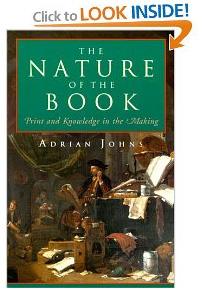 I sat down with my Kindle e-reader on Saturday morning to read the Los Angeles Times. There was an article about an L.A. used bookstore called Iliad Books. Sounded nice. So I went. What should I find but a section of books about books and publishing. There was a copy of The Nature of the Book: Print and Knowledge in the Making by Adrian Johns. The author’s main thrust is to examine how books in early modern England influenced and largely caused the development of the modern scientific method and the general acquisition and spread of knowledge. He wonders why readers assume that books are accurate and fixed. This is an interesting inquiry in light of the recent changes in publishing which involve ever-changeable electronic publishing and web postings. The history of the effort to make books fixed and true representations of their authors’ intentions and ideas is a fascinating one. It includes an analysis of widespread piracy that dogged publishers of books from the very beginnings of printed material.

Thinking about the nature of books and their history, along with the underworld of book manipulation, piracy, copyright, and the conveying of knowledge is essential as publishing undergoes its greatest changes since the beginnings of the printed page.
Kindles and Little Bookstores
I don’t understand much about the book business. But I do know what makes a person want to go and be somewhere. I read a good blog post at The Devil’s Accountant about the troubles small bookstores have with the existing book business and the emerging business of ebook publishing. Small bookstores have to purchase books at wholesale for too much money and can’t make enough profit when they sell at retail. That’s true. But most movie theaters can’t make much money selling tickets either. They sell candy and sodas at big markups to make good money. In fact, there’s no such thing as the ‘movie business.’ There’s only a candy selling business that uses movies to bring you up to the candy counter.
An important point I’d also like to make about independent and small bookstores is that most of them really suck. Seriously. Most small bookstores are just a modest room full of books on poorly built shelves. Dead boring. Nothing puts me to sleep faster than a crappy independent bookstore. Good riddance to them. Most independent bookstores can’t hold a candle to any Barnes & Noble or a Borders. Don’t open a bookstore if all you want to do is sell books. You’re an idiot if you do. And I won’t give you my money. I’ll give it to Amazon. They are not boring. They are smart and interesting. I enjoy watching them slaughter dull little bookshop owners every single day. It’s a fascinating and wonderful bloodbath. These booksellers are being eaten by lions and their screams are rare amusement.
Reading On a Kindle Is a Pleasure
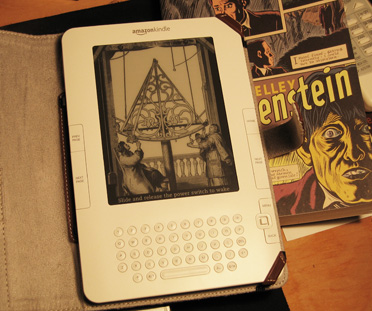 After two years of reading reviews, watching products come out and compete, listening to people gripe about DRM and ebook pricing, I jumped directly into the fray and opted for the Kindle from Amazon.
Gustaf Tenggren and the Classic Golden Book Style
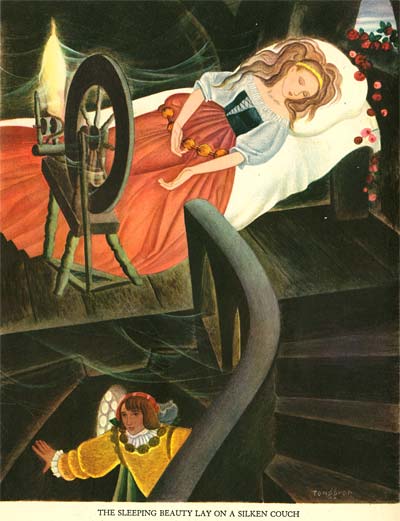
Sleeping Beauty by Gustaf Tenggren
Stephen Worth of the ASIFA-Hollywood Animation Archive has an excellent post about how Gustaf Tenggren developed illustrations techniques that led directly to the classic Golden Book style of illustration.
Watch a Book Being Made
Here’s a stop-motion film about the making of a book called The Complex of All These. It was made at the Women’s Studio Workshop in Rosendale, New York and consists of 3,000 photographs taken over a 2-month period.
Via Dangerous Minds
Remember the Book?
 Remember the book? Of course you do, because you have plenty of them in shelves, half-read, dusty, bent, torn, coffee-stained, wine-colored, smudged, smelly, misprinted, broken and cherished. They catch your glance as you walk from one room to another, reminding you of a year or a moment when you were doing something else but had that book in your bag or backseat and meant to finish it or did in fact, and put it away and moved it several times in a box, cursing its weight and trying not to bend it. So there it sits now, quite possibly closed until the day you die. But you know it’s there and it’s a marker in your life. Remember this thing with books?
And LPs of vinyl? Mine used to function like books in my shelf. But I put them into a closet years ago because of CDs. Now I can’t stand searching a shelf of CDs, so I mainly use MP3 files. My albums no longer work as markers of life and time. The same thing is happening to books. All of mine are still on the shelves. But the world is changing and books are beginning to look a lot like information that wants to weigh less. It doesn’t matter how one feels about this, whether it makes us sad or not. It’s a creeping fact. Our books are turning into wonderful collector’s items. I can tell this is happening partly from all the excitement and business surrounding these e-reader devices. Books will continue to play an important role in literature but they will gradually be eclipsed by some other technology. The current e-readers are not necessarily it, but they are the harbingers of things to come. We are lightening our load because we can’t carry it around forever. We’ll have to travel light. Walt Whitman wouldn’t mind though, because he’d want to travel with us.
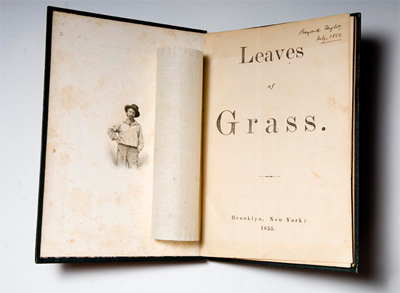
But this fellow, Raymond Danowski, has amassed the largest collection of 20th Century English poetry books in the world. He collected over 70,000 books, periodicals, and artifacts. The collection includes a first edition of Whitman’s Leaves of Grass, printed by the poet himself. It also has a first edition of T.S. Eliot’s Prufrock and Other Observations. There are so many books that when he donated the entire collection to Emory University in Atlanta, it took volunteers over a year just to unbox all the volumes. The university is now the major center for researching 20th Century English poetry books.
I’d like to see that collection. It must be fascinating. And anything is worth touching that Walt Whitman touched. Seeing books is the thing. They have a presence in a room, lining its walls and giving it enormous depth. But we are engaged in a process of making our books invisible. What will we put in their place? I’m not really too worried about that because when you turn all those words into digital form you present yourself with infinite possibility. When words float around in the air you are in the realm of magic beyond anything any book could have ever accomplished. Then again, sometimes just touching a book is enough to send your mind wandering down an unexpected path. Can touching a virtual keyboard have the same effect? Does it have to have the same effect? Maybe not. I’m sure banging a chisel into a clay tablet did things to a mind that ancient peoples were loath to part with.
Does the emergence of a world without books frighten or worry you? Do you see something wrong with a world in which literature is simply information that travels wirelessly? Do you think that ink is inherently superior to bits?
Eventually, we will read War and Peace by passing someone on the street and glancing into their eyes for a brief moment. That person will give us the book as nothing more than a polite ‘How do you do?’ At that point, we will remember books the way we remember the clay tablet.
Publishers Doomed by Predatory Book Pricing? So what?
John Grisham on NBC’s Today Show discusses his new book, writing novels versus short stories, and so-called predatory book pricing by large retailers like Walmart, Target and Amazon.com. I like Grisham in this interview. He’s a good interview and he seems sharp. He talks about how it’s much more difficult to fix a problem in the middle of writing a novel than to do so with a short story. So he advises writers to ‘not have a problem.’ The trick is to thoroughly outline your entire novel before you even start to write it so that you know every single thing that happens along the way. Pretty sound advice in most cases. Not all. Some of the greatest novels in the world were written by writers who had absolutely no idea where the novel was going from page one. It depends on what kind of book you’re writing. I think his advice is perfectly good for most books that are intended for sale in a grocery store. Certainly. But writers should never listen to famous writers. They’re full of crap. You write what makes you sweat and drink lots of coffee late into the night and bang your fingers on your keyboard until they hurt. Or not. Whatever. I hate outlines. Especially in word processors. Awful things. They destroy good minds and belong mostly in PowerPoint presentations for corporate managers. I’m not sure what the hell Grisham is talking about quite frankly. But then again, I’m not selling thrillers in the grocery store either.
But what mainly interests me in this interview is the discussion about ‘predatory pricing’ by the giant retailers. Apparently, if you listen to publishers, this spells doom for publishing and book selling as we know it. When asked what he thinks about his latest book being available for nine dollars at Target, Grisham says:
It’s shortsighted. Short term, they know what they are doing, I think. But if a book is worth $10 then suddenly the whole industry is going to change. You are going to lose publishers and book stores, and though I’ll probably be alright, aspiring authors are going to find it difficult to get published.
Yeah? So what. So we lose publishers and book stores. Who cares? The key in Grisham’s statement is where he says, ‘…and though I’ll probably be alright.’ He means writers will be alright. The big scary fact of the matter is that we simply don’t give a tiny damn whether or not a publisher prints a book or an author does. Publishers read, accept, edit, design, print and promote books. At least they used to. I don’t care what anyone tells you, but we do not need the editors. Writers can do that. You write the book and you edit it and you’re done with it. Readers are getting used to reading writers without editors. That’s why blogs are so popular. No editors. If you have an editor poking around in a blog, trust me, it’s not a blog. It’s a corporate front-end. A writer can also design and print a book. And sell it. Writers are publishers. No reader cares about Penguin. They care about the guy holding the gun. The guy holding the gun is put there by the writer. Writers will make guys, guns and gals forever. It’s what they do and it’s what readers want.
I don’t care if the guy with the gun says, ‘I’ve been looking for you for a long time, Mr. Peabody. Smile, because it’s the last thing you’ll ever do.’ Or if he says, ‘I’ve been looking for you. Smile. It’s your last.’
The writer can pick. The editor can go watch Kitchen Nightmares.
There is absolutely no excuse for a writer to work hard on a story, hammering it into existence from nothing, polishing it and making it exactly what he or she wants it to be… and then sit around to wait for some agent or publisher to get back via the U.S. mail so that said writer can be allowed to move on and send out yet another plea for acceptance. This is old technology. Twentieth century. It’s gone. In this century a writer writes and edits and publishes and sells. His book can sell in Target for nine dollars or three dollars. Magnificent. Literature available to people who don’t make lots of money. What a novel idea! If you’re griping about Target selling books for nine dollars, you must not be buying books. Go watch His Girl Friday and pretend that typewriters still make newspapers.
And you know something else? The guy with the gun doesn’t care. He’ll always be there. He’s not going anywhere. All the publishers and book stores could burn and all the editors could go to their early graves, and you know what? The guy with the gun is still gonna getcha. He’s going to find you wherever you go. He’s alive.
Problem With Nook eBook Reader?
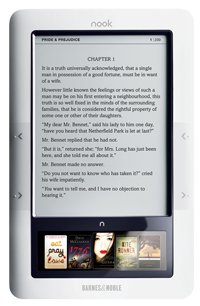 I’m looking at this new e-reader from Barnes & Noble called the nook and I’m a little worried. It’s that split screen. The top is an e-Ink display for reading your books. But the bottom is a color LCD. Look at that picture. I don’t know about most readers, but I certainly don’t want that row of book covers staring me in the face as I read. Can one totally black that screen out while reading? What else shows up in there? Ads? Does anything move around to distract the reader?
I don’t know about this nook thing. I’ve got doubts.
Book: The Vampire Archives
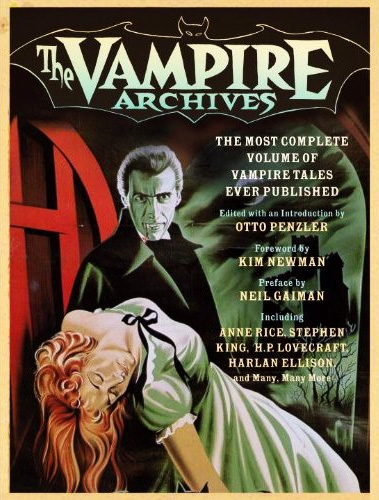 On Friday evening I went into Hollywood looking for monsters. I found some really bad ones. They’re inside The Vampire Archives, an enormous volume of vampire stories edited by Otto Penzler and published by Vintage Crime.
The book is organized into sections like Pre-Dracula, which holds gems like Good Lady Ducayne by English writer M.E. Braddon, Carmilla by Sheridan Le Fanu, and Ligeia, by Edgar Allen Poe.
Another section is That’s Poetic, with works by John Keats, Lord Byron and Johann Wolfgang Von Goethe.
The final section is Modern Masters, with stories by Ray Bradbury, Peter Tremayne and Brian Lumley.
The book finishes with what is advertised as the most comprehensive bibliography of vampire fiction ever assembled. And it certainly goes on for many pages.
The book is a big fat heavy pulpy treasure and I dug right into it as soon as I got home. This thing will put you in right good shape for the approaching Halloween day of terror and magic.
And let me stick my thumb into the eyes of literary bloggers everywhere who can’t write about a book and link to its purchase page without sadly trying to make 14 cents off the deal, I am going to pull an unexpected sleight of hand trick and link to this fantastic book without making a single pathetic penny.
Next time I see some jackass literary blogger link to a book as an ‘Amazon Associate’ I’m a gonna send that hungry fool 14 cents so they can go buy a Big Mac.
Science Fiction Story Anthology from Starship Sofa
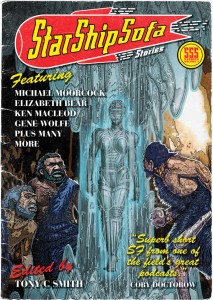 The wonderful science fiction podcasting site, Starship Sofa, in celebration of its 100th episode, has published its first collection of stories as a book. Not just an ordinary book. It’s a book filled with fantastic illustrations and gorgeous layout that hearkens back to the pulp publications of the 1930s through 1950s. It even has vintage advertisements!
The best part is that you can either buy the book or read it as a free ebook in an excellent ebook viewer.
Some of the authors featured are Michael Moorcock, Alastair Reynolds, Ken Scholes, Ruth Nestvold, Elizabeth Bear, and more.