CNN has a live blog following the quake and tsunami.
The Huffington Post has live coverage.
Here is how you can donate to the Red Cross Japan Earthquake effort.
CNN has a live blog following the quake and tsunami.
The Huffington Post has live coverage.
Here is how you can donate to the Red Cross Japan Earthquake effort.
Czech animator Karel Zeman made this film almost entirely with glass in 1948. A glass blower finds inspiration inside an imaginary water drop.
Mature Content:
This is a 1980 film starring American artist Jean Michel Basquiat. It follows him around and through the downtown New York art and music scene, presenting real people and events in a barely fictionalized semi-documentary. It’s a fascinating look into the world of 1980 New York and the quickly rising star painter who was to pass away in 1988. It’s a glimpse of a New York just a few years before it was bombed by The Gap. It was directed by Edo Bertoglio.
You can stare straight into the open face of Basquiat and find more mystery than Banksy could conjure with a black velvet cloak, top hat and a mask.
Here’s a humorous tribute to the Universal horror films of old. It was directed by Ricky Lewis Jr. and features a forest, an inn, Frankenstein, Red Riding Hood, an invisible man, vampires, fog and various comedic chills. The production has a large cast who give themselves over entirely to the mood of the piece. There’s a nice underground vibe to the proceedings and the effects are surprisingly good.
I loathe geek culture. Its practitioners and reporters consistently talk about pixel art and steampunk. But removing the pixel art from their smartypants realm and into the realm of the artist does have its merits. It seems useful to at least consider what small blocks of light have to offer.
Picasso, Matisse, Cezanne, Chagall, Braque, Warhol, Rothko, Kandinsky, de Kooning, Motherwell, Nevelson, Pollock, Miro, Duchamp, Calder, Ernst, Richter, Beuys, Giocometti, Klee, and on. Hosted by Orson Welles. Directed by Herbert Kline. It’s great because there are so many of the artists speaking for themselves.
A ravishing beauty from Iran! Look at this mysterious and subtle film by director Samira Eskandarfar. Her figures drift through time and space in a stage setting that seems open-ended and universal. The underlying themes and messages are probably far more complex than I can ascertain without a proper understanding of Iranian culture. But the film stands as a mysterious and slightly harrowing glimpse into the progress of attraction, love and communication between individuals. The characters, played by Kazem Sayahi Saharkhiz and Faranak Miri, engage in mundane conversation, offer each other drinks, smoke cigarettes, make eyes at each other, play music on a tape recorder and disappoint each other in all the little ways of a normal life. But they seem symbolic of something greater and perhaps very much to do with the filmmaker’s Iran. There are some amazing artists working with enormous expressive power in Iran. Samira Eskandarfar is one of them.
By the way, the filmmaker is also a painter.
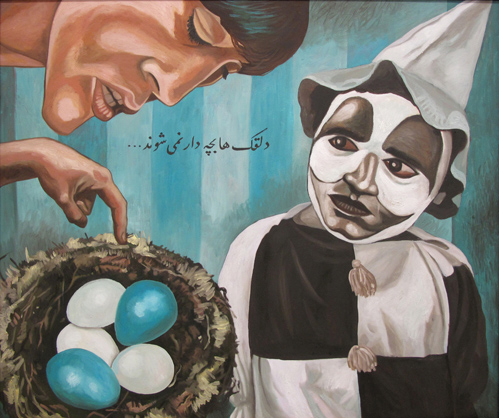
Visit the filmmaker’s web site.
Filled with different art styles, as if an artist went on a trip and tried new things with each page in a sketch book. This film, directed by Bastien Dubois, was nominated for a 2010 Academy Award.
This 1954 RKO Radio Pictures film was based on Engelbert Humperdink’s opera and directed by Michael Myerberg. Be warned: the actress who plays Gretel gives what is possibly the single worst vocal performance in the history of animated films!
The film takes its name from a neighborhood in Paris. It was directed by Dimitri Kirsanoff and is considered to be his greatest work. It moves very quickly, using a montage technique that tells the story without a single intertitle. It’s a riveting and powerful tale of disillusionment and violence. The lead actress is wonderful and has some of the best eyes for silent film I’ve ever seen.
Chris Koelsch made this slyly humorous space tale by appropriating footage from an old sixties science fiction cartoon called Space Angel. He put the footage to his own wise uses and came up with something memorable.
Philip Brett’s short film is an unsettling hybrid of puppets and animation. It’s dollhouse weird, full of shadows and garish colors, blood and clowns. Horrific. It’s based on the tales of naughty children by Heinrich Hoffman. The music is by the Vendetta Orchestra.
Canadian experimental filmmaker Heidi Phillips made this little ghost story film that could almost as easily be called a memory film. Mike Everleth over at Bad Lit: The Journal of Underground Film has some good comments in his review of the film.
‘It ain’t about being the best. It’s about being multiple.’ Marvin Tiberious makes the best films about street art that I have seen from anywhere in the world.
Kirby Ferguson continues his Everything is a Remix series by showing us how many of our most cherished and familiar films combine elements taken from or inspired by other films to create their seemingly unique experiences. Sometimes, shots are reproduced almost exactly. Yet, the movie industry is extremely aggressive in prosecuting or suing anyone who tries to use their material.