On Reading Thomas Pynchon’s Gravity’s Rainbow – Part 1

Every word in Thomas Pynchon’s deranged dance macabre, ‘Gravity’s Rainbow,’ seems, like HTML, to link out to some other subject. The book seems for me to exist in-between worlds, barely attached to this one while trying desperately to connect us with another fuzzily glimpsed, just-hinted, vague world, suggested by pure chance connections between ideas and events here on a fractured and demented earth. I’m barely one hundred and sixty-five pages into this book and I’m reacting for it and against it in nearly equal measure. It’s a goddamn blast. It’s also a motherfucking bitch. Every page of it so far mentions some kind of rocket trajectory, launch pad, descent, explosion or blast of light. Everyone in the book seems to be living out one debauchery or another while all the time expecting to be blown away in bits, perhaps even looking forward to it. Death, for Pynchon, seems on the surface like fun. The book almost makes a mockery of dark humor, of dying. It’s as if Pynchon wants to give the finger straight into the yawning mouth of death’s favorite century.

Things I notice so far about the book: Rockets of course. Everywhere and in every mind of the characters. It’s all about predicting bomb hits and finding the rockets. People want to understand how one of the characters can possibly manage to have sex in various locations just prior to those spots being bombed into oblivion by German V-2 rockets. The books seethes with sexual excitement that’s a death-wish. I also notice that Pynchon is associating Hansel & Gretel, the forest and the witch’s oven with Germany and the events of World War II. The Holocaust is looming over this book on every page. There are constant mentions of cause and effect, how it operates and whether it might be possible to break out of its logic. Can a rocket attack be sensed before it even hits? Psychological early warning system. Brain radar. Statistical analysis for making predictions.

Imagine a missile one hears approaching only after it explodes. The reversal! A piece of time neatly snipped out…a few feet of film run backwards…the blast of the rocket, fallen faster than sound–then growing out of it the roar of its own fall, catching up to what’s already death and burning…a ghost in the sky…

Quite a few references to film in this book so far up to page one hundred and sixty-five.

What could be more paranoid than a constant worry about bomb rockets? The book seems like a grotesque exaggeration at first. But that’s the joke I think. It’s actually an understatement and proves paranoia to be the most well-placed and logical mental operation in a century during which people were dug into trenches and told to march toward each other like polite firing squads. A century in which men marched millions of people into gas chambers and pushed them through ovens. A century in which entire cities were blown off the face of the planet while the citizens were out shopping for groceries. Pynchon seems like an author who is not afraid of any of it. He’s like a guy laughing at the scene of a traffic accident. Or photographing it like Warhol did. And the book’s laugh-in-a-sort-of-half-shocked-way funny. Here’s a bit from a funny scene where a guy visits a nurse he wants to sleep with but must endure a lengthy sit-down with an older woman patient who wants to share her candy:

Under its tamarind glaze, the Mills bomb turns out to be luscious pepsin-flavored nougat, chock-full of tangy candied cubeb berries, and a chewy camphor-gum center. It is unspeakably awful. Slothrop’s head begins to reel with camphor fumes, his eyes are running, his tongue’s a hopeless holocaust. Cubeb? He used to smoke that stuff. “Poisoned…” he is able to croak.

“Show a little backbone,” advises Mrs. Quoad.

“Yes,” Darlene through tongue-softened sheets of caramel, “don’t you know there’s a war on? Here now love, open your mouth?”

It’s funny, no? But it should also set off sparks off recognition in your head that link up with gas chambers. You just can’t trust Pynchon to be genuinely funny. He’s watching you laugh and getting ready to slit your careless throat. No wonder Pynchon uses a secret identity. He’s dangerous. He seems slightly criminal. This guy loves conspiracies. He must have some really excellent ideas about who killed Kennedy. I mean he’d probably say Oswald did it, but it’s why Oswald thought he was doing that makes it interesting.

I love it when authors hide their identities. Pynchon has been effectively doing this for about fifty years now. This reminds me, as all secret identities do, of Batman.
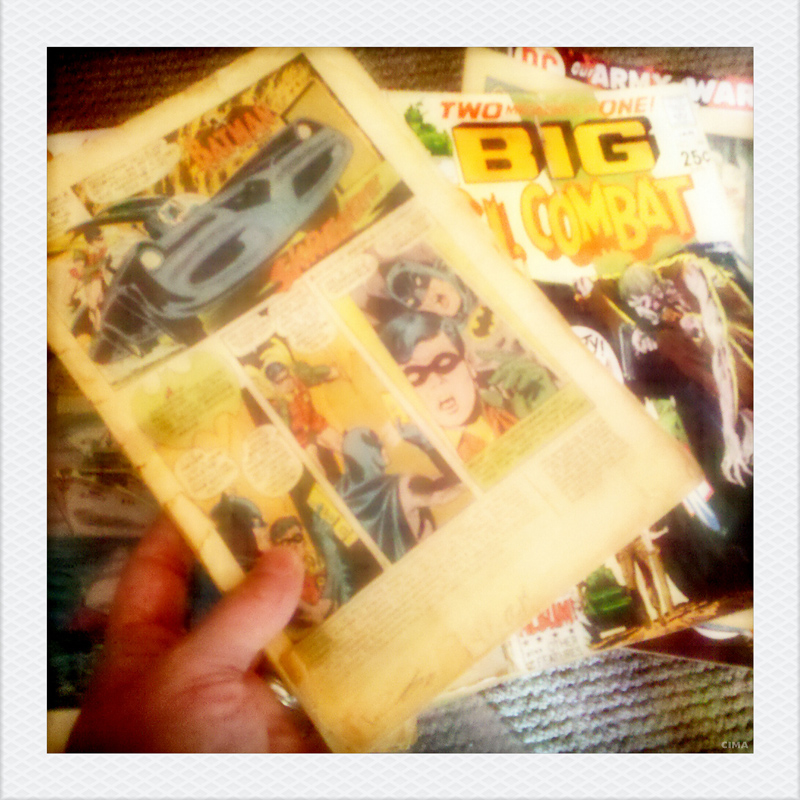
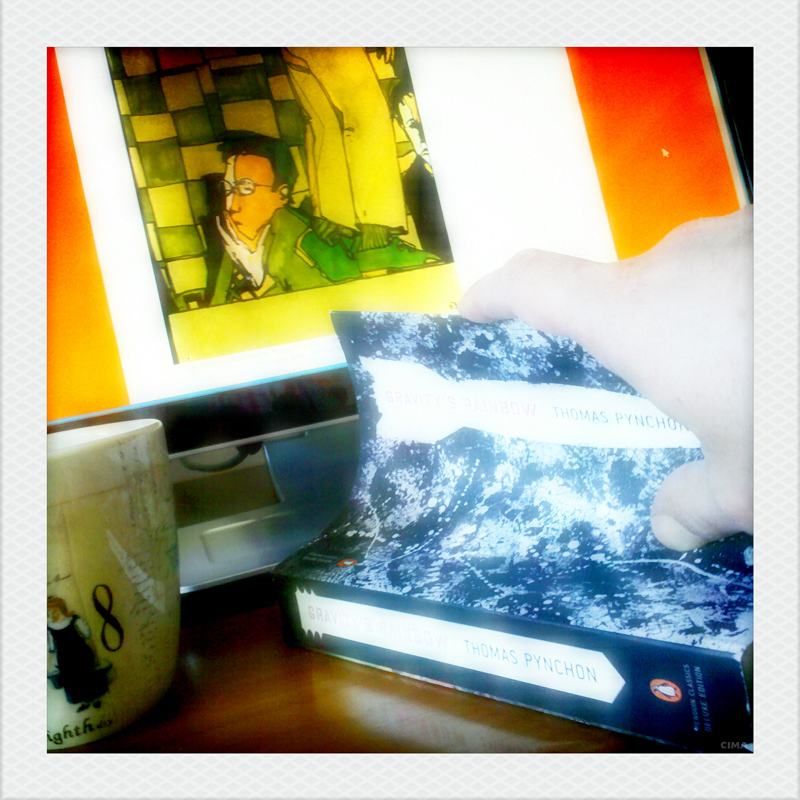
Here’s my ancient and torn copy of a Batman giant issue from 1969. Down in the lower margin there I wrote ‘fuck.’ I’m not sure why I would have done something so charming to a Batman comic. I must have been practicing my favorite words or something. What does an old comic book have to do with Pynchon? I don’t really know but it seems to fit. In fact, comic artist Frank Miller did the cover for the recent Penguin edition of Gravity’s Rainbow. That’s the copy of the book in the first photograph above. Behind the book in that photo is a computer screen showing a drawing by artist Zak Smith who did a thing he called ‘Illustrations for Each Page of Gravity’s Rainbow.’ It’s been shown at the Whitney Museum and you can buy it in book form.

It’s strange how much I’m enjoying this book because I hated ‘Ulysses’ by James Joyce. I think Pynchon snagged some stuff from Joyce. He even resorts to script format for some portions of the book the way Joyce did. But I only like the first part of Ulysses which takes place on top of a tower and has a character shaving. I also enjoy the part about Bloom in the park watching the girl’s underpants. But that book suggests to me that Joyce was mentally ill. With Pynchon I get the feeling that the world and everyone in it is mentally ill.

There’s also a definite connection between Pynchon and William S. Burroughs. In fact I wouldn’t be surprised if they were the same person. But that’s impossible. They both like secret organizations of scientists or researchers though. They share this fascination with science gone crazy and used to control minds – populations. But Pynchon is a better writer – less concerned with gimmicks. His language is a constant beauty which is the great antidote to his hilariously murderous world view. His entertaining and wildly connecting sentences indicate to me that Thomas Pynchon is an optimist. But, as with Joyce, I find myself constantly shutting the book and wondering, ‘How did he do it?’ How for fuck’s name did this guy not only maintain a secret identity but accumulate so much esoteric knowledge in the late sixties so as to be able to jam-pack every single sentence in the bloody book with some reference or other to some event or other that no sane person would ever have heard of in a lifetime? What the hell is going on in this man’s mind that allowed him to achieve Google knowledge density in 1973?

For all the good it might do anyone, I’ll keep reading the book and make a few more posts about it. I tend to relate work like Pynchon’s to my own video work. It’s something to do with the density of thought and imagery. It’s always good to read solid evidence of someone being crazier than you are so that you can get down and work at your own stuff with a little less embarrassment.
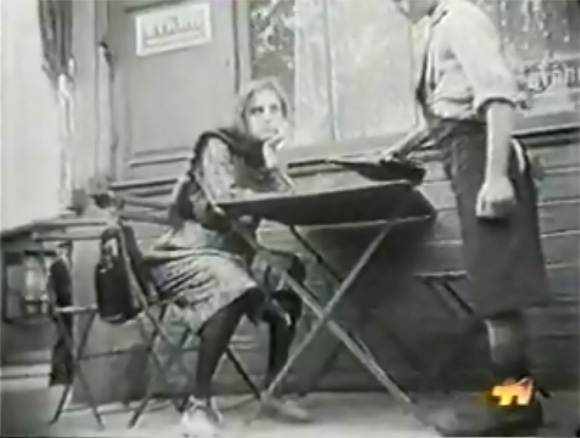
Celles Qui S’En Font: 1928 Short Film by Germaine Dulac

Germaine Dulac was one of the original French film ‘auteurs.’ She was also a film theorist and feminist. She had a relatively short career as an avant-garde filmmaker, making such works as ‘The Smiling Madam Beaudet (1923) and ‘The Seashell and the Clergyman’ (1928) which is often credited as being the first Surrealist film.

In this film, the title translated as ‘Those Who Make Themselves,’ we follow a destitute drunk woman who appears to yearn for the life of a prostitute or to engage in some sort of tryst. It is also possible that she is simply despondent over rejection by a lover. She appears to fail at everything she tries and eventually walks down a staircase into the Seine river. It’s a very simple film that manages to convey a deep sense of loneliness.

Dulac insisted on being credited as the author of her films, not accepting the standard partnership between a screenwriter and director.

Here’s a 1923 quote from Dulac:

I believe that cinematographic work must come out of a shock of sensibility, of a vision of one being who can only express himself in the cinema. The director must be a screenwriter or the screenwriter a director. Like all other arts, cinema comes from a sensible emotion … To be worth something and “bring” something, this emotion must come from one source only. The screenwriter that “feels” his idea must be able to stage it. From this, the technique follows.

Here’s a Senses of Cinema article on Germaine Dulac entitled ‘The Importance of Being a Film Author: Germaine Dulac and Female Authorship.’

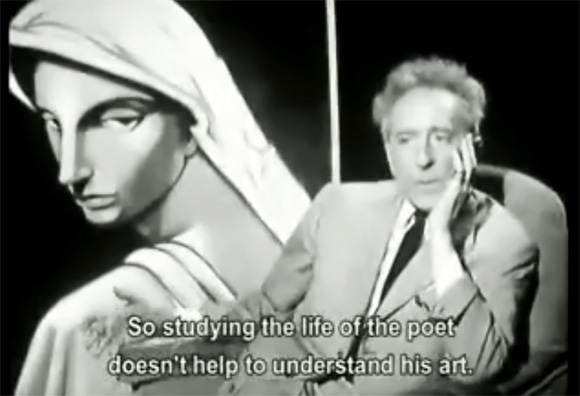
Jean Cocteau – Lies and Truths: 1996 French Documentary


This is a 1996 documentary by Noël Simsolo, featuring many interviews with Jean Cocteau himself, Jean-Luc Godard and actor Jean Marais. The great French director of films like ‘Blood of a Poet,’ ‘Orpheus,’ and ‘Beauty and the Beast,’ was also an essayist, poet, artist, and playwright. When I was a kid I read the book he wrote about filming ‘Beauty and the Beast.’ I understood little of it except that there was the general impression of someone working against constant hardship to attain a mysterious something. The book detailed his struggles with the subtleties of light, weather and performance in the pursuit of a mysterious quality that must be present in the fairytale. I knew that his efforts had worked because I had seen the film on television and understood that it was simply the most convincing fairytale I had ever seen. Another film with this totally mysterious quality is ‘Orpheus,’ which is Cocteau’s modern version of the Greek myth in which the great musician/poet descends into the underworld to bring his wife back to the world of the living. Cocteau’s telling of the tale is at once ancient and modern, always mysterious and always trying to get close to poetry. Whenever I see that film I feel that I am seeing an important picture of French artistic life in the late 1940s told through the prism of ancient Greek myth. The film sits in that fascinating period of artistic ferment and dawning of a new cinematic movement that was a reaction to the end of World War II. Possibilities in films of that period seem limitless. There is a calmness of the image, an almost casual approach to creating scenes. Things are becoming more fluid and less studio-bound. Films are beginning to lean toward poetry and art.

Even though I never really understood what was being said in the ‘Orpheus’ film, it is probably one of the most important influences on the little bits of work that I do in film and video. Various images and scenes from ‘Orpheus’ regularly pop into my head as I work.

One of the best things I think an artist can learn from looking at Jean Cocteau is to follow one’s own interests without worrying about being unqualified – pretending can eventually get you where you want to go if you do it absolutely.

Continue reading

A Colour Box: 1935 Abstract Direct Paint on Film Animation by Len Lye

Len Lye’s 1935 film, ‘A Colour Box,’ was made by painting and applying dye directly to the film surface. It is apparently the first direct paint film to gain a general public release and has been widely seen ever since. The film is an odd way to advertise for cheap parcel post and this message starts popping up near the end. The cheerfully infectious music is ‘La Belle Créole’ by Don Baretto and his Cuban Orchestra. Lye’s work must have been hugely influential for the later work of direct paint filmmaker Stan Brakhage.

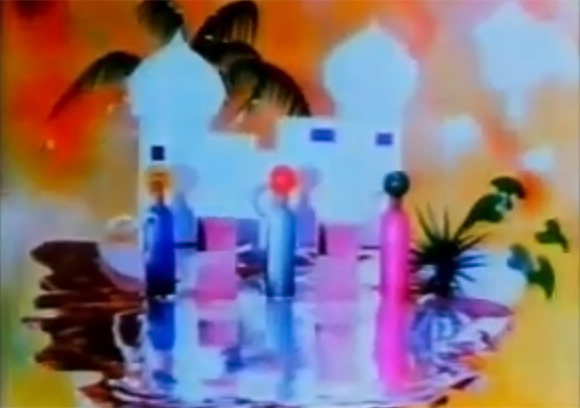
The Birth of the Robot: 1936 Experimental Advertising Film by Len Lye for Shell Oil Company


In 1936, experimental filmmaker Len Lye made this short surreal animation to advertise the benefits of Shell oil for lubricating things. The film is a hyper-saturated stop-motion extravaganza that involves a mechanical world turning on some sort of hand crank. There’s an adventurer driving around the sands of Egypt. His car winds down and konks out leaving the man dead in the desert. The angel of oil rains drops of lubricating crude down on the Egyptian landscape bringing the parched skeleton to life as the Shell Oil robot. Fascinating. It’s got that awkward, shiny, naive beauty that could only be achieved in the 30s. Parts of this thing look like they might be influenced by Salvador Dali’s work. Something about that dead skeleton and the desert looks like it could fit right into the Surrealist master’s paintings.

Lye was from New Zealand and worked not only as an experimental filmmaker but also in newsreels and advertising. He was a kinetic sculptor, poet, painter and a writer of essays on artistic theory and philosphy. He made a 1935 short film called ‘A Colour Box’ which was the first generally exhibited film made by painting directly on the film emulsion. It’s a brilliant experimental animation posing as an advertisement for cheaper parcel post.  I’m sure the great direct paint filmmaker Stan Brakhage must have been familiar with Lye’s work.

Here’s a gallery site with information and examples of his artwork.

7362: 1967 Experimental Film by Pat O’Neill

Patrick O’Neill is one of the Los Angeles artists currently featured in the huge citywide exhibit known as ‘Pacific Standard Time.‘ He has made many experimental films using techniques perfected with an optical printer. This film incorporates footage of oil derricks in Venice, California and nude models filmed in the artist’s studio. Its synthesizer score is by Joseph Byrd. I don’t know much about optical printers, but I do know that they allow images or films to be projected and rephotographed by a movie camera. So my guess is that one could set up multiple layers of screens and projections to film them and blend them into a single image. Optical printers were used to create special effects in Hollywood films. I think perhaps the most famous use of the printer was in the creation of the light show sequence near the end of Stanley Kubrick’s ‘2001: A Space Odyssey.’

O’Neill is one of the people who form the incredible fabric of the Los Angeles art scene post World War II. I did not know of him until I found his work through the Pacific Standard Time exhibit which is really something remarkable and I think that its effects will be felt in the art world for quite some time. Its broad scope, grouping and explanation of the Los Angeles art history and its significance cannot help but influence artists here in the city and far beyond. It’s essentially saying, ‘Look, here’s a great and fascinating body of work inspired by a city for the second half of the twentieth century. Here’s how it all happened, who the people were and what they were trying to do.’ It’s a very strong impression to make on a city. It must be a very great honor for an artist to be included in it.

O’Neill from a 1997 Millennium Film Journal interview:

I finished my first film in 1962. Then I started doing abstract or composite films. I began to use the camera as a sort of gathering device to provide elements for manipulation through re-photography. This led to 7362 which was finished in 1967. I didn’t have much knowledge about the history of the medium at that time. I’d had maybe three film classes at UCLA and beyond that the midnight screenings at the Coronet and the Cinema Theater were my education. That series at the Cinema Theater was going on from the early sixties.

The artist’s Lookout Mountain Studios has a web site.

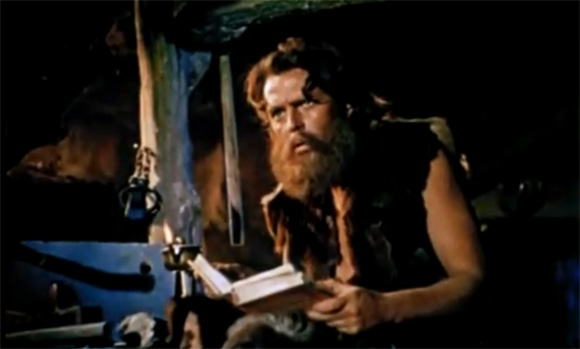
Robinson Crusoe: 1954 Feature Film Directed by Luis Buñuel

Spanish film director and original member of the Surrealist movement, Luis Buñuel, directed this version of Daniel Defoe’s ‘Robinson Crusoe‘ in 1954. It’s a very good and straightforward telling of the story with a totally convincing island locale. The Defoe novel is now more important reading than it’s ever been. That’s because it is the greatest story ever told about being alone with one’s self. All you have to do is live in Los Angeles for a while with your eyes open to understand how few people want to ever be alone with themselves. You see this problem with people very clearly when they break up with significant others and immediately slide into whatever relationship presents itself. It signifies a profound weakness of mind and character. Defoe wrote about the intricate workings of a mind alone with itself and the unexpected joys and truths one discovers in one’s self. So, read the book. It’s a tough book, full of very fine sentences and very subtle thought. Give it a try.

If you are so inclined, you can listen to the entire book right here because I sat down and read the whole thing into a microphone several years ago. But I suggest you listen now and then while making your way through the book on your own.

Here’s an article on Luis Buñuel at the Senses of Cinema site.

1964 Documentary on Spanish Surrealist Film Director Luis Buñuel


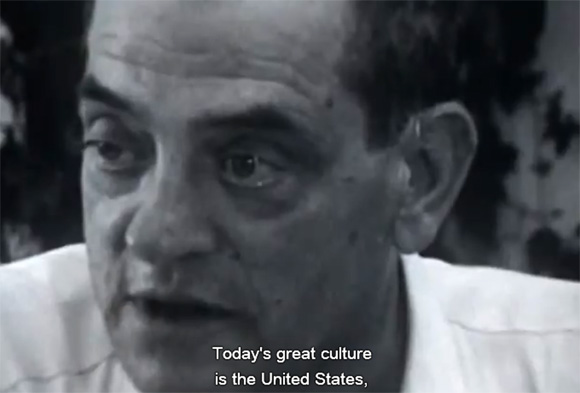
Luis Buñuel was the great Spanish film director who made ‘Un Chien Andalou’ and ‘L’Age d’Or,’ two of the original surrealist films. This documentary, directed by Robert Valey, was made in 1964. The director talks freely and with a certain charming guile about his influences, friends, paranoias, enjoyments and his impressions of various countries. He once smacked Salvadore Dali down on 5th Avenue in New York city!

I enjoy listening to people like him talk about their work because they talk about how they see things – how they interpret the world. Compare the way he talks in this film to what you normally see coming from people like Steven Spielberg or Martin Scorsese. Those people don’t seem real. They don’t seem to have any point of view. Notice how people in the film consistently associate Buñuel’s filmmaking with the work of painters. It is the continual grinding down of art into business that destroys real culture. One should immerse one’s self in better ideas and more subtle things if one wants to avoid the dullness that permeates most film work currently going on in the United States. I have found it to be a general rule that people with real talent who are artists answer questions in a slightly confusing manner. Clarity is another word for fake. Buñuel appears to me to fit this general principal.

Buñuel wrote a short and very beautiful autobiography called ‘My Last Sigh.’ I recommend it very highly if you want to know more about the mind behind Surrealist film.

And of course, here is the great Surrealist short film, ‘Un Chien Andalou,’ made by Buñuel in 1929.

The Life of an Agent: Hungarian Secret Police Training Films From 1958 – 1988


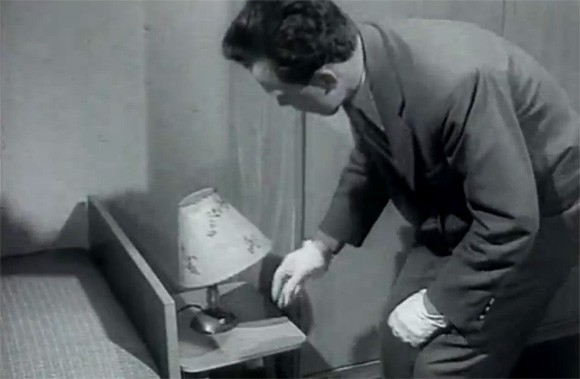
This is a 2004 film compilation by Gábor Zsigmond Papp that presents a ‘best of’ series of clips from thirty years of Hungarian secret police training films geared toward protecting the socialist regime. Subjects covered include: how to place a bug, how to film people from handbag cameras, how to follow someone, how to secretly search a home, how to recruit agents, and how to effectively network for information gathering. These are all marvelous skills for finding a job in today’s high-tech world of modern American surveillance. But I view the film from an artistic perspective and find it fascinating in its easy ability to create mood and tension with the bare minimum of cinematic effort.

Worldwide Protest as U.S. Government Threatens to Censor Internet


Today Candlelight Stories joins with other sites to protest two proposed laws in the United States, called SOPA and the PROTECT IP Act. On January 24th, the U.S. Senate will vote on the PROTECT IP Act to censor the Internet, despite opposition from the vast majority of Americans. These laws give corporations the ability to sue any web site they feel threatens their copyrights in some way. They could essentially shut down any site simply by pointing a finger. So corporations would use this power to harm smaller competitors. The U.S. government could shut down any site or blog it had the slightest problem with. Censorship as practiced in places like China would suddenly become the norm here in the United States. China is a nightmare. We don’t want to do things like they do.

A free, open, uncensored Internet is a basic and fundamental right that must be preserved here in the United States if it is to have any chance at all on a worldwide basis.

Join us to protect our rights to free speech, privacy, and prosperity.

Here’s a massive list at the Center For Democracy & Technology of organizations, companies, web sites, blogs and individuals who are opposed to the censorship bills.

At the links below you can send your protest to Congress and learn much more about these bills and how they seek to end the open Internet.

Take action by contacting Congress via the Electronic Frontier Foundation.

AmericanCensorship.org has a large selection of ways you can take action and black out your web site in protest.

Take action by contacting Congress via Google.

Das Kleine Chaos: 1966 Short Film by Rainer Werner Fassbinder


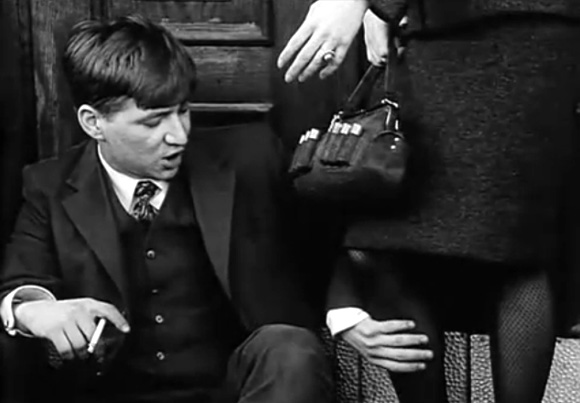
Here’s a 1966 short crime film by a young and learning Rainer Werner Fassbinder. The great and too-soon-departed German filmmaker actually plays one of the three young criminals who decide to invade a woman’s home to terrorize and rob her. The film is relentlessly cool and begins at around the 3 minute mark to really show how deeply Fassbinder was mining the work of Jean Luc Godard. Those shots in the apartment with Fassbinder reading the novel out loud in front of a wall of pinned art prints is straight up Godard stuff. But it’s just fine to imitate other filmmakers as long as your real intention is to destroy them from the inside. Fassbinder was just that kind of filmmaker.

Here’s an article about Fassbinder on the Senses of Cinema site.

Camera: A Short Film by David Cronenberg


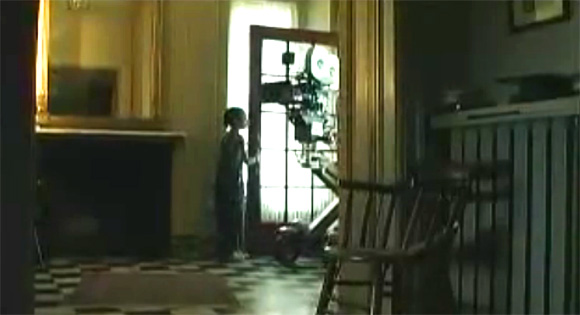
This is a short film made in 2000 for the Toronto International Film Festival by David Cronenberg. ‘Videodrome’ actor Les Carson talks about how afraid he is of the movie camera while children bring one into the house and set up to shoot their own movie with professional equipment. The actor’s fear and doubt contrast sharply with the enthusiasm of the kids. But of course they are interested in him as subject matter because they know that he is real. This is an excellent and moving study of time, creativity and how all art is an unfathomable mixture of enthusiasm and terror.

Jean Renoir’s 1928 Version of The Little Match Girl


This is a 1928 version of Hans Christian Andersen’s ‘The Little Match Girl,’ directed by French film great Jean Renoir and Jean Tédesco. The story is a simple one about the visions of a poor match girl as she freezes to death in the snow. It’s a loose adaptation that actually seems rather rigid and too involved with its sets and props to really give any feeling of the fantastic. It is also pro-forma in its pathos or portrayal of the match girl’s despair. Also, the leading actress, Catherine Hessling, is completely unappealing. Apparently, one of the toy soldiers was played by Lucia Joyce, the daughter of author James Joyce.