Podcast Novel: A Princess of Mars (Chapter 17)

DOWNLOAD MP3 AUDIO

A Princess of Mars

This is the first John Carter of Mars novel by Edgar Rice Burroughs, the author of the Tarzan books. It was his first novel, published in 1917 and it’s a work of rip-roaring science fiction that has inspired many of the great writers in the genre.

Chapter 17: John Carter, Dejah Thoris, and Sola make their escape across the Martian landscape for the city of Helium.

You can find all the previous chapters of the book here.

You’ll find regular podcasts of all the chapters over the next couple of months. Subscribe to our feed.

Duration: 00:17:43
Read by Alessandro Cima

All audio stories are Copyright © Candlelight Stories, Inc., All Rights Reserved.

Audio Podcast Novel: Pinocchio (Chapter 6)

DOWNLOAD PINOCCHIO – CHAPTER 6

Per l’Italia!  More of our story!

This is one of the great gifts from Italy to the children of the world. Carlo Collodi’s 1883 masterpiece, The Adventures of Pinocchio, is the story of the wooden marionette who desperately wants to be a real boy. His adventures are full of mischief, wonder, sadness, joy, treachery, danger and all the exuberant life of a real Italian boy. This is the English translation by Carol Della Chiesa.

Subscribe to audio podcast

Subscribe to audio with iTunes

Reading and illustration by Alessandro Cima

All audio stories are Copyright © Candlelight Stories, Inc., All Rights Reserved. Do not distribute copies of our MP3 audio or video stories. They are for your personal use. If you choose to burn our MP3 stories onto a personal CD, do not make copies of the CD or distribute them to other people. Also, do not sell CDs containing our audio stories. All audio stories are copyrighted by Candlelight Stories, Inc.

Audio Podcast Novel: Pinocchio (Chapter 5)

DOWNLOAD PINOCCHIO – CHAPTER 5

Per l’Italia!  More of our story!

This is one of the great gifts from Italy to the children of the world. Carlo Collodi’s 1883 masterpiece, The Adventures of Pinocchio, is the story of the wooden marionette who desperately wants to be a real boy. His adventures are full of mischief, wonder, sadness, joy, treachery, danger and all the exuberant life of a real Italian boy. This is the English translation by Carol Della Chiesa.

Subscribe to audio podcast

Subscribe to audio with iTunes

Reading and illustration by Alessandro Cima

All audio stories are Copyright © Candlelight Stories, Inc., All Rights Reserved. Do not distribute copies of our MP3 audio or video stories. They are for your personal use. If you choose to burn our MP3 stories onto a personal CD, do not make copies of the CD or distribute them to other people. Also, do not sell CDs containing our audio stories. All audio stories are copyrighted by Candlelight Stories, Inc.

I’m Gonna Beat You With My Poem

I’m about to show you why I have so few friends.  It’s because I don’t put up with ‘team mentality.’  Hey kids, come over here and join my poetry team!  Yeah dudes!  Get with it!  Get hip to my dang poetry team, bro!  We could win!  We could take the whole prize, sista!  Yeah, baaaaaaby!

I’m the kid eating the Twinkies, picking my nose, twirling the Frisbee on my finger and looking at you like you’ve got a gun.  That’s me.  You scare me, poetry dude.

For some reason, in our young national culture, we enjoy teaching our children to compete via talent shows of all stripes.  Since it’s National Poetry Month, the Louder Than a Bomb demo video caught my somewhat jaundiced eye.  I put up with it all the way through even though it made me squirm.  Poetry as in your face talent competition doesn’t fit my world view.

Right away the video starts out with total obnoxiousness.  The guy says, ‘We de-emphasize the competition, but you want to win!’  A-hole.  What an idiot.  Kids, remember, always run from a guy that says something like that.  Run and don’t look back.

I feel the same way about film festivals, American Idol, Dancing with the Stars and the Academy Awards.  I even feel the same way about online writing contests, though I’ve hosted them myself.  They are intended to boost traffic on a web site.  They serve no real purpose and offer no true value at all.  Contests are held to make mediocrities feel like they can hand out prizes.  A kid who is going to be a poet is going to leave by the back door every time.

Bertrand Russell on the Foolishness of Religious Belief

British philosopher Bertrand Russell on why it is foolish to ‘believe’ in something that is totally unverifiable.  I think I would have really liked this guy.  I agree with him completely.  One should simply ‘suspend judgment’ on something as unverifiable as the existence of god.  There is so much religious dogma that the world would be so much better off without.  Many people over the years wrongly interpreted this web site with its book and candle logo as having something to do with religious belief.  It has been my profound pleasure to disappoint them.  The book and candle logo actually represent the intellect expressed through creativity, along with a nice light to read by.

My view on all religions that purport to represent the word of god is quite simple:  No god has ever spoken a single word to any human being on the planet throughout all of history.  If a god had spoken, it would not have done so in a subtle or confusing manner.  A giant mouth would have appeared above Mount Everest and it would have spoken very clearly and would have left no room for any doubts whatsoever.  That should be self-evident to anyone who is not mentally deficient.

Via Dangerous Minds

WikiLeak Video Appears to Show U.S. Military Killing Without Cause

Extremely graphic video that shows killing:

WikiLeaks, an organization that releases whistle-blower information, has released a 2007 video that appears to be part of a U.S. military cover-up. It shows U.S. Apache helicopter gunship crews shooting a group of men on a sidewalk that included two Reuters journalists. They also kill innocent people who arrive to help the wounded, seriously injuring two small children in the process. We can hear the helicopter gun crews begging for clearance to fire on people who are simply talking on a street corner. After killing most of them, they then beg for permission to kill a man who stops his van to render assistance to a victim (one of the journalists, in fact) who is crawling on the sidewalk.  Even if the soldiers thought the van was in fact trying to rescue wounded insurgents, so what?  Since when and under what rules of war are medical personnel or rescuers fired upon and killed for helping the wounded?  That’s a war crime.

I cannot see anything on this video that would give any sane and rational person the slightest motive for firing a weapon.  It is clear and simple murder.

After seeing this video, I think it would have been perfectly justifiable for anyone, including an American, to have taken these helicopters down.  This makes one wonder just how many attacks against American troops might actually be perfectly justifiable self-defense.  The idea that money I’ve earned actually goes into the pockets of murderous military personnel like this crew is hard to accept.  What’s really frightening is how widespread these bad soldiers must be in our military.  After all, these gunship crews are supposed to be the cream of the crop.  These soldiers should not want to live with what they did.

I think everyone should show this video on every web site in the U.S.  And we should find the men in these helicopters and on the radios and charge them with murder.  If this is how we are fighting our wars, I want no part of it.

Jean-Luc Godard Interviews Woody Allen

Jean-Luc Godard interviews Woody Allen… sort of.  What is clear to me from watching this video is that Woody Allen is an ordinary thinker.  Jean-Luc Godard is not.  And frankly I’m not certain who is funnier.  I think this is a devastating dismantling of Mr. Allen.  It’s bordering on open mockery.  Watch how Allen looks at Godard.  He hasn’t the slightest idea what’s going on.  Every single answer Allen gives is perfectly expected and we’ve heard all of them before from a hundred other filmmakers.  Godard’s questions however, come dropping out of the bottom of a 747 that’s flying without a pilot.

Jean-Luc Godard’s New Trailer is the Entire Film!

Film director Jean-Luc Godard has made one of the sharpest comments on copyright, piracy and film advertising that I have ever seen by releasing a trailer for his upcoming new film, Socialisme, that is actually the entire film in super-fast forward for 1 minute and 7 seconds.  This is wit and intelligence like no other filmmaker in the world can muster.  Once you see the opening presented to you by the films of Godard it becomes very difficult indeed to get up the energy to go watch highly paid American film stars mug and smile their way through belabored mega-scripts that seek opportunities to display Coke bottles and laundry detergent alongside Aston Martins and designer shoes.  You begin to see that the Hollywood product is in reality just a very large catering operation and that movies are made with approximately 10 to 20 times the resources actually required to make any given film.  American films, even the ‘independent’ ones, are shot from exactly the same point of view and think that movies are about telling stories.  They are conceptually still living in the 19th century.  They all adhere to the ‘beginning, middle and end’ framework and they uniformly lead to a ‘climax’ and a ‘resolution.’

Godard, on the other hand, functions in the present, treats film as an actual art form, and always uses a unique point of view that cannot be pinned down or turned into a style.  He is death to James Cameron.  He murders people like Woody Allen.  He makes Scorsese look like the heavy-handed New York buffoon that he is.  Godard makes films by persuading people to give him money on the basis of totally fake scripts, then shows up with a note pad and a bunch of confused actors and decides literally on the spot what he might want to be making that day and hopes for the best when it comes to fitting his material inside the structure of a project he might happen to be working on.  In short, he works just like an artist is supposed to work.  He works from himself.  The fact that we have been misled by a century of industrial product aimed at showing us Paul Newman’s teeth is not of any concern to him.

If James Cameron showed up at my door with a contract to be in his next film, I would shove him backwards off my front porch.  But I would fly to Europe to stand in the background of a Godard film for free.

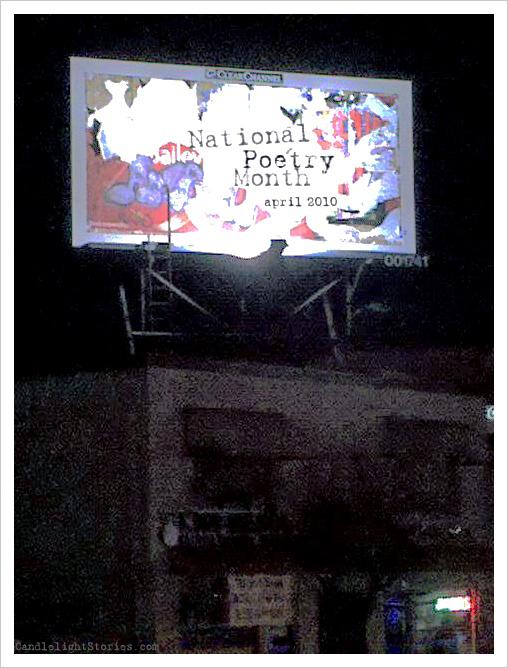
National Poetry Month – April 2010

It’s almost here.  April will be National Poetry Month, during which we celebrate the placement of words into various shapes, patterns and meanings that only a select few can decipher.  Don’t worry, if you saw the poetry reading at the most recent Presidential Inauguration, she was only placed at the podium to intercept bullets.  That has nothing to do with poetry.

For those of us fortunate and intelligent enough to avoid the study of poetry in a university, the month of April can be a strangely rewarding treat.  It’s an awkward and sort of a lame month of celebration, but it works.  Don’t ask me why.  Just think of yourself as being in the National Poetry Month and walk into a good bookstore and go to the poetry shelf to see what happens.  If you’re a total dumbass, nothing will happen of course.  But if you can read, you might start wondering why words make you want to have a coffee, or a piece of bread, or some wine, or cheese, or wear a hat, or some old boots.

I think I am going to celebrate Poetry Month by posting parts of my unfinished new video.  It mixes images, music, and words to make something that can really only be explained in terms of poetry anyway.  So I claim the right, during National Poetry Month, to be somewhat mysterious, cryptic, unfinished, insulting, fuzzy, indulgent, and unintelligible.

Audio Podcast Novel: Robinson Crusoe (Part 9)

DOWNLOAD ROBINSON CRUSOE – PART 9

Let’s get on with our story, shall we? It’s a good story and reading it is a lot of fun. Difficult, but fun. Defoe’s language is up and down and backward and forward. It makes you think fast. Try picking up the book and reading any part of it out loud and fast. It’s tricky. But it’s a very good way to learn more about how Defoe’s mind worked. Amazing. Are you starting to wonder why Crusoe constantly reminds us of things and says things like: ‘As I told you before,’ or ‘As I said earlier?’

He almost insists that you follow the correct sequence of events, but he skips ahead in order to achieve a much more important goal. He wants you to follow along with his state of mind. That’s why his story-telling language is so twisty and folds back on itself so often. This is certainly one of the most fantastic things about Defoe’s novel. Its obsessive focus on the man’s state of mind sets a precedent that influences almost all of literature following Defoe. It is really this that makes the book so modern.

Subscribe to audio podcast

Subscribe to audio with iTunes

Read by Alessandro Cima

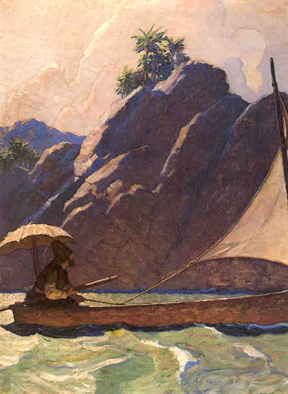
Illustration is by NC Wyeth (1920)
Crusoe battles the currents on the far side of his island

All audio stories are Copyright © Candlelight Stories, Inc., All Rights Reserved. Do not distribute copies of our MP3 audio or video stories. They are for your personal use. If you choose to burn our MP3 stories onto a personal CD, do not make copies of the CD or distribute them to other people. Also, do not sell CDs containing our audio stories. All audio stories are copyrighted by Candlelight Stories, Inc.

Podcast Novel: Pirate Jack (Chapter 17)

DOWNLOAD MP3 AUDIO

This book contains pirate battles, violence and death. Please use your judgment before playing for very young children.

Here’s a free podcast of our fantastic pirate adventure novel written for young readers. It’s got hidden scrolls, time travel, ships, battles, navigation, gold, islands, jungles and helicopters in it.

You can purchase the high-quality paperback from Amazon for $11.95 or just $1.99 for a Kindle e-book version.

You can purchase the paperback from Barnes & Noble (Price: $11.95)

You can also get it on Scribd.com as a download for just $1.99

Description:
Young Jack Spencer sees his father’s boat-building business destroyed by a powerful land developer. Then Jack unearths three ancient scrolls that propel him on a dangerous adventure through time in search of a pirate treasure.

When Jack finds himself aboard the pirate ship Revenge with Captain Jameson’s crew, he enters a life or death world of ship battles, jungle islands, prison escapes, gold, and treachery.

Set during the golden age of Caribbean piracy, Pirate Jack combines rollicking adventure with the moving story of a boy’s love for his father and a courageous effort to save a way of life.

Get all the chapters of the book podcast here.

You’ll find regular podcasts of all the chapters over the next couple of months. Subscribe to our feed.

This book is read by the author.

All audio stories are Copyright © Candlelight Stories, Inc., All Rights Reserved.

Reality Hunger: I Think David Shields Missed the Joke

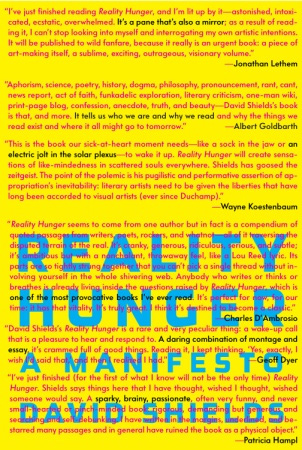
I finished it a couple of weeks ago.  Reality Hunger: A Manifesto by David Shields is a fascinating read most of the time.  Some quotations are simply better than others.  I have my favorites.  Hemingway gets quoted for his: “The most essential gift for a good writer is a built-in, shock-proof shit detector.”

What might Ernest have meant by that? Did he mean that a writer should be writing what he/she knows?  Writing from reality?  David Shields seems to think so.  He puts this quote in the chapter called ‘Reality.’  But I don’t know.  I think the inclusion of this quote is a weak pin in the framework of Reality Hunger.  I don’t think Hemingway had any concern whatsoever with reality.  I don’t think Hemingway’s ‘shit’ equals ‘fiction’ or ‘made-up.’  I think Hemingway’s ‘shit’ equals shit.  My shit-detector is going off and it’s pointing in Mr. Shields’ direction.

His book pinpoints the weakness of fictional form in today’s reality-obsessed culture.  The more real we get in our art, the more real our art will be.  We see it all around us, this fixation on reality shows and data and news and of-the-moment information.  We want people to write memoirs more than we want them to write fantasies with fictional characters running around dragging us through the usual plot structures of the worn-out novel form.

I’d believe David Shields if he’d tell more lies.  His book is a big collection of quotations from writers, artists, philosophers, academics, photographers, and filmmakers through history.  The quotations lead us ever closer to the general idea that the observation and reporting of reality in and of itself creates all the fiction we really need.  The pulling together of various shards and bits of reality and observation build art and culture.  To hold a memoir writer hostage to absolute truth is futile and ridiculous because the writer’s job is simply to write.

But I think I’d prefer the book if, having read it to the end and found the appendix with all the sources of the book’s quotations listed, I then could go on to discover that every single one of the quotations was in fact… fake.

The book should have been an absolutely made-up total fake because that would be really real.