Reality Hunger: I Think David Shields Missed the Joke

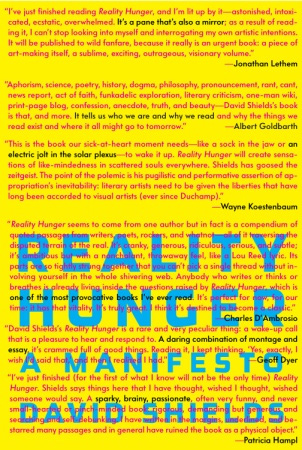
I finished it a couple of weeks ago.  Reality Hunger: A Manifesto by David Shields is a fascinating read most of the time.  Some quotations are simply better than others.  I have my favorites.  Hemingway gets quoted for his: “The most essential gift for a good writer is a built-in, shock-proof shit detector.”

What might Ernest have meant by that? Did he mean that a writer should be writing what he/she knows?  Writing from reality?  David Shields seems to think so.  He puts this quote in the chapter called ‘Reality.’  But I don’t know.  I think the inclusion of this quote is a weak pin in the framework of Reality Hunger.  I don’t think Hemingway had any concern whatsoever with reality.  I don’t think Hemingway’s ‘shit’ equals ‘fiction’ or ‘made-up.’  I think Hemingway’s ‘shit’ equals shit.  My shit-detector is going off and it’s pointing in Mr. Shields’ direction.

His book pinpoints the weakness of fictional form in today’s reality-obsessed culture.  The more real we get in our art, the more real our art will be.  We see it all around us, this fixation on reality shows and data and news and of-the-moment information.  We want people to write memoirs more than we want them to write fantasies with fictional characters running around dragging us through the usual plot structures of the worn-out novel form.

I’d believe David Shields if he’d tell more lies.  His book is a big collection of quotations from writers, artists, philosophers, academics, photographers, and filmmakers through history.  The quotations lead us ever closer to the general idea that the observation and reporting of reality in and of itself creates all the fiction we really need.  The pulling together of various shards and bits of reality and observation build art and culture.  To hold a memoir writer hostage to absolute truth is futile and ridiculous because the writer’s job is simply to write.

But I think I’d prefer the book if, having read it to the end and found the appendix with all the sources of the book’s quotations listed, I then could go on to discover that every single one of the quotations was in fact… fake.

The book should have been an absolutely made-up total fake because that would be really real.

Reality Hunger: A Manifesto

I haven’t finished it yet.  But Reality Hunger: A Manifesto by David Shields is making me forget to eat my food. That’s how good it is. I’m sitting there in my local restaurants trying my best to finish my Pasta Siciliana, but I’m staring at my Kindle screen and almost jumping out of my chair with ideas. That’s what this book is for. It was written to light a fire underneath the bottom of an artist.

Don’t be afraid of stealing.  Just do it.

David Shields is a thief and he’s the happiest most energetic thief you’ll ever meet between to covers.  All art is theft.  We build all our original creations on top of other creations.  We consume and then we spit the pieces back out in exploding new arrangements.  We appropriate all the time when we incorporate bits of newsprint into paintings, or street sounds into symphonies, or quotes into novels.

Novels.  What are they and what do they really do?  Do we need or want novels anymore?  Fiction?  Or do we want the more real?  Are we craving more and more reality?  It’s on TV everywhere.  Can the old form of the novel that describes scenes so well and gets into the characters’ heads really compete with all the new forms coming to life that are built primarily upon reality?

What is reality?  Whose reality?  Isn’t one’s perception of a simple street scene actually fiction once it passes through the subjective filter?  Isn’t everything ultimately fiction?

Shields’s book is composed of many fragments mostly snatched from other people throughout history.  Shields leaves his own remarks unannounced until the back of the book where he finally credits his sources.  The point is to connect thoughts from all over the world through many ages to gradually build up a central argument or ‘manifesto’ for a modern art or literature that eliminates the guilt from borrowing or ‘stealing.’  The ideas are obviously not all new, otherwise there would be no fragments to put in the book.  But the expression of the ideas in this way is new.  Reality Hunger is a jolt and it will offend as many or more people than it inspires.

Several years ago Bob Dylan got into hot water for using a phrase from a relatively unknown novel.  Sure enough, Dylan’s phrase did match the novelist’s.  Outrage ensued.  When the novelist was asked about his feelings he stated that if Bob Dylan wanted to use one of his phrases he was simply honored.

This book is very timely in a world where people are getting into lawsuits because some artist’s sculpture appears in a street photo.  We’ve been waiting for this book.  Fortunately, Mr. Shields is as excited about this book as his readers are – those who aren’t outraged anyway.  He comes off as a very energetic and enthusiastic partner to the artist.  I admire this book a great deal and will most likely be referring to bits and pieces of it for many years – and stealing them.

An Aerial Literature Puzzle

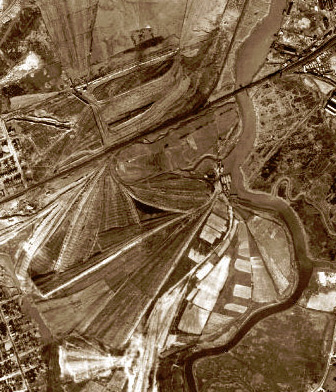
Head over to Literary Kicks to try your literary knowledge against a cool puzzle.  Guess what the picture is of and what it has to do with a book.  This kind of thing can keep you going for hours while you hunt through your book collection for clues and learn about fascinating web sites you never knew existed.  I spent quite some time going comfortably down quite the wrong track with this little puzzle.  But then… Aha!  My mistake became obvious.

Try the contest at LitKicks.com.

William S. Burroughs on Human Race and Space

Someone named Brian Duffy at Massachusetts College of Art and Design made this peculiar animation featuring the voice of William S. Burroughs. He gets that face animation of Burroughs just absolutely perfect. And that copy of Naked Lunch is the exact copy I’m reading this very evening. Who is this animator?  He’s very good.

You know, this is what’s so great about reading today, so far and beyond what any other time has allowed people to enjoy.  It’s that you can read something like Naked Lunch and think ‘Whew!  What a weird creature that Burroughs must have been!  What a lunatic!  Very sharp and very crazy.’  And then you can go out across the Web and find all sorts of fantastic films that have him walking around in them.  You can find some kid up in Massachusetts who reads this lunatic and gets so inspired that he makes an incredible film about some one little thing Burroughs said at some point in his long life.  Amazing.  It’s never been better to read than now.

Henry Miller Hated America – Even Before Bush

Henry Miller hated America. So he moved to Paris and then, eventually, moved back to the U.S. In this 1969 television interview, he says he thinks the end is near for America. He was right. Bush ended it in 2000. We just don’t realize it yet. We’ve elected an insurance salesman to the presidency and we think he’s going to change the world. He won’t. The experiment in democracy came to a horrifying grinding failure with the criminal organization of Bush. And some tepid fake hipster bloggers aren’t going to do a damn thing about it either. We need more creeps like Henry Miller who hate America. You can’t fix it if you love it. You’ve got to hate it.

Edgar Allen Poe Digital Collection

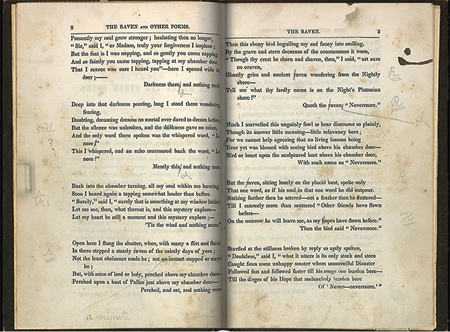
PoeRavenThe University of Texas has an excellent program online called The Edgar Allen Poe Digital Collection.  They’ve got digital copies of Poe manuscripts, letters, early editions, books that he owned, newspaper clippings, and photos.  This image shows an edition of collected poems owned by Poe in which can be seen his handwritten notes and corrections for the publisher.  Look at how pissed off he was about the word ‘Raven’ consistently appearing with a lowercase ‘r.’
Halloween is coming.  What better way to prepare than by reading some Poe?

Via Boing Boing

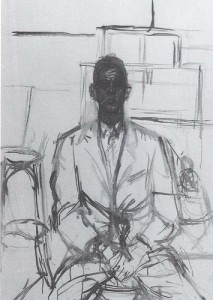
Giacometti Painting a Portrait

GiacomettiThe Rumpus has short article by Julie Greicius about her favorite book by biographer James Lord who recently passed away.  His book, A Giacometti Portrait, chronicles the effort by Alberto Giacometti to paint a portrait of Mr. Lord.  The work goes on for days with the artist constantly destroying the previous day’s work and starting over.

Here’s a quote from her article:

Lord exposed how much destruction was necessary—at least for Giacometti—to the process of creation. He also captured the complexity of the relationship between artist and subject.

Book Trailer: Inherent Vice

I’ve never been able to get through a book by Thomas Pynchon. Well, I should reveal that I’ve only tried once with his Against the Day.  Unreadable as far as I’m concerned.  But I still went out and bought a copy of Gravity’s RainbowJames Joyce is unreadable too and yet I still like him.  I never hold unreadability against a writer because I know how truly stupid I can be while reading – sometimes falling asleep and having to reread many pages.  But this video is probably the best book trailer I have ever seen.  I’d been thinking that the book sounded like a bore, but this trailer has me digging into the side pouch of my briefcase to find some spare change for the bookstore.

Another thing – whoever did the voiceover for this little movie is a stark raving mad genius.  He should read the entire book out loud.  I’d buy that too.

Dante’s Inferno: The Game

Improving upon the most boring character in the history of world literature, Electronic Arts is going to release an action game called Dante’s Inferno.  From the looks of the preview, this version of the Dante character is much more interesting and capable than the literary original who is the main character in the Divine Comedy trilogy consisting of the epic poems called Inferno, Purgatorio, and Paradiso.  Author Dante Alighieri wrote himself into his epic poem as a rather stolid, questioning dullard who follows the ghost of Virgil around in hell.  He whines about all the people who did him wrong in life and coincidentally runs into almost all of them during his sour-grapes tour of Satan’s domain.  But this video version of Dante kicks some smokin’ butt.  This is the Dante I’ve been waiting for and I am going to relish using my Xbox controller to stomp around and cut the heads off some nasty devils and repentant sinners.

It’s probably best to at least read Inferno before playing so that you can agree with me on how to improve the irritating main character.  But I will credit Mr. Dante Alighieri with one major achievement: he seems to have invented multi-level game play.  His version of hell is a series of rings that descend toward the most terrible of sins and punishments.  That’s pretty much the definition of modern computer gaming.

Continue reading

Five Chapters Offers Serialized Stories

FiveChaptersFive Chapters is a literary site that offers stories in 5-chapter installments each week.  Begun by magazine editor Dave Daley, Five Chapters has published over 150 stories by such authors as Stewart O’Nan, Arthur Phillips, Curtis Sittenfeld, John Wray, Wells Tower, Julia Glass, Darin Strauss, Jay McInerney and Kate Christensen.  The site has an incredible simplicity that fully focuses the visitor on the story being offered.

Here’s a Washington Post article about the site.

Charles Bukowski Meets Another Poet

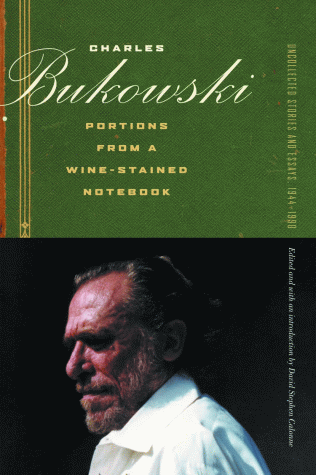
bukowskiThe Rumpus has a piece that Charles Bukowski wrote as a forward to a book of poems by William Wantling in 1974.  He writes about meeting the other poet for the first time and liking him.  It must have been a big thing to be liked by Bukowski because he seems to have a problem with most people.  His piece is touching and shows how sensitive Bukowski really was to the unspoken things.

He writes a bit about style and says:

Style means no shield at all.
Style means no front at all.
Style means ultimate naturalness.
Style means one man alone with billions of men about.

Is that really it?  Boy, Bukowski would have hated me to the ends of his toes because I’m always arguing my point.  The problem I have with what he’s saying there is that he made a living by writing with the biggest shield of all in front of him.  A bottle.  It’s the best shield there is.  Bullet-proof.  So he must be wrong about style.

Saving Books and Finding a Rare Don Quixote

My wife and I were knocking around New York City last week because we visited the excellent show of Picasso paintings and etchings at the Gagosian Gallery on West 21st Street.  Afterward, we stopped into The Strand bookstore in Greenwich Village.  They were selling the book that accompanies the Picasso show for a full twenty dollars less than the gallery.  We decided to go next door to the store’s rare book department where they keep their very valuable and dusty old tomes for the serious collectors of New York.  We went through the steel door and felt that we were entering the high-security wing.  The smell of decaying literature was immediate and sort of relaxing as all rotten literature should be.  We walked around quietly as the employees set up tables of wine glasses for a publisher’s party that would be starting shortly.

I soon found myself strolling down a narrow aisle toward a large window with a massive old air conditioner cranking away near the ceiling.  I could feel the cold air flowing past me and after walking all over the Village it was a welcome respite.  I came to the shelf near the window and noticed a wonderful illustrated volume full of Shakespeare’s history plays.  I pulled it out and began to flip through and was amazed to find a picture on nearly every page.  I wanted it.  I was also enjoying the cold air and the nice fine spray of water droplets on and about my head and shoulders.  ‘Ahh, misters,’ I thought to myself languidly.  ‘They must think of everything here because of the serious collectors who come through each day.  They must be kept comfortable in the heat or they will go elsewhere.’

So I continued to flip through Henry the Fifth and wondered if one hundred and twenty-five dollars was a lot to pay for the histories.  But I didn’t want to leave the misters yet because they were cooling me very nicely… ‘Misters?,’ I thought.  ‘Misters?  Really?  Water spraying about my head in the rare books department?  What on earth kind of idea is this?’ I looked up at the air conditioner and was met with an increased volume of cold water against my face.  Then I looked down at the shelf of rare books beneath the windowsill and saw a large puddle of water on the shelf and droplets of water spattered far and wide over an intimidating selection of fine rare books.  ‘This just can’t be right,’ I thought as I backed away quietly.  I had a bizarre impulse to gather my wife silently and flee.  But I could find no apparent wrongdoing in my situation so I halted.

Continue reading