The Books of Anselm Kiefer

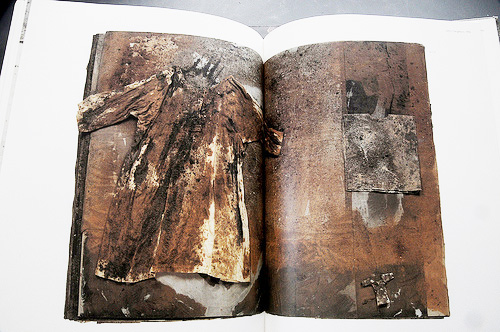
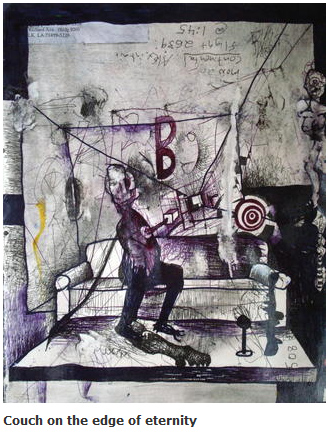
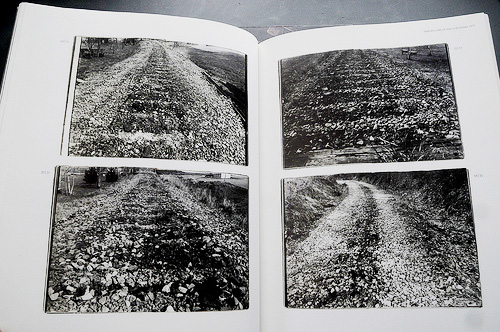
The Art of Memory, a blog that specializes in minimal film, music, literature, poetry and art, has posted a series of images from a rare book called The Books of Anselm Kiefer, 1969-1990Kiefer has worked on books since the sixties and incorporates many different materials in them, including photography, painting, sand, straw, cloth, and metal.  The books are one of a kind artworks and are seldom seen.

There is always something fascinating about a book made by the hand of an artist.  The problem with seeing books in museums is always the same though: you can only see two pages of any given book.  But since most people have no experience with turning a book’s pages, you simply would not want to trust patrons with this responsibility.

One of Kiefer’s main instincts has always been to try to look directly at the horrific history of Germany in the twentieth century.  These book pages contain some of his attempts to do so.

Art: Don’t Look Now!

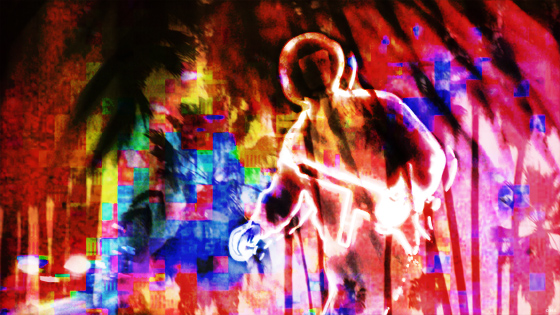
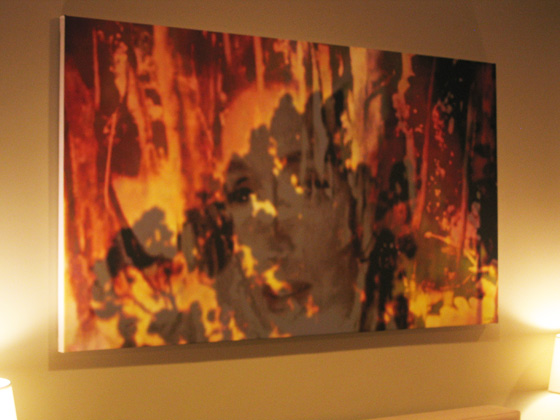
This is the latest version of a print I’ve been working on that’s loosely based on my Yellow Plastic Raygun film. I printed what I thought was my final version on a large canvas and looked at it for several weeks until I decided that it was timid and boring. So I went back to work and tried to let loose with the image and not worry about mooring the thing in some kind of reality. So this is what I’ve got to show for the effort. I like it much better this way.

I also renamed it from Don’t Turn Back to Don’t Look Now!

Here are the first two versions of the print.

Art: John Baldessari Designs iPhone App to Rearrange Crappy Dutch Painting

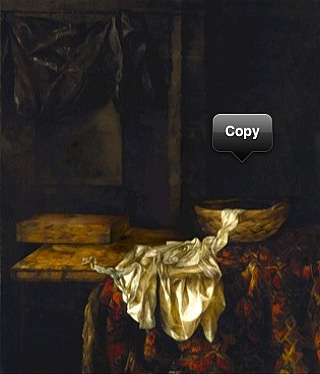
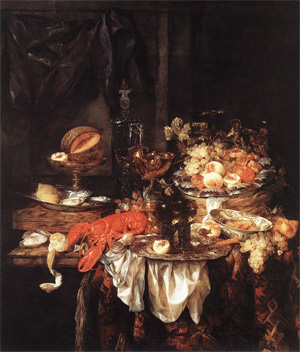
Artist John Baldessari has designed a curiously dopey iPhone app that allows a user to rearrange most of the objects in a 17th century still life painting called Banquet Still Life, by Abraham van Beyeren.  Looking at this mess of a Dutch painting is like being beaten about the eyes with a hammer.  But Baldessari is promoting his huge current retrospective, Pure Beauty, at the Los Angeles County Museum of Art.  The show is extraordinary.  If you are in L.A. between now and September 12, you should certainly go see it.

The app is called In Still Life 2001 – 2010.

This is the still life I came up with on my iPod Touch.  I got rid of all the annoying little objects and just kept the good part of the painting. But my main question is, who painted in the parts of the background that are hidden in the original? Baldessari? That would be mildly amusing. Frankly, it would be more interesting than the app. Original missing parts of 17th century paintings by John Baldessari!

Here is the horrific original painting:

Posted in: Art |

Can a Video Game be Art?

Here’s a relatively uninteresting article by Grant Tavinor called Video Games and the Philosophy of Art.  Can video games be art?  I don’t know.  Can a tree be art?  Can a car be art?  Can a rear end be art?  Certainly, under certain circumstances they can all be art.  But forgive my asking why do people spend so much time discussing a question that is equivalent to, ‘Can a hairbrush be art?’

In most cases I think a video game can only be art because of the player.  Any video game, no matter how crappy, can be art in the hands of… well… an artist.  Artists make art.  If you ain’t an artist you can’t get no art.  An artist can load up a copy of Grand Theft Auto on their Xbox 360 and walk into that gigantic world of violence and stand perfect still on a virtual street corner doing nothing but stare at a lamp post for days on end and turn that video game into art.  It’s magic.  Not theory.  Magic.  You know it when you see it.

Here’s a film with my own use of a video game as art.  Well, I think it’s art, but you may think it’s idiotic.  Check it out.  You’ll know it when you see it.  It contains extreme violence and nudity (just like video games!).  It’s intended for an adult audience. There’s my disclaimer.  Here’s the film.

Art: Don’t Turn Back (Two Versions)

Don’t Turn Back (Final Version)

Don’t Turn Back (First Version)

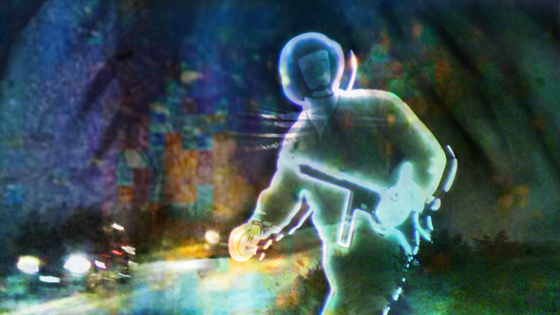
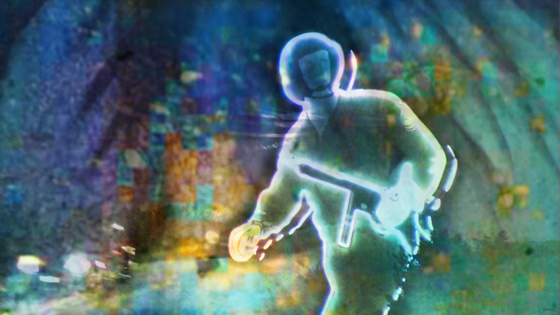
Here’s the little art problem I’ve been working on for the past few weeks.  It’s one of those things where I have no theory or rule to fall back on in order to make the decision.  Aside from some small touches like removing the Sergeant stripes from the figure’s shoulder, I was mainly trying to decide whether the right side of the image should be dark or light.  Ultimately, after scrutinizing the picture from a distance time after time, I decided that it was more dramatic if it depicted a night scene and if the figure was moving away from a more painterly zone toward a more digitized one.  I also made the road on the left a little more defined.  But canvas isn’t that expensive and I might just decide to hang both versions right next to each other in a gallery.

My own favorite part of the picture is right around the figure’s legs where you can see through to the landscape with that slight glow on the ground and how the shrubbery overlaps the neon line of the leg.  The image is about fear.  It is also connected directly to Jean Cocteau and the myth of Orpheus.  The figure looking back is from a single frame of video I shot of a store sign while walking along Hollywood Boulevard at night.  The road is a sharp bend in Laurel Canyon Boulevard near Mulholland Drive above Los Angeles that I shot through a windshield.  The background landscape is a shoreline I shot from a moving car near Rehoboth Beach, Delaware.  The dark palm fronds hanging down are from some throw-away footage I shot in high winds.  The pixelation is the product of blowing up a frame of a digital copy of decomposed celluloid film until the digital artifacts became pronounced.  I made all of these things individual layers and then went in with a digital pen and worked on a trial and error basis to make things come out the way they did.  What is interesting to me about making such an image is how I begin with an initial image – the glowing figure – and shuffle parts of other images on top of and underneath it to build a new image.  It requires an extreme confidence that you will know what you need exactly when you see it.  So you start going through piles of video or photos both on screen and in your head and pull out the pieces that snap into place for a new picture.  It’s like walking up to a leaf on a tree and taking it as the basis for a painting.  You know that from the leaf you will be able to connect to other things and end up with exactly the right final result.

This print measures 68″ x 38″. It’s an original work created from elements used in my film Yellow Plastic Raygun.

Art: Don’t Turn Back

Don’t Turn Back

This is my next large canvas print.  I’ve been making original artist prints through a gallery in Los Angeles. They measure 68″ x 38″. They are original works created from images used in my film Yellow Plastic Raygun.  They are not exact frames from the film, but rather artworks based on segments of the film.

11-Year-Old Raises Money For Gulf Birds With Art

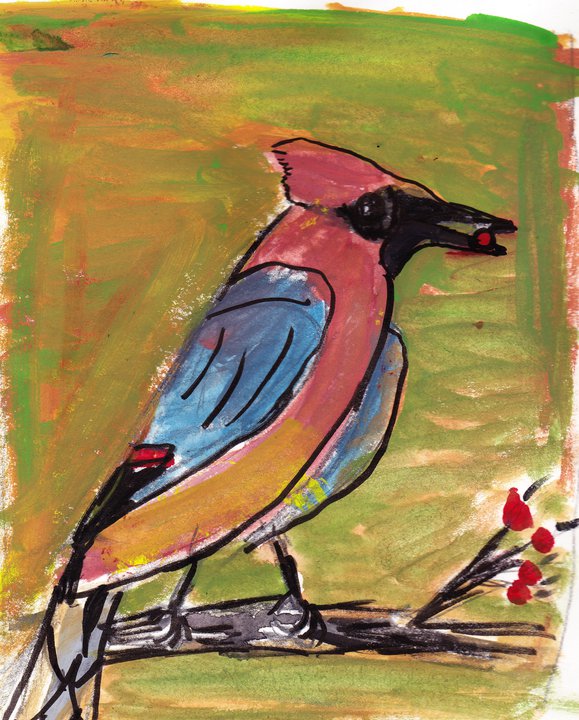
This is a nice kid. She’s Olivia Bouler and she’s an artist with a great love for birds. She is offering her art for sale to help the birds in the BP Gulf Oil Disaster. The money goes to organizations that can help out like the National Audubon Society.

Here’s a Facebook page that Olivia’s parents set up for the project.

The Mona Lisa Curse: Do High Prices Ruin the Art World?

This is a 12-part film on YouTube called The Mona Lisa Curse by art critic Robert Hughes. The film is fascinating for its overview of the art scene in New York since the 1960s. Hughes, the art critic for Time Magazine, goes on an extended diatribe against the fast-paced and overpriced world of art collectors and auctions that he says have debased recent art. He hates Damien Hirst because, according to him, the work does not merit the inflated prices. He hates Andy Warhol and thinks he was stupid and stole ideas from Robert Rauschenberg.  He thinks wealthy collectors have become simple investors without a thought in their heads about why the art is important.

But I think Mr. Hughes is a giant bore.  He walks around with a comical scowl on his block-like face.  He lumbers into a collector’s home to question him about why he would want to own 800 Andy Warhol pieces.  The collector gives him decent and somewhat thoughtful answers that are soundly rejected by the ogre in the room because he thinks Warhol was ‘one of the stupidest people he ever met in his life.’  Why?  ‘Because he had nothing to say.’

Nothing to say.  First of all, if you are waiting for someone to say something, you are going to waste half of your life doing so.  Warhol never said a damn thing that I can recall reading anywhere except that when asked why another artist was so good he said that it was because he made good lunches.  But Mr. Hughes is looking for something else.  Warhol had nothing to say.  In fact, I met him at a bookstore in Manhattan once and he just said, ‘Hi.’  It fit the occasion quite nicely in fact.  There’s your answer, Mr. Hughes.  The quietest voice in the museum must be Andy Warhol’s.

But if Hughes insists on asking some uninspired collector about what made Warhol so good, he is only going to get an answer culled from some brochure.  He needs a real answer.  Here’s mine.  Andy Warhol was great because he tried to destroy meaning.

Hughes’ most scathing remarks are saved for the wheeler dealer art auctioneers and representatives in New York.  They run around selecting high-priced art for their clients and hold bidding wars at places like Sotheby’s and Christie’s.  This pushes art prices up into the stratosphere, making every artist want to earn the big bucks.

So what?  Who cares?

The money people are having much more fun than tiresome old Mr. Hughes.  This guy should live under a bridge.  Who cares if a painter does something that costs $400 one day and $40,000,000 the next?  Where’s the problem?  It’s fun to trade money for art.  The more expensive it is the more well cared for it will be.  If you don’t want to spend large sums on art you don’t have to.  There are plenty of fine artists selling for a few hundred dollars.

I like Mr. Hughes’ film, but I don’t accept his views.

For instance, he despises this huge sculpture by Damien Hirst:
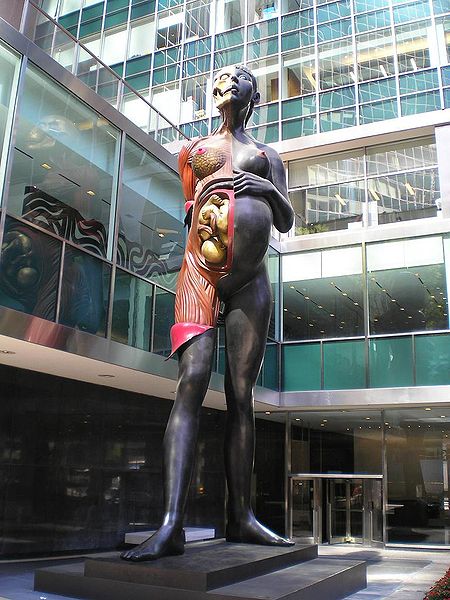
Why?  It’s an astounding statue.  Reminds me of ancient Egypt.  Look at the feet.  And those cut off fingers!  Look at what that face is doing.  It’s a face!  I would jam this thing into my backyard if I could unseat it from its pedestal.

But watch the film all the way through.  It’s very unusual and I have to love Mr. Hughes for making it and for being so willing to be so cranky.  Cranks are always fun.  I say stupid things just to make them mad.

Go here for part 2 and you’ll find the other 10 parts as well.
Art: Digital Prints on Canvas

I Was Thinking

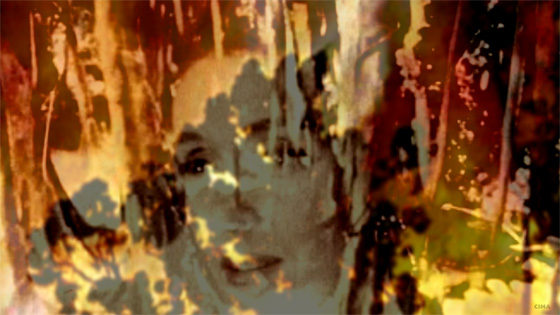
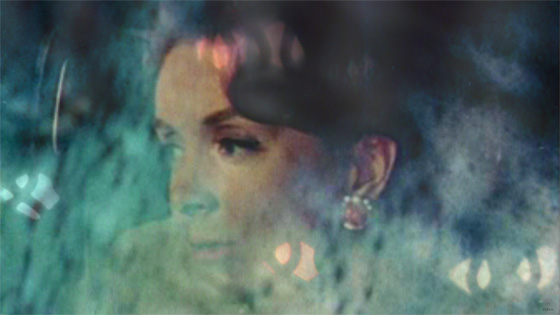
I’ve been making large original artist prints of these images through a gallery in Los Angeles. They measure 68″ x 38″. They are original works created from images used in my film Yellow Plastic Raygun.  They are not exact frames from the film, but rather artworks based on fragments of the film.  I make the film, then I mine it for artworks that will stand on their own.  So the film becomes a sort of a paintbox or a scrapbox that I dig through and manipulate.  I could go on working like this forever.  It’s an endless trove to explore.

Wave Rider

I Was Thinking hanging on a wall:

Painter: Andrew Abbott

One of my favorite sites is The Rumpus, an online culture magazine that covers literature, art, film, politics, sex, comics, music and generally excellent and useful ideas.  One of their writers, Julie Greicius, did a piece on a painter I’ve never seen before: Andrew Abbott.  I really liked his paintings as soon as I saw them.  They are harsh and beautiful at the same time.  I have no idea how much they cost or anything like that.  Probably a lot.  They’re really good and I imagine they are hanging in a lot of fancy living rooms right at this moment.

But his web site is plenty of fun for me and this guy can paint like some serious business.

Go visit Andrew Abbott’s paintings.