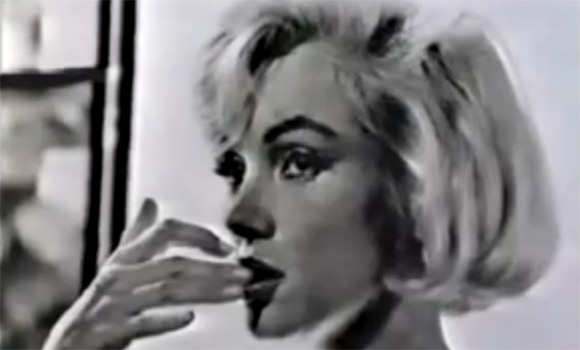
Marilyn Monroe – The Last Interview


This is the last interview Marilyn Monroe ever gave. It was for Life Magazine in 1962. The interviewer is editor Richard Meryman. The film includes various pieces of Monroe documentary and news footage. As she speaks, she seems delicate and somewhat forced in her cheerful girlishness. I’ve never given much a damn about Monroe. I view her as one of those totally false put-ons of sexuality that worked for a while because of the grotesque and revolting American male of the 1950s. Men were so totally warped about their own bodies and what they thought women should be that they were willing to worship one who walked out and turned them all into jokes. That’s Monroe – a vicious mockery of American sexuality in the 50s. She knew it and she couldn’t find a way out of the role she had chosen.

Aleph: California Beat Artist Wallace Berman’s Only Film

While I was running through the Getty Center’s flagship portion of the massive citywide ‘Pacific Standard Time‘ art exhibit, I was struck by just how great this Wallace Berman fellow really was. Known primarily as the ‘father’ of assemblage art, he was also a member of the Beat Movement. He made a single film which occupied much of his time through the 1960s and 70s. It’s less than eight minutes long and it’s a drop dead gorgeous thing to see. He’s one of those film artists interested in what I like to call the messy image. The film seems to have been dragged through ink and dirt. It’s been scratched, wrinkled, folded, cut, slashed and stained. Letters flash by like subliminal messages. Pop culture crashes into modern art. He films magazines, papers, radios, faces, hands, rock stars, body parts, buildings, streets and apparently just about everything he had lying around in his studio. This film is a quiet little reminder that crystal clear HD and super sharp focus are not anywhere near the concerns of some artists.

And here is California assemblage artist George Herms talking about Berman recently as part of the Pacific Standard Time series of exhibits:

Crosscurrents: Film About Pacific Standard Time Art Exhibits Focused on Los Angeles Art From 1945 – 1980

Pacific Standard Time is a massive overview of Los Angeles art from 1945 to 1980. At least sixty galleries and museums are taking part over the next few months. I have already been to the largest exhibits at the Museum of Contemporary Art, Los Angeles County Museum of Art, and the Getty Center. The whole thing is a lot of fun and I have discovered artists I never knew about before. There are magnificent things on display and the curators have also published big books to go along with each exhibit. I seriously recommend that you always get the books because they have far more information in them than the exhibits themselves. I view it as my own effort to compile a record of this unique regional art show.

You can find almost everything you need at the Pacific Standard Time web site.

This film was put together for the Getty Center’s flagship exhibit, Crosscurrents, which covers 1950 to 1970. It’s a very nice little documentary about some of the major art developments in Los Angeles.

Trip to Moon: Bizarre Bollywood Sci-Fi Spectacle

Oh dear! What have we here? This is a Bollywood science fiction (and I use that term very lightly!) film that was apparently made in 1967, though it looks more 1950s to me. It was directed by one T.P. Sundaram. It is ostensibly about an astronaut who gets kidnapped to the moon and then has to fight for the moon princess and her kingdom when martians try to invade. The movie is a roaring low-fi spectacle with songs, fights and cheesy cardboard special effects. Spaceship controls are actually steering wheels. If you want some good advice, skip through to the 2 hour 15 minute mark and just watch the glorious action sequence that closes the film. You will see grown men fighting with giant sparklers aboard a crash-landing spaceship. You’ll see robots, a Cyclops, and two men engaged in a lunar surface wrestling match that makes Captain Kirk look like Bruce Lee’s star pupil. You will then see a rhinoceros. If you are not laughing hard enough to burst a vessel of some sort, then I don’t think anything can be done for you!

Vive Le Tour! – 1962 Film About the Tour de France

This is a charming look at the world’s greatest bike race from 1962. I see that Louis Malle is credited as one of the directors. You can see the incredible efforts put in by racers in the mountains and how back in the early sixties they would eat fruit on their bikes and sometimes dart into village restaurants along way to snatch bottles of water, wine and ice cream! The film also mentions the issue of doping as it was practiced in 1962 which seems to have mainly been an effort to mask the pain. The one depressing thing about this film is that it shows the sport of bike racing in 1962 was as uniformly white as it is today. The complete lack of diversity in the Tour de France is a shame and an unforgivable embarrassment to the race itself and to the sport as a whole. The damn race is so white that it makes my teeth hurt to watch it. And I watch every stage of it every single year. So trust me, it’s an all-white event and the organizers and teams should be investigated for that issue which is actually far more important than the doping issue. Every single racer dopes. But quite obviously the dope is only given to white racers. The Tour de France is becoming a European NASCAR. Just go ask Lance.

Voices: Documentary on Jean-Luc Godard Filming ‘One Plus One’ with the Rolling Stones

Here’s a film begun by director Richard Mordaunt. It shows Jean-Luc Godard working on scenes from his film, ‘One Plus One,’ that featured the Rolling Stones as they recorded ‘Sympathy For the Devil’ in 1968. Godard always has something nearly unintelligible to say but which ends up making perfect sense later on. You might also note that Godard seems to have very little in the way of a plan as he shoots his scenes. He appears to discover his scenes as he goes.  That is the only kind of intelligence in filmmaking that I can truly respect.  A director with a storyboard is usually a jackass.

Thanks to Paul Gallagher at Dangerous Minds.

Ford Magic Skyway Film from 1964

At the 1964 World’s Fair in New York, Walt Disney built the Ford Magic Skyway ride which took visitors on a ride in Ford cars through history and into the future. It makes me realize that all we are really doing when we visit Disney theme parks is celebrating nostalgia for the 1950s and 60s. Were we ever naive enough to actually attend a World’s Fair?

Snow – 1963 Short Film by Geoffrey Jones

This 1963 film was nominated for an Oscar. Director Geoffrey Jones captured the shovel work being done to keep British rail lines open during the winter. It’s an elegant and beautifully edited short film.  You can read more about its origin and rhythmic beat editing at the BFI site.

Made available by the British Film Institute.

The Animated Films of Painter György Kovásznai

While visiting Your Daily Cartoon, I watched an animated film by Hungarian painter György Kovásznai.  I liked the calm mishmash of drawing styles and quiet humor. The 1965 film is called Mesék a m?veszet világából (Tales From the World of Art). It has no subtitles but is pretty easy to follow, taking a bemused look at several kinds of art. The first part is an action movie, the second is a theatrical piece, the third is a piano recital.

This one is called Várakozni jó (Waiting for Good). It’s about a traffic jam with a truck that suddenly opens its back doors and explodes into a 1969 rock & roll jam. The wild sketchy ever-changing animation style is more psychedelic than most commercialized sixties psychedelia could ever be.

This one is Gitáros fiú a régi képtárban (Boy Guitarist of the Old Hits) from 1964. It’s simply a guitarist playing and dancing his way through artworks by old masters presented in a very avant-garde fashion. Understanding the art is one thing, but the person who can truly enjoy it is far ahead in the game.

A.45 at 50th – A Film About Actor James Cromwell and the Black Panthers in 1968

MATURE CONTENT AND LANGUAGE:

I got a nice surprise submission to my Vimeo Candlelight Stories Short Film group this week.  It’s a fascinating documentary about one famous actor’s experiences during the turmoil of the civil rights movement in the 1960s.

John Cromwell, the son of actor James Cromwell, directed this short film with Joshua Bell. It’s about his father’s experience with members of the Black Panther Party civil rights organization in 1968. It’s a fascinating short documentary look at someone who finds himself in an unfamiliar world just trying to lend a decent helping hand. James Cromwell has been involved with the defense of the Black Panthers and other human rights causes for decades.  I like the film’s professional quality and easy capturing of the sixties look.  It presents its important and dramatic subject matter with a good dose of rather charming humor.

Here’s an article and interview with the director and his father.

Rising to High Places – 1963 Documentary On Office Buildings

A great example of mid-twentieth century English pride in… office buildings! This is a 1963 production of the Rank Organization. My depressing view on modern city skylines, regardless of how beautiful they may be at night, is that all those magnificent towers are simple stacks of flimsy cubicles and low ceilings with ugly lighting. Modern cities are nothing more than support structures for desks.