Fake Artist Sues Photographer for Taking Pics of Public Sidewalk Art

Some abject fool of an artist named Jack Mackie made a deal with the city of Seattle to embed an artwork called Dancers’ Series: Steps into a sidewalk back in 1979.  Then a photographer named Mike Hipple went and did a logical thing; he took a photograph of a public sidewalk with the artwork in it.  Now the nitwit fraudulent artist is suing him for using his artwork in a photograph!  It’s jackasses like this Mackie dude that need to be put out of business.  By this jerk’s reasoning I would have to pay royalties to all of the architects responsible for the design of every single building in the Manhattan skyline if I took a photograph of New York.  Ridiculous!  This fool is an insult to artists and intellectual property courts all over the country.

The only good thing about this Jack Mackie art is that people get to step on it.

I have an idea for a great photograph.  Someone goes up to Seattle with a jackhammer for a 4:00 am dig-and-run operation then takes a photograph of the hole that’s left and its caption reads, ‘Please Fill This Hole.’

And this would be something to do to every public artwork attached to a moronic lawsuit like Mr. Mackie’s. Every time one of these lawsuits is filed, destroy the artwork. Eventually, corporate midgets like Jack Mackie will go away.

And another thing, Mr. Mackie, I recognize the concrete incorporated in your artwork on the sidewalk.  It’s extremely distinctive.  My uncle owns the mill that made that concrete and he will expect to be compensated for the use of his concrete in your public artwork.  You owe him $600,000.  He’s coming to collect.  His name is Lou.  Smile when you open the door.

Polaroid Gets Smart – Brings Back Classic Instant Film Camera

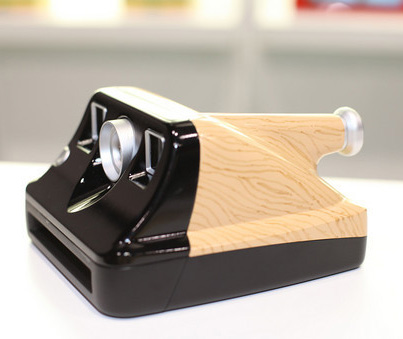
Polaroid has used the Consumer Electronics Show (CES) in Las Vegas to announce a new line of classic instant film cameras!  Called the Polaroid PIC-1000, the camera will work with 10-packs of instant film just like the great old Polaroid cameras of the past.  This is a very smart move by a company that looked supremely dumb a few years ago when it canceled the best product it had ever created.  It was almost as dumb as Volkswagen canceling the Bug.

But no worries, we will have our instant pictures back.  Not even digital cameras are instant.  Not really.  You have to plug them into your computer or printer or something and get your files sorted out and then you may need to do a some digital color correction on them.  But with a Polaroid, you point click and enjoy the little whirring sound for a few seconds.  Then you hold your picture and watch it come to life!  There’s absolutely no good reason why digital should not coexist with analog technologies.  The main difference between working with film and working with digital, as I see it, is this –  with digital you know pretty much exactly what you are going to get when you take a picture.  With analog film you never know what you are going to get.  There’s a wonderful fuzzy zone filled with error and chance that Polaroids allow you to enjoy.  Each picture is a little surprise.

Paris Filmmaker in 1929 Shows Us What a Camera is For

This is an odd post and I’m not entirely sure I can pull it off. The film above is called Montparnasse. It was made in 1929 by Eugene Deslaw.  I watched the film and want to write about it cold, without looking up Mr. Deslaw on Google.  I’ll check up on him after I’ve posted this and see if I’m even in the ballpark.

Watch the film all the way through.  If you think it’s just a collection of boring tourist shots in Paris with nothing happening, then stop reading and leave now because this post is for the four out of one hundred who catch the drift of the camera work.  Deslaw was shooting in the Paris of Pablo Picasso and Matisse.  He appears to have had a close connection to art and the cafe life of the city.  His film is full of odd angles and closeups.  He runs up onto a balcony in order to shoot straight down at some tabletops.  He catches a woman applying makeup at about the 13-minute mark and makes a shot that is worth paying for.  He films traffic and buildings, windows, curbs, chairs, newspapers, smokers, drinkers, snake-handlers, paintings, and water.  He’s fascinated by his city and by his camera.  He’s making art.  He set out one morning with his camera and went around making art.  Everyone was happy to be alive there in Paris in 1929 and he was playing his part in it.  Films made at that time tend to have this cheerful experimental quality.  Deslaw is nearly drawing with his camera.  It’s an immediate act of finding visual meaning.  He was walking and was struck by something and filmed it in an excited state.  He was consciously being an artist.

The film he made is beautiful.  It’s very hard to make a film with its kind of beauty today.  Think about it a little.  What would you do?  Go to a Best Buy and look around for a brand new digital camera.  You know, one of those shiny silver things with the HD viewfinder and all the buttons.  One of those?  Then what?  You’d march out into the neighborhood with this gleaming tourist gizmo and look like a ninny bending over to film trash as it floated down into a storm drain?  You’d walk up to a guy behind a news stand and ask to film him?  Really?

Yes.  That’s what you’d do.  You’d get a little camera and do just that.  And here’s your assignment: you must do this with the total conviction that you are about to make the greatest film ever made about your subject matter.  Set out for a particular street corner and make a magnificent short film or a long one about that corner and everything on it.  Spend an entire day doing only that.  Skip lunch.  Just stay there and make your film without ever entertaining even the slightest doubt that you are working on something of incredible importance and value.  It’s going to be very hard to do.  Some people will walk by and giggle.  Some will become belligerent and tell you to stop.  Film those people.  Run away if they chase you.  Then come back and continue your work.  Remember that you are an artist on a mission to make something and absolutely nothing will stop you.  Then come back home and figure out how to edit it and then put it online.  Tell me about it even and I’ll watch it.

In 1929 it would have been recognized by the maker of this film that a camera is a camera and it will make your film if you want it to.  Ever wonder why you don’t ever see Steven Spielberg out and about with his little camera making a movie for himself?  It’s strange isn’t it?  Could you imagine Pablo Picasso or David Hockney never carrying a sketchbook to make some quick pictures while having coffee or dinner?  I couldn’t imagine such a thing?  So when was the last time you ever heard of a Spielberg or Scorsese out with a camera making little films for their web site?

You could almost think of all the decades of massive budget film production and the studio structures built to support the film industry and film schools as an organized effort to confuse the issue and make people forget what a film actually is.  We think of screenwriters and producers and agents and superstars and all the talk shows.  But it’s very hard for the artist to walk out with the camera and go make a film the way a painter would work alone on a canvas.  The Montparnasse film should help to illuminate the proper use of the camera for anyone who’s interested.

The film comes from UBUWeb

Message to Pittsburgh Police: We’re All With The Press

The Pittsburgh, Pennsylvania police have arrested a 41-year-old man for using Twitter to post messages about police movements during the recent protests surrounding the G20 Summit.  Also, FBI agents entered the man’s home in New York City and confiscated computer equipment.  The man is charged with directing others to avoid apprehension.  The police declared the entire protest in Pittsburgh illegal, giving themselves the apparent freedom to charge anyone who helps the protesters.  But anyone could have read the Twitter postings anywhere in the world.  It was a public announcement about what the police were doing in plain sight.  The American Civil Liberties Union (ACLU) has stated that if this were happening in Iran or China, it would be condemned as a human rights violation.  It most certainly is.

Police movements are public knowledge.  Posting to Twitter about the whereabouts of police during a protest is simply the publication of public information.  There is absolutely nothing illegal about it.  If I stand on a street corner with my cell phone and Twitter about the movements of police cars, I’d be doing exactly what this man was arrested for.  If those cars happened to be on their way to intercept a criminal, could the police come and arrest me for aiding that criminal?

The problem of police brutality and illegal actions against protesters is wildly out of control all over the nation.  In Los Angeles you have the police violently attacking a peaceful gathering of immigration protesters in MacArthur Park.  The riot police beat up television journalists and smashed their cameras.  Later, the department had to pay over fourteen million dollars to private citizens and has even more to pay to the journalists they attacked.  In Minneapolis the police burst into a home containing the organizers of a peaceful group planning protests for the Republican National Convention.  The police held the organizers at gunpoint, tied-up on the floor for hours, just to keep them away from the convention. These were young highly-educated people with attorneys present on scene being held at gunpoint by a police force with no other intention than to prevent the exercise of their right to free speech and public assembly.

Look at this video from the G20 protests in Pittsburgh.  Pay special attention during the arrest and assault on some protesters at the 5 minute and 12 second mark.  What do you see?  It’s a press photographer clearly wearing some sort of credential on his chest.  He saunters through the melee without concern.  He’s carrying a camera.  The cops ignore him because he’s got that press credential. Then at the 6 minute and 15 second mark you hear a cop arresting someone and he says: ‘You’re with the press?  Who are you with?’  Presumably, he’s going to let a member of the press go instead of arresting him.

I think this video is fascinating because it shows who the free press really is.  Look at what the protesters are doing. They are using cameras against the police. Everywhere you look someone is trying to point a camera at the police.  The press is the people with all the cameras pointed at the cops.  The credentialed press photographer is walking around with his credential.  He’s filming nothing at a moment when protesters are being abused, beaten with sticks, and pepper sprayed.  The press is the other people.  The ones with the cameras who are being chased and beaten.  That’s the press.  We are the press.  We film bovine imbeciles with sticks and helmets and we upload our movies to YouTube.  There’s always something to film when a cop’s got a stick in his hand.  Everywhere you turn someone with a camera is catching some jackass cop murdering or beating someone.  It’s a war.  Cameras against cops.  And the big one hasn’t hit yet.  It’s coming.  Something will snap and when it does it will be covered by the free press on the ground live in the struggle right up close in a cop’s face.

The fact of the matter is that most of these G20 protesters are highly educated literate people. They are vastly more intelligent than the cops. The cops actually know that. It irritates them and they are itching to beat people up.  It’s universal to all police forces.  When you get a crowd of these people in body armor with sticks and guns you have an extremely volatile situation on your hands.  The masks confine the cops’ breathing and vision, increasing anxiety and tension.  These cops don’t think well and they are far more dangerous than the crowds they are trying to control.  I’m all for sticking cameras in their faces.  And Twittering about their movements.  It’s legal.  It’s free speech and it’s protected.

And yessir, Mr. Pittsburgh cop, we’re with the press.

We’re All With The Press.

Philadelphia Thinks Photographers are Terrorists

Philadelphia, Pennsylvania thinks people who take photos of its SEPTA trains might be terrorists.  CBS3 in Philadelphia prints what I can only interpret as a serious article about a cashier at a train station who reported two men taking pictures near the train lines as ‘suspicious.’ This cashier actually questioned one of the photographers about his activities while waiting for police to arrive.  The photographer understandably left the scene before the officers could arrive.  I would have too.

How do you take a suspicious photograph?  I’ve always harbored ambitions of taking some suspicious photos but I’ve never quite been able to figure out how.  Do you hold the camera behind your back and then flip it out real quick while pointing the other way and yelling, ‘Hey, look at that!  What is that over there?’  Do you take photos through holes cut out of your pants?

Or do you take photos while sporting a beard?  Or dark skin? Do you have to be male?  What makes a suspicious photographer?

Nothing does.

Look at this:  National Terror Alert posts about it in all seriousness.

I’ve never seen a photograph explode.  I’ve never seen a camera explode.  I suppose one could.  But most terrorists I’ve ever heard of use other things – like shoes.

Photographers actually make people safer.  Wherever you see people taking pictures you have more safety for obvious reasons.  Furthermore, U.S. intelligence agencies have made it very clear that there is no evidence that a terrorist has ever used photography as a means to prepare for an attack. I want photographers in my train stations.  At my bank too.  In the department store… wait, there are cameras in those places.  They’re hidden in the ceilings I think.  Suspicious.  Everywhere we go we are photographed for security reasons.  But as soon as one of us regular old folk take a camera out in a train station we are regarded as ‘suspicious.’

I declare the weekend of September 26 and 27 ‘Photograph a Philadelphia Train Station Weekend.’ Everyone should feel free to descend upon a SEPTA station and take some flattering photos of the helpful cashiers.

Here’s a blog written by a photographer who was arrested in Miami, Florida in 2007 for taking photos of police which is a totally legal act in all parts of the U.S.

The problem is that police across the United States are totally out of control when it comes to people utilizing their constitutional right to free speech.  After all, the taking of photographs is nothing more than the exercise of free speech which is protected by the First Amendment to the Constitution.  What’s really going on is that all these cameras everywhere, built into cell phones and hidden in sunglasses, are driving police crazy because they get caught doing illegal things.  Cops don’t like cameras.

When I lived in New York City I once pulled out my video camera and filmed a group of perhaps twenty cops who pulled up in front of a brownstone apartment building and ran inside.  One cop ran across the street toward me and screamed, ‘What are you filming?’

I said, ‘You!’

He said, ‘Well, anyone taking pictures when police come on a call is suspicious because sometimes people call us just to film us.’

I said, ‘Yeah, well you never know do you?’

He turned and went back to his job.  And I’ve still got that video.

Suspicious, isn’t it?
Panoramic Image of Milky Way Galaxy

Two French photographers, Serge Brunier and Frédéric Tapissier, spent weeks in the desert highlands of Chile, and a week in the Canary Islands, taking photos of the stars. Using a Nikon D3 digital camera, they took thousands of photos of the night sky and then stitched the photos together to make a panoramic view of the Milky Way Galaxy as seen from Earth. The pictures are extremely high-resolution because the photographers took them from some of the darkest spots on Earth, giving unsurpassed clarity of view.

You can see an excellent interactive zoomable version of the image at photographer Serge Brunier’s web site.

You can also see a zoomable version of the image at Gigagalaxyzoom.

ApSci Makes Music Video from Still Photos

Electro-hop husband and wife duo ApSci have made a music video for their upcoming album Best Crisis Ever consisting entirely of still photos with no post-production effects at all.  It’s a great idea and makes for an excellent little film.  I like the music too.  They shot the black and white photos that you see held up by a hand with an iPhone and then printed out all the shots in sequence.  Then they travelled around the world and took more still photos while holding each black and white photo up in the original sequence.  So you get the odd effect of two still photo animation tracks going on at the same time.  It’s very clever and very simple.  Of course, it makes no difference whatsoever that it was all shot with an iPhone.  It could have been any camera.

A Wolf Loves Pork: Stop Motion Photo Animation

Takeuchi Jaijin made this film by photographing the action in stop motion then photographing the photos again in his room.  He makes the action seem to take place all along his walls, countertops and floors.  I love the way the boy dives into the filled sink and swims across!  The photo animation technique reminds me of the photo collages of artist David Hockney.

Thanks to David Pescovitz at BoingBoing for posting this.