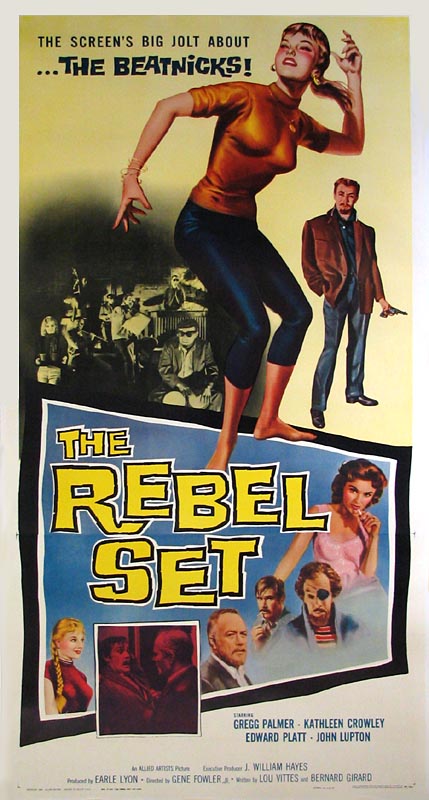
The Rebel Set: 1959 Beatnik Film Noir

Gene Fowler, Jr. directed this peculiar Beatnik crime noir in 1959. It starts right off with a Beat jazz club and then just gradually slides into trying to be a crime thriller. It’s about an out of work actor, an unpublished novelist and a movie-star’s son who are teamed up by the club owner to pull off an armored car robbery. The Beat scenes start off in Los Angeles and then the action moves by train toward New York, with a four-hour layover in Chicago where the crime is to occur. I love all the jazzy xylophone music, the black-clad dancing girl, the paintings on the walls, the bohemian sleeping quarters and the silly little beards. I think we really need to bring back the whole idea of the Beat jazz club. I’d go for sure.
The movie has some great touches. Like the hard luck actor reciting Shakespeare’s ‘Taming of the Shrew’ along with an LP. There’s my favorite line, delivered by the club owner: ‘When in Rome, Sydney, do the Romans.’ The poet giving a performance with musical backing says, ‘The passengers on this sad train are the five senses.’

Behind The Wall: The Battle for LA’s Murals

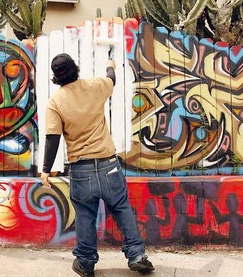
Oliver Riley-Smith made this short documentary about the disappearing mural art of Los Angeles. It features a prominent muralist complaining about how murals have been ‘bludgeoned by graffiti’ and ‘censored by the city.’ Perhaps so. The city does make it difficult to get permits for murals. But I don’t really like murals. They tend to be stiff and unoriginal. I like the murals that have been vandalized by the graffiti artists. Sorry but I do. They are much more interesting than the clean murals which are entirely unimaginative and offer nothing to move art in any direction whatsoever. If muralists want to preserve their images, they should paint indoors. Look at the mural on the highway underpass wall that’s covered with graffiti at the 42 second mark in the film. Beautiful. Much better than the mural ever was. The muralist in the film says, ‘Museums are for the dead. I want life.’

Bullshit.

There’s a guy in this film called ‘Ghost One.’ I like what he says about art.  He’s realistic and open to whatever comes along.  He says that taggers mark up murals because they assume that their marks will have more longevity that way. That’s a very interesting thought. An artists seeks longevity by making his mark inside the work of another artist. Fascinating. Much more interesting than the murals. Such thinking shows possibility.

But then the film draws the two sides together and our muralist says he ‘hopes our two styles can work together.’ Well, they can’t really, but it’s a nice thought.

Los Angeles to Ease Restrictions on Murals

The Los Angeles Times reports that the City Council is easing its restrictions on outdoor murals.  It will no longer classify them the same way it does billboards.  Since 2002 it has been illegal to paint a mural on private or public property because the artworks are considered advertisements.  But Los Angeles is going to try to do a better job of distinguishing between the two.

Of course this will all get muddled again as soon as an artist paints a figure holding a can of Coke!  Is it art or is it an ad?  As a rule though, it is never difficult to tell when something is a giant ad and when it’s not.  It just takes a little common sense and observation.  Surely the City Council can manage this.

But the bottom line is that the murals of L.A. are inspiring and extraordinary.  The city needs to reclaim its title as ‘The Mural Capital of the World!’

The photo is a portion of a photo by Al Seib for the Los Angeles Times,  April 6, 2011.

On Skid Row: Documentary Film by Sam Slovick

Sam Slovick made this 2008 documentary on skid row in downtown Los Angeles. The area is home to approximately 9,000 homeless people who deal with life on the streets, drugs, crime and serious physical and mental health issues. The film was made just prior to the massive economic collapse of 2008 when the numbers of homeless began to rapidly increase.

Parts 3 through 5 follow the jump.

Continue reading

Pacific Standard Time: Anthony Kiedis Celebrates Ed Ruscha

Red Hot Chili Pepper, Anthony Kiedis rides along with L.A. artist, Ed Ruscha. They talk about using words for art and how that inspires them. I like shooting L.A. this way. The film uses the car and the streets well. I think I even see some duct tape holding Kiedis’ passenger door mirror together.

Pacific Standard Time web site.

Unions and Students Join the Occupy Wall Street Protests

Powerful unions have joined with the protesters at Occupy Wall Street. The movement is exploding across the nation, taking root in major cities like New York, Los Angeles, Chicago, and Washington, D.C. The protests are a direct reaction to the inability of the government to fairly tax its people even in the face of a major worldwide financial catastrophe. With the shrill and irrational assertions of Republicans and their Tea Party people sounding like some sort of majority opinion, people are getting out in the streets to show what the real majority really thinks.


A Drive Through Bunker Hill and Downtown Los Angeles in the 1940s

Extraordinary and crystal clear film of L.A.’s old Bunker Hill neighborhood. The entire area up the hill was blown out completely and basically strip-mined to make way for L.A.’s skyscraper district. On the one hand, it is a damn good thing the city isolated the destruction to the hill and left much of old downtown intact. But neighborhoods are always better than corporate complexes because people can actually do things in them. You can’t do anything in a corporate complex except hold a fake job that nobody needs anyway. You can’t even go for a walk on Bunker Hill anymore. Not really. You may think you can but you’re really just sneaking along next to a cement wall that’s meant to keep you out. Watching this film also makes it clear just how right they got 1948 Los Angeles in the recent L.A. Noir game.
 

Greetings From Los Angeles 1978: Super 8 Film by George Porcari

George Pocari made this film of Los Angeles in 1978. It’s beautiful and it shows the things one sees every day without really noticing. Films like this one turn out to be incredibly valuable glimpses of the past. It’s funny how home movies end up getting closer to art films as they age. But this one actually started off as a kind of art film. It’s very well made.


Pacific Standard Time: Los Angeles Art From 1945 to 1980

Don’t let anyone ever tell you that it doesn’t matter where you are when you make art. It matters very much. You have to know who’s buried in the ground that you’re dancing on. You have to know what’s in the air. You have to know who walked where you are walking now. If you don’t know those things, you might as well be working via modem from an igloo in the antarctic. This Pacific Standard Time thing is a bunch of galleries in Southern California working under the general umbrella of the Getty Center to put on exhibits of post World War II through 1980 art by Southern California artists. Los Angeles is the only great American city that hasn’t been entirely bombed by corporations yet. New York has been a dead zone since 1980. I lived there for almost ten years. Every footstep taken in that city was like a death march for me. The oppression of mind that goes on in New York is akin to being trapped inside some sort of giant grinding machine that keeps on working even though all its parts are broken. Coming to Los Angeles was like seeing the horizon for the first time. The city opens out and spreads with a psychotically unhinged freedom and chaos that is the very essence of creativity. It is the perfect antidote to the black death of New York. This is apparently the first art exhibition of its kind ever. An entire region is presenting its art and imagination for all the world to see. There are going to be roughly sixty different shows happening over the six months of this thing.

Pacific Standard Time is a collaboration of more than sixty cultural institutions across Southern California, coming together for six months beginning in October 2011 to tell the story of the birth of the Los Angeles art scene and how it became a major new force in the art world. Each institution will make its own contribution to this grand-scale story of artistic innovation and social change, told through a multitude of simultaneous exhibitions and programs. Exploring and celebrating the significance of the crucial post-World War II years through the tumultuous period of the 1960s and 70s, Pacific Standard Time encompasses developments from L.A. Pop to post-minimalism; from modernist architecture and design to multi-media installations; from the films of the African American L.A. Rebellion to the feminist activities of the Woman’s Building; from ceramics to Chicano performance art; and from Japanese American design to the pioneering work of artists’ collectives. Initiated through $10 million in grants from the Getty Foundation, Pacific Standard Time involves cultural institutions of every size and character across Southern California, from Greater Los Angeles to San Diego and Santa Barbara to Palm Springs.

Los Angeles Plays Itself: Documentary Through the Eyes of Fiction

This astounding 2003 documentary by Thom Andersen takes what I am certain is the most thorough look ever at how films, both popular and obscure, have depicted the city of Los Angeles. Through the accumulation and precise organizing of clips, Andersen actually describes the essential heart of Los Angeles better than anyone I have seen before. Unfortunately, the film has never been released due to rights issues with some of the clips in the film. I can’t imaging what those issues might be since this all looks like fair use for a documentary to me. This is quite obviously a journalistic essay and he has every right to use the clips in short portions.

The film’s narration has a sort of dry weariness that tends to fit the general tendency toward crime or noirish films and their views of the city. His description of the brutal destruction of Bunker Hill is a masterpiece of documentary filmmaking, illustrating the horror of a corporate dead zone built on top of a once vibrant and colorful community that served as inspiration to many down-at-the-heel artists like John Fante, the great Los Angeles novelist who wrote ‘Ask the Dust.’

Andersen moves through a dizzying array of films including, Point Blank, Zabriskie Point, Double Indemnity, The Outsider, The Exiles, Kiss Me Deadly, Chinatown, The Omega Man, Blade Runner, Heat, Rebel Without a Cause, and many many more. It’s a tour with attitude through Hollywood’s fascination with Los Angeles. It’s also a look at how wrong many depictions of the city have been – how twisted, altered, faked and misrepresented L.A. has been. The film is a lifelong Los Angeles resident who knows what’s missing in the superficial portraits of the city and gets mad about it. But in general, Andersen’s film gradually and unremittingly builds a detailed portrait of the city like no other portrait ever attempted. He reserves some snide comments for a director that I have always considered to be one of the best at portraying L.A., Michael Mann. Andersen’s comments about the characters of ‘Heat’ who live in the hills overlooking the flats of L.A. are accurate but somewhat literal. Here’s an article that Andersen later wrote about Mann’s film ‘Collateral’ which was apparently an improvement on the city’s portrayal.

But Andersen’s irritation with fakery and distortion are what make this film work. He insists on showing the false, exposing it for what it is, and then showing us a contradictory viewpoint. One of the kickers in this magnificent film is when Andersen makes a very obvious and clear note of Steve Martin’s racist perspective on Los Angeles in ‘L.A. Story,’ where any non-white character must work in a restaurant. Frankly, I’m so tired of hearing about how brilliant the idiotic and dull Martin is that I vote for this film on that basis alone! He has scathing remarks for writers like Joan Didion who wrote about car culture, maintaining that nobody walked in L.A., but really meant to say that no rich white people walked in L.A. Meanwhile, the city has always had a huge and fully utilized mass transit system.

A further thought that comes to me while watching this film is that over the past 100 years, racism in the U.S. has in fact been led and encouraged by Hollywood. The mass majority of its product over the decades has portrayed non-whites in demeaning fashion. The treatment of black characters throughout the Hollywood studio heyday is an embarrassment to the nation. All you need to know about Hollywood is on view in any Spencer Tracy/Katherine Hepburn romantic comedy. Just watch the way they treat their household employees. Casual and appalling.

I found this film while working on my own Los Angeles film that looks at the city through the prism of the imagination as conditioned by films. But my film looks at this distortion as actually being the real heart and living soul of the city. What makes Los Angeles the greatest American city is precisely its hidden history, its distorted images, and its ability to exist in different forms entirely within the imaginations of people who think they live there. There are vast numbers of people who live and work in Los Angeles who have never actually seen Los Angeles. When you summon the false gods and demons of L.A. they actually appear.

Part 2:

Parts 3 – 12 after the jump…

Continue reading

Artist Profile: X – A Film by Adolfo J. Lara

Here’s some action art complete with painters scaling buildings at night, secret identities and even a police chase. Artist X made the beautiful ‘Thank You Andy Warhol’ images that went up across L.A a few months ago. I drove by one that was attached to one of the pillars holding up a major highway overpass and was struck by it immediately. I even tried to video it with limited success through my windshield.

The film is by Adolfo J. Lara.

CHAD MU$KA x CYRCLE presented by AJL: An Art Film

I was filming a ton of shots on Melrose Avenue this past Friday and I stopped purely by chance in front of this piece at the De La Barracuda wall where I took closeups of various parts of the image. I didn’t realize it had just gone up and was a collaboration by artists Chad Muska and Cyrcle. This fun art film is by Adolfo J Lara.

Found the film via Melrose & Fairfax.

Wall – Ethos: A Film by Alessandro Cima

Brazilian artist Claudio Ethos works on his first Los Angeles art piece. I happened upon him down on Main Street and thought he was a worker about to paint over a painting of a face. I started shooting and after several minutes realized that he was the artist.

Printing Banksy: Modern Multiples Creates the LA Prints

The art is thin, but secret identities are always fascinating. No artist needs one. They are always put in place to cover up a glaring weakness.  In Banksy’s case, the weakness is that he is simply a mildly talented, professionally skilled illustrator with some measure of showmanship.  The showmanship is the primary industry in his case.  He draws for people who are texting.  There is absolutely no art being produced.  None at all.  But that is one hell of grand joke if you ask me!  Banksy naked would simply be the emperor with no clothes.  I do however believe that the energy and impulses behind the current explosion of street art will lead directly into the next great movement in art.  But that movement will most assuredly not include Banksy.

This is a video about the Los Angeles fine art printer, Richard Duardo, who worked with Banksy to prepare for a 2006 gallery show. The film was made by Brad Beyer and Robert Dragan. There’s an official website.

http://www.youtube.com/watch?v=xUzUQfyA1sg&feature=player_embedded&w=560