Paris Filmmaker in 1929 Shows Us What a Camera is For

This is an odd post and I’m not entirely sure I can pull it off. The film above is called Montparnasse. It was made in 1929 by Eugene Deslaw.  I watched the film and want to write about it cold, without looking up Mr. Deslaw on Google.  I’ll check up on him after I’ve posted this and see if I’m even in the ballpark.

Watch the film all the way through.  If you think it’s just a collection of boring tourist shots in Paris with nothing happening, then stop reading and leave now because this post is for the four out of one hundred who catch the drift of the camera work.  Deslaw was shooting in the Paris of Pablo Picasso and Matisse.  He appears to have had a close connection to art and the cafe life of the city.  His film is full of odd angles and closeups.  He runs up onto a balcony in order to shoot straight down at some tabletops.  He catches a woman applying makeup at about the 13-minute mark and makes a shot that is worth paying for.  He films traffic and buildings, windows, curbs, chairs, newspapers, smokers, drinkers, snake-handlers, paintings, and water.  He’s fascinated by his city and by his camera.  He’s making art.  He set out one morning with his camera and went around making art.  Everyone was happy to be alive there in Paris in 1929 and he was playing his part in it.  Films made at that time tend to have this cheerful experimental quality.  Deslaw is nearly drawing with his camera.  It’s an immediate act of finding visual meaning.  He was walking and was struck by something and filmed it in an excited state.  He was consciously being an artist.

The film he made is beautiful.  It’s very hard to make a film with its kind of beauty today.  Think about it a little.  What would you do?  Go to a Best Buy and look around for a brand new digital camera.  You know, one of those shiny silver things with the HD viewfinder and all the buttons.  One of those?  Then what?  You’d march out into the neighborhood with this gleaming tourist gizmo and look like a ninny bending over to film trash as it floated down into a storm drain?  You’d walk up to a guy behind a news stand and ask to film him?  Really?

Yes.  That’s what you’d do.  You’d get a little camera and do just that.  And here’s your assignment: you must do this with the total conviction that you are about to make the greatest film ever made about your subject matter.  Set out for a particular street corner and make a magnificent short film or a long one about that corner and everything on it.  Spend an entire day doing only that.  Skip lunch.  Just stay there and make your film without ever entertaining even the slightest doubt that you are working on something of incredible importance and value.  It’s going to be very hard to do.  Some people will walk by and giggle.  Some will become belligerent and tell you to stop.  Film those people.  Run away if they chase you.  Then come back and continue your work.  Remember that you are an artist on a mission to make something and absolutely nothing will stop you.  Then come back home and figure out how to edit it and then put it online.  Tell me about it even and I’ll watch it.

In 1929 it would have been recognized by the maker of this film that a camera is a camera and it will make your film if you want it to.  Ever wonder why you don’t ever see Steven Spielberg out and about with his little camera making a movie for himself?  It’s strange isn’t it?  Could you imagine Pablo Picasso or David Hockney never carrying a sketchbook to make some quick pictures while having coffee or dinner?  I couldn’t imagine such a thing?  So when was the last time you ever heard of a Spielberg or Scorsese out with a camera making little films for their web site?

You could almost think of all the decades of massive budget film production and the studio structures built to support the film industry and film schools as an organized effort to confuse the issue and make people forget what a film actually is.  We think of screenwriters and producers and agents and superstars and all the talk shows.  But it’s very hard for the artist to walk out with the camera and go make a film the way a painter would work alone on a canvas.  The Montparnasse film should help to illuminate the proper use of the camera for anyone who’s interested.
The film comes from UBUWeb

Film: The Wild

This film was made by Franck Deron.  On his blog he says that he filmed it without a lens, using a pinhole through some aluminum foil.  I’m not exactly sure what that means.  I’d be curious to know more about exactly how he set that up.  But I like the results.  It’s a mysterious and moving film.  I watched it with total absorption and the blurry glowing camera work reminds me of old super 8 movie cameras. The director has quite an accomplished list of films he’s made as music videos and promo spots.  They are very well shot and edited.  But I always like a director’s more personal films, made with no other client in mind than his or her own demanding internal artist.  This is just such a film.

I found this on a beautiful web site called The Rumpus.

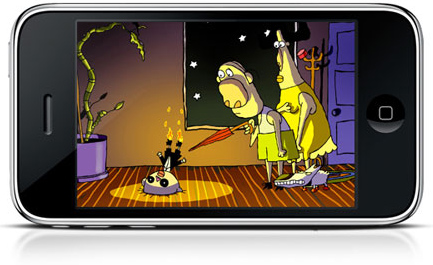
National Film Board of Canada Releases Huge Film Library for iPhone App

Iphone-App_blanc_horizontal1

The NFB (National Film Board of Canada) has just released a new free iPhone app that lets you watch hundreds of their films.  You can use the app even while you’re away from hotspots by downloading films for viewing during a 24-hour period.  The NFB is one of my favorite places on the web for film.  They just do it the right way.  They make it easy.

This is an excellent way to distribute their huge collection of ground-breaking films.

You can get the app at the iTunes store.

Horror Movie: The Road to Moloch

Here’s a horror movie about some U.S. soldiers in Iraq who face an ancient evil in a cave.
This is very mature subject matter with extreme violence and mature language. Not for young viewers.

This is not a very good film. That’s why I posted it. The filmmaking interests me because of its complete lack of vision. It tries to replicate to perfection other films that the director has seen. The director wants to be a professional and get hired somewhere. It shows in his work. Sorry, sir, but you put it out there and I’m calling it like I see it. The problem here is that the film is not frightening. It’s slick and well-shot, like television or feature films, but it spends all its energy that way. You don’t scare people by being professional. You don’t scare them by being violent. You scare them by showing them that you – director – are a little bit off.

That’s how you scare an audience. Not with professionalism. Try again and make it real this time.

Horror Movie: The Curse of Frankenstein

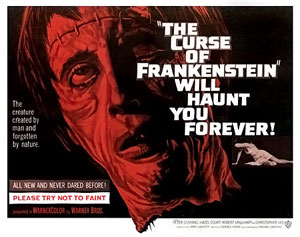
CurseoffrankensteinIn keeping with our horrific new game, Frankenstein – The Creature Must Die!, here’s a 1957 Hammer Film called The Curse of Frankenstein.  It stars Peter Cushing as Victor Frankenstein and Christopher Lee as the monster.

This version of the Frankenstein story caused critical outrage when it was released.  It was ground-breaking in its level of gore and violence and it kicked off a long series of popular horror flicks from Britain’s Hammer Film Productions.

New Film: Lunch With Bardot


My latest little film. It’s actually a cinegram. The subject is trains. Time. Memory. The present doesn’t exist. You can’t find it with measurement. You can’t even define it. The future is not there yet. You cannot see it. The only thing that really exists is the past. I say that because we can all see the past – some more clearly than others. But we can most certainly see it.

A cinegram is a short motion picture that uses images and text that are packed with meaning and suggestion. It’s my new word for things I once referred to as film poems.

Here’s the poem from inside the movie:

Lunch With Bardot

Trains run on time
With passengers asleep
Temporarily forgotten
Between observation points
Colliding lines
Of fictional transport

German Film Directer Werner Herzog Eats His Shoe

He’s a German film director named Werner Herzog and in 1980 he made a bet with another filmmaker that if that other guy actually finished his first feature film Herzog would sit down in front of cameras and eat his own shoe. The friend did finish his movie, and so Mr. Herzog sat down to dine upon his footwear. During the strange event, he talks about how deadly television is and how we must fight its influence. It’s an old refrain, but he puts it in a way that I’ve not heard before. He goes on to talk about how we as a culture have not developed adequate images.  I’m not sure he’s right about this, but he certainly thinks he is and that’s always fun to watch. He is deadly serious about what he’s saying, but of course you must not forget that during it all he is cooking and eating a shoe. I always love to see people who are being funny while being totally serious.

Noteboek: A Tricky Hand-Drawn Live-Action Film

Noteboek is one of those films that illustrate what personal filmmaking is. It’s an artist’s hand-made, direct expression. Evelien Lohbeck is the performer and animator in this little gem. There’s something a little Chaplin-like in her clever tricks with drawings and food. I love the part where she’s reflected in the drawing in her notebook. This is really excellent and gently humorous work.

A Wolf Loves Pork: Stop Motion Photo Animation

Takeuchi Jaijin made this film by photographing the action in stop motion then photographing the photos again in his room.  He makes the action seem to take place all along his walls, countertops and floors.  I love the way the boy dives into the filled sink and swims across!  The photo animation technique reminds me of the photo collages of artist David Hockney.

Thanks to David Pescovitz at BoingBoing for posting this.

It is Repose in the Light: A Film by Jennifer MacMillan

It is repose in the light, neither fever nor languor,
on a bed or on a meadow.

It is the friend neither violent nor weak. The friend.

It is the beloved neither tormenting nor tormented. The beloved.

Air and the world not sought. Life.

— Rimbaud, “Vigils”

This film is by Jennifer MacMillan who runs the Invisible Cinema blog where she posts about experimental film and her own poetic interests and observations. She makes many wonderful short films that are the highlight of her blog. She made this one to accompany a poem by Arthur Rimbaud.  Beautiful and thought-provoking.

Film Taken From Streetcar in 1908 Barcelona

Here’s an absolutely fascinating film shot from the front of a streetcar in Barcelona, Spain.  Look at the way the people in the city of 1908 run along with the streetcar trying to see and be seen by the camera.  They seem to be full of joy and excitement.  They run along and ride bikes and wave.  Can you imagine people acting this openly today?  There’s something profound in this little film.  It just goes on along the tracks and through the crowds of happy onlookers without trying to make a point of any kind, but it makes a strong impression.  Wonderful film.  Watch it through to the end.  It will make you feel inexplicably happy.