This is a beautiful graphic novel written by Susan Schade and illustrated by Jon Buller for readers 9 – 12 years old. It’s about a post-apocalyptic world in which humans are gone and only exist in legends and in the artifacts of their once-great civilizations. After being swept away by a flood, Thelonious finds himself in a city filled with criminal animals. As he tries to find his way home again he discovers clues about what happened to all the humans.
The Hunt for Gollum is a 40-minute fan-made film that will be available for free downloading on May 3, 2009. The film was made through open collaboration of enthusiastic fans working under the leadership of director Chris Bouchard. The all-volunteer production looks so much like a Peter Jackson LOTR movie that it’s almost scary. One wonders why all the big budget money was spent if the films could have been produced by this crew of hard-working talented volunteers! This film looks like it’s going to be a serious lot of fun and will be a great addition to the LOTR world for its fans.
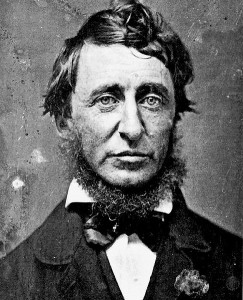
In 1839, Henry David Thoreau and his brother made a river voyage in a boat that they built themselves. This voyage became the subject of Thoreau’s first book, A Week on the Concord and Merrimack Rivers, published in 1849 at his own expense. In this thirty-three minute excerpt, Thoreau finds himself describing the incredible beauty and serenity of the natural scene around him. But his mind wanders into a profound examination of poetry and the requirements of good writing. His call to man for a life of poetry and his demand that writers create simply from an impulse to action are powerful and true. I don’t think there is a better piece of advice that exists for writers and readers alike.
Thoreau frequently quotes from Homer’s Iliad and other sources in this piece. I have tried to separate his quotes with pauses and a change in reading tone. You might want to glance at the actual words as you listen for clarification.
Here is the text of the reading:
What would we not give for some great poem to read now, which
would be in harmony with the scenery,–for if men read aright,
methinks they would never read anything but poems. No history nor
philosophy can supply their place.
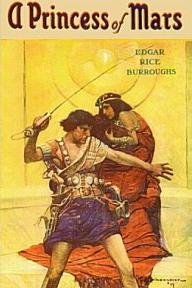
This is the first John Carter of Mars novel by Edgar Rice Burroughs, the author of the Tarzan books. It was his first novel, published in 1917 and it’s a work of rip-roaring science fiction that has inspired many of the great writers in the genre.
Chapter 4: John Carter is a prisoner of the strange martians. He is taken to a magnificent structure where he is introduced under strange circumstances to a leader of the martian warriors.
You’ll find regular podcasts of all the chapters over the next couple of months. Subscribe to our feed.
Poetry Through the Ages is an excellent site that offers clear and concise explanations of different poetic forms, a general history of poetry and a simple guide to reading and appreciating difficult poems.
“When a poem arises, it feels like the bosom of the poet lifts up and births the spoken or written moment. The point of origin lies at the furthest depths of the poet, often calling into play ancestral memories, divine or universal inspiration, and insights or truths that “magically” resonate with the reader.”
Tesfaye is a film by Brent Gudgel, made for Eden Reforestation Projects. It’s the story of an Ethiopian man who blames himself for helping to destroy the trees of his country. Now he wants to help fix the problem. It’s a beautiful film told with great simplicity and seriousness. It is the clear and direct communication from the man in the film that makes it so effective.
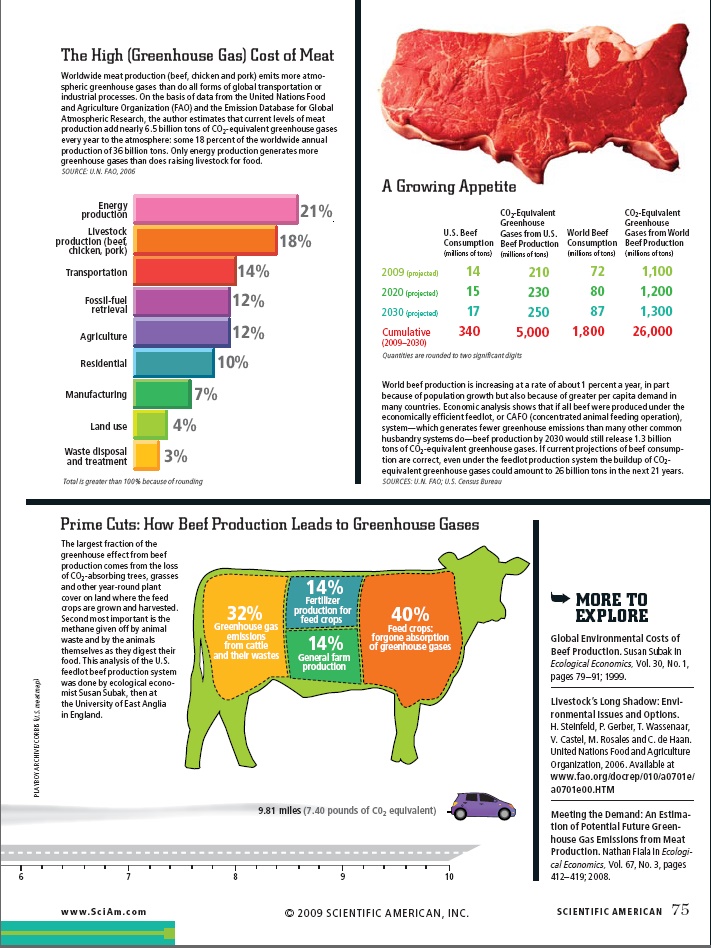
Scientific American published the page of charts on the left. Click the image to get a high-res version. It explains how bad for the environment the production and consumption of meat really is. According to the magazine, the annual beef diet of the average American emits as much greenhouse gas into the atmosphere as a car driven approximately 1,800 miles.
That’s very bad. Here’s another statistic: According to Environmental Defense, if every American skipped one meal of chicken per week and substituted vegetarian foods instead, the carbon dioxide savings would be the same as taking more than half a million cars off of U.S. roads.
The New York Times produced this environmental film that follows a group of Oberlin College students for a day of green ideas that they used on their group student house. Their sustainable living ideas are easy to do and fun. Their methods for capture and reuse of water are effective and cost nothing to implement. I really like their very balanced view of sustainable energy and resources. They also go out to peoples’ homes in the area and exchange regular incandescent lightbulbs for energy-efficient compact fluorescent lightbulbs.
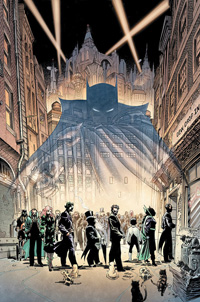
DC Comics picked Neil Gaiman to write the final two issues of their monthly Detective Comics. The two-part series is called Whatever Happened to the Caped Crusader? It chronicles the death of Batman. This July, both issues of the comic will go on sale in a hardcover version. After a period of no Batman comics, DC intends to reboot the franchise with new stories. That sounds interesting.
The Gaiman story about Batman’s death sounds fascinating and the artwork looks incredible. The issues were pencilled by Andy Kubert and inked by Scott Williams. This looks like Batman comics just the way I like to see them.
Heliotrope is a free quarterly magazine of speculative fiction that publishes stories, poetry and articles. This issue features a story by Neil Gaiman called One Life, Furnished in Early Moorcock. There are also several articles about writer Michael Moorcock’s profound influence on the science fiction and fantasy genres. His most popular works are the Elric of Melniboné stories.
Fear on Demand is an excellent horror story podcast. Their latest offering is Room 412 by Michael Laimo. The narrator is Gord Mackenzie. When a man checks into a hotel during a business trip he is irritated by a constant thumping from the room next door. What’s making that noise? His terror mounts as the circumstances around room 412 become increasingly bizarre.
The story really had me sitting perfectly still with complete dread.
Moon is a new science fiction film directed by Duncan Jones. It stars Sam Rockwell as a man administering a lonely moon base for a shift that lasts several years. The trailer looks pretty good, but I’m not sold on it. I do like to see a serious science fiction film getting projected in theaters after the horrific damage that’s been done to the genre by clever little men like George Lucas. In fact, I blame Lucas more than Tolkien for the fact that every bookstore loads its science fiction shelves with sword fantasy books. As soon as the idiotic Obi Wan Kenobi pulled out a lightsaber, the sci-fi film genre was doomed. But this thing looks from its trailer to be a mashup of homages to 2001: A Space Odyssey, Silent Running and Solaris. I just don’t get into ‘homage’ movies. A little subtle homage is fine. But this trailer is just packed to the gills with barely altered rips right out of these classic films. No serious science fiction director makes a movie that’s an homage to other movies. Stanley Kubrick would have choked on a chess piece if someone had suggested such a thing to him. So, I’m sure I’ll give this movie a chance and go see it, but I fear that it will be exactly the movie it appears to be in its trailer. The effects do have that wonderful super-reality quality to them that 2001 and television show Space 1999 had.
Well… it better not jam. That’s my two cents. But really this is a neat idea. A book printer. It lets a user download, print, and bind a real book in just a few minutes. The New York Public Library has one. I’m not sure if one is expected to return the books it prints, but if they think it’s a good machine, it probably is. The Bibliotheca Alexandrina in Egypt has one. This is the kind of machine that makes online book printing services like Lulu.com really start making sense. Of course, the shops and libraries must keep themselves supplied with the right paper and cover materials. But it is quite obvious that the days of publishers shipping cartons of books to bookstores all over the world in such bulk are very numbered. Pretty soon there will be a book printer in many homes. That’s assuming that everyone doesn’t switch to ebooks. But with companies like Amazon building portable cash registers instead of real ebook devices, that will not happen for a long time.
I was very interested in a post about Henry David Thoreau at BoingBoing this weekend. I got into one of those wonderfully dignified arguments in the comments with other Thoreau lovers and haters. But one of the commenters posted a link to this fascinating podcast episode in which a Thomas Jefferson fan and expert named Clay Jenkinson discusses Thoreau’s masterwork and its connection to the thinking of Jefferson. It’s a great listen and has me all excited about Walden again. In fact, I think I’m going to do a full reading the book right here. Perhaps I’ll start it this week. We’ll see. But I certainly think it needs to be read with all the punkish attitude and brilliant observation that I see in the book. If you want to read Walden, you sort of have to become Henry David Thoreau for a while. Not an easy task.
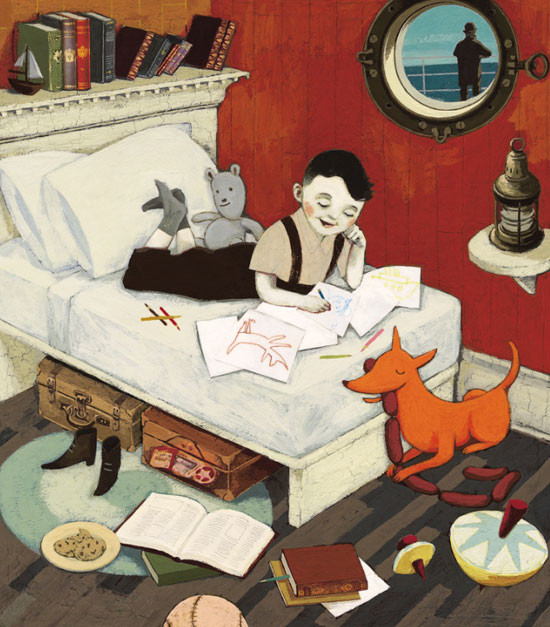
This is an illustration by Isabelle Arsenault for a picture book called Mr. Gauguin’s Heart, published in 2004. She is based in Montreal, Canada and has been a finalist for The Governor General’s Literary Awards in 2008.
I like the oil-painting approach and the way she evokes illustration styles from the past.
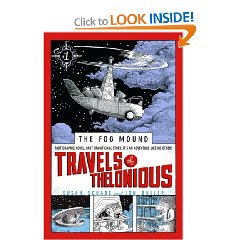 Travels of Thelonious (Fog Mound)







 This is an illustration by