A 5-year-old girl named Phoebe decided she wanted to collect cans in order to raise money from the 5-cent per can deposits. With the help of her day care center in San Francisco, she raised $3,736.30 from cans and cash donations. That translated into 17,800 people being fed via local food banks. If a 5-year-old can do that, imagine what wealthy Americans and corporations could do.
Author Archives: Editor
Five Chapters Offers Serialized Stories
 Five Chapters is a literary site that offers stories in 5-chapter installments each week. Begun by magazine editor Dave Daley, Five Chapters has published over 150 stories by such authors as Stewart O’Nan, Arthur Phillips, Curtis Sittenfeld, John Wray, Wells Tower, Julia Glass, Darin Strauss, Jay McInerney and Kate Christensen. The site has an incredible simplicity that fully focuses the visitor on the story being offered.
Here’s a Washington Post article about the site.
Cambridge Police Arrest Famous Black Professor for Breaking No Law
 Well-known black Harvard professor Henry Louis Gates Jr. was returning home from a trip when he and his driver found that the front door to Gate’s home was jammed. The professor went into his home through the back door and and helped the driver push the front door open. Meanwhile, a neighbor, suspecting a burglary, called the police. Of course, you might wonder why the neighbor didn’t spend a bit more time figuring out that the homeowner was simply opening his own door. But that’s not the real story.
The real story is that when the Cambridge, Massachusetts police showed up, professor Gates didn’t like the way the officer treated him and he did not cooperate fully with the officer. Remember that in United States we are under no legal obligation whatsoever to cooperate with a police officer who is asking questions. We don’t have to say anything. Professor Gates decided that since he was inside his own home the cop had no business asking him to prove that he was in fact in his own home. This is a perfectly justifiable attitude to have inside one’s own home. A police officer must be extremely cautious in dealing with a situation like this, especially when it becomes quite clear to anyone of average intelligence that it really is the homeowner the officer is dealing with. So professor Gates decided to give the officer a good piece of his mind. He apparently refused to show ID then changed his mind and did. He apparently told the officer that he was being racially profiled and that he was suffering under the treatment given to blacks by law enforcement. He may have insulted the officer and yelled at him. He may have insulted the officer’s mother.
The officer says that there are radio call recordings that will prove professor Gates was yelling in the background. So, this Cambridge police officer arrested professor Gates for ‘disorderly conduct’ – in his own home. Disorderly conduct for being angry at a police officer in his own home. Disorderly conduct is a very vague statute in most states, used primarily to give officers the ability to round people up for simply being uncooperative. Basically, if a cop doesn’t like you, he or she can arrest you for ‘disorderly conduct.’
I post about this episode at length because it goes straight to the heart of free speech in this country. Law enforcement versus free speech is the subject. We are living during a time when law enforcement seems to think it can record the phone calls of American citizens without a search warrant, physically assault journalists during the Democratic and Republican conventions, and harass photographers in public places while attempting to confiscate their equipment. Police in Minneapolis, Minnesota staged an armed assault on a young peaceful protest group just prior to the Republican Presidential Convention in 2008. They burst into their house with weapons drawn and made these young people lie on the floor while illegally searching the house because they wanted to prevent the group from protesting near the convention. Much of this was caught on video and witnessed by onlookers. Many police officers around the nation seem to have very little understanding of what constitutes protected free speech and what constitutes a real threat. Some officers actually do understand the difference but choose to ignore the law.
If professor Gates insulted the officer in his home, it’s protected free speech. If he insulted the officer’s mother, it’s protected free speech. I he called the officer a racist, it’s protected free speech. None of it matters in the slightest. The correct response from a police officer in such a situation is to shrug it off and say, ‘Have a nice day.’ To arrest someone for behaving the way professor Gates did is outrageous and stupid. Just like president Obama says: the Cambridge police acted stupidly.
Now the Cambridge police department is furious that Obama has insulted them and they demand an apology. Obama owes them no such apology. He called them stupid and they most certainly are. All you need to know about this arrest is that prosecutors refused to press charges and all charges were dropped. That means it was a bad arrest. That means the police behaved stupidly and made an arrest that was not supported by law. They arrested someone for breaking no law. I cannot think of a better word for it than ‘stupid.’
To arrest a prominent black scholar for expressing his outrage inside his own home to police officers is stupid and might possibly be an act of racism. The police are now parading a black officer around who was at the scene of the stupidity and says he supports the arrest because ‘Mr. Gates was acting strange.’ Acting strange. Obviously, being a black Cambridge cop has not prevented this guy from being stupid. We are not supposed to be arresting people in the United States for ‘acting strange.’ If there’s a cop on a force who thinks that acting strange qualifies for an arrest, he or she should be let go pronto.
So we join president Obama in calling the Cambridge police who arrested professor Gates stupid. They also seem to be poorly trained, insensitive, unaware of legal protections for free speech, and perhaps somewhat racially biased. The race part really isn’t the important part because we don’t know if anyone on the scene really is racist. But we do know beyond any doubt whatsoever that the police on the scene arrested someone for exercising his right to free speech.
Officer Friendly sure isn’t working up in Cambridge, Massachusetts.
Podcast Novel: Pirate Jack (Chapter 6)
This book contains pirate battles, violence and death. Please use your judgment before playing for very young children.
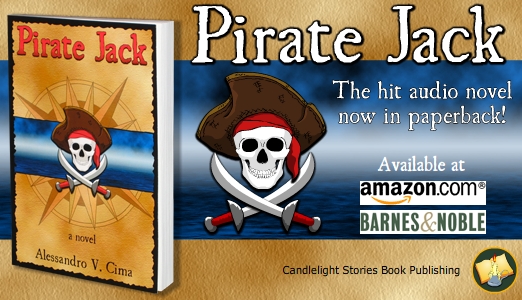
Here’s a free podcast of our fantastic pirate adventure novel written for young readers. It’s got hidden scrolls, time travel, ships, battles, navigation, gold, islands, jungles and helicopters in it.

You can purchase the paperback from Barnes & Noble (Price: $11.95)
You can also get it on Scribd.com as a download for just $1.99
Description:
Young Jack Spencer sees his father’s boat-building business destroyed by a powerful land developer. Then Jack unearths three ancient scrolls that propel him on a dangerous adventure through time in search of a pirate treasure.
When Jack finds himself aboard the pirate ship Revenge with Captain Jameson’s crew, he enters a life or death world of ship battles, jungle islands, prison escapes, gold, and treachery.
Set during the golden age of Caribbean piracy, Pirate Jack combines rollicking adventure with the moving story of a boy’s love for his father and a courageous effort to save a way of life.
You’ll find regular podcasts of all the chapters over the next couple of months. Subscribe to our feed.
This book is read by the author.
All audio stories are Copyright © Candlelight Stories, Inc., All Rights Reserved.
40-Year Anniversary of Apollo 11 Moon Landing
Forty years ago today, on July 20, 1969, Apollo 11 landed humans on the moon. Amazing. We should really go back… if we still know how.
Amazon Deletes Purchased Copies of ‘1984’ and ‘Animal Farm’ From Kindles
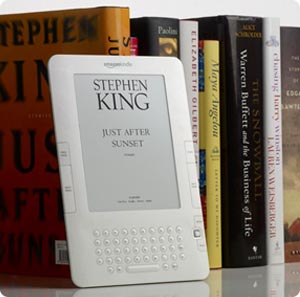 We have totally had enough of Amazon.com at Candlelight Stories and have completely removed them from advertising space on this site and permanently severed our ‘associate’ relationship with the company. The reason is simple. Over the weekend, Amazon went into customers’ Kindle ebook devices and deleted purchased copies of George Orwell’s classic novels, Nineteen Eighty-Four and Animal Farm. Apparently, the U.S. owner of the novels’ copyrights either decided to change its mind about offering an ebook of the novels or complained about illegal electronic copies on Amazon. So Amazon removed them from the site and then reached out into Kindle devices that are legally owned and whose owners had legally purchased Nineteen Eighty-Four and Animal Farm from Amazon’s own site and completely removed all traces of the novels from those devises. I call it an eBurn.
What this means is that when you buy a Kindle ebook device you don’t actually own the device or anything on it. Amazon does. They can simply reach into your device and destroy any file they want to at any time, without your knowledge or permission. I call that vandalism. I think any company behaving that way should face a class action lawsuit and be investigated for violations of law. I will not allow Candlelight Stories to engage in any further business with such a company and cannot recommend that anyone purchase a Kindle or any electronic file from Amazon.com whatsoever. What Amazon did was basically like this: imagine you go to buy a book for $14.95 at a Barnes & Nobel store. Then Barnes & Nobel decides for whatever reason that they actually didn’t really want to sell you that book. So they send an employee into your home while you’re out to remove the book from your bookshelf and leave $14.95 under your pillow. That’s exactly what Amazon thinks it can do to you. Appalling. George Orwell must at this moment be laughing in his grave. And the joke’s on Amazon.
Amazon has gotten into the habit recently of engaging in digital censorship and then apologizing once they get wind of a public outcry. They then try to spin their bad behavior as a technical glitch that won’t happen again. They have replied to this latest debacle by saying that it happens ‘rarely’ and that it will not happen again. We do not believe them. What this episode proves beyond any shadow of doubt is that the company can press a button and blow away any book you may have purchased. Refunding the purchases simply does not make up for this grotesque behavior. So, when you buy a Kindle, you really don’t own anything. You are simply renting a little portable Amazon cash register that Amazon retains full rights to. Companies like Amazon are building distribution systems that make censorship as easy as the press of a button. How far are we willing to go in allowing just a few companies to control the distribution of most of our literature and reference material. If that handful of companies decides it doesn’t like the politics of a certain kind of literature, it can blow it away completely by pressing a button or entering a simple code. Book burnings have never been able to eradicate ideas so efficiently. We now have something new: the eBurn. No company that cared in the slightest for literature or for books would ever behave this way for any reason. I am disgusted and horrified by Amazon. I actually bought a television through Amazon. Now I’m wondering if they can get inside it and delete my favorite TV shows. My digital camera. Can they blow away my vacation photos?
We have an excellent open-source web browser called Firefox, we now desperately need an open-source ebook device that allows us to purchase from any bookseller in any format available. Hey, Mozilla, are you listening?
Oh, and by the way, here’s a technology writer to stay away from. He actually says he thinks it’s a good idea for Amazon to sneak into Kindles and destroy books: Read his dimwitted comments on nothing other than C-Net.com.
Interactive Moon Mission Underway

Yesterday I posted about the JFK Presidential Library’s interactive recreation of the 1969 Apollo 11 moon landing mission. The mission has now reached stage 6 with the command module at a distance of 22,000 nautical miles from earth. The site is doing an absolutely marvelous job of making you feel as if you are riding along with the historic Apollo 11 mission. They have all the real-time radio communications between the astronauts and Mission Control. So you can listen to exactly what was happening through every second of the entire mission! They also have video clips that fit the current point you are watching in the mission.
This was an excellent web idea and it is extremely well executed. I can’t wait until they reach the part with the Lunar LEM trying to find its landing spot on the moon! Go see the We Choose the Moon site right away!
Real-Time Interactive Recreation of 1969 Trip to Moon

At 8:02 am Pacific Time, Thursday July 16, the John F. Kennedy Presidential Library’s We Choose the Moon project recreates the launch of the Apollo 11 moon rocket. The interactive site will recreate the entire mission to the moon down to the minute, complete with status reports, images, 3D animations and even Twitter updates. The site is very slick and recreates the anticipation before a launch at the space center quite well. You even hear the seagulls flying around the launchpad as you watch the rocket on waiting for liftoff.
This is about as close to the moon as we’re likely to get for quite some time since the national ‘let’s go to the moon again’ quagmire persists in spite of the fact that Nasa has no more spaceships to fly once the shuttle heads for the junkyard. The International Space Station is quite possibly going to be dumped into the ocean in 2016 due to lack of interest. But a space agency that can run radio-controlled cars on the surface of Mars is at least doing something with its money.
Animation: The Astronomer’s Dream
The Astronomer’s Dream is by Malcolm Sutherland. I can hardly make any sense out of it but I see endless repetition, making of the same mistakes over and over again, Buddhism, the serpent eating its own tail, ancient Mayan predictions and star observations, evolution, looking out equals looking in. That’s all I can make of it. It’s a strange piece of work. I like all the little lines and dashes in the weirdo drawings.
Frank Baum and ‘The Wizard of Oz’
This is the oldest known film version of The Wonderful Wizard of Oz, made in 1910. It was made by the Selig Polyscope Company and did not involve the author, L. Frank Baum.
Smithsonian Magazine has an article called Frank Baum, the Man Behind the Curtain. It describes how Baum came to write what amounted to the first American children’s book and how he was so convinced he’d written a great book that he framed the pencil stub he’d written it with.
‘Pirate Jack’ Novel on Scribd.com for Download
I just went and uploaded the print version of the Pirate Jack adventure novel to Scribd.com. That’s the embedded preview of the book in their viewer above. You can read about 53 pages of the book for free and then pay $1.99 to get the entire thing. It’s the book version of our Pirate Jack podcast that you can find in our audio section. We’re putting new chapters of the audio up each week. I think $1.99 is a pretty good price for the whole book in downloadable Adobe PDF format. If you buy it have a great read!
Mystery Contest Winner
The winner of our April 2009 Mystery Contest is Pippa, age 10!
Congratulations to the winner! Pippa has written an imaginative and interesting continuation of the story that is a pleasant surprise.
Riley’s Crypt
The trees of the forest bent over sideways in the howling wind. The white disk of the full moon shimmered behind the swaying branches. Southbay Forest was being battered by the storm. Rain began to pelt the ground. It was an altogether nasty evening.
Riley Hitchens made his way along the muddy path with dread. The lantern’s feeble light swung wildly back and forth across the narrow way as his fingers gripped its handle tightly.
It was just an old crypt. That’s all. Nothing but a pile of old stones with a rusty iron door. That door was clanging in the wind now. It had disturbed Riley’s sleep.
So now poor Riley staggered in his soaking nightclothes toward the crypt that was creating such a din.
A wolf howled.
Riley stopped in his soggy tracks and glanced behind him. A shape flashed between the trees. He lurched forward and bolted down the mud path toward the old stone crypt.
He burst through the half-open door and sucked the dank air into his lungs. His mud-caked slippers echoed in the stone chamber. The rain pounded the forest outside. Just ahead, Riley could make out the dim shape of the tunnel entrance.
He stopped and felt the cold sweat of terror at the back of his neck.
From far down the dark winding way of the tunnel, underneath the raging of the storm, came the delicate sound of… music.
The winner’s story continues from this point…
YouTube Offering Citizen Journalism
A fascinating development at YouTube: The Reporters’ Center, where you can get tips on effective journalism from prominent reporters. The new YouTube channel went live today and is already offering some interesting how-to videos like the one above by reporter Nicholas Kristof of the New York Times. He shows you how to be careful when trying to interview war lords with big guns, how to hide your money, and how to always be a little skeptical and double-check witness accounts and stories that sound too good. Arianna Huffington of The Huffington Post has a video about the impact of citizen journalism best demonstrated by the recent uprising in Iran. During the past few weeks, the government of Iran tried to shut down the operations of journalists and restrict the use of internet and text messaging in order to suppress information about government violence against protesters. But they were not able to prevent people with cell phone cameras from making videos and sending them out of the country for the world to see. These people have also been reporting on the situation via Twitter to give real-time coverage of many events in Iran.
This movement toward citizen journalism is extremely interesting because it democratizes the press. Cameras in the hands of millions become a formidable tool for keeping an eye on government and limiting its ability to suppress information. The press has always functioned like a fourth branch of the U.S. government, preventing the administrative, legislative, and judiciary from thinking they operate out of sight. In fact, it probably wouldn’t hurt to constitutionally formalize the press as some kind of fourth branch!
We Make Stories: Oddly Deceptive Membership Site from Penguin Books
 Penguin’s Puffin Books has a new membership site called We Make Stories, where kids can use an online tool to create stories. There are several types of story creation, including a remix tool to use on existing classic tales, a map maker, and a comic book style creator. It’s all drag and drop type stuff and is intended to teach creativity and encourage literacy.
While this is reasonably fun-looking, I cannot understand why a site would present itself for pay membership and not really give any useful demonstration versions of its tools. There is a single demo based on remixing old stories, but this is not sufficient to make me want to offer $9.99. That price, by the way, is very effectively hidden from view and presented in a rather disturbing manner. Here’s what I mean:
1. First create a user name and password and give us your parent’s email address.
2. Your parent will then get an email asking them to pay for the membership (£5.99/$9.99).
3. Once your parent has paid this, your membership will be activated and you can start to play all the games.
Those are the instruction on the sign-up page. So kids are expected to blunder forth and sign up without the benefit of an effective demonstration. Give away a parent’s email address without permission. Then the parent receives an email demanding money. No sir. Absolutely not. You put the price in big print on the front page and you don’t mislead children into presenting their parents with an unexpected request for money. Everything should be up-front and visible right at the beginning. I just can’t believe what I’m seeing online from a major publisher. Perhaps we have here an example of how the publishing industry intends to get money out of people – by tricking their children.
Animation: Red Rabbit
Egmont Mayer of Germany made this 3D animated film. A man lives with his secret rabbit and cuts his social interactions to nearly nothing as a result of his shame. I like the way animators are starting to revel in making their films look like they are rendered in 3D software rather than trying to defeat the software to make things look realistic.