
Photo: Detour
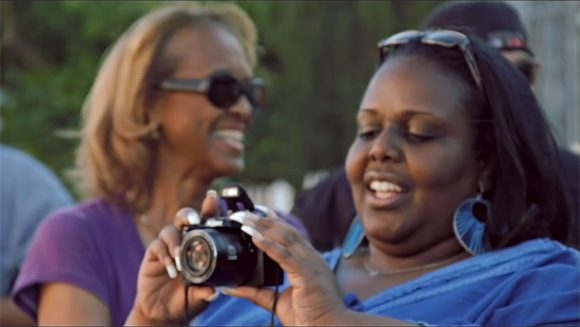
Artist Michael Heizer’s enormous new work on the grounds of the Los Angeles County Museum of Art required a 340-ton boulder as its centerpiece. The boulder had to be transported over 100 miles from its quarry. At first, I was very interested in this rock. It’s huge! But soon I became more interested in the city’s reaction to the rock. So this film documents the final few miles of the rock’s journey, but it also documents the people who came out to be a part of the great Los Angeles rock transport. The film is part documentary and part personal impression. The simple fact of the matter is that the rock’s arrival is an unusual milestone in the life of this city. You can tell that simply by looking at the faces in my film.
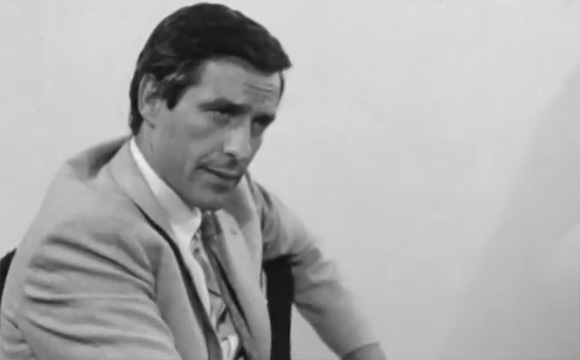
John Cassavetes’ first film was called ‘Shadows.’ It was made in 1959 and I think it might be the greatest film about race in America that’s ever been made. Cassavetes has always struck me as having an element of that required con-man aspect of the personality that is present in many good actors. When he talks he seems impressed with what he is saying and he knows how to deliver it with just the right amount of humor and a few self-deprecating remarks. But he means every goddamn word of it and he puts all of his thoughts into his film works. He’s one of those rare objects of confusion that sometimes crop up in American art. I’ve been watching a bunch of his films lately and I don’t think I’ve ever seen a filmmaker so interested in looking at the inability of the American adult to understand or even perceive the meaning of their habitual mannerisms. For me, his films illuminate what it means to be a grownup and how the performance required of grownups contrasts with what they really want to be.
Cassavetes on making ‘Shadows:’
That people can go out with nothing and through their own will and through their determination make something that exists… out of nothing. Out of no technical know-how, no equipment. There wasn’t one technician on the entire film. There wasn’t anybody who knew how to run a camera… walked in and started to read the directions of how to reload it. Got a Movieola and looked at it. Did all the things in the world and we made eight million mistakes. But it was exciting and fun.
This is a 1968 French documentary that was probably shot just after or during the making of his great marriage disaster film, ‘Faces.’
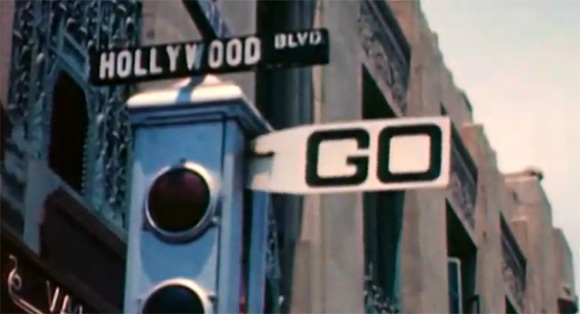
The film eventually tries to justify its title with a few shots of Christmas decorations and clubs where New Years could be properly celebrated.
While I was running through the Getty Center’s flagship portion of the massive citywide ‘Pacific Standard Time‘ art exhibit, I was struck by just how great this Wallace Berman fellow really was. Known primarily as the ‘father’ of assemblage art, he was also a member of the Beat Movement. He made a single film which occupied much of his time through the 1960s and 70s. It’s less than eight minutes long and it’s a drop dead gorgeous thing to see. He’s one of those film artists interested in what I like to call the messy image. The film seems to have been dragged through ink and dirt. It’s been scratched, wrinkled, folded, cut, slashed and stained. Letters flash by like subliminal messages. Pop culture crashes into modern art. He films magazines, papers, radios, faces, hands, rock stars, body parts, buildings, streets and apparently just about everything he had lying around in his studio. This film is a quiet little reminder that crystal clear HD and super sharp focus are not anywhere near the concerns of some artists.
And here is California assemblage artist George Herms talking about Berman recently as part of the Pacific Standard Time series of exhibits:
Pacific Standard Time is a massive overview of Los Angeles art from 1945 to 1980. At least sixty galleries and museums are taking part over the next few months. I have already been to the largest exhibits at the Museum of Contemporary Art, Los Angeles County Museum of Art, and the Getty Center. The whole thing is a lot of fun and I have discovered artists I never knew about before. There are magnificent things on display and the curators have also published big books to go along with each exhibit. I seriously recommend that you always get the books because they have far more information in them than the exhibits themselves. I view it as my own effort to compile a record of this unique regional art show.
You can find almost everything you need at the Pacific Standard Time web site.
This film was put together for the Getty Center’s flagship exhibit, Crosscurrents, which covers 1950 to 1970. It’s a very nice little documentary about some of the major art developments in Los Angeles.
Oliver Riley-Smith made this short documentary about the disappearing mural art of Los Angeles. It features a prominent muralist complaining about how murals have been ‘bludgeoned by graffiti’ and ‘censored by the city.’ Perhaps so. The city does make it difficult to get permits for murals. But I don’t really like murals. They tend to be stiff and unoriginal. I like the murals that have been vandalized by the graffiti artists. Sorry but I do. They are much more interesting than the clean murals which are entirely unimaginative and offer nothing to move art in any direction whatsoever. If muralists want to preserve their images, they should paint indoors. Look at the mural on the highway underpass wall that’s covered with graffiti at the 42 second mark in the film. Beautiful. Much better than the mural ever was. The muralist in the film says, ‘Museums are for the dead. I want life.’
Bullshit.
There’s a guy in this film called ‘Ghost One.’ I like what he says about art. He’s realistic and open to whatever comes along. He says that taggers mark up murals because they assume that their marks will have more longevity that way. That’s a very interesting thought. An artists seeks longevity by making his mark inside the work of another artist. Fascinating. Much more interesting than the murals. Such thinking shows possibility.
But then the film draws the two sides together and our muralist says he ‘hopes our two styles can work together.’ Well, they can’t really, but it’s a nice thought.
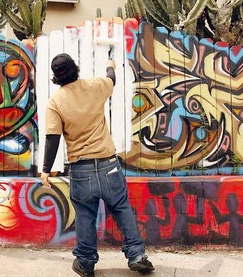 The Los Angeles Times reports that the City Council is easing its restrictions on outdoor murals. It will no longer classify them the same way it does billboards. Since 2002 it has been illegal to paint a mural on private or public property because the artworks are considered advertisements. But Los Angeles is going to try to do a better job of distinguishing between the two.
Of course this will all get muddled again as soon as an artist paints a figure holding a can of Coke! Is it art or is it an ad? As a rule though, it is never difficult to tell when something is a giant ad and when it’s not. It just takes a little common sense and observation. Surely the City Council can manage this.
But the bottom line is that the murals of L.A. are inspiring and extraordinary. The city needs to reclaim its title as ‘The Mural Capital of the World!’
The photo is a portion of a photo by Al Seib for the Los Angeles Times, April 6, 2011.
Former Rage Against the Machine member, Tom Morello, who has been playing for and talking to Occupy Wall Street and Occupy Los Angeles, speaks with reporters about what is going on with this explosive movement.
And here is a repost of my film, ‘One Day Occupy L.A.,’ which features an incredible live soundtrack of Morello playing for the protest in Los Angeles just this week.
Sam Slovick made this 2008 documentary on skid row in downtown Los Angeles. The area is home to approximately 9,000 homeless people who deal with life on the streets, drugs, crime and serious physical and mental health issues. The film was made just prior to the massive economic collapse of 2008 when the numbers of homeless began to rapidly increase.
Parts 3 through 5 follow the jump.
I went down to the demonstration to make a film. I liked the people there. They were very focused and happy. They were talking, explaining, arguing, educating, dancing, singing, playing, making signs, painting, photographing. Some of them made speeches at the microphone. Some read poems. There were lots of cameras.
The music and words in this film are by Tom Morello (http://nightwatchmanmusic.com), former Rage Against the Machine guitarist. He sings his own ‘Maximum Firepower’ and Woody Guthrie’s ‘This Land is Your Land.’
The mood at City Hall was high energy and cheerful. The underlying anger and frustration of the movement seemed to be moving through a positive channel. It was exciting but also comfortable there because of the people and their open attitudes.
The Los Angeles police headquarters is directly across the street from the protest grounds. That’s where I began shooting my film – right into the windows of police headquarters. Several squad cars drove up First Street, but there was not a single cop anywhere near the protest area. The crowd is organized and respectful, but also very serious about its messages which are various and multifaceted.
The city has taken a protective stance over its protesters. I’m very proud of Los Angeles for this.
Occupy Los Angeles is one of the spreading protests coming out of the Occupy Wall Street protest in New York. Hopefully, the incredible momentum of the movement will continue and be heard very clearly across the country and the world.
The simple messages that I get from the protests are that government cannot function while it is under the control and influence of corporations. The economy cannot function properly while corporations and their extremely wealthy owners are allowed to operate without oversight and control. The country cannot pave its roads or build its schools or house its people while corporations and the wealthy play with money that is nearly tax-free, removing it entirely from the real world economy. The country cannot function as a democracy while its politicians and Supreme Court justices are working for corporations. The country cannot be free while racism and bigotry are increasingly seen as legitimate reactions to change. The country cannot be secure while corporations are given the power to run wars and people’s basic privacy rights are removed.
That’s what I see in the Occupy movement.
If every city in the U.S. could have as fine an Occupy movement as Los Angeles, they would be very lucky indeed.
Pacific Standard Time, the roaringly cheerful celebration by Southern California of its own art from the late 40s through the early 80s is releasing short videos to pump everyone up for its brand of art. I should be horrified by this silly video, but I’m not. I kind of like Baldessari’s big ass head on the wall. It works all the way up until he says ‘Art should be fun.’ Yeah, really? I dunno. Sounds like the kind of thing you say to an idiot.
But whatever. I’m going to see a lot of the exhibitions that are part of this festival. Should be really great.
Extraordinary and crystal clear film of L.A.’s old Bunker Hill neighborhood. The entire area up the hill was blown out completely and basically strip-mined to make way for L.A.’s skyscraper district. On the one hand, it is a damn good thing the city isolated the destruction to the hill and left much of old downtown intact. But neighborhoods are always better than corporate complexes because people can actually do things in them. You can’t do anything in a corporate complex except hold a fake job that nobody needs anyway. You can’t even go for a walk on Bunker Hill anymore. Not really. You may think you can but you’re really just sneaking along next to a cement wall that’s meant to keep you out. Watching this film also makes it clear just how right they got 1948 Los Angeles in the recent L.A. Noir game.
George Pocari made this film of Los Angeles in 1978. It’s beautiful and it shows the things one sees every day without really noticing. Films like this one turn out to be incredibly valuable glimpses of the past. It’s funny how home movies end up getting closer to art films as they age. But this one actually started off as a kind of art film. It’s very well made.
Don’t let anyone ever tell you that it doesn’t matter where you are when you make art. It matters very much. You have to know who’s buried in the ground that you’re dancing on. You have to know what’s in the air. You have to know who walked where you are walking now. If you don’t know those things, you might as well be working via modem from an igloo in the antarctic. This Pacific Standard Time thing is a bunch of galleries in Southern California working under the general umbrella of the Getty Center to put on exhibits of post World War II through 1980 art by Southern California artists. Los Angeles is the only great American city that hasn’t been entirely bombed by corporations yet. New York has been a dead zone since 1980. I lived there for almost ten years. Every footstep taken in that city was like a death march for me. The oppression of mind that goes on in New York is akin to being trapped inside some sort of giant grinding machine that keeps on working even though all its parts are broken. Coming to Los Angeles was like seeing the horizon for the first time. The city opens out and spreads with a psychotically unhinged freedom and chaos that is the very essence of creativity. It is the perfect antidote to the black death of New York. This is apparently the first art exhibition of its kind ever. An entire region is presenting its art and imagination for all the world to see. There are going to be roughly sixty different shows happening over the six months of this thing.
Pacific Standard Time is a collaboration of more than sixty cultural institutions across Southern California, coming together for six months beginning in October 2011 to tell the story of the birth of the Los Angeles art scene and how it became a major new force in the art world. Each institution will make its own contribution to this grand-scale story of artistic innovation and social change, told through a multitude of simultaneous exhibitions and programs. Exploring and celebrating the significance of the crucial post-World War II years through the tumultuous period of the 1960s and 70s, Pacific Standard Time encompasses developments from L.A. Pop to post-minimalism; from modernist architecture and design to multi-media installations; from the films of the African American L.A. Rebellion to the feminist activities of the Woman’s Building; from ceramics to Chicano performance art; and from Japanese American design to the pioneering work of artists’ collectives. Initiated through $10 million in grants from the Getty Foundation, Pacific Standard Time involves cultural institutions of every size and character across Southern California, from Greater Los Angeles to San Diego and Santa Barbara to Palm Springs.