There was once on a time a Fisherman who lived with his wife in a miserable hovel close by the sea, and every day he went out fishing. And once as he was sitting with his rod, looking at the clear water, his line suddenly went down, far down below, and when he drew it up again he brought out a large Flounder. Then the Flounder said to him, “Hark, you Fisherman, I pray you, let me live, I am no Flounder really, but an enchanted prince. What good will it do you to kill me? I should not be good to eat, put me in the water again, and let me go.” “Come,” said the Fisherman, “there is no need for so many words about it — a fish that can talk I should certainly let go, anyhow,” with that he put him back again into the clear water, and the Flounder went to the bottom, leaving a long streak of blood behind him. Then the Fisherman got up and went home to his wife in the hovel.
Grimms’ Fairy Tales: Straw, Coal and Bean
In a village dwelt a poor old woman, who had gathered together a dish of beans and wanted to cook them. So she made a fire on her hearth, and that it might burn the quicker, she lighted it with a handful of straw. When she was emptying the beans into the pan, one dropped without her observing it, and lay on the ground beside a straw, and soon afterwards a burning coal from the fire leapt down to the two. Then the straw began and said, “Dear friends, from whence do you come here?” The coal replied, “I fortunately sprang out of the fire, and if I had not escaped by main force, my death would have been certain, — I should have been burnt to ashes.” The bean said, “I too have escaped with a whole skin, but if the old woman had got me into the pan, I should have been made into broth without any mercy, like my comrades.” “And would a better fate have fallen to my lot?” said the straw. “The old woman has destroyed all my brethren in fire and smoke; she seized sixty of them at once, and took their lives. I luckily slipped through her fingers.”
Grimms’ Fairy Tales: The White Snake
A long time ago there lived a king who was famed for his wisdom through all the land. Nothing was hidden from him, and it seemed as if news of the most secret things was brought to him through the air. But he had a strange custom; every day after dinner, when the table was cleared, and no one else was present, a trusty servant had to bring him one more dish. It was covered, however, and even the servant did not know what was in it, neither did anyone know, for the King never took off the cover to eat of it until he was quite alone.
Grimms’ Fairy Tales: The Three Snake Leaves
There was once on a time a poor man, who could no longer support his only son. Then said the son, “Dear father, things go so badly with us that I am a burden to you. I would rather go away and see how I can earn my bread.” So the father gave him his blessing, and with great sorrow took leave of him. At this time the King of a mighty empire was at war, and the youth took service with him, and with him went out to fight. And when he came before the enemy, there was a battle, and great danger, and it rained shot until his comrades fell on all sides, and when the leader also was killed, those left were about to take flight, but the youth stepped forth, spoke boldly to them, and cried, “We will not let our fatherland be ruined!” Then the others followed him, and he pressed on and conquered the enemy. When the King heard that he owed the victory to him alone, he raised him above all the others, gave him great treasures, and made him the first in the kingdom.
Grimms’ Fairy Tales: Hansel and Gretel
Hard by a great forest dwelt a poor wood-cutter with his wife and his two children. The boy was called Hansel and the girl Gretel. He had little to bite and to break, and once when great scarcity fell on the land, he could no longer procure daily bread. Now when he thought over this by night in his bed, and tossed about in his anxiety, he groaned and said to his wife, “What is to become of us? How are we to feed our poor children, when we no longer have anything even for ourselves?” “I’ll tell you what, husband,” answered the woman, “Early to-morrow morning we will take the children out into the forest to where it is the thickest, there we will light a fire for them, and give each of them one piece of bread more, and then we will go to our work and leave them alone. They will not find the way home again, and we shall be rid of them.” “No, wife,” said the man, “I will not do that; how can I bear to leave my children alone in the forest? — the wild animals would soon come and tear them to pieces.” “O, thou fool!” said she, “Then we must all four die of hunger, thou mayest as well plane the planks for our coffins,” and she left him no peace until he consented. “But I feel very sorry for the poor children, all the same,” said the man.
Weird Tales: ‘Late Night TV’
 By Heidi Logothetti
Heidi Logothetti was born in Northern California and attended Santa Clara University. She currently lives in Alexandria, Virginia, and works in Washington, DC. She is an omnivorous reader, enjoys hiking, and loves old movies and anime.
Today’s weird little tale concerns a woman and her television. What’s the TV saying? Listen. It has something on its mind. Through the chatter and between the channel surfs, is it trying to say more than you think?
Adult Themes – Not Intended for Young Children
Iran: A Nation of Bloggers
Created by Hendy Sukarya, Aaron Chiesa, Toru Kageyama and Lisa Temes as a student production, this film offers interesting information about the revolution of young people in Iran who have made the repressive Islamic nation the third largest nation of bloggers in the world. It is very well done and packs a good informational punch. Young bloggers getting their words out from under the watchful eye of an extremist religious government is admirable. But a nation that becomes a fanatical religious state run by clerics who kill people for speaking out cannot be trusted even a little. That goes for its young bloggers too. I am wholly unconvinced by the urge to ‘freedom’ in Iran. It requires a fire much stonger than a blog to burn religion out of a government.
Is Amazon Run by a Simpleton?
 Tim O’Reilly has posted quotes from an interview with Amazon’s Jeff Bezos.
“We’ve co-evolved with our tools for thousands of years,” he says, explaining how ease of Kindle buying changes behavior.
“Reading is an important enough activity that it deserves a purpose-built device….It’s a myth that multi-purpose devices are always better…. I like my phone… I like my swiss army knife too, but I’m also happy to have a set of steak knives.”
“I get grumpy now when I have to read a physical book….The physical book has had a great 500 year run, but it’s time to change.”
Hmmm. First of all, anyone who uses the expression ‘swiss army knife’ in a conversation is skating on very thin ice because if he actually owns one he understands perfectly well that those things are not ‘multi-purpose’ at all. And no army in the world carries them. Secondly, if Mr. Bezos is grumpy when he has to read a physical book, he should get out of the bloody book selling business. What a simpleton. During Amazon’s entire history of steady growth as the Wal-Mart of the internet, I have never heard Mr. Bezos utter a single intelligent or captivating remark.
Thirdly, I think it is very clear that Mr. Bezos gets grumpy whenever he has to read anything at all.
Bob Dylan Needs a Blog
 This is Bob Dylan with his typewriter. I got the image from a nice blog called Daily Dose of Dylan. I know Mr. Dylan really likes playing his music everywhere and I sure like listening to him when he does it. But I have a message for him too: Hey, you with the boots, you really should make a blog and write in it. Not a fake one. A real one that you write for on a laptop in airports and stuff like that. Or on long bus rides. That would be something I’d read. I always wonder what a blog by Jack Kerouac might have been like had he been around to write one. I don’t want to die without knowing what a Bob Dylan blog would be like.
Iran Protests Are Irrelevant
The rallies and protests in support of opposition presidential candidate Hossein Moussavi or current president Mahmoud Ahmadinejad in Iran are totally irrelevant. The president of Iran is purely a middle-management position that reports to the Supreme Leader Ayatollah Ali Khamenie who is an Islamic religious leader of a theocratic state. The protesters in the current uprising are arguing for their votes to be counted in a meaningless election which does nothing but support a theocratic regime that rules the entire country by their interpretation of the word of god. The religious government of Iran completely suppresses anything that might pass as free speech, it treats women like animals who have no rights and who count as only one half of a man. It also threatens to wipe other nations off the face of the globe.
If I were a crowd of a few million protesters in Iran (after all, crowds often act as a single entity), I would not bother about protesting presidential votes. I would remove the Supreme Leader and the Guardian Counsel completely and by any means necessary. I would eliminate the religious government entirely. Only then would the protests have any meaning. Only then would there be any possibility of a free election. And only then would I take the protests seriously. It’s all or nothing, folks. If you don’t like your government, get rid of it. Meanwhile, you’re just a side-show.
Online Comic of James Joyce’s ‘Ulysses’
 Robert Berry is adapting Ulysses by James Joyce into web comic form. It’s very watercolory and seems to capture that disjointed free-floating narrative of the novel pretty well.
I found this via Literary Kicks.
Civilization: A Film that Takes You From Hell to Heaven
I love this! It’s a video created by artist Marco Brambilla for installation in the elevators of the Standard Hotel in New York City. The artist worked with a production company called Crush. The video takes you on a journey from hell to heaven. Where’s Dante when you really need him? On the elevators at the hotel, the film goes up toward heaven if the elevator is rising, down to hell if you’re going down. Clever. I think I’ll spend a weekend at the Standard Hotel inside the elevator.
Booking the Future: An Article About Where Publishing is Headed
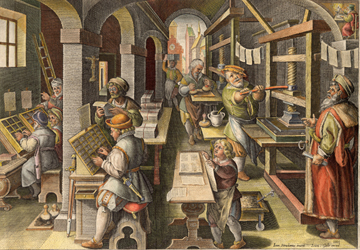 Here’s a reprint of a fascinating and well thought out CC-licensed article by Ransom Stephens on the openDemocracy Network about the future of books and publishers. The main thrust of the article is that books will survive mainly in hardback versions, electronic on-demand publishers will take over the bulk of book publishing, this takeover will begin the day Stephen King releases a major novel through an online self-publishing outlet, major publishers will whither and eventually be outmoded, and bookstores will thrive in a healthy relationship with electronic publishing.
Booking the Future
Ransom Stephens (openDemocracy Network)
Though the role of publishing has not changed – connect readers to writers – the revolution will not be led by an established publisher. To date, no established player has prospered through, much less led, the transition to the digitally-based economy. What’s left of the recording industry is still pursuing the fascinating how-to-best-prosecute-our-customers business model. No one was better positioned to profit from the web-based economy than Sears, with its legendary catalog, but Amazon all but killed it. Even IBM barely survived the computer revolution.
For some reason, even when entrenched companies can see the iceberg they can’t turn the ship. In 2000, at the height of the “Napster Crisis,” Time-Warner/AOL’s CEO, Richard Parsons said, “It’s an assault on everything that constitutes cultural expression of our society… And the corporations won’t be the only ones hurt. Artists will have no incentive to create. Worst-case scenario: the country will end up in a sort of Cultural Dark Age.”
Have YouTube, Facebook, iTunes, Blogspot, et al reduced cultural expression? Here’s a better example. In 1977, Ken Olson, President of Digital Equipment Corporation (DEC) which, at the time, built the best computing hardware, said, “There is no need for any individual to have a computer in their home.” Time-Warner/AOL, Sears and IBM survived, but are swimming in the wake of Dell, Google, Amazon, etc.
Jean-Luc Godard Film
Film director Jean-Luc Godard is making a film that appears to be called Le Socialisme. I’m not entirely certain, but it sure looks to me from this trailer for the film like Mr. Godard is shooting with a small video camera. I can even hear the wind hitting the microphone during shots on board the ship. He’s always had a keen interest in shooting with small cameras, going so far at one point as to have a tiny 35 mm camera designed for one of his films in the seventies. I like this kind of filmmaking. This is how a filmmaker approaches a method that resembles the method of the painter or the writer. Filmmaking, for all its technical achievements and its massive budgets and enormous popularity, lags far behind painting, photography, writing and music. A filmmaker, in order to really be an artist, must be capable of functioning with the autonomy of the writer or the painter or the composer. Until then, the filmmaker is simply interested in socializing, not making art.
Mr. Godard’s films are often difficult, infuriating, perplexing, gorgeous, ugly, profound, ridiculous, and experimental – but they are always, without a single exception, the expressions of an artist who owes nothing to anyone.
Iran Election Fraudulent Because of No Free Press and No Free Women
The protests raging over the recent presidential election in Iran are an expression of distrust of the official election results that seem to declare the current and totally insane president, Mahmoud Ahmadinejad the overwhelming victor. Riots are becoming extremely violent, with police beatings in the streets and clouds of black smoke rising above Tehran. However, the arguments over whether or not the election was fraudulent are a complete waste of energy. No election in any country that does not have a free press can ever be legitimate. Without a free press to report on an election and possible election fraud there is no one to hold a sitting government accountable to the people. You cannot have a democracy or an election in a country that does not allow reporters freedom to write whatever they want. It’s impossible. Iran’s election is fraudulent because Iran’s government is controlled entirely by Islamic clerics who have absolutely no respect for freedom of expression, freedom of information, freedom of religion, freedom of education, or freedom of women.
I define as barbaric any country anywhere on the planet that forces women to wear specific attire. Iran is a barbaric nation with a population of extremely fearful males lacking in an essential self-confidence. This is what drives male-dominated Islamic governments to require certain codes of conduct and dress for women. In countries where elections are legitimate women wear shorts and makeup. Think I’m just being glib? Go check it out.
Iran has cut off internet services, cell phone service, and texting services in order to prevent discussion and organization of opponents to the religious government. It has arrested journalists, shut down newspapers, and confiscated television cameras in a crackdown on activities of the international media in Iran. These are the actions of a total dictatorship.
In fact, there is almost no hope at all for the protesters in Iran. Even if they succeed in overturning the election, they would not be able or willing to eliminate religious control of their government. Countries ruled by Islam are permanently and hopelessly barbaric. It’s like a law of physics that’s completely unbreakable.
The root of the problem with Iran is the root of the problem for almost every single government in the Middle East: religious control. There is no possibility of the slightest freedom of expression or freedom for women in any country controlled by a religious entity. None whatsoever.
Photo from AFP/Getty