Charles Bukowski Meets Another Poet

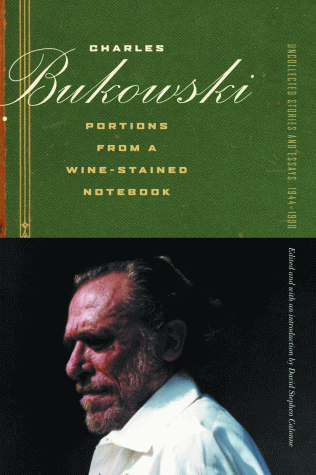
bukowskiThe Rumpus has a piece that Charles Bukowski wrote as a forward to a book of poems by William Wantling in 1974.  He writes about meeting the other poet for the first time and liking him.  It must have been a big thing to be liked by Bukowski because he seems to have a problem with most people.  His piece is touching and shows how sensitive Bukowski really was to the unspoken things.

He writes a bit about style and says:

Style means no shield at all.
Style means no front at all.
Style means ultimate naturalness.
Style means one man alone with billions of men about.

Is that really it?  Boy, Bukowski would have hated me to the ends of his toes because I’m always arguing my point.  The problem I have with what he’s saying there is that he made a living by writing with the biggest shield of all in front of him.  A bottle.  It’s the best shield there is.  Bullet-proof.  So he must be wrong about style.
New Film: Lunch With Bardot


My latest little film. It’s actually a cinegram. The subject is trains. Time. Memory. The present doesn’t exist. You can’t find it with measurement. You can’t even define it. The future is not there yet. You cannot see it. The only thing that really exists is the past. I say that because we can all see the past – some more clearly than others. But we can most certainly see it.

A cinegram is a short motion picture that uses images and text that are packed with meaning and suggestion. It’s my new word for things I once referred to as film poems.

Here’s the poem from inside the movie:

Lunch With Bardot

Trains run on time
With passengers asleep
Temporarily forgotten
Between observation points
Colliding lines
Of fictional transport

Hear Walt Whitman Reading His Poem ‘America’

The Walt Whitman Archive has a 36-second recording taken from an old wax cylinder of what is thought to be Whitman himself reading four lines from his poem, America.

Listen to Walt Whitman reading America

Here’s the text of the poem:

America

Centre of equal daughters, equal sons,
All, all alike endear’d, grown, ungrown, young or old,
Strong, ample, fair, enduring, capable, rich,
Perennial with the Earth, with Freedom, Law and Love,
A grand, sane, towering, seated Mother,
Chair’d in the adamant of Time.

A Little Poetry Contest: The Winner

the-poor-poet

DOWNLOAD MP3 AUDIO

Sascha Cooper is our Little Poetry Contest winner.  Her poem, A Blank Canvas, is a meditation on the power of creativity in normal surroundings.  We didn’t get many poems for the contest so it only makes sense to pick a single winner.  Perhaps more poets will want to enter the next Little Poetry Contest.  But this poem would stand out in any group of poems.  Actually, I was quite surprised to receive a poem this good during the very first contest.

You can listen to the winning poem with the player above while you read it here.

A Blank Canvas

Inspiration comes from all seeing eyes.
Let the imagination run wild
With all colours that light up at night.

Outside the window looms a palace
With domes that stretch up to the sky.
Stuck in time, yet current;

Transporting me back to a time of
Princes, kings and queens.
Arabian nights coax and tempt me.

Back in the land of reality,
The box is blaring, mum is cooking
And my best friend is next to me.

The computer is on a small table
That was a shelf – makeshift, but handy.
Drink and numerous papers at my side.

White walls, sleek lines;
Carpet that’s light and not right,
Sliding doors of black and silver.

All this in a box of glass
Ready to be personalised.
A blank canvas.

Audio Poem: Ode to a Nightingale

491px-john_keats_by_william_hilton

DOWNLOAD MP3 AUDIO

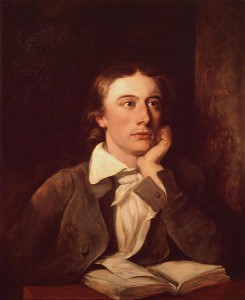
For the last day of National Poetry Month 2009, here’s a reading of Ode to a Nightingale, by English poet John Keats.  It was written in 1819 after the poet had been listening to a nightingale in the yard of a friend one morning.

Here is the text of the poem:

My heart aches, and a drowsy numbness pains
My sense, as though of hemlock I had drunk,
Or emptied some dull opiate to the drains
One minute past, and Lethe-wards had sunk:
‘Tis not through envy of thy happy lot,
But being too happy in thine happiness, –
That thou, light-winged Dryad of the trees,
In some melodious plot
Of beechen green and shadows numberless,
Singest of summer in full-throated ease.

Continue reading

Podcast of Henry David Thoreau on Poetry and Writing

486px-henry_david_thoreau

DOWNLOAD MP3 AUDIO

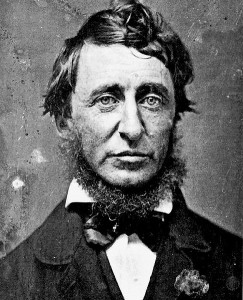
In 1839, Henry David Thoreau and his brother made a river voyage in a boat that they built themselves. This voyage became the subject of Thoreau’s first book, A Week on the Concord and Merrimack Rivers, published in 1849 at his own expense. In this thirty-three minute excerpt, Thoreau finds himself describing the incredible beauty and serenity of the natural scene around him. But his mind wanders into a profound examination of poetry and the requirements of good writing. His call to man for a life of poetry and his demand that writers create simply from an impulse to action are powerful and true. I don’t think there is a better piece of advice that exists for writers and readers alike.

Thoreau frequently quotes from Homer’s Iliad and other sources in this piece. I have tried to separate his quotes with pauses and a change in reading tone. You might want to glance at the actual words as you listen for clarification.

Here is the text of the reading:

What would we not give for some great poem to read now, which
would be in harmony with the scenery,–for if men read aright,
methinks they would never read anything but poems. No history nor
philosophy can supply their place.

Continue reading

Poetry Through the Ages

penandpaperPoetry Through the Ages is an excellent site that offers clear and concise explanations of different poetic forms, a general history of poetry and a simple guide to reading and appreciating difficult poems.

“When a poem arises, it feels like the bosom of the poet lifts up and births the spoken or written moment. The point of origin lies at the furthest depths of the poet, often calling into play ancestral memories, divine or universal inspiration, and insights or truths that “magically” resonate with the reader.”

Audio Poem by Walt Whitman: I Sing the Body Electric

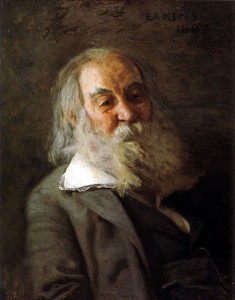
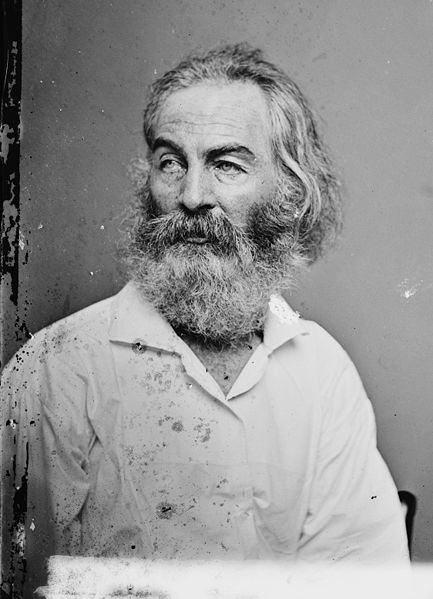
471px-whitmaneakinsI Sing the Body Electric is a poem that celebrates the life of the body and its equal status with the soul.  Walt Whitman is probably the greatest poet in the English language since William Shakespeare.  Some might argue with this but there is no other poet who so muscularly tore the page to shreds with his wild, raging, soaring, lunatic language.  I think Shakespeare would have liked and admired this man because it is only he who is a match for Shakespeare’s fearless destruction and rebuilding of language.  I think that great poets always destroy before they create.  To read Whitman’s massive lifelong work, Leaves of Grass, is to wake up and realize that poetry is like blood exploding through your body and spraying its meanings and music out all over the city.  You cannot read Whitman and be the same as you were before reading him.  He is a shock to the system.
He lived from 1819 to 1892 and is often called the father of free verse.  His discovery of the loose free form of poetry is an astounding development that is still being worked out.  The problem for today is that Whitman still has the hardest punch and could do terrible damage to most poets alive and writing today.  It would not be a fair fight.

Here is the great I Sing the Body Electric, from Whitman’s Leaves of Grass book.

Download the MP3

Remember to enter a poem in our Little Poetry Contest.

A Little Poetry Contest

Write a poem for National Poetry Month!  Just let your mind wander and write a poem of any kind in the comments area for this post.

Get your poem done by 12:00 am PST Friday April 24, 2009.

Your poem can be any length.  It can rhyme or not.  Just make a poem and let me read it.

I’ll pick my 3 favorites and do audio versions of them to post right here in the blog.

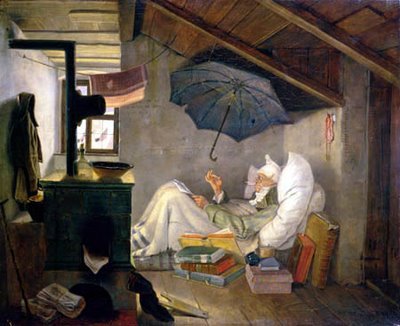
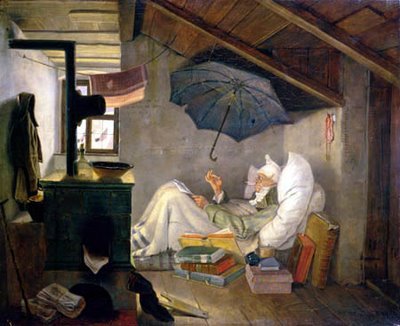
This painting is of a poor old poet trying to come up with his next poem.  Be exactly like him.

Doña Josefina Counsels Doña Concepción Before Entering Sears

Our roll of poetry for National Poetry Month continues with an animated poem by Maurice Kilwein Guevara.  His poem has two Spanish-speaking women planning to speak only English as they enter a Sears store.  It’s funny on the surface but it’s also a serious look at how people try to avoid being themselves in order to convince others that they are not stereotypes to be feared.

Tornado Child: A Kwame Dawes Poem

Here’s another animated poem. This one is by Kwame Dawes who grew up in Jamaica and now lives in South Carolina. I like the way the poet is unafraid to show pleasure in the language of the poem. This seems to be a happy poet.

I Started Early: A Poem by Emily Dickinson

For National Poetry Month, here’s an Emily Dickinson poem rendered as a beautiful animation with a reading by actress Blair Brown. This is part of the Poetry Foundation’s series of videos known as Poetry Everywhere.
Here is the complete poem for you to read:

I started Early – Took my Dog –
And visited the Sea –
The Mermaids in the Basement
Came out to look at me –

And Frigates – in the Upper Floor
Extended Hempen Hands –
Presuming Me to be a Mouse –
Aground – upon the Sands –

But no Man moved Me – till the Tide
Went past my simple Shoe –
And past my Apron – and my Belt
And past my Bodice – too –

And made as He would eat me up –
As wholly as a Dew
Upon a Dandelion’s Sleeve –
And then – I started – too –

And He – He followed – close behind –
I felt His Silver Heel
Upon my Ankle – Then my Shoes
Would overflow with Pearl –

Until We met the Solid Town –
No One He seemed to know
And bowing – with a Mighty look –
At me – The Sea withdrew –

Poet John Ashbery Gives Interesting Answers

Poet John Ashbery sat down to answer questions on a program called Open Book. He’s fascinating. I’m not sure why he is not running away from the questions, but whatever his infirmity might be, he is interesting in spite of the interviewers.

One thing in particular caught my attention: I don’t have any hidden meanings in my poems.

I think that’s an astounding thing to hear from one of the most difficult and impenetrable poets I have ever read.

Vetiver
by John Ashbery

Ages passed slowly, like a load of hay,
As the flowers recited their lines
And pike stirred at the bottom of the pond.
The pen was cool to the touch.

Read the rest of the poem…

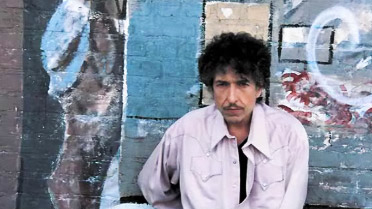
Bob Dylan Walks with Ghosts

Bill Flanagan at Times Online has an interview with Bob Dylan.  They talk about Dylan’s impressions of Barack Obama’s writing in Dreams of My Father.  It seems that Dylan considers the president to be a pretty good writer, capable of making readers think and feel at the same time.  He thinks Obama says some ‘profoundly outrageous things.’  I always enjoy the slightly argumentative way Bob Dylan answers questions.  So often, when an interviewer thinks something is obvious, Dylan says, ‘not exactly,’ and goes on to carefully explain how the interviewer is wrong.

Dylan talks about ghosts in the American South:

It must be the Southern air. It’s filled with rambling ghosts and disturbed spirits. They’re all screaming and forlorning. It’s like they are caught in some weird web – some purgatory between heaven and hell and they can’t rest.

Then this:

BF: Are you a mystical person?

BD: Absolutely.

BF: Any thoughts about why?

BD: I think it’s the land. The streams, the forests, the vast emptiness. The land created me. I’m wild and lonesome. Even as I travel the cities, I‘m more at home in the vacant lots. But I have a love for humankind, a love of truth, and a love of justice. I think I have a dualistic nature. I’m more of an adventurous type than a relationship type.

BF: But the album is all about love – love found, love lost, love remembered, love denied.

BD: Inspiration is hard to come by. You have to take it where you find it.

Anyone who talks that way is definitely going to be able to sell me some music.  I will be all ears and I will walk around for months trying to find those ghosts.  If he says they’re there, then they are.

Is Poetry Dead Just In Time for National Poetry Month?

Well goodness!  Newsweek as seen fit, just as National Poetry Month was about to begin, to announce the possibility that poetry has completely and totally kicked the proverbial country bucket.  Could this really be?  If no one is reading poetry, can it still be a living thing? Apparently, the National Endowment for the Arts released a report titled Reading on the Rise.  Sounds optimistic.  But they mean fiction.  Not poetry.  Readership for poetry has declined to its lowest point in 16 years.  Everybody is worried.  Nobody knows what to do.  I suggest doing nothing.  Enjoy National Poetry Month because it’s kind of fun to see unpopular poets stand up and try to be famous.  Read some popular poems if you haven’t already and just remember that poetry really is very hard to understand.  I think that’s the key to the whole thing.  It’s a huge pain to read.  There’s all these words sometimes rhyming, sometimes not.  I can never tell what the poet is talking about and I get annoyed.  It’s not like Twilight at all.  Although some really good poems do have vampires in them.

But then, perhaps a week later – maybe a year.  I’ll be walking along looking for a good plate of hotwings, and I’ll stop and think to myself, ‘Oh right!  That’s what that lady meant by that weird line in her poem.  Very cool.’

That’s why I like poetry.  It hits you when it hits you and that’s all that matters.

The painting is by poet/painter, Carl Spitzweg. It’s called The Poor Poet.  It’s from 1835 and appears to show one of these poets taking the easy way out as he concocts a nearly indecipherable verse.  That umbrella is either magically floating or it’s caught in some serious cobwebs.