The last few Star Trek movies have been uniformly awful. But this new one looks very promising. I think it was a great idea to go back and redo the original show’s characters as they venture forth on their first mission together. The main hitch would be if the movie misses the sly humor that made the original characters so interesting. But this looks like the first really fresh take on the old series in many years. Great trailer.
Marvel.com is posting all the original Spider Man television episodes for free viewing. They originally aired in 1967 on ABC. They are actually very good. Highly recommended. This is the first episode.
Amazing science fiction podcast site, StarShipSofa, is offering all the 2008 Nebula Award short story nominees for free download.
The world of sci-fi periodical publishing seems to be moving in the direction of excellent online podcasts. This is a prime example of the movement. I’ve enjoyed many short science-fiction podcasts over the past several years. This one is a real standout.
It’s National Poetry Month! That means that bookstores, publishers and bloggers all over the U.S. and elsewhere are celebrating poetry in all its forms. There’s a poem-a-day series that will email you one poem each day for the entire month. Poets.org has instructions for teachers trying to motivate students to enjoy poetry in the classroom and tips for bookstores trying to sell poetry.
The video is from W. W. Norton publishers who decided to ask eleven of their published poets what poetry is for. Their answers are incredibly bad, but it’s a good try. It should be abundantly clear from these poets’ answers that there is very little actual thought going on about what poetry is for.
Here’s my answer: Poetry is for bread.
But here’s a guy named Charles Bernstein who says that National Poetry Month is a bad thing. He says it encourages the most bland of easy-reading poetry available to make people think poetry is safe to read. He’s right. And so what? So people read some bland crappy poems. That is what most poetry is. That’s realistic. Perhaps a few of those people will have the energy to go out and find the real, hard, evolving, beautiful and terrifying poetry that would never even stoop to asking, ‘What is poetry for?’
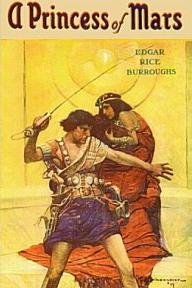
This is the first John Carter of Mars novel by Edgar Rice Burroughs, the author of the Tarzan books. It was his first novel, published in 1917 and it’s a work of rip-roaring science fiction that has inspired many of the great writers in the genre. The story concerns soldier John Carter who is mysteriously transported to the red planet where he fights to protect his princess against impossible odds and many peculiar creatures. The book is very much a product of its time, with outdated ideas about the red planet and outdated social ideas. But if you can just go along for the adventurous ride, you are in for a sci-fi space opera swashbuckling treat.
You’ll find regular podcasts of all the chapters over the next couple of months. Subscribe to our feed.


 Amazing science fiction podcast site,