Los Angeles Times Newspaper Died on Thursday

On Thursday, April 9, 2009, The Los Angeles Times newspaper placed an advertisement disguised as a column of news on its front page!  A major American newspaper cannot do this.  It is totally unacceptable.  The cheapening of the LA Times over the past year due to financial problems and poor management has gradually gutted the paper.  It’s once high-quality book review section on Sundays is now part of another section and has become a smattering of generalized culture articles.

As soon as I found out about the disguised ad on Thursday I ran to the phone and cancelled my 12-year subscription to the paper.  The woman on the phone asked what my reason was and I told her I was disgusted by the ad placement.  Perhaps someone in the paper’s management will realize that the end has arrived and save us all some trees by shutting down the presses and letting the reporters go work for an internet news organization.

Newspapers are in trouble.  It’s imbeciles like the ones running the LA Times that make a recovery impossible for them.

Rest in peace, Los Angeles Times.

Doña Josefina Counsels Doña Concepción Before Entering Sears

Our roll of poetry for National Poetry Month continues with an animated poem by Maurice Kilwein Guevara.  His poem has two Spanish-speaking women planning to speak only English as they enter a Sears store.  It’s funny on the surface but it’s also a serious look at how people try to avoid being themselves in order to convince others that they are not stereotypes to be feared.

Tornado Child: A Kwame Dawes Poem

Here’s another animated poem. This one is by Kwame Dawes who grew up in Jamaica and now lives in South Carolina. I like the way the poet is unafraid to show pleasure in the language of the poem. This seems to be a happy poet.

I Started Early: A Poem by Emily Dickinson

For National Poetry Month, here’s an Emily Dickinson poem rendered as a beautiful animation with a reading by actress Blair Brown. This is part of the Poetry Foundation’s series of videos known as Poetry Everywhere.
Here is the complete poem for you to read:

I started Early – Took my Dog –
And visited the Sea –
The Mermaids in the Basement
Came out to look at me –

And Frigates – in the Upper Floor
Extended Hempen Hands –
Presuming Me to be a Mouse –
Aground – upon the Sands –

But no Man moved Me – till the Tide
Went past my simple Shoe –
And past my Apron – and my Belt
And past my Bodice – too –

And made as He would eat me up –
As wholly as a Dew
Upon a Dandelion’s Sleeve –
And then – I started – too –

And He – He followed – close behind –
I felt His Silver Heel
Upon my Ankle – Then my Shoes
Would overflow with Pearl –

Until We met the Solid Town –
No One He seemed to know
And bowing – with a Mighty look –
At me – The Sea withdrew –

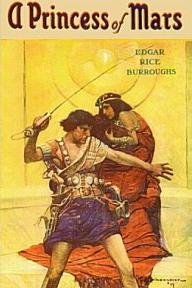
Podcast Novel: A Princess of Mars (Chapter 2)

DOWNLOAD MP3 AUDIO

A Princess of Mars

This is the first John Carter of Mars novel by Edgar Rice Burroughs, the author of the Tarzan books. It was his first novel, published in 1917 and it’s a work of rip-roaring science fiction that has inspired many of the great writers in the genre.

Chapter 2: John Carter tells how he awoke inside the cave in danger of losing his life to his pursuers or possibly to the thing making strange noises behind him.  Our pulp sci-fi novel makes its first reach for the stars in this chapter.

You’ll find regular podcasts of all the chapters over the next couple of months. Subscribe to our feed.

Duration: 00:10:32
Read by Alessandro Cima

All audio stories are Copyright © Candlelight Stories, Inc., All Rights Reserved.

Poet John Ashbery Gives Interesting Answers

Poet John Ashbery sat down to answer questions on a program called Open Book. He’s fascinating. I’m not sure why he is not running away from the questions, but whatever his infirmity might be, he is interesting in spite of the interviewers.

One thing in particular caught my attention: I don’t have any hidden meanings in my poems.

I think that’s an astounding thing to hear from one of the most difficult and impenetrable poets I have ever read.

Vetiver
by John Ashbery

Ages passed slowly, like a load of hay,
As the flowers recited their lines
And pike stirred at the bottom of the pond.
The pen was cool to the touch.

Read the rest of the poem…

World Digital Library Set to Open or Fizzle?

Set to open on April 21, 2009, the World Digital Library will make freely available in multilingual format, significant materials from different cultures, including manuscripts, maps, rare books, musical scores, recordings, films, prints, photographs, and others.  The library promises to promote cross-cultural understanding and provide resources to educators.  The Library of Congress is involved in the project along with the Bibliotheca Alexandrina, the National Library of Brazil, the National Library and Archives of Egypt, and the National Library of Russia.

There are a couple of videos that claim to show prototypes of the library.  These look to me like quickly produced mock-ups of very little substance.  If you were really building such a library online, you would not have only four or five paragraphs of text and two videos on your web site to show for your efforts.  You’d be trying to show off how great your project is and how well it works.

I could be wrong, but this kind of mystery project that sits for years in ‘development’ and includes such enormous claims from such an international cast of characters always makes me suspicious.  I take an ‘I’ll believe it when I see it’ attitude.  Sort of the like the absolutely transparent $100 laptop con job otherwise known as One Laptop Per Child, which has received a Fiasco Award. 

After all, we already have The Internet Archive.  It actually works.  It has material from all over the world.  It’s free.  It’s easy to use.  Why don’t these great libraries just use that?

Grimms’ Fairy Tales: The Three Spinners

There was once a girl who was idle and would not spin, and let her mother say what she would, she could not bring her to it. At last the mother was once so overcome with anger and impatience, that she beat her, on which the girl began to weep loudly. Now at this very moment the Queen drove by, and when she heard the weeping she stopped her carriage, went into the house and asked the mother why she was beating her daughter so that the cries could be heard out on the road?

Continue reading

Grimms’ Fairy Tales: The Three Little Men in the Forest

There was once a man whose wife died, and a woman whose husband died, and the man had a daughter, and the woman also had a daughter. The girls were acquainted with each other, and went out walking together, and afterwards came to the woman in her house. Then said she to the man’s daughter, “Listen, tell thy father that I would like to marry him, and then thou shalt wash thyself in milk every morning, and drink wine, but my own daughter shall wash herself in water and drink water.”

Continue reading

Grimms’ Fairy Tales: Rapunzel

There were once a man and a woman who had long in vain wished for a child. At length the woman hoped that God was about to grant her desire. These people had a little window at the back of their house from which a splendid garden could be seen, which was full of the most beautiful flowers and herbs. It was, however, surrounded by a high wall, and no one dared to go into it because it belonged to an enchantress, who had great power and was dreaded by all the world.

Continue reading

Grimms’ Fairy Tales: Little Brother and Little Sister

Little brother took his little sister by the hand and said, “Since our mother died we have had no happiness; our step-mother beats us every day, and if we come near her she kicks us away with her foot. Our meals are the hard crusts of bread that are left over; and the little dog under the table is better off, for she often throws it a nice bit. May Heaven pity us. If our mother only knew! Come, we will go forth together into the wide world.”

Continue reading

Grimms’ Fairy Tales: The Pack of Ragamuffins

The cock once said to the hen, “It is now the time when our nuts are ripe, so let us go to the hill together and for once eat our fill before the squirrel takes them all away.” “Yes,” replied the hen, “come, we will have some pleasure together.” Then they went away to the hill, and on it was a bright day they stayed till evening.

Continue reading

Grimms’ Fairy Tales: The Twelve Brothers

There were once on a time a king and a queen who lived happily together and had twelve children, but they were all boys. Then said the King to his wife, “If the thirteenth child which thou art about to bring into the world, is a girl, the twelve boys shall die, in order that her possessions may be great, and that the kingdom may fall to her alone.” He caused likewise twelve coffins to be made, which were already filled with shavings, and in each lay the little pillow for the dead, and he had them taken into a locked-up room, and then he gave the Queen the key of it, and bade her not to speak of this to any one.

Continue reading

Grimms’ Fairy Tales: The Wonderful Musician

There was once a wonderful musician, who went quite alone through a forest and thought of all manner of things, and when nothing was left for him to think about, he said to himself, “Time is beginning to pass heavily with me here in the forest, I will fetch hither a good companion for myself.” Then he took his fiddle from his back, and played so that it echoed through the trees. It was not long before a wolf came trotting through the thicket towards him.

Continue reading

Grimms’ Fairy Tales: The Good Bargain

A Special Note About This Story:
This story is one of several examples of bigotry in the Grimms’ collection of stories. The outrageous bigotry on display in the story is a frightening example of how long hatred against Jewish people had existed in the parts of Germany where this tale was told.

While it contains prejudice and absolutely calls into question the entire collective work of the Brothers Grimm, it is a story that should be understood and studied in the interests of keeping the historical record accurate. It is also worth studying the possible influence of stories like this one on the entire tradition of Western fairy tales. To think that this sort of thing is purely historical in nature is a mistake.

Continue reading